Understanding the Esophagus: Anatomy, Function, and Health

Updated: 2 days ago
Medically reviewed by Dr. Baraa Alnahhal, MD · Last reviewed: October 2026
Quick Answer
The esophagus is part of the digestive system, the muscular tube between the pharynx (throat) and the stomach [1]. It utilizes two sphincters—upper and lower—to control the entry of food and prevent the backflow of stomach acid [1]. Maintaining its health involves a balanced diet, avoiding triggers for reflux, and seeking medical advice for persistent symptoms like heartburn or difficulty swallowing.
What the research says
A higher body mass index goes hand in hand with more reflux. A meta-analysis of 43 studies (484,219 participants) found that higher BMI was associated with symptomatic reflux (relative risk 2.04, 95% CI 1.51–2.76) and GERD (relative risk 1.37, 95% CI 1.26–1.50), with a 68% higher risk of GERD for every 10 kg/m² increase in BMI and overweight (BMI ≥25) acting as an inflection point; most studies were cross-sectional, so causation is not proven. (Mao et al., Front Physiol, 2025) [2]
Barrett’s esophagus is not rare in people with digestive symptoms. In a meta-analysis of 9 studies (4,978 patients with gastrointestinal symptoms in Iran), the pooled prevalence of Barrett’s esophagus was 4.4%, within a global range the authors cite of 0.4% to 20%; because Barrett’s is a premalignant change that predisposes to esophageal adenocarcinoma, timely diagnosis matters. (Rashidian et al., BMC Gastroenterol, 2025) [3]
Diet can induce remission in eosinophilic esophagitis. A meta-analysis of 43 studies (2,825 patients) found an overall histologic remission rate of 60.6% with dietary therapy, ranging from 94.5% for elemental diets and 63.9% for six-food elimination diets to 39.5% for allergy-test-directed elimination, with efficacy rising as dietary restriction increased. (Arias et al., Nutrients, 2024) [4]
The esophagus represents a critical, yet often overlooked, component of the human digestive tract. Situated in the center of the chest within the mediastinum, this muscular tube acts as the primary bridge between the mouth and the stomach [1]. In a typical adult, the esophagus measures between 10 and 13 inches in length and is roughly three-quarters of an inch thick at its narrowest point [1]. It is positioned behind the trachea (windpipe) and in front of the spinal column [1], allowing it to facilitate the seamless passage of nutrients while remaining protected by the surrounding skeletal and muscular structures.
Functionally, the esophagus is far more than a simple passive pipe. It employs a sophisticated mechanism of coordinated muscular movements known as peristalsis to propel food and liquids downward [1]. This process begins the moment the upper esophageal sphincter relaxes to accept food from the throat [1]. As the food travels, the lower esophageal sphincter acts as a gatekeeper, opening to allow entry into the stomach and then closing firmly to shield the delicate esophageal lining from corrosive gastric acids [1]. This one-way system is essential for both efficient digestion and the prevention of respiratory complications.
What is the anatomical structure of the esophagus?
The esophagus is defined by its specialized muscular composition and the presence of two critical ring-shaped muscles that regulate flow. These structures ensure that the digestive process remains orderly and that the airway is protected during swallowing.
Feature | Description |
|---|---|
Location | Mediastinum (center of chest), behind the trachea and in front of the spine [1]. |
Average Length | 10 to 13 inches in an adult [1]. |
Upper Sphincter (UES) | Senses incoming food/liquid and relaxes to allow entry from the throat [1]. |
Lower Sphincter (LES) | Regulates entry into the stomach and prevents acid backflow [1]. |
Primary Movement | Peristalsis (waves of muscular contractions) [1]. |

What are common esophagus conditions and symptoms?
A variety of disorders can affect the esophagus, ranging from mild irritation to serious structural changes. The most common issue is acid reflux, which occurs when the lower esophageal sphincter opens when it is not supposed to, allowing stomach contents to irritate the esophageal lining [1]. Over time, chronic reflux can lead to Gastroesophageal Reflux Disease (GERD), a more severe condition that may cause significant tissue damage if left untreated [1].
Condition | Primary Characteristics | Common Symptoms |
|---|---|---|
Acid Reflux / GERD | Persistent backflow of stomach acid. | Heartburn, chest pain, bad breath [1]. |
Achalasia | Failure of the LES to open correctly [1]. | Difficulty swallowing, regurgitation. |
Esophagitis | Inflammation of the esophageal lining [1]. | Sore throat, painful swallowing. |
Barrett’s Esophagus | Tissue changes due to chronic acid exposure [1]. | Often has no symptoms; increases cancer risk [1]. |
Esophageal Varices | Swollen veins in the esophageal lining [1]. | Can be fatal if they bleed [1]; often related to liver issues. |
Achalasia, a rare disorder in which the lower sphincter fails to open [1], is often managed with a procedure such as a Heller myotomy. Other symptoms of esophagus problems can include chest pain, regurgitation, a feeling of food stuck in the throat, cough, hoarseness, vomiting blood, and weight loss [1].

How can you keep your esophagus healthy?
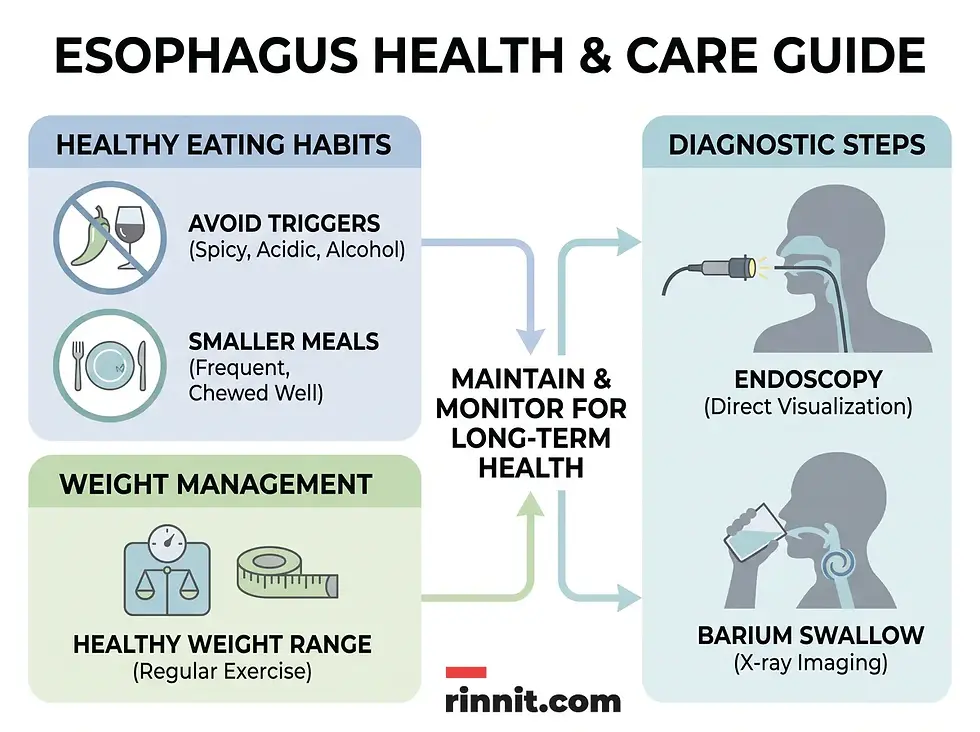
Caring for the esophagus primarily involves lifestyle adjustments and proactive management of digestive symptoms. Diet plays a central role; avoiding large meals before bedtime and identifying personal triggers—such as spicy foods, caffeine, or alcohol—can help reduce the incidence of acid reflux (see our guide to the lifestyle triggers of GERD). Additionally, maintaining a healthy weight reduces pressure on the abdomen, which helps the lower esophageal sphincter function more effectively.
For individuals experiencing persistent symptoms, modern medicine offers several diagnostic tools to ensure the esophagus is functioning correctly. Upper endoscopy (EGD) allows healthcare providers to visually inspect the lining [1], while barium swallow tests provide clear X-ray images of the swallowing process [1]. If symptoms like dysphagia (difficulty swallowing) or persistent heartburn last for more than two weeks, consulting a healthcare professional is vital to rule out more serious underlying conditions and to develop a personalized care plan. Get emergency care right away if you vomit blood or material that looks like coffee grounds, pass black or tarry stools, have food stuck that you cannot swallow, or have chest pain, which can also be a sign of a heart attack.
Conclusion
The esophagus is a highly specialized muscular organ that performs the essential task of delivering nutrients to the stomach while protecting the body’s internal environment. By understanding its anatomy and the mechanics of swallowing, individuals can take proactive steps to prevent common disorders like GERD and esophagitis. Prioritizing digestive health through mindful eating and regular medical check-ups helps keep this vital pathway clear and functional throughout life.
Next Steps for Health
If you are struggling with recurring heartburn, a persistent cough, or difficulty swallowing, do not ignore these signals from your body. Start tracking your dietary triggers today and schedule a consultation with a healthcare professional to ensure your digestive health is on the right track.
Frequently Asked Questions
1. How long is the average adult esophagus?
The average adult esophagus is typically between 10 and 13 inches long.
2. What is the main function of the esophagus?
The esophagus's primary role is to transport food and liquid from the throat to the stomach.
3. What is peristalsis?
These are waves of muscular contractions that push food down the esophagus.
4. What does the lower esophageal sphincter (LES) do?
The LES opens to let food into the stomach and closes to keep acid out.
5. What is the difference between the trachea and the esophagus?
The trachea carries air to the lungs, while the esophagus carries food to the stomach.
6. What is the most common esophagus problem?
Acid reflux is the most common problem that affects the esophagus.
7. What is GERD?
GERD is a chronic and more severe form of acid reflux that can damage the esophagus.
8. What are the symptoms of Barrett’s esophagus?
Barrett’s esophagus often has no symptoms but is a serious condition that increases cancer risk.
9. What is dysphagia?
Dysphagia is the medical term for difficulty swallowing.
10. Can food allergies affect the esophagus?
Yes, conditions like eosinophilic esophagitis are often linked to food allergies.
11. How is an upper endoscopy performed?
A flexible tube with a camera is inserted through the throat to examine the digestive tract.
12. What is a barium swallow?
A barium swallow is an X-ray test where you drink a special liquid to make the esophagus visible.
13. How can I prevent acid reflux at night?
Avoid eating large meals close to bedtime and try elevating your head.
14. What are esophageal varices?
Esophageal varices are swollen veins in the esophagus that can be dangerous if they bleed.
15. When should I see a doctor for heartburn?
If it occurs more than twice a week or is accompanied by trouble swallowing.
Related Reading
Dysphagia (Trouble Swallowing): Symptoms, Causes, Diagnosis & Treatment — Complete Guide explains causes of trouble swallowing and how it is evaluated.
Esophagitis: Symptoms, Causes, and Treatment covers inflammation of the esophagus, its causes and treatment.
Eosinophilic Esophagitis: Symptoms, Causes, and Treatment describes an allergic inflammation of the esophagus and how it is managed.
Achalasia: Symptoms, Causes, and Treatment explains the swallowing disorder where the lower esophageal valve will not relax.
References
Cleveland Clinic. Esophagus: Anatomy, Function & Conditions. Cleveland Clinic. Last updated August 4, 2021. https://my.clevelandclinic.org/health/body/21728-esophagus
Mao Y, et al. Association between body mass index at different levels and risk of gastroesophageal reflux disease: a systematic review with dose-response meta-analysis. Frontiers in Physiology. 2025;16:1675457. PMID 41384250. https://doi.org/10.3389/fphys.2025.1675457
Rashidian M, et al. The prevalence of Barrett’s esophagus in Iranian patients with gastrointestinal symptoms: a systematic review and meta-analysis. BMC Gastroenterology. 2025;25(1):217. PMID 40175906. https://doi.org/10.1186/s12876-025-03822-1
Arias Á, et al. Efficacy of Dietary Therapy for Eosinophilic Esophagitis in Children and Adults: An Updated Systematic Review and Meta-Analysis. Nutrients. 2024;16(14):2231. PMID 39064673. https://doi.org/10.3390/nu16142231
Medical disclaimer
This article is for informational purposes only and does not constitute medical advice. Consult a healthcare professional for diagnosis and treatment.



Comments