Achalasia: Symptoms, Causes, and Treatment

Updated: 2 days ago
Medically reviewed by Dr. Baraa Alnahhal, MD · Last reviewed: October 2026
Quick Answer
Achalasia is a condition in which the esophagus cannot push food into the stomach because the valve at its bottom stays closed. Signs include difficulty swallowing, regurgitation, heartburn and weight loss. It most often appears between ages 25 and 60 and is often mistaken for GERD. There is no cure, but balloon dilation, Botox and surgery manage symptoms.
What the research says
Achalasia is often diagnosed late and mistaken for other conditions. A retrospective analysis of 300 patients with achalasia found a mean diagnostic delay of 4.7 years. A single false diagnosis occurred in 26% and multiple false diagnoses in 16%, with gastroesophageal reflux disease (GERD) the most common gastrointestinal misdiagnosis (16.7%); atypical symptoms such as heartburn (16.3%), vomiting (15.3%) and belching (7.7%) were common (Müller et al., Dis Esophagus, 2023) [5].
Peroral endoscopic myotomy (POEM) kept more people free of symptoms than balloon dilation. In a multicenter randomized trial of 133 treatment-naive adults, therapeutic success at 5 years was 81% (50 patients) after POEM versus 40% (25 patients) after pneumatic dilation (adjusted absolute difference 41%; 95% CI 25–57). Proton-pump inhibitor use was higher after POEM (46% vs 13% of those still in remission) (Kuipers et al., Lancet Gastroenterol Hepatol, 2022) [6].
POEM and Heller myotomy both work well; reflux is the main trade-off to discuss. A meta-analysis of 53 studies of laparoscopic Heller myotomy (5,834 patients) and 21 of POEM (1,958 patients) estimated dysphagia improvement at 12 months in 93.5% after POEM and 91.0% after Heller myotomy, but POEM carried higher odds of erosive esophagitis (OR 9.31; 95% CI 4.71–18.85) (Schlottmann et al., Ann Surg, 2018) [7]. A later meta-analysis of 20 retrospective studies (5,139 participants) found no significant difference in GERD symptoms, esophagitis, complications or reintervention between the two (Sobral et al., Esophagus, 2024) [8], so the evidence on reflux is not yet settled.
What Is Achalasia?
Achalasia is a swallowing condition that affects the esophagus — the tube that carries food and liquid from the mouth to the stomach. Damaged nerves make it hard for the esophageal muscles to squeeze food down, and the valve at the bottom of the tube stays shut instead of relaxing.

Because food cannot pass through, it collects in the esophagus. It can even ferment there and wash back up into the mouth — and fermented food can taste bitter.
Achalasia is fairly rare. It is sometimes mistaken for GERD (acid reflux). The key difference: in achalasia, the material that comes back up comes from the esophagus; in GERD, it comes from the stomach.
There is no cure. Once the esophagus is damaged, the muscles cannot work properly again. But symptoms can usually be managed with procedures done through endoscopy, minimally invasive therapy, or surgery.
What are the symptoms of achalasia?
Achalasia symptoms appear gradually and get worse over time. That slow start is one reason the condition is often overlooked or misdiagnosed at first.

The main symptoms to notice are listed below.
Symptom | What it feels like |
Difficulty swallowing (dysphagia) | Food and drink feel stuck in the throat |
Regurgitation | Swallowed food or saliva flows back into the throat |
Heartburn | Burning discomfort in the chest |
Belching | Frequent burping |
Chest pain | Pain that comes and goes |
Coughing at night | Nighttime coughing fits |
Aspiration pneumonia | Food entering the lungs causes pneumonia |
Weight loss | Reduced nutrition from trouble eating |
Vomiting | In some cases |
What causes achalasia, and who is at risk?
The exact cause of achalasia is poorly understood. The leading explanation is a loss of nerve cells in the esophagus. Researchers suspect a viral infection or an autoimmune response — where the body's immune system mistakenly attacks healthy tissue — may play a role.
Very rarely, achalasia is caused by an inherited genetic disorder or by infection.
Risk factor | Detail |
Age | Can affect all ages; most common between 25 and 60 |
Allergic disorders | The risk of achalasia is higher in people with allergic disorders |
Adrenal insufficiency | Linked in some cases |
Allgrove syndrome | A rare inherited genetic condition |
How is achalasia diagnosed?
Achalasia can be overlooked or misdiagnosed because its symptoms resemble other digestive disorders. If a swallowing problem is suspected, doctors use these tests.
Test | What it does |
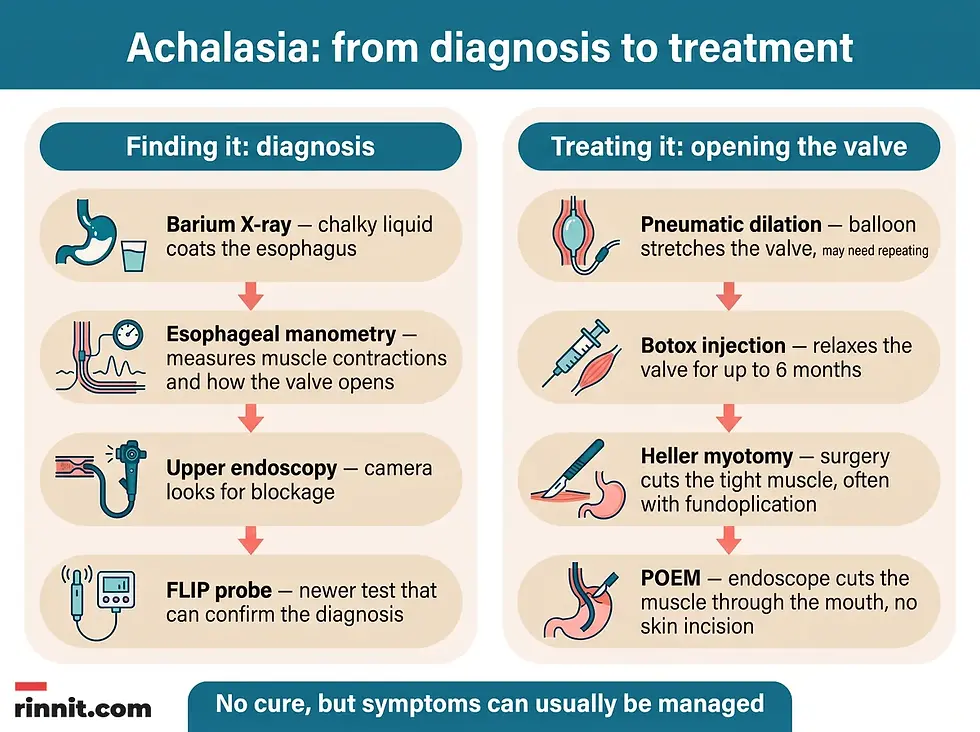
Esophageal manometry | Measures muscle contractions during swallowing and how well the lower esophageal sphincter opens — the most helpful test for deciding the type of swallowing condition |
Barium X-ray | After drinking a chalky barium liquid that coats the lining, X-rays show the silhouette of the esophagus, stomach, and upper intestine; a barium pill can reveal blockage |
Upper endoscopy | A tiny camera on a flexible tube looks for a partial blockage and can take a biopsy (for example, to check for Barrett esophagus from long-term reflux) |
FLIP probe | A newer technique (functional luminal imaging probe) that can confirm the diagnosis when other tests are not enough |
How is achalasia treated?
The goal of treatment is to relax or stretch open the lower esophageal sphincter so food and liquid can move into the stomach. The best option depends on your age, overall health, and how severe the condition is.
Nonsurgical Treatments
Pneumatic dilation places a balloon into the center of the lower esophageal sphincter and inflates it to enlarge the opening. It is done as an outpatient procedure with sedation. It may need to be repeated if the sphincter does not stay open — nearly one-third of people need repeat treatment within five years.
Botox injection (onabotulinumtoxinA) relaxes the muscle. A needle injects it directly into the sphincter during an endoscopy. The effect typically does not last more than six months, so it may need repeating — and repeats can make later surgery more difficult. It is recommended mainly for people who cannot have dilation or surgery because of age or health. Interestingly, strong improvement after Botox can help confirm the diagnosis.
Medicine such as the muscle relaxants nitroglycerin or nifedipine taken before eating has limited effect and can cause severe side effects. It is considered only when dilation, surgery, and Botox are not options.
Surgical Treatments
Heller myotomy cuts the muscle at the lower end of the esophageal sphincter so food can pass into the stomach. It is often done minimally invasively (laparoscopic Heller myotomy). Some people later develop acid reflux after this procedure.
Fundoplication prevents that reflux: the surgeon wraps the top of the stomach around the lower esophagus to create an anti-reflux valve. It is usually done laparoscopically, at the same time as a Heller myotomy, to avoid future acid reflux.
POEM (peroral endoscopic myotomy) avoids skin incisions entirely. An endoscope is passed through the mouth and down the throat to make an incision in the inner lining of the esophagus, then cut the muscle at the lower end of the sphincter. It may be combined with or followed later by a fundoplication to prevent reflux. People who develop reflux after POEM can often be treated with daily oral medicine.
Conclusion: Getting a Swallowing Problem Checked Early
Achalasia is rare, and its slow-moving symptoms are easy to mistake for ordinary heartburn. The pattern that should raise a flag is trouble swallowing that gradually worsens, combined with food coming back up and nighttime coughing — especially in adults between 25 and 60.
Because the esophagus cannot recover once damaged, earlier diagnosis matters. If swallowing problems persist, ask for specific testing — especially esophageal manometry — rather than accepting a reflux diagnosis at face value. While there is no cure, modern dilation, injection, and surgical techniques can manage symptoms for most people and protect long-term health.
Take the next step: Persistent trouble swallowing deserves a proper workup. Talk to a health care provider about whether esophageal testing is right for you.
FAQ
Can achalasia go away on its own?
No. Achalasia does not go away on its own, and the damaged esophageal muscles cannot recover normal function. Symptoms usually worsen over time without treatment, which is why an evaluation is important when swallowing problems persist.
Can achalasia be cured?
There is no cure for achalasia. But treatments that open the lower esophageal sphincter — balloon dilation, Botox injection, Heller myotomy, or POEM — can manage symptoms effectively for most people.
Is achalasia the same as acid reflux (GERD)?
No, but they are often confused. In achalasia, food and liquid that come back up come from the esophagus; in GERD, stomach acid comes up from the stomach. A key clue is trouble swallowing, which is not typical of GERD.
How is achalasia diagnosed?
The most helpful test is esophageal manometry, which measures muscle contractions and how well the valve opens. Barium X-ray, upper endoscopy, and the newer FLIP probe can support or confirm the diagnosis.
What happens if achalasia is not treated?
Untreated achalasia leads to worsening swallowing difficulty, weight loss, and a risk of aspiration — food entering the lungs, which can cause pneumonia. Early diagnosis and treatment help prevent these complications.
Disclaimer: This article is for general informational purposes only and does not constitute medical advice. Always consult a qualified healthcare professional for diagnosis and treatment.
Related Reading
Learn more in our guide to Esophageal Dilation: Uses, Procedure, Risks and Recovery.
Learn more in our guide to Esophagram (Barium Swallow): Purpose, Prep, Procedure and Results.
Esophageal Manometry: What the Test Measures, How to Prepare and What Results Mean explains the test that measures how your esophagus muscles and valves work.
Upper GI Series: What It Is, Why It's Done, How to Prepare and What to Expect explains the barium X-ray test that can show this condition in the esophagus, stomach and duodenum.
References
Mayo Clinic Staff. Achalasia - Symptoms and causes. Mayo Clinic. February 7, 2026. https://www.mayoclinic.org/diseases-conditions/achalasia/symptoms-causes/syc-20352850
Mayo Clinic Staff. Achalasia - Diagnosis and treatment. Mayo Clinic. February 7, 2026. https://www.mayoclinic.org/diseases-conditions/achalasia/diagnosis-treatment/drc-20352851
Lynch KL. Achalasia. Merck Manual Professional Edition. Updated February 2026. https://www.merckmanuals.com/professional/gastrointestinal-disorders/esophageal-and-swallowing-disorders/achalasia
Genge A. Achalasia. GI Society (badgut.org). Accessed October 14, 2026. https://badgut.org/information-centre/a-z-digestive-topics/achalasia/
Müller M, Förschler S, Wehrmann T, et al. Atypical presentations and pitfalls of achalasia. Dis Esophagus. 2023;36(10):doad029. PMID 37158189. https://doi.org/10.1093/dote/doad029
Kuipers T, et al. Peroral endoscopic myotomy versus pneumatic dilation in treatment-naive patients with achalasia: 5-year follow-up of a randomised controlled trial. Lancet Gastroenterol Hepatol. 2022;7(12):1103-1111. PMID 36206786. https://doi.org/10.1016/S2468-1253(22)00300-4
Schlottmann F, et al. Laparoscopic Heller Myotomy Versus Peroral Endoscopic Myotomy (POEM) for Achalasia: A Systematic Review and Meta-analysis. Ann Surg. 2018;267(3):451-460. PMID 28549006. https://doi.org/10.1097/SLA.0000000000002311
Sobral J, et al. Achalasia: laparoscopic Heller myotomy with fundoplication versus peroral endoscopic myotomy-a systematic review and meta-analysis. Esophagus. 2024;21(3):298-305. PMID 38775883. https://doi.org/10.1007/s10388-024-01063-x



Comments