Esophageal Manometry: What the Test Measures, How to Prepare and What Results Mean

Updated: 2 days ago
Written and medically reviewed by Dr. Baraa Alnahhal, MD · Last reviewed: November 2026 · How we review
Quick Answer: What is esophageal manometry?
Esophageal manometry is a test that measures how well the esophagus moves food from the mouth to the stomach. A thin, flexible catheter with pressure sensors is passed through the nose into the esophagus while you swallow sips of water. It helps diagnose swallowing problems such as achalasia, esophageal spasms and scleroderma, and takes about 15 minutes. [1]
What the research says
Manometry patterns help predict which achalasia treatments work. In 99 newly diagnosed people with achalasia, those with the type II pattern on high-resolution manometry responded far better to treatment (71% to Botox, 91% to pneumatic dilation, 100% to Heller myotomy) than those with type I (56% overall) or type III (29% overall). (Pandolfino et al., Gastroenterology, 2008) [2]
Results are read using an international standard. The Chicago Classification version 4.0, built by 52 international experts over two years, sets a standard testing protocol with lying and upright swallows and stricter criteria for diagnosing esophageal motility disorders. (Yadlapati et al., Neurogastroenterology and Motility, 2021) [3]
Key takeaways
Esophageal manometry measures esophageal motility, meaning how well your esophagus squeezes and how its valves open and close. [1]
It is usually done when swallowing trouble, regurgitation or reflux continues and imaging has found no structural cause. [1]
You should not eat or drink for six hours before the test. [1]
The catheter goes through your nose; the test is not usually painful and takes no more than 15 minutes. [1]
Results help diagnose conditions like achalasia and show whether surgery such as anti-reflux surgery is likely to be safe and effective. [1]
What is esophageal manometry?
Esophageal manometry is a test of esophageal motility. Your esophagus is the muscular tube that connects your mouth to your stomach. When you swallow, its muscles contract in waves (peristalsis) to push food down, and valves (sphincters) at the top and bottom open and close to let food through. [1]

The test measures two things: [1]
The wave-like muscle contractions that move food down your esophagus
How the valves at the top and bottom of your esophagus open and close
Why is esophageal manometry done?
Providers use it when symptoms continue, usually after an imaging test has found no structural cause. Symptoms that can lead to the test include: [1]
Difficult or painful swallowing
Food coming back up (regurgitation)
Chronic acid reflux that medicine does not control
Heartburn
Chest pain that is not caused by the heart (noncardiac chest pain)
What conditions can it diagnose?
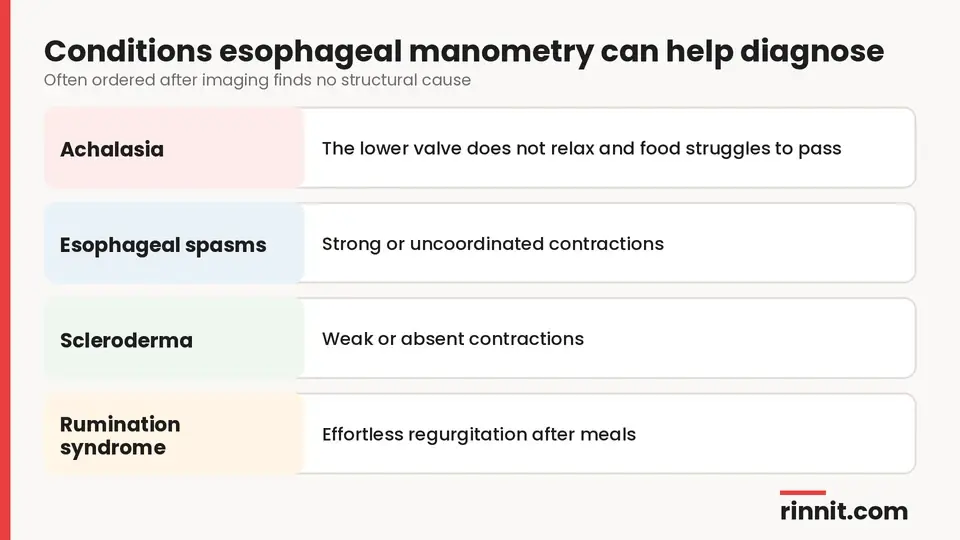
Achalasia
Scleroderma
Esophageal spasms
Rumination syndrome
Sources: [1]
How does esophageal manometry work?
High-resolution manometry uses a catheter with up to 36 pressure sensors spaced 1 centimeter apart. A computer turns the pressure readings into a color map called an esophageal pressure topography (EPT), which your provider reads. [1]
How do you prepare for esophageal manometry?
What happens during esophageal manometry?
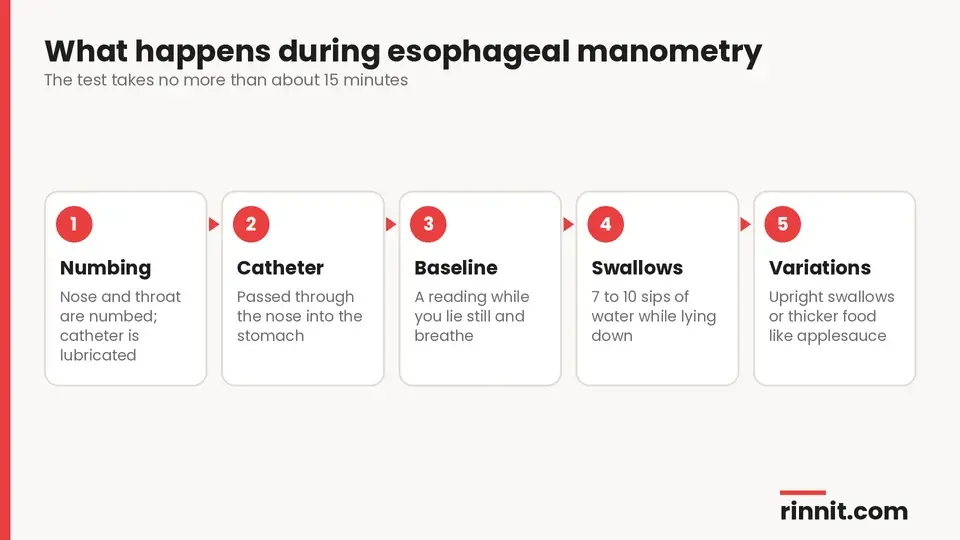
Your provider lubricates the catheter and numbs your nose and throat with a topical anesthetic. [1]
The catheter is passed through your nose and down your esophagus into your stomach. [1]
A baseline reading is taken while you lie on your back and breathe normally. [1]
You take small sips of water and swallow. In the standard test you swallow seven to 10 times while lying down or reclining. [1]
You may be asked to repeat swallows sitting upright or to swallow a thicker food such as applesauce. [1]
The whole test should take no more than 15 minutes. [1]
Does esophageal manometry hurt?
The test should not be painful, but the catheter can feel uncomfortable. You may feel like coughing, choking or gagging while it is placed, which usually passes quickly. Your throat may be sore afterward. [1]
What are the risks of esophageal manometry?
The test is low risk. Gagging or coughing during catheter placement is common and short-lived, and nosebleeds from the tube are uncommon. [1]
What do esophageal manometry results show?
A provider reads the pressure map and looks at four main features: [1]
What is measured | What it tells your provider |
Peristaltic vigor | How strong the contractions are that move food down |
Peristaltic integrity | Whether contractions are steady or have gaps |
Distal latency | Whether contractions slow down normally near the lower esophageal sphincter |
Deglutitive LES relaxation | Whether the lower valve relaxes enough when you swallow |
Sources: [1]
What are abnormal results?
Overly strong or spasming contractions (hypertensive or hypercontractile peristalsis)
Weak or absent peristalsis
Contractions that arrive too early (reduced distal latency)
A lower valve that does not relax or that spasms
Sources: [1]
Your results guide treatment and can show whether procedures such as anti-reflux surgery or hiatal hernia repair are likely to be safe and effective for you. [1]
How is manometry different from a barium swallow?
A barium swallow (esophagram) is mainly an imaging test: you swallow barium while video X-rays are taken. It can show defects or blockages but not how well the muscles work. Providers usually order an esophagram first and then manometry if more answers are needed. [1]
Conclusion
Esophageal manometry shows how your esophagus muscles and valves work when you swallow. It is a short, low-risk test that helps explain swallowing trouble, regurgitation or reflux that other tests have not explained.
If your provider recommends it, ask how your results will shape treatment, especially if surgery is being considered.
Keep learning: Read our guides to the esophagram (barium swallow) and upper endoscopy (EGD). For more background, see the MedlinePlus page on esophageal manometry.
FAQ
What is esophageal manometry?
A test that measures how well your esophagus muscles and valves move food from your mouth to your stomach. [1]
Why would I need esophageal manometry?
For ongoing trouble swallowing, regurgitation, reflux that medicine does not control or noncardiac chest pain. [1]
What conditions does esophageal manometry diagnose?
It can help diagnose achalasia, scleroderma, esophageal spasms and rumination syndrome. [1]
How do I prepare for esophageal manometry?
Do not eat or drink for six hours before the test; some medicines may be stopped 24 hours earlier. [1]
Does esophageal manometry hurt?
It should not be painful, but the tube can be uncomfortable and you may gag briefly. [1]
Will I be sedated for esophageal manometry?
Sedation is not usually used, but you can discuss it if you feel very anxious. [1]
How long does esophageal manometry take?
No more than about 15 minutes. [1]
What are the risks of esophageal manometry?
Brief coughing or gagging, a sore throat and, uncommonly, a nosebleed. [1]
What does an abnormal manometry result mean?
It may show weak, absent or spasming contractions or a lower valve that does not relax properly. [1]
Is esophageal manometry the same as a barium swallow?
No; a barium swallow is an imaging test, while manometry measures how the muscles work. [1]
Related Reading
EndoFLIP Test: Measuring Your Esophagus for Swallowing Problems explains the balloon test that measures how well the esophagus opens.
Bravo Test: Wireless pH Monitoring for GERD, Prep and Results explains the wireless capsule test that measures acid reflux.
Achalasia: Symptoms, Causes, and Treatment explains the swallowing disorder manometry most often confirms.
Esophageal Spasms: Symptoms, Causes, and Treatment covers the spasming contractions the test can show.
Dysphagia (Trouble Swallowing): Symptoms, Causes, Diagnosis & Treatment — Complete Guide explains the symptom that most often leads to manometry.
Scleroderma Guide: Symptoms, Causes, Diagnosis, and Treatment covers a condition that can weaken esophagus muscles.
What Is Rumination Syndrome? A Plain-Language Guide to the Condition Behind Effortless Food Regurgitation After Meals explains another condition manometry can help identify.
Acid Reflux & GERD: Symptoms, Causes, Diagnosis, and Treatment covers reflux that may need manometry before surgery.
References
Cleveland Clinic. Esophageal Manometry: What It Is, What To Expect, Results. Cleveland Clinic. Last updated May 10, 2023. https://my.clevelandclinic.org/health/diagnostics/4952-esophageal-manometry-test
Pandolfino JE, Kwiatek MA, Nealis T, et al. Achalasia: a new clinically relevant classification by high-resolution manometry. Gastroenterology. 2008;135(5):1526-1533. PMID 18722376. https://doi.org/10.1053/j.gastro.2008.07.022
Yadlapati R, Kahrilas PJ, Fox MR, et al. Esophageal motility disorders on high-resolution manometry: Chicago classification version 4.0. Neurogastroenterol Motil. 2021;33(1):e14058. PMID 33373111. https://doi.org/10.1111/nmo.14058
Medical disclaimer
This article is for general education only and does not replace advice from a qualified healthcare professional. Talk to your doctor about your own diagnosis and treatment, and seek emergency care right away for severe or sudden symptoms.



Comments