Bravo Test: Wireless pH Monitoring for GERD, Prep and Results

Updated: 3 days ago
Written and medically reviewed by Dr. Baraa Alnahhal, MD · Last reviewed: November 2026 · How we review
Quick Answer
The Bravo test is a wireless esophageal pH test that measures how much stomach acid flows back into the esophagus, usually over 48 hours. During an upper endoscopy, a provider attaches a capsule to the esophagus that sends acid readings to a recorder you wear. It helps diagnose and monitor GERD. The capsule falls off on its own.
What the research says
Acid exposure time defines GERD: the international Lyon Consensus states that acid exposure time above 6% on pH monitoring is conclusive evidence of GERD, while less than 4% is considered normal, and it supports prolonged wireless monitoring when results are borderline (Gyawali CP et al., Gut, 2018) [2]
Wireless monitoring finds more reflux: a review found the wireless capsule is at least as accurate as the older nasal catheter, gives a higher diagnostic yield for GERD thanks to longer recording and fewer daily restrictions, and is better tolerated, with mild chest discomfort as the main side effect (Roman S et al., Endoscopy, 2012) [3]
Key takeaways
The Bravo test measures acid in your esophagus for about 48 hours.
A capsule is placed during a brief endoscopy under sedation.
You wear a small recorder and log symptoms, meals and lying down.
Stop proton pump inhibitors 7 days before, unless told otherwise.
Avoid MRI for 30 days because the capsule contains a magnet.
What is the Bravo test?
Acid reflux happens when stomach contents flow back up into the esophagus. The Bravo capsule measures pH, a scale of acidity; a pH below 4 means high acidity. Unlike older tests that use a thin tube through the nose for 24 hours, the Bravo capsule is wireless, so you can eat, work and sleep more normally. Recording for 48 hours, and sometimes longer, also makes it more likely to capture reflux. Sources: [1, 3]
Why it's done
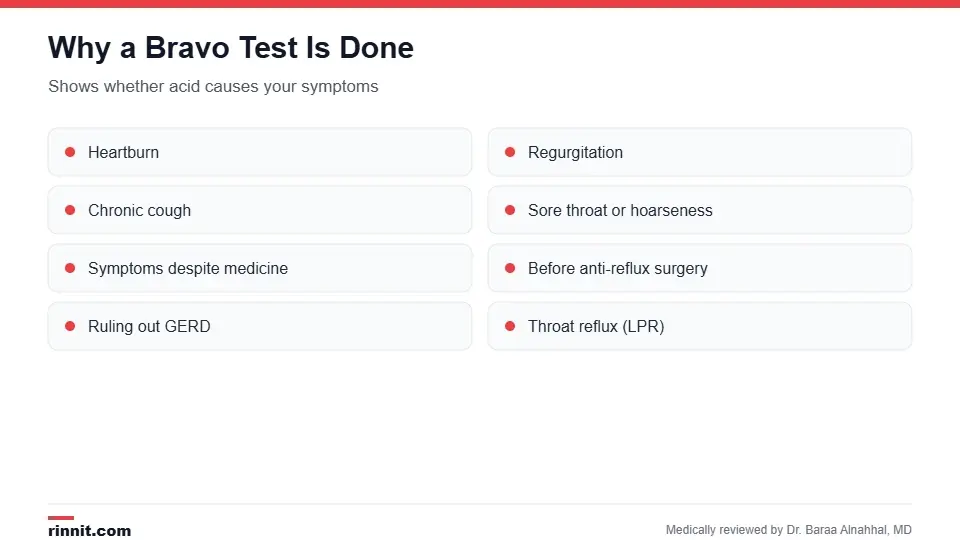
The test shows whether acid is causing your symptoms.
Heartburn or regurgitation that doesn't respond to treatment.
Chronic cough, sore throat or hoarseness, which can come from laryngopharyngeal reflux.
Confirming GERD before anti-reflux surgery such as the LINX procedure.
Ruling out acid reflux so your provider can look for other causes. Sources: [1, 2]
How to prepare

Follow your provider's exact instructions.
When | What to stop |
7 days before | Proton pump inhibitors (PPIs) |
48 hours before | H2 blockers and metoclopramide |
6 hours before | Antacids |
4 to 6 hours before | All food and drink |
Tell your provider if you have a nickel allergy, a pacemaker or defibrillator, a bleeding problem or esophageal problems. Your provider may ask you to keep taking acid medicine if they want to see how well it's working. Sources: [1]
What happens during the test

Placement takes less than 30 minutes.
You receive sedation, and an endoscope is passed through your mouth.
The capsule is attached to the wall of your esophagus, and the team checks that it's sending data.
You recover for up to an hour and need someone to drive you home.
For 48 hours you wear the recorder, which is about the size of a computer mouse, near your waist.
You press buttons when you have symptoms, eat or drink, and lie down or get up, and keep a written diary.
You return the recorder for analysis. Sources: [1]
During the monitoring period
Follow your normal routine and eat at least two regular meals a day.
Avoid hard candy, lozenges and gum.
Stay upright except at bedtime or usual rest times.
Keep the recorder close to you at all times.
Don't have an MRI for 30 days. Sources: [1]
Risks
Most people have no problems, though some feel the capsule, have a sore throat or have mild trouble swallowing. Other risks include the capsule coming off early or not detaching, device problems and, rarely, damage to the esophagus, bleeding or aspiration. Get help right away for severe chest pain, trouble swallowing, bleeding or fever. Sources: [1, 3]
Results
The report shows the number and length of reflux episodes, how much of the time your esophagus was acidic, reflux during sleep, and whether your symptoms matched reflux events. Results can take up to two weeks. Abnormal results confirm GERD and guide treatment, which may include lifestyle changes, medicine or surgery. Normal results point your provider toward other causes, and tests such as esophageal manometry may follow. Sources: [1, 2]
Conclusion
The Bravo test gives your provider a 48-hour picture of acid reflux while you live your normal life. It's a comfortable, accurate way to confirm or rule out GERD and choose the right treatment.
Keep learning: read about GERD and esophageal manometry.
Frequently asked questions
What is the Bravo test?
A wireless test that measures acid in your esophagus for about 48 hours.
How is the Bravo capsule placed?
During a short upper endoscopy under sedation.
Does the Bravo test hurt?
No, but you may feel the capsule or have a mild sore throat.
How long does the test last?
Usually 48 hours.
Can I eat normally?
Yes. Eat regular meals but avoid gum and hard candy.
When should I stop my PPI?
Usually 7 days before, unless your provider says otherwise.
When does the capsule come out?
It falls off and passes in your stool, usually within 7 to 10 days.
Can I have an MRI after the test?
Not for 30 days, because the capsule contains a magnet.
What does a pH below 4 mean?
High acidity in the esophagus.
When will I get results?
Within about two weeks.
Related Reading
EndoFLIP Test: Measuring Your Esophagus for Swallowing Problems explains the balloon test that measures how well the esophagus opens.
Acid Reflux & GERD: Symptoms, Causes, Diagnosis, and Treatment the condition the Bravo test diagnoses.
Esophageal Manometry: What the Test Measures, How to Prepare and What Results Mean a test of how the esophagus muscles work.
Esophagoscopy: Why It's Done, Types, What to Expect, Results and Risks the scope exam used to place the capsule.
Heartburn: What It Is, Why Stomach Acid Causes the Burn, and How to Get Relief the most common symptom of acid reflux.
Understanding Laryngopharyngeal Reflux (LPR): Symptoms, Causes, and Care reflux that affects the throat and voice.
LINX Procedure: A Modern Treatment for GERD a surgical treatment for GERD.
References
Cleveland Clinic. Bravo Esophageal pH Test: Capsule, Procedure & Results. Cleveland Clinic. Last updated August 25, 2025. https://my.clevelandclinic.org/health/diagnostics/12042-bravo-test
Gyawali CP, Kahrilas PJ, Savarino E, et al. Modern diagnosis of GERD: the Lyon Consensus. Gut. 2018;67(7):1351-1362. PMID 29437910. https://doi.org/10.1136/gutjnl-2017-314722
Roman S, Mion F, Zerbib F, et al. Wireless pH capsule: yield in clinical practice. Endoscopy. 2012;44(3):270-276. PMID 22275050. https://doi.org/10.1055/s-0031-1291541
Medical disclaimer
This article is for general education only and does not replace advice from a qualified healthcare professional. Talk to your doctor about your own diagnosis and treatment, and seek emergency care right away for severe or sudden symptoms.



Comments