Esophagoscopy: Why It's Done, Types, What to Expect, Results and Risks

Updated: 2 days ago
Written and medically reviewed by Dr. Baraa Alnahhal, MD · Last reviewed: November 2026 · How we review
Quick Answer: What is an esophagoscopy?
An esophagoscopy is a procedure in which a provider passes a thin tube with a light and video camera through the mouth or nose into the esophagus. It's used to look for signs of disease, take tissue samples, diagnose conditions such as GERD or Barrett's esophagus and remove stuck objects. You usually go home the same day. [1]
What the research says
Transnasal esophagoscopy is well tolerated and often finds the answer. In 257 people who had a scope passed through the nose in an ear, nose and throat clinic, the procedure succeeded 97% of the time and found a problem in 44%. The most common findings were hiatus hernia (7%) and Barrett's esophagus (5%), and 59% of patients could go back to their referring doctor afterward. (Abou-Nader et al., Clinical Otolaryngology, 2014) [2]
Rigid esophagoscopy still helps remove swallowed objects. In 162 people treated for swallowed foreign bodies, most often bones or stuck food, rigid esophagoscopy remained an effective option when flexible removal didn't work. A tear in the esophagus happened in 8%, and objects lying beyond the upper esophagus raised that risk. (Alexandre et al., Cureus, 2024) [3]
Key takeaways
An esophagoscopy is a type of endoscopy that looks inside your esophagus. [1]
The scope goes in through your mouth (transoral) or your nose (transnasal). [1]
A transnasal esophagoscopy may take about 15 minutes; a transoral one may take up to 60 minutes. [1]
It isn't painful, though you may feel some discomfort as the scope goes in. [1]
Complications are rare but can include bleeding, sore throat, a reaction to anesthesia or a tear in the esophagus. [1]
What is an esophagoscopy?
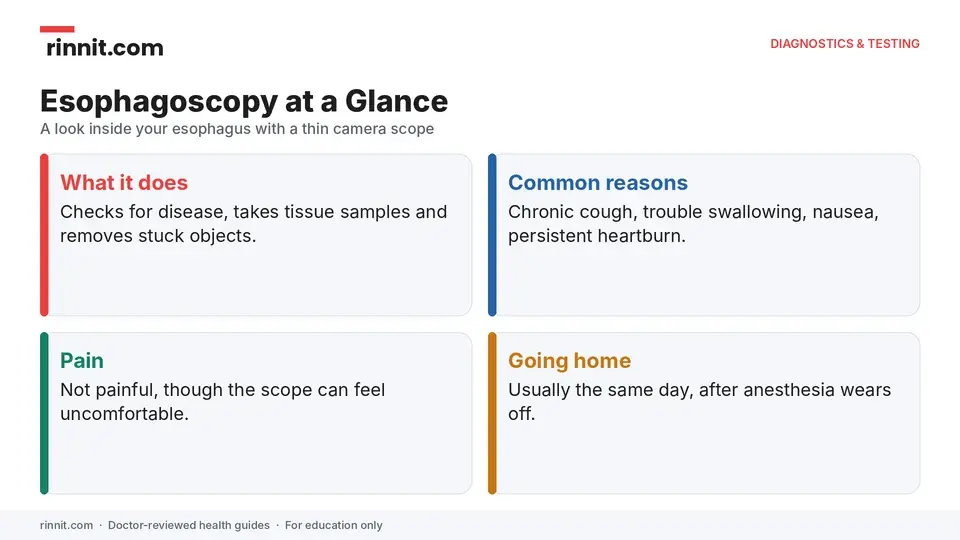
An esophagoscopy is a procedure that lets healthcare providers check the inside of your esophagus, the tube that carries food and liquid from your throat to your stomach. Your provider may do one to look for signs of disease or to take tissue samples. [1]
The procedure is a type of endoscopy. An endoscope is a long, flexible tube with a camera and a light on the end. Your provider passes the scope, called an esophagoscope, into your mouth or nose and moves it down your throat to your esophagus. [1]
Feeling anxious about a tube going down your throat or nose is completely normal. The test is one of the best ways to find out what's happening in your esophagus, and that's the first step toward feeling better. [1]
Why would you need an esophagoscopy?
Your healthcare provider may recommend this test if you have symptoms such as: [1]
A chronic cough
Difficulty swallowing
Nausea and vomiting
Persistent heartburn
You may also need an esophagoscopy if food gets caught in your esophagus or you swallow something by accident. Providers use the procedure to diagnose esophageal disorders, including: [1]
Barrett's esophagus
Dysphagia (difficulty swallowing)
Esophageal cancer
What are the types of esophagoscopy?

Type | How the scope goes in | Typical time |
Transoral esophagoscopy | Through your mouth into your esophagus | Up to 60 minutes |
Transnasal esophagoscopy | Through your nose, past the back of your mouth, into your esophagus | About 15 minutes |
Sources: [1]
Both types work the same way: the lighted camera sends images to a screen. Most esophagoscopes are flexible tubes that bend, but some are narrow metal tubes that don't bend. A procedure with a straight metal scope is called a rigid esophagoscopy. [1]
How do you prepare for an esophagoscopy?
Some esophagoscopies are done with anesthesia so you don't feel pain. Your provider will explain exactly how to get ready, but in general you should: [1]
Plan transportation. You usually go home the same day, but you can't drive after anesthesia, so arrange for someone to take you home.
Plan for anesthesia. You may need to fast for eight hours beforehand, and your provider may ask you to stop certain herbal supplements.
What happens during an esophagoscopy?
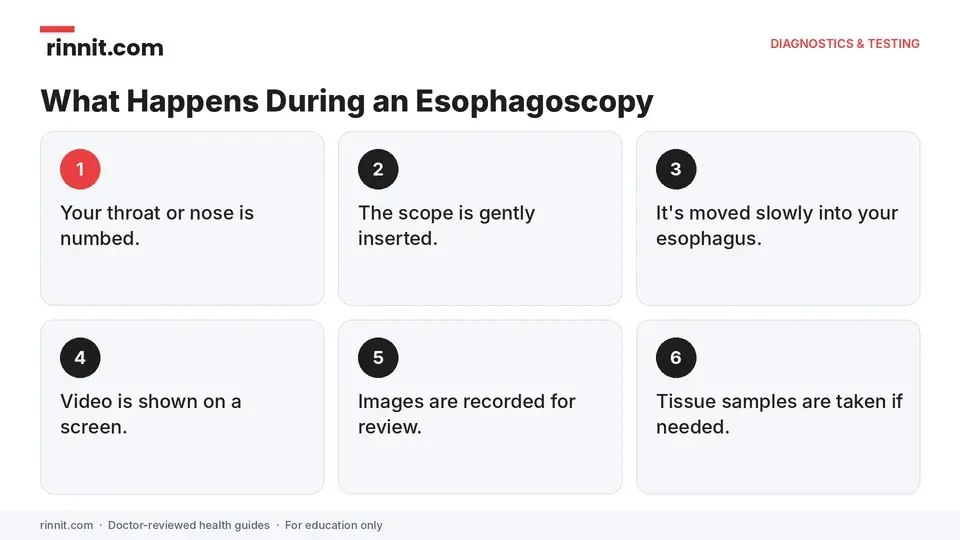
An anesthesiologist gives you medicine to put you to sleep or sedation to help you relax. Then your provider will: [1]
Numb your throat if the scope goes through your mouth, or numb the inside of your nose if it goes through your nose.
Gently insert the esophagoscope into your mouth or nose.
Slowly move the scope into your esophagus.
Project the video from the scope onto a screen.
Record images to review later if needed.
Take tissue samples (a biopsy) if needed. A pathologist then examines the samples under a microscope.
Is an esophagoscopy painful?
No. You may feel uncomfortable as the scope is inserted, but the procedure isn't painful. [1]
What happens after an esophagoscopy?
Esophagoscopy is an outpatient procedure, so you can go home the same day. You'll stay at the office or hospital until the anesthesia wears off. For example, it may take about an hour for the numbing medicine in your throat or nose to wear off. [1]
Benefits and risks
Benefits | Possible complications (rare) |
Diagnosing conditions such as Barrett's esophagus | Bleeding |
Detecting cancer cells early, which leads to earlier treatment for esophageal cancer | Irritated or sore throat |
Removing objects stuck in your esophagus | Reaction to anesthesia |
Taking tissue samples for testing | A tear (perforation) in your esophagus |
Sources: [1]
Esophagoscopies are safe procedures with very few complications. Get medical care right away if you have chest, neck or belly pain, trouble swallowing or breathing, fever, or you vomit blood or have black stools after the procedure, because these can be signs of a tear or bleeding. [1]
What results do you get?
Your results depend on why you had the test. For example: [1]
The test shows you have GERD, and your provider recommends treatments and ways to manage it.
You have Barrett's esophagus, and the test shows whether it's the same or getting worse.
You have trouble swallowing, and the test helps find out why.
Your provider may share some results right away. If tissue samples were taken, results may take a few days to a week, and your provider will tell you when to expect them. [1]
When should you call your provider?
Contact your provider after an esophagoscopy if you develop: [1]
A nosebleed that doesn't go away
A severe sore throat
Esophagoscopy vs. bronchoscopy
Both are types of endoscopy. An esophagoscopy looks at your esophagus, while a bronchoscopy looks at your trachea (windpipe) or lungs. [1]
Conclusion
An esophagoscopy gives your provider a direct look inside your esophagus to find the cause of symptoms like heartburn, coughing or trouble swallowing, take samples and remove stuck objects. It isn't painful, it's usually done as an outpatient procedure and serious complications are rare.
If you feel anxious about the test, tell your provider. They can explain what to expect and how they'll support you during and after it.
Keep learning: Read our guide to acid reflux and GERD or our explainer on upper endoscopy (EGD). For more trusted, doctor-reviewed health guides, visit Rinnit.com.
FAQ
What is an esophagoscopy?
A procedure that uses a thin scope with a light and camera to look inside your esophagus.
Why is an esophagoscopy done?
To find the cause of symptoms, take tissue samples, diagnose esophageal disorders or remove stuck objects.
What are the types of esophagoscopy?
Transoral, through the mouth, and transnasal, through the nose.
How long does an esophagoscopy take?
A transnasal one may take about 15 minutes and a transoral one up to 60 minutes.
Is an esophagoscopy painful?
No. You may feel some discomfort as the scope goes in, but it isn't painful.
Do I need to fast before an esophagoscopy?
If you're having anesthesia, you may need to fast for eight hours beforehand.
Can I drive home after an esophagoscopy?
No. Plan for someone to take you home because you'll have had anesthesia.
What are the risks of esophagoscopy?
Rare complications include bleeding, sore throat, a reaction to anesthesia and a tear in the esophagus.
How long do esophagoscopy biopsy results take?
If tissue samples are taken, results may take a few days to a week.
When should I call my doctor after an esophagoscopy?
If you have a nosebleed that won't stop or a severe sore throat.
Related Reading
EndoFLIP Test: Measuring Your Esophagus for Swallowing Problems explains the balloon test that measures how well the esophagus opens.
Enteroscopy: Seeing and Treating the Small Intestine explains the scope exam that reaches deep into the small intestine.
Bravo Test: Wireless pH Monitoring for GERD, Prep and Results explains the wireless capsule test that measures acid reflux.
Acid Reflux & GERD: Symptoms, Causes, Diagnosis, and Treatment explains the reflux disease that an esophagoscopy can help diagnose and monitor.
Understanding Laryngopharyngeal Reflux (LPR): Symptoms, Causes, and Care covers reflux that reaches the throat and voice box, one reason providers do this test.
Dysphagia (Trouble Swallowing): Symptoms, Causes, Diagnosis & Treatment — Complete Guide describes trouble swallowing, a common reason to look inside the esophagus.
Esophagitis: Symptoms, Causes, and Treatment explains inflammation of the esophagus that the scope can reveal.
Eosinophilic Esophagitis: Symptoms, Causes, and Treatment covers an allergic esophagus condition diagnosed with a scope and biopsy.
Esophageal Strictures: Symptoms, Causes, Diagnosis, Treatment and When to Seek Emergency Care — What You Need to Know explains narrowing of the esophagus that can make food get stuck.
References
Cleveland Clinic. Esophagoscopy: What It Is, Procedure, Complications. Cleveland Clinic. Last updated December 3, 2024. https://my.clevelandclinic.org/health/diagnostics/esophagoscopy
Abou-Nader L, Wilson JA, Paleri V. Transnasal oesophagoscopy: diagnostic and management outcomes in a prospective cohort of 257 consecutive cases and practice implications. Clin Otolaryngol. 2014;39(2):108-113. PMID 24713033. https://doi.org/10.1111/coa.12241
Alexandre PL, Pinto JV, Costa L, et al. Rigid Esophagoscopy for Foreign Body Extraction: Results and Complications in the Endoscopic Era. Cureus. 2024;16(1):e53040. PMID 38410347. https://doi.org/10.7759/cureus.53040
Medical disclaimer
This article is for general education only and does not replace advice from a qualified healthcare professional. Talk to your doctor about your own diagnosis and treatment, and seek emergency care right away for severe or sudden symptoms.



Comments