Esophageal Strictures: Symptoms, Causes, Diagnosis, Treatment and When to Seek Emergency Care — What You Need to Know

Updated: 2 days ago
Medically reviewed by Dr. Baraa Alnahhal, MD · Last reviewed: September 2026
Quick Answer: An esophageal stricture is an abnormal narrowing of your esophagus — the swallowing tube that runs from your mouth through your chest down to your stomach. As many as 75% of strictures result from chronic acid reflux, which inflames the lining, creates scar tissue and gradually squeezes the tube shut. Symptoms start as slowly worsening difficulty swallowing, then may include chest pain, coughing or choking when swallowing, regurgitation and unintended weight loss. Most strictures are treatable with esophageal dilation, an outpatient procedure that stretches the opening wider over a few weekly sessions. Contact a healthcare provider for any difficulty swallowing, and seek immediate care for food stuck in your throat, inability to swallow solids, inhaled food or severe chest pain. [1]
TL;DR
An esophageal stricture narrows the passageway food travels down. The most common culprit — up to 75% of cases — is chronic acid reflux, which repeatedly irritates the esophageal lining, triggers inflammation and leaves behind scar tissue that tightens the tube. Other causes include medications (NSAIDs, acetaminophen, potassium), viral and fungal infections, eosinophilic esophagitis, caustic or thermal injury, cancer treatments and, less commonly, cancer itself.
Strictures usually develop slowly, which is why the first sign is often a gradual need for smaller bites. Providers distinguish simple strictures (small area, straight borders, still passable for solids) from complex ones (long, irregular or too narrow for anything but liquids), because this determines how intensive treatment must be.
Dilation — stretching the narrowing with a balloon or cylinder across several weekly outpatient sessions — resolves most simple strictures within weeks. Refractory or recurrent strictures may need steroid or mitomycin C injections, incisional therapy, stents or surgery. Because stricture symptoms overlap with esophageal cancer warning signs, prompt evaluation matters, and certain situations demand immediate emergency care.
Limitation statement: The referenced clinical source states that up to 75% of esophageal strictures result from chronic acid reflux, but it does not publish overall prevalence or incidence figures for the condition. No additional statistics are invented here; everything in this article comes directly from the cited source.
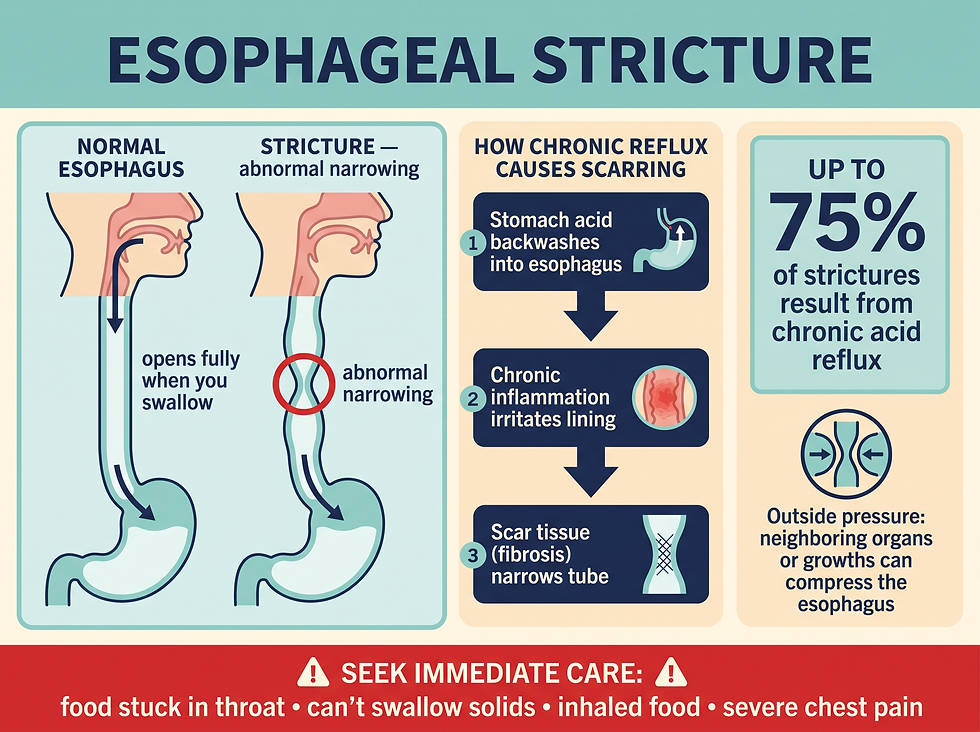
What Is an Esophageal Stricture?
An esophageal stricture is an abnormal narrowing of your esophagus. Your esophagus is the swallowing tube that runs through your chest, from your mouth down to your stomach. "Stricture" refers to any channel or passageway in your body becoming narrower or constricted. A stricture makes it hard for things to pass through that channel — in your esophagus, that means difficulty swallowing. [1]
Many different disease processes can cause strictures, and they can occur from inside or outside of the esophagus. Processes on the inside cause the inner lining (the mucosa) to swell and stiffen so it no longer stretches when you swallow. Narrowing from outside the esophagus happens due to pressure from neighboring organs or growths. These processes usually happen slowly. [1]
How serious is an esophageal stricture?
Healthcare providers take esophageal strictures seriously because they affect your swallowing and are likely to worsen with time. Although they usually develop slowly, providers prefer to treat them as soon as possible to prevent them from worsening. Most strictures are treatable with minor interventions. However, a small percentage of them are due to cancer, which is more serious. [1]

What Symptoms Does an Esophageal Stricture Cause?
The first and most common symptom is that swallowing becomes increasingly difficult. You might manage this for a while with smaller bites and more thorough chewing. Some people begin avoiding tougher foods without realizing it. But as the stricture worsens, these adjustments help less and less. You might feel like there's a lump in your throat, or like the muscles in your throat aren't working. [1]
You might also experience noncardiac chest pain related to your esophagus, coughing or choking when you try to swallow, regurgitation (food coming back up), and unintended weight loss from reduced food intake. [1]
Increasingly difficult swallowing: First and most common sign; smaller bites help less over time
Lump in throat sensation: Feeling that food sits high in the throat
Throat muscles not working: Swallowing feels mechanical or effortful
Noncardiac chest pain: Chest pain related to the esophagus
Coughing or choking: Occurs when you try to swallow
Regurgitation: Food coming back up
Unintended weight loss: From reduced food intake
What Causes Esophageal Strictures?
As many as 75% of esophageal strictures result from chronic acid reflux. That's when stomach acid routinely backwashes into your esophagus and irritates the mucous lining. Chronic acid reflux causes chronic inflammation inside your esophagus. Over time, this leads to scarring (fibrosis), and scar tissue narrows your esophagus — in part of it or all of it, depending on how far the acid travels. [1]
What are the main types of causes?
Causes fall into a few main types. Each works through a different mechanism, which influences how the stricture behaves and how it's treated. [1]
Chronic esophagitis: Chronic acid reflux (most common), pill esophagitis, infectious esophagitis, eosinophilic esophagitis. Long-term inflammation causes swelling and scarring.
Injury or trauma: Caustic ingestion, thermal injury, radiation therapy, esophageal cancer surgery. Swelling and scarring inside or outside the esophagus; external pressure can compress it.
Cancer: Adenocarcinoma, squamous cell carcinoma, metastatic cancer (e.g., from the lungs). Rapid overgrowth of cancer cells, or external tumors compressing the esophagus.
Which forms of esophagitis cause strictures?
Most common causes are types of chronic esophagitis — long-term inflammation of the esophagus lining. Chronic acid reflux is the most common, but several others exist. Pill esophagitis is drug-induced erosion of the lining from swallowing certain medications too often, especially NSAIDs (nonsteroidal anti-inflammatory drugs), acetaminophen and potassium. Infectious esophagitis comes from chronic viral infections — including HPV, HSV-1 and CMV — and fungal infections like Candida albicans, typically in people with weaker immune systems. Eosinophilic esophagitis is a rare autoimmune disease in which the immune system overreacts to potential allergens, triggering chronic inflammation; it can begin in childhood. [1]
How do injuries and cancer cause strictures?
Traumatic injury to the esophagus lining — accidental, intentional or iatrogenic (related to medical treatment) — can cause scarring and stricture. Specific injuries include accidentally or intentionally swallowing something caustic or corrosive, swallowing something very hot and burning the esophagus (thermal injury), and cancer treatments: radiation therapy can inflame the esophagus (mucositis), with radiation-induced esophageal stricture (RIES) as a possible side effect, and surgery to remove esophageal cancer can also cause scarring. [1]
Esophageal cancer is an uncommon but possible cause. When it happens, it isn't inflammation and scarring that narrows the esophagus but the overgrowth of cancer cells — and this overgrowth occurs rapidly compared with the inflammation and scarring process. If you develop difficulty-swallowing symptoms quickly and unexpectedly, see a healthcare provider right away. [1]
Most esophageal cancers relate to chronic esophagitis, often from chronic acid reflux. Chronic esophagitis can cause cellular changes in the esophageal lining known as intestinal metaplasia or Barrett's esophagus, which can lead to cancerous changes. The cancers include adenocarcinoma, squamous cell carcinoma and metastatic cancer that has spread from somewhere else, like the lungs. Tumors developing outside the esophagus can compress it. [1]
What are the risk factors?
You might be more likely to get an esophageal stricture with a history of gastroesophageal reflux disease, eosinophilic esophagitis, frequent use of over-the-counter (OTC) pain relievers, or cancer treatment in the neck or chest region. [1]
Gastroesophageal reflux disease: Chronic acid exposure drives inflammation and scarring
Eosinophilic esophagitis: Autoimmune inflammation stiffens and scars the lining
Frequent OTC pain reliever use: Pills (NSAIDs, acetaminophen) can erode the lining
Cancer treatment in neck or chest: Radiation and surgery damage esophageal tissue
How Is an Esophageal Stricture Diagnosed?
Esophageal disorders are often diagnosed by a gastroenterologist. They'll review your symptoms and health history, then look for evidence of the stricture using one of two common tests. [1]
The first is a type of X-ray called an esophagram, also known as a barium swallow test. For this test, you swallow a chalky substance called barium, and the X-ray machine takes live video of you swallowing. An alternative test is an upper endoscopy (EGD test). You'll be sedated, and your gastroenterologist will pass an endoscope — a tiny camera on the end of a long, thin tube — down your throat through your esophagus. It shows the inside lining of your esophagus in detail, and your provider can also take a biopsy through the endoscope, if necessary, to help diagnose a disease. [1]
Esophagram (barium swallow): You swallow chalky barium; the X-ray machine takes live video of you swallowing. It shows how the narrowing behaves as liquid passes through.
Upper endoscopy (EGD): Sedated; a tiny camera on a thin tube examines the lining in detail. It gives a direct view of the stricture, and a biopsy is possible to diagnose underlying disease.
How Is an Esophageal Stricture Treated?
The goal of treatment is to widen the opening again so that you can swallow adequately and comfortably. For most strictures, esophageal dilation will accomplish this. Dilation means stretching the opening with a balloon or cylinder that widens a little at a time. Dilation is usually successful in treating simple strictures. Complex strictures may need more complex treatment. [1]
What makes a stricture simple vs complex?
Healthcare providers consider a stricture simple if it covers a relatively small area, has straight borders and is still wide enough for you to swallow solids through it. Strictures caused by chronic esophagitis are usually simple. A complex stricture, on the other hand, may be long or irregular, or so narrow that you can only swallow liquids. Cancer, injury or trauma may cause more complex esophageal strictures. [1]
Simple: Small area, straight borders, solids still passable. Typical cause: chronic esophagitis. Typical treatment: dilation, usually successful.
Complex: Long or irregular, or only liquids passable. Typical cause: cancer, injury or trauma. Typical treatment: dilation plus additional treatments.
What does dilation involve?
Dilation is an outpatient procedure done once a week or so for several weeks, until your esophagus reaches its target diameter. During each session, your provider widens the dilator incrementally. Most strictures improve with a few sessions. But some complex strictures are refractory (resistant) to dilation, or they come back later (recur). These strictures may require other treatments. [1]
What other treatments exist?
Refractory or recurrent strictures that don't respond to dilation alone may require a combination of treatments. Cancerous (malignant) strictures may require a different approach entirely — since treating the cancer is the top priority, providers often defer dilation in these cases and address the stricture in more temporary ways first. [1]
Medication (steroid injections): Steroids injected at the stricture site reduce inflammation and prevent or delay recurrence after dilation. Used for refractory or recurrent strictures.
Mitomycin C injections (under study): Researchers are testing this medication to prevent fibrosis. Used for refractory strictures.
Endoscopic stricturoplasty (incisional therapy): An electrosurgical needle knife breaks up scar tissue; up to 8 incisions per session, possibly over a few sessions. Used for refractory or recurrent strictures.
Stenting: A small tube props open passageways that have become too narrow. Used after dilation therapy, or for malignant strictures not yet dilated.
Surgery: Esophagectomy removes part or all of the esophagus; Nissen fundoplication fixes chronic acid reflux to prevent further damage. Used for malignant strictures and those unresponsive to other treatments.

What's the Outlook? Can a Stricture Be Cured?
Esophageal strictures are treatable, and most will respond to conservative treatments like dilation, which works quickly to relieve your symptoms. Some complex strictures are trickier to treat — they might require extended treatment, multiple treatments or more intensive treatments, like surgery. It's also important to address the underlying cause of your stricture to prevent it from happening again. [1]
How soon will I feel better?
Dilation works progressively, opening your esophagus a little at a time. You'll find it a little easier to swallow after each session, though you might also feel a little sore. Simple strictures can usually be successfully dilated within a matter of weeks. Considering how long it takes for most strictures to develop, that's a fast recovery. If you need more complex treatment, your provider can give you an idea of what to expect. [1]
Should I change my diet?
You might need to change your diet to make swallowing easier, and you may need to adjust your diet before and after treatment as well. Your healthcare provider will give you specific instructions. Providers usually recommend a gastrointestinal soft diet for esophageal strictures — a diet that is low in fiber, easy to digest and gentle going down your food pipe. [1]
When should I seek immediate care?
Emergency — seek immediate care if you:
Get food stuck in your throat
Can't swallow solids
Accidentally inhale a piece of food
Develop severe chest pain
Contact a healthcare provider any time you have symptoms of esophagitis or difficulty swallowing.
How Can Esophageal Strictures Be Prevented?
Not all causes are preventable, but some of the most common ones are. If you have symptoms of esophagitis or chronic acid reflux — like heartburn or chest pain — see your healthcare provider. It's important to realize these symptoms aren't just a nuisance but a sign that real damage is occurring. They're also usually treatable, once your healthcare provider has determined the cause. [1]
A note from your care team: "Esophageal strictures usually develop gradually over time, but you're likely to notice symptoms along the way. If you have chronic esophagitis, inflammation inside your esophagus, it probably feels sore from time to time. You might notice a burning sensation after eating or a general soreness in your chest. Seeking treatment for these symptoms sooner rather than later can help prevent strictures from forming."
Conclusion: Treat a Narrowing Esophagus Sooner Rather Than Later
An esophageal stricture starts small — a few harder bites here, a meal skipped there — and most people adjust without realizing how much their swallowing has changed. But strictures are likely to worsen with time, and a small percentage trace back to cancer. That combination makes early evaluation important.
The good news is that most strictures respond well to dilation, with simple ones typically resolved in a matter of weeks. Managing the underlying cause — reflux, medications, inflammation — is what keeps it from coming back. If swallowing has become a project, talk to a gastroenterologist and ask about your options. If food ever gets stuck, solids won't go down, you inhale food, or you develop severe chest pain, get emergency care right away.
Disclaimer: This article is for general informational purposes only and is not a substitute for professional medical advice, diagnosis or treatment. Always seek the advice of a qualified healthcare provider with any questions about a medical condition.
Frequently Asked Questions
What is an esophageal stricture?
An esophageal stricture is an abnormal narrowing of your esophagus, the swallowing tube that runs through your chest from your mouth down to your stomach. A stricture is any channel or passageway in your body that becomes narrower or constricted, and in the esophagus it causes difficulty swallowing. [1]
What causes esophageal strictures most often?
Up to 75% of esophageal strictures result from chronic acid reflux, when stomach acid routinely backwashes into the esophagus and irritates the mucous lining. This chronic inflammation leads to scarring (fibrosis), and scar tissue narrows the esophagus. [1]
Is an esophageal stricture serious?
Providers take strictures seriously because they affect your swallowing and are likely to worsen with time. Most are treatable with minor interventions, but a small percentage are due to cancer, which is more serious. Providers prefer to treat strictures as soon as possible. [1]
What does an esophageal stricture feel like?
The first and most common symptom is that swallowing becomes increasingly difficult. You may also feel like there's a lump in your throat or that the muscles in your throat aren't working. [1]
What are the other symptoms of an esophageal stricture?
Other symptoms include noncardiac chest pain related to the esophagus, coughing or choking when you try to swallow, regurgitation (food coming back up) and unintended weight loss from reduced food intake. [1]
Can I manage difficulty swallowing on my own for a while?
You might manage for a while by taking smaller bites and chewing more thoroughly, and you may begin avoiding tougher foods without realizing it. But as the stricture worsens, these adjustments help less and less. [1]
How does a stricture narrow the esophagus from the inside?
Inside processes cause the inner lining (mucosa) to swell and stiffen so that it no longer stretches when you swallow. Narrowing from outside the esophagus occurs due to pressure from neighboring organs or growths. [1]
Do strictures develop quickly?
No — these processes usually happen slowly. That's why stricture symptoms tend to worsen gradually rather than suddenly. [1]
What is chronic esophagitis?
Chronic esophagitis is long-term inflammation of your esophagus lining. Chronic inflammation causes swelling and scarring, and most common causes of esophageal stricture are types of chronic esophagitis. [1]
What is pill esophagitis?
Pill esophagitis is drug-induced erosion of your esophagus lining from swallowing certain medications too often, especially NSAIDs (nonsteroidal anti-inflammatory drugs), acetaminophen and potassium. [1]
Can infections cause esophageal strictures?
Yes. Infectious esophagitis from chronic viral infections — including HPV, HSV-1 and CMV — and fungal infections like Candida albicans can cause esophagitis, especially in people with weaker immune systems. [1]
What is eosinophilic esophagitis and how does it cause strictures?
Eosinophilic esophagitis is a rare autoimmune disease in which your immune system overreacts to potential allergens, triggering chronic inflammation. It can begin in childhood and lead to strictures. [1]
What injuries can cause an esophageal stricture?
Accidental, intentional and iatrogenic (medical-treatment-related) injuries can all cause scarring and stricture, including swallowing something caustic or corrosive (caustic ingestion) and swallowing something very hot (thermal injury). [1]
Can cancer treatment cause an esophageal stricture?
Yes. Radiation therapy to treat cancer in the area can inflame your esophagus (mucositis), and radiation-induced esophageal stricture (RIES) is a possible side effect. Surgery to remove esophageal cancer can also cause scarring and stricture. [1]
Can esophageal cancer cause a stricture?
Yes — it's an uncommon but possible cause. In cancer-related strictures, the overgrowth of cancer cells narrows the esophagus rather than inflammation and scarring, and this overgrowth occurs rapidly compared with the scarring process. [1]
Why should suddenly appearing swallowing difficulty be taken seriously?
Because cancer-related overgrowth happens rapidly, if you develop symptoms like difficulty swallowing quickly and unexpectedly, you should see a healthcare provider right away. [1]
How do esophageal cancers lead to strictures?
Most esophageal cancers relate to chronic esophagitis, often from chronic acid reflux. Chronic esophagitis can cause cellular changes in the lining known as intestinal metaplasia or Barrett's esophagus, which can lead to cancerous changes. Esophageal cancers include adenocarcinoma, squamous cell carcinoma and metastatic cancer (for example, spread from the lungs), and tumors outside the esophagus can compress it. [1]
What are the risk factors for esophageal strictures?
You might be more likely to get a stricture with a history of gastroesophageal reflux disease, eosinophilic esophagitis, frequent use of over-the-counter pain relievers, or cancer treatment in the neck or chest region. [1]
How is an esophageal stricture diagnosed?
A gastroenterologist reviews your symptoms and health history, then looks for evidence of the stricture using an esophagram (barium swallow test) or an upper endoscopy (EGD test). [1]
What is a barium swallow test?
For an esophagram, you swallow a chalky substance called barium, and the X-ray machine takes live video of you swallowing. [1]
What happens during an upper endoscopy?
You'll be sedated and your gastroenterologist will pass an endoscope — a tiny camera on the end of a long, thin tube — down your throat through your esophagus. It shows the inside lining in detail, and your provider can also take a biopsy, if necessary, to help diagnose a disease. [1]
What is the goal of stricture treatment?
The goal is to widen the opening again so that you can swallow adequately and comfortably. For most strictures, esophageal dilation will accomplish this. [1]
What is esophageal dilation?
Dilation means stretching the opening with a balloon or cylinder that widens a little at a time. It's an outpatient procedure done once a week or so for several weeks, until your esophagus reaches its target diameter. It's usually successful for simple strictures. [1]
What's the difference between a simple and a complex stricture?
A simple stricture covers a relatively small area, has straight borders and is still wide enough to swallow solids through; strictures from chronic esophagitis are usually simple. A complex stricture may be long or irregular, or so narrow that you can only swallow liquids. Cancer, injury or trauma may cause complex strictures. [1]
What if dilation doesn't work?
Some complex strictures are refractory (resistant) to dilation or recur later. These may need other treatments, such as steroid injections at the stricture site, stricturoplasty, stents or surgery. [1]
What are steroid injections used for?
Providers sometimes inject steroids at the site of the stricture to reduce inflammation and to prevent or delay recurrence of the stricture after dilation. Researchers are also testing mitomycin C injections for preventing fibrosis. [1]
What is endoscopic stricturoplasty?
Also called incisional therapy, stricturoplasty breaks up the scar tissue in your stricture with an electrosurgical needle knife. Your provider makes up to eight incisions in each session, working through an endoscope, and it might take a few sessions. [1]
When are stents or surgery used?
Stents — small tubes that prop open passageways — are sometimes placed after dilation therapy or for malignant strictures that haven't been dilated. Esophagectomy (removing part or all of the esophagus) may be necessary for malignant strictures and those that don't respond to other treatments, and chronic reflux may prompt a Nissen fundoplication to prevent further damage. [1]
How are cancerous strictures treated?
Since treating the cancer itself is the top priority, providers often defer dilation for malignant strictures and may need surgery or other treatments first, addressing the stricture in more temporary ways. [1]
How soon will I feel better after dilation?
Dilation works progressively, so it gets a little easier to swallow after each session, though you might also feel a little sore. Simple strictures can usually be successfully dilated within a matter of weeks — a fast recovery given how slowly strictures develop. For complex treatment, your provider can tell you what to expect. [1]
Can esophageal strictures be prevented?
Not all causes are preventable, but some of the most common ones are. Heartburn and chest pain are signs that real damage is occurring, not just a nuisance — see your provider, because these symptoms are usually treatable once the cause is determined. [1]
When should I contact my healthcare provider?
Contact a healthcare provider if you have any symptoms of esophagitis or difficulty swallowing. Seek immediate care if you get food stuck in your throat, can't swallow solids, accidentally inhale a piece of food, or develop severe chest pain. [1]
Should I change my diet with an esophageal stricture?
You might need to change your diet to make swallowing easier, and also adjust it before and after treatment. Providers usually recommend a gastrointestinal soft diet — low in fiber, easy to digest and gentle going down your food pipe. Your healthcare provider will give you specific instructions. [1]
References
Esophageal Strictures — Cleveland Clinic (last updated Feb 2, 2024)
External authoritative references cited on the source page:
Comments