Esophageal Disorders: Symptoms, Types, Causes, Diagnosis, Treatment and Prevention — What You Need to Know

Updated: 2 days ago
Medically reviewed by Dr. Baraa Alnahhal, MD · Last reviewed: September 2026
Quick Answer: Esophageal disorders are problems with how your esophagus works — the tube that carries food from your mouth to your stomach. The most common type is gastroesophageal reflux disease (GERD), which happens when the lower esophageal sphincter doesn't close properly. Other types include achalasia, Barrett's esophagus, eosinophilic esophagitis, esophageal cancer, diverticulum, spasms, strictures and hiatal hernias. Symptoms range from heartburn and regurgitation to difficulty swallowing and unexplained weight loss. Most disorders improve with medications, habit changes or procedures like endoscopic dilation, myotomy or fundoplication surgery. [1]
TL;DR
Esophageal disorders cover a wide range of conditions that disrupt the way your esophagus moves food into your stomach. GERD is by far the most common — the valve at the bottom of the esophagus fails to close, letting stomach acid and contents flow backward. A second group of disorders works in the opposite direction: the sphincter won't relax (achalasia), the tube narrows (strictures, eosinophilic esophagitis), or abnormal spasms make swallowing painful.
Symptoms depend on the specific disorder, but commonly include heartburn, regurgitation, trouble swallowing, chronic cough, hoarseness and unexplained weight loss. Untreated reflux can progress to Barrett's esophagus — changes that may be precancerous — and disorders like GERD and achalasia can raise cancer risk if treatment is skipped.
Diagnosis usually involves a physical exam plus an upper endoscopy, barium swallow X-ray, esophageal manometry or a pH test. Treatment spans acid-reducing medications, Botox injections, endoscopic dilation and surgery such as Heller myotomy, POEM or fundoplication. Many everyday habits — meal timing, head elevation, weight management, quitting smoking — lower your risk.
Limitation statement: The referenced clinical source does not publish prevalence, incidence or cure-rate statistics for these disorders as a group. No figures are invented here; everything in this article comes directly from the cited source.

What Are Esophageal Disorders?
Esophageal disorders are problems that impact how your esophagus works. Your esophagus is an important part of your digestive system. It's a tube that helps food travel from your mouth to your stomach. If you have an esophageal disorder, something is getting in the way of this process. [1]
Your symptoms depend on the type of disorder, but these conditions can disrupt everyday life. In some cases, changes to your daily routine can help you feel a little better. Treatment can also include medications and surgery. [1]
Which esophageal disorder is most common?
Gastroesophageal reflux disease (GERD) is the most common esophageal disorder. It happens when the lower esophageal sphincter doesn't close properly. This causes stomach acid and contents to flow backward into your esophagus. [1]
GERD: Lower esophageal sphincter doesn't close; stomach acid flows back into the esophagus
Achalasia: Sphincter doesn't relax; food doesn't empty into the stomach well
Barrett's esophagus: Chronic, untreated reflux causes inflammatory changes that may be precancerous
Eosinophilic esophagitis: Allergic reaction to food allergens causes chronic inflammation, scarring and narrowing
Esophageal cancer: Cells multiply abnormally; can spread to other organs and be deadly
Esophageal diverticulum: A pocket or outpouching forms on a weak spot in the esophagus (see also Zenker's diverticulum)
Esophageal spasms: Abnormal muscle spasms make swallowing harder and can be painful
Esophageal strictures: The esophagus becomes unusually narrow over time, making swallowing harder
Hiatal hernia: Top of the stomach pushes through the diaphragm into the chest (learn more about hiatal hernia)
The list above covers the full set of conditions the source groups under esophageal disorders, including the four conditions (hiatal hernia, diverticulum, strictures, spasms) often described alongside GERD, achalasia, Barrett's esophagus, eosinophilic esophagitis and esophageal cancer.
What Symptoms Do Esophageal Disorders Cause?
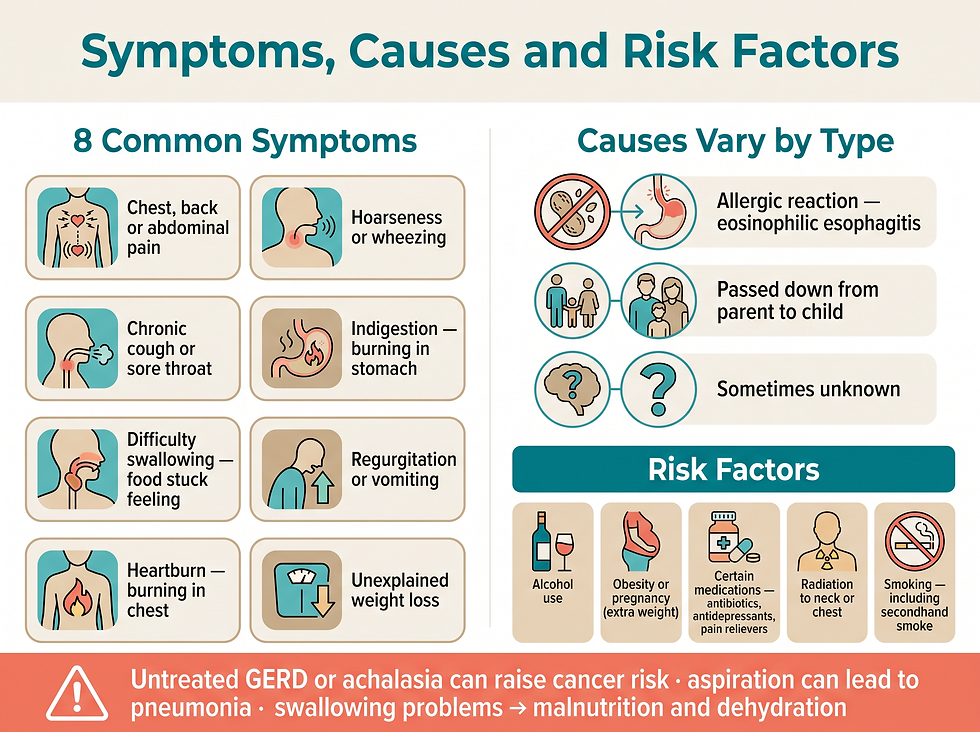
Your symptoms depend on the type of esophageal disorder you have. The most familiar sign is heartburn — a burning feeling in your chest. But the symptom list runs wider than reflux alone. [1]
Common symptoms to watch for
You may experience abdominal pain, chest pain or back pain. A chronic cough or sore throat can develop, along with hoarseness or wheezing. Many people feel indigestion — a burning feeling in the stomach — or notice regurgitation, where stomach acid or contents come back up the esophagus to the mouth, sometimes with vomiting. [1]
Difficulty swallowing is another key sign. You may feel like you have food stuck in your throat. Unexplained weight loss also appears on the symptom list — a signal worth taking seriously because it can point to narrowing, obstruction or more serious disease. [1]
Abdominal, chest or back pain: Pain in the upper abdomen, chest or back
Chronic cough or sore throat: Persistent coughing or throat irritation
Difficulty swallowing: Feeling like food is stuck in your throat
Heartburn: Burning feeling in your chest
Hoarseness or wheezing: Voice changes or noisy breathing
Indigestion: Burning feeling in your stomach
Regurgitation or vomiting: Stomach contents coming back up to the mouth
Unexplained weight loss: Losing weight without trying
Why symptoms matter
Because these symptoms overlap so heavily — heartburn, cough, trouble swallowing — it's easy to dismiss them as everyday reflux. But the underlying cause determines how serious the condition is and what treatment works. That's why an accurate diagnosis matters more than self-treating the symptoms. [1]
What Causes Esophageal Disorders?
Causes of esophageal disorders largely vary by type. Some disorders can develop after you have an allergic reaction — this is how eosinophilic esophagitis begins. Others are passed down from biological parent to child. And sometimes, providers don't know the causes. [1]
What raises your risk?
Several factors increase the chances of developing an esophageal disorder. These risk factors are largely shared across conditions, which means modifying them can help protect your esophageal health broadly. [1]
Alcohol use: Increases acid exposure and irritation
Extra weight ({{obesity|https://www.rinnit.com/post/obesity-symptoms-treatment-guide}} or pregnancy): Adds pressure that pushes stomach contents upward
Certain medications: Includes some antibiotics, antidepressants and pain relievers
Radiation therapy to neck or chest: Damages esophageal tissue
Smoking, including secondhand smoke: Irritates and damages the esophageal lining
What complications can develop?
Regurgitation may cause food to go into your trachea (windpipe) and lungs. This is called aspiration. It can lead to pneumonia and other lung infections. Swallowing problems also make you more prone to malnutrition and dehydration. [1]
Untreated disorders carry their own long-term risks. Some esophageal disorders — like GERD and achalasia — can increase your risk of cancer if you don't get treatment. That's one reason persistent symptoms deserve evaluation rather than indefinite self-management. [1]
How Are Esophageal Disorders Diagnosed?
What tests will your provider order?
Your healthcare provider will start by asking about your symptoms and performing a physical exam. They may feel your neck while you swallow. From there, specific tests help pinpoint the exact disorder. [1]
Upper endoscopy: A long, thin scope examines the upper digestive tract; a biopsy may follow to look for inflammation, cancer and other diseases
GI X-rays (barium swallow): Imaging shows how liquid barium solution flows through your esophagus and digestive tract
Esophageal manometry: Measures how well the esophageal muscles and lower esophageal sphincter work as you swallow
Esophageal pH test: Measures the amount of stomach acid (pH levels) in your esophagus
What does an endoscopy involve?
During an upper endoscopy, your provider uses a long, thin scope to examine the upper part of the digestive tract. They may also perform a biopsy — taking tissue samples and looking for signs of inflammation, cancer and other diseases. This combination of visual inspection plus tissue sampling is often the decisive step in diagnosis. [1]
How Are Esophageal Disorders Treated?
Treatments for esophageal disorders depend on the condition. Options fall into two broad groups: medications and procedures. Most people start with medications and habit changes; surgery becomes relevant for specific disorders. [1]
Which medications are used?
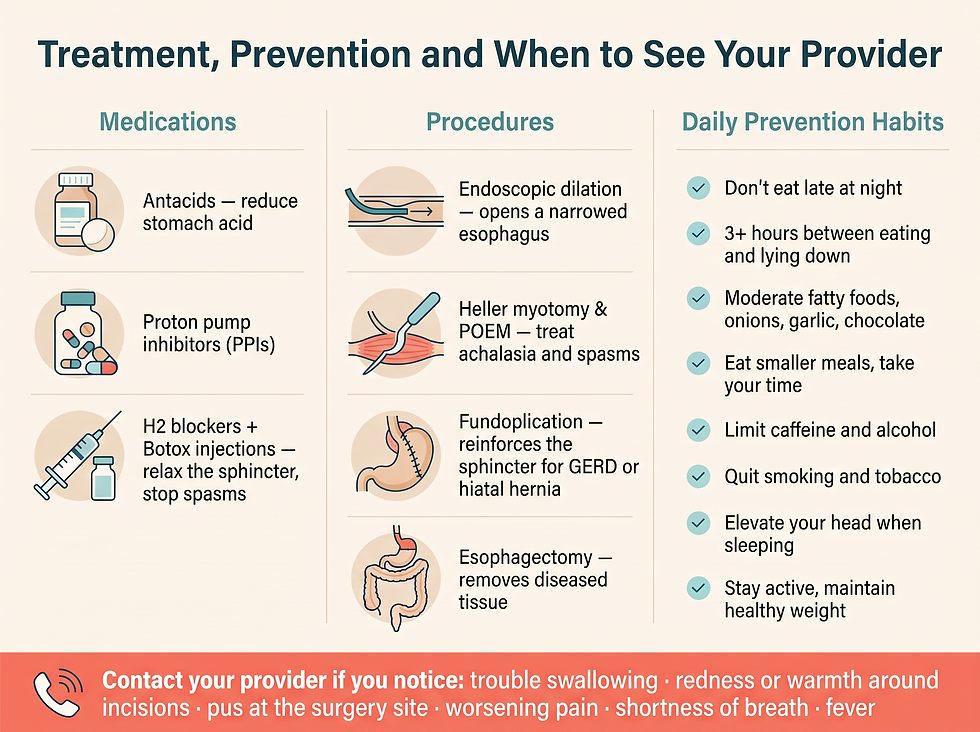
Medications may include antacids, proton pump inhibitors and histamine receptor (H2) blockers to reduce stomach acid. Botulinum toxin (Botox®) injections can temporarily stop esophageal spasms or relax the sphincter muscle. [1]
Which procedures are used?
Endoscopic dilation: Opens a narrowed esophagus or relaxes a sphincter muscle
Esophagectomy: Removes part or all of a diseased esophagus
Heller myotomy and POEM: Treat achalasia and esophageal spasms
Laparoscopic antireflux surgery (fundoplication): Treats GERD or a hiatal hernia by reinforcing the lower esophageal sphincter
Heller myotomy and peroral endoscopic myotomy (POEM) specifically target the tight sphincter in achalasia and esophageal spasms. Laparoscopic antireflux surgery, also called fundoplication, treats GERD or a hiatal hernia by reinforcing the lower esophageal sphincter. Esophagectomy removes part or all of a diseased esophagus, typically in the setting of cancer or severe disease. [1]
When should you see your healthcare provider?
Alert: Reach out to your provider — especially if you're taking medications or have recently had surgery — if you experience redness or warmth around your incisions, trouble swallowing, pus coming from the surgery site, worsening pain that medications aren't helping, shortness of breath, or fever.
What's the Outlook?
If you have an esophageal disorder, you may find symptom relief with over-the-counter (OTC) or prescription medications. Surgery is also an effective treatment for disorders like hiatal hernia and esophageal spasms. [1]
Daily habits make a meaningful difference. Sticking to the routine your provider recommends — like eating smaller meals and staying physically active — can go a long way in helping you feel better. [1]
A note from your care team: "Esophageal disorders can affect so much more than your esophagus. They might cause unpleasant symptoms that lower your quality of life. You may even dread the thought of eating altogether. But the right treatment, or combination of treatments, can bring relief. If you have any questions about your care plan, reach out to your provider. They're here to help find treatment that works for you."
How Can You Prevent Esophageal Disorders?
Esophageal disorders aren't always preventable. But you may be able to lower your risk by adopting a set of habits that reduce acid exposure and pressure on the esophagus. [1]
Don't eat late at night: Reduces nighttime acid reflux
Allow at least 3 hours between eating and lying down: Gives stomach time to empty before reclining
Eat fatty foods, onions, garlic and chocolate in moderation: These trigger reflux in many people
Eat smaller meals and take your time: Less volume, less pressure on the sphincter
Limit caffeine and alcohol: Both relax the sphincter and irritate the lining
Quit smoking and tobacco products: Removes a direct irritant to the esophagus
Elevate your head when you sleep: Uses gravity against overnight reflux
Stay active and maintain a healthy weight: Reduces abdominal pressure that drives reflux
Questions to Ask Your Provider
You may want to ask your healthcare provider:
What type of esophageal disorder do I have?
What caused my esophageal disorder?
What's the best treatment for my esophageal disorder?
How can I modify my habits to protect my health?
Should I look out for complications?
Conclusion: Don't Let Esophageal Symptoms Go Unchecked
Esophageal disorders disrupt one of the most basic functions you have — getting food from your mouth to your stomach safely. The most common, GERD, is highly treatable with medications and habit changes. But other types — achalasia, eosinophilic esophagitis, strictures, cancer — need accurate diagnosis and, in many cases, specialized procedures to prevent complications like aspiration, malnutrition and cancer.
If heartburn, regurgitation, trouble swallowing or unexplained weight loss has become part of your everyday life, that's your cue to get evaluated. The right treatment — or combination of treatments — can bring real relief. Talk to your healthcare provider about what's going on and build a care plan that works for you.
Disclaimer: This article is for general informational purposes only and is not a substitute for professional medical advice, diagnosis or treatment. Always seek the advice of a qualified healthcare provider with any questions about a medical condition.
Frequently Asked Questions
What is an esophageal disorder?
An esophageal disorder is a problem that impacts how your esophagus works. The esophagus is the tube that carries food from your mouth to your stomach, and these conditions get in the way of that process. [1]
What are the most common esophageal disorders?
GERD (gastroesophageal reflux disease) is the most common esophageal disorder. Other types include achalasia, Barrett's esophagus, eosinophilic esophagitis, esophageal cancer, esophageal diverticulum, esophageal spasms, esophageal strictures and hiatal hernia. [1]
What is GERD?
Gastroesophageal reflux disease (GERD) happens when the lower esophageal sphincter doesn't close properly, causing stomach acid and contents to flow backward into your esophagus. [1]
What is achalasia?
Achalasia is the opposite problem from GERD — the lower esophageal sphincter doesn't relax, so food doesn't empty into the stomach well. [1]
What is Barrett's esophagus?
Barrett's esophagus develops when chronic, untreated acid reflux leads to inflammatory changes in your esophagus that may be precancerous. [1]
What causes eosinophilic esophagitis?
Eosinophilic esophagitis is an allergic reaction to food allergens that causes chronic inflammation in your esophagus. Over time, chronic inflammation leads to scarring and narrowing. [1]
Is esophageal cancer a type of esophageal disorder?
Yes. In esophageal cancer, cells in your esophagus make more of themselves than they should. These cancerous cells can spread to other organs and be deadly. [1]
What is an esophageal diverticulum?
An esophageal diverticulum forms when a pocket or outpouching develops on a weak spot in your esophagus. [1]
What are esophageal spasms?
Esophageal spasms are abnormal muscle spasms that happen in your esophagus. They can make it harder to get food down and can also be painful. [1]
What are esophageal strictures?
Esophageal strictures develop when your esophagus becomes unusually narrow over time, making swallowing harder. [1]
What is a hiatal hernia?
A hiatal hernia happens when the top of your stomach pushes up through an opening in your diaphragm and into your chest. [1]
What symptoms do esophageal disorders cause?
Symptoms depend on the type but can include abdominal, chest or back pain; chronic cough or sore throat; difficulty swallowing or a food-stuck feeling; heartburn; hoarseness or wheezing; indigestion; regurgitation or vomiting; and unexplained weight loss. [1]
Can esophageal disorders cause chest pain?
Yes. Abdominal pain, chest pain and back pain are all listed symptoms of esophageal disorders, which is one reason chest pain should always be evaluated. [1]
Can an esophageal disorder cause a chronic cough?
Yes. A chronic cough or sore throat is a recognized symptom, along with hoarseness and wheezing. [1]
Why do esophageal disorders cause difficulty swallowing?
Swallowing difficulty comes from conditions that narrow the esophagus (strictures, eosinophilic esophagitis), block passage (achalasia), or involve abnormal spasms. People may feel like food is stuck in their throat. [1]
Are esophageal disorders inherited?
Sometimes. Causes vary by type — some disorders develop after an allergic reaction, others are passed down from biological parent to child, and sometimes providers don't know the causes. [1]
What are the risk factors for esophageal disorders?
Risk factors include alcohol use, extra weight from obesity or pregnancy, certain medications (some antibiotics, antidepressants and pain relievers), radiation therapy to the neck or chest, and smoking — including secondhand smoke. [1]
Can esophageal disorders cause aspiration?
Yes. Regurgitation may cause food to go into your trachea (windpipe) and lungs — called aspiration — which can lead to pneumonia and lung infections. [1]
Do esophageal disorders increase cancer risk?
Some do. GERD and achalasia can increase your risk of cancer if you don't get treatment. [1]
How are esophageal disorders diagnosed?
Diagnosis starts with a symptom review and physical exam (your provider may feel your neck while you swallow), then tests such as upper endoscopy, barium swallow X-rays, esophageal manometry or an esophageal pH test. [1]
What does an upper endoscopy show?
An upper endoscopy uses a long, thin scope to examine the upper digestive tract. Your provider may also take a biopsy — tissue samples checked for inflammation, cancer and other diseases. [1]
What is esophageal manometry?
Esophageal manometry measures how well the muscles in your esophagus and lower esophageal sphincter work as you swallow a liquid. [1]
What is a barium swallow test?
Gastrointestinal X-rays (barium swallow) use imaging to see how a liquid barium solution flows through your esophagus and digestive tract. [1]
How are esophageal disorders treated with medication?
Medications may include antacids, proton pump inhibitors and H2 blockers to reduce stomach acid, plus botulinum toxin (Botox®) injections to temporarily stop spasms or relax the sphincter muscle. [1]
What surgical procedures treat esophageal disorders?
Procedures include endoscopic dilation to open a narrowed esophagus, esophagectomy to remove a diseased esophagus, Heller myotomy and POEM for achalasia and spasms, and laparoscopic antireflux surgery (fundoplication) for GERD or hiatal hernia. [1]
Is surgery effective for esophageal disorders?
Surgery is an effective treatment for disorders like hiatal hernia and esophageal spasms, and many people also find symptom relief with over-the-counter or prescription medications. [1]
How can I prevent esophageal disorders?
Esophageal disorders aren't always preventable, but you can lower your risk by not eating late at night, allowing at least three hours between eating and lying down, moderating fatty foods/onions/garlic/chocolate, eating smaller meals, limiting caffeine and alcohol, quitting smoking, elevating your head when sleeping, and staying active at a healthy weight. [1]
Can pregnancy cause esophageal disorders?
Extra weight from pregnancy is listed as a risk factor that increases the chances of developing an esophageal disorder. [1]
When should I contact my healthcare provider about an esophageal disorder?
Reach out if you're taking medications or had surgery and experience redness or warmth around incisions, trouble swallowing, pus from the surgery site, worsening pain that medications aren't helping, shortness of breath, or fever. [1]
Can esophageal disorders affect my quality of life?
Yes. Care teams note that esophageal disorders can affect much more than your esophagus — unpleasant symptoms may lower your quality of life, and you may even dread eating. But the right treatment or combination of treatments can bring relief. [1]
References
Esophageal Disorders — Cleveland Clinic (last updated Jun 18, 2026)
External authoritative references cited on the source page:
Comments