Zenker's Diverticulum: The Throat Pouch That Traps Food — Symptoms, Diagnosis, and Treatment Explained

Updated: 2 days ago
Medically reviewed by Dr. Baraa Alnahhal, MD · Last reviewed: September 2026
Editor's note: This article was written on August 19, 2026. All clinical information is based on authoritative medical sources, including Mayo Clinic pages updated October 24, 2024, and peer-reviewed epidemiology studies. This content is for educational purposes only and does not replace professional medical advice, diagnosis, or treatment.
TL;DR
Zenker's diverticulum is a pouch that forms at the top of the esophagus and traps food, mucus, and pills. It most often affects men over 60 and causes trouble swallowing, regurgitation of undigested food 1–2 hours after eating, a gurgling throat, and bad breath. It is diagnosed with a barium swallow X-ray and most often treated with surgery (endoscopic or open neck repair). Mild cases may only need softer foods — surgery is not always necessary.
Quick Answer: What is Zenker's diverticulum and how is it fixed?
Zenker's diverticulum is a benign pouch (diverticulum) that forms at the very top of the esophagus, just above the upper esophageal sphincter muscle. Food and liquids collect in the pouch instead of moving into the stomach. It is rare — roughly 2 to 3 new cases per 100,000 people per year — and mostly affects men over 60. Diagnosis is usually a barium swallow X-ray. When symptoms are significant, treatment is a procedure or surgery (endoscopic laser/stapler repair, or open neck surgery) that eases symptoms for most people. Small pouches with mild symptoms sometimes need no surgery at all [1] [2] [3].
What exactly is Zenker's diverticulum?
The esophagus is the muscular tube that carries food from the throat down to the stomach. In Zenker's diverticulum, a bulge or pouch forms at the very top of the esophagus, just above the cricopharyngeus muscle — the sphincter that opens to let food pass [1].
Zenker's diverticulum is a pouch of mucosa that comes off the top of the esophagus... just above the upper sphincter, you can get this outpouching of mucosa that can actually collect food up there [1].
The condition is not common and is not cancer. It is a mechanical problem, not a disease of the tissues themselves. Over time, the pouch can grow larger. As it enlarges, food, pills, and thick mucus get stuck inside it instead of continuing through the esophagus [1].
The medical literature reports an annual incidence of roughly 2 per 100,000 persons — a large 2022 Finnish population study measured 2.9 per 100,000 person-years, the most recent population-level estimate [3] [4]. Pooled estimates put the prevalence at 0.01%–0.11% of the general population [5].
Quick fact | Detail |
What it is | A pouch in the esophageal wall that collects food and fluid |
Where it forms | Top of the esophagus, just above the upper esophageal sphincter |
How common | ~2–3 new cases per 100,000 people per year; prevalence 0.01%–0.11% |
Who gets it | Mostly men over 60 (median age at diagnosis: 72 years; men:women ≈ 1.5:1) |
Is it cancer? | No — it is a benign structural pouch |
Is it curable? | Yes — symptoms are eased for most people with repair surgery or procedures [1] [2] [3] |
What does Zenker's diverticulum feel like? The 7 hallmark symptoms
A small Zenker's diverticulum may produce no symptoms at all. The pouch grows gradually, and symptoms typically appear only once it is large enough to trap food [1].
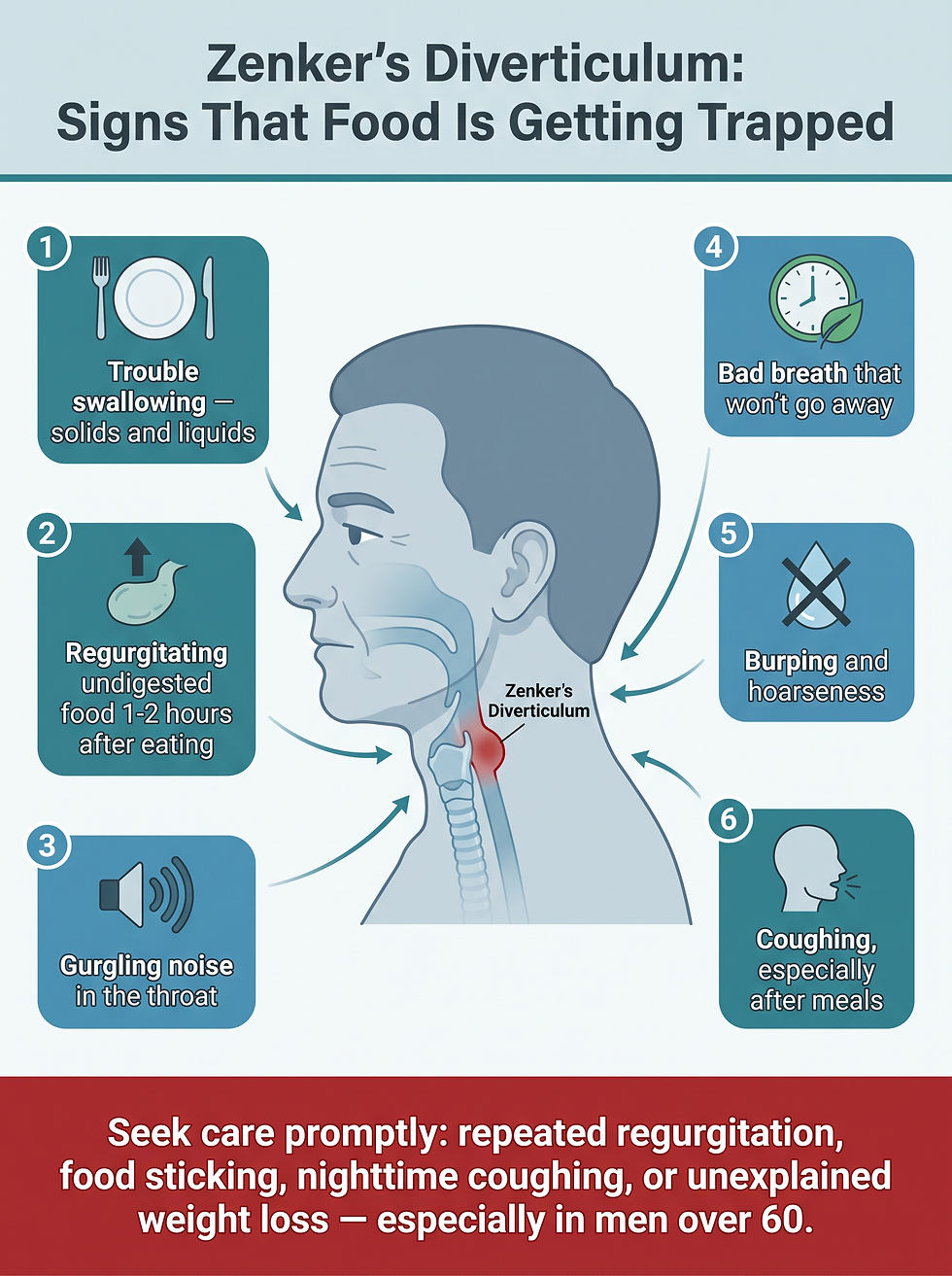
The core symptom is trouble swallowing (dysphagia), especially with solid foods, but also with liquids. Beyond that, the classic symptom set reads like this:
Symptom | What it feels like | Why it happens |
Trouble swallowing (dysphagia) | Food moves slowly or sticks, especially solids | The pouch traps food; the sphincter muscle is uncoordinated |
Regurgitation of undigested food | Coughing up or spitting up food 1–2 hours after eating | Trapped food spills back out of the pouch into the throat |
Gurgling noise in the throat | A bubbling or crackling sound, often heard by others | Air and fluid shifting inside the pouch |
Bad breath | Persistent halitosis despite brushing | Food decomposes inside the pouch |
Burping | Frequent belching | Trapped air in the pouch and esophagus |
Coughing | Especially after meals or when lying down | Pouch contents irritate the airway |
Hoarseness / feeling of a lump in the throat | Voice changes, "something stuck" sensation | Pressure and irritation near the voice box [1] |
If the pouch grows large enough, its contents can spill into the airway — aspiration. Most people have a strong cough reflex that clears it, but aspiration can lead to aspiration pneumonia (a lung infection), one of the condition's two main complications [1]. The other is weight loss and malnutrition, because swallowing problems interfere with eating [1].
When to seek care promptly: repeated regurgitation of undigested food, food sticking, nighttime coughing, unexplained weight loss, or chest congestion after meals — especially in a man over 60 [1] [2].

Why does the pouch form? (And what increases your risk)
The cause of Zenker's diverticulum is not known. Researchers have not identified why the esophageal wall changes to form the pouch [1].
The leading theory involves the muscles of the esophagus not working together (discoordination). Normally, the muscle at the top of the esophagus relaxes to let food pass downward. If it stays tight or fails to coordinate, food gets trapped. If the wall in that area is weak, the trapped food pushes outward, bulging the esophageal lining into a pouch [1]. Reflux (GERD) may play a role, but this is unconfirmed [1].
Certain factors make the condition more likely, though most people with these factors never develop it:
Risk factor | How it relates |
Age over 60 | By far the strongest factor; median diagnosis age is ~72 years [1] [6] |
Being male | About 1.5 men affected for every woman [5] |
GERD (gastroesophageal reflux disease) | Chronic reflux may weaken the esophageal wall area [1] |
Hiatal hernia | Part of the stomach bulges into the chest; often accompanies reflux [1] |
History of spinal surgery | Identified as a risk factor in clinical reviews [1] |
Over time, the bulge of Zenker's diverticulum can get bigger. Food, pills and even thick mucus can get stuck in the pouch instead of going through the esophagus [1].
It is worth emphasizing: more than half of affected patients present between ages 60 and 80, and the pouch is rarely found in people under 40 [6].
What complications can occur if Zenker's diverticulum is left untreated?
Without treatment, the pouch can continue to enlarge, and the trapped material creates two significant risks [1]:
Complication | What happens | Warning signs |
Aspiration pneumonia | Food or liquid from the pouch spills into the lungs, causing infection | Coughing during/after meals, fever, chest congestion, nighttime coughing fits |
Weight loss and malnutrition | Swallowing difficulty reduces food intake | Unintentional weight loss, weakness, nutrient deficiencies |
Pouch enlargement | The bulge keeps growing, worsening all other symptoms | Progressive trouble swallowing, more frequent regurgitation [1] |
The good news is that this is a treatable condition — and for small pouches with minimal symptoms, watchful waiting with diet changes may be enough [1] [2].
How is Zenker's diverticulum diagnosed?
Diagnosis usually starts with a primary care visit, where an ear, nose, and throat (ENT) specialist — an otolaryngologist — performs a physical exam and asks about symptoms. Referral to ENT is the typical pathway when swallowing trouble is reported [2].
The most common diagnostic test is the barium swallow, also called an esophagram. You drink a barium sulfate liquid that coats the walls of the digestive tract, and a series of X-rays shows the pouch clearly as the contrast collects in it [2].
Test | What it shows | Why it matters |
Barium swallow (esophagram) | The pouch itself — size, shape, location | The standard confirmatory test [2] |
Video fluoroscopic swallow study (modified barium swallow) | A moving X-ray of the entire upper swallow, from tongue through the pouch | Shows exactly where swallowing breaks down [1] |
Physical exam + symptom history | Gurgling sounds, throat findings | Often raises the first suspicion [2] |
Specialists typically recommend both the modified barium swallow and the full esophagram together, because they also check for other swallowing problems — such as esophageal movement disorders (dysmotility) or a hiatal hernia — that can affect treatment planning [1].
Zenker's diverticulum treatment: the three main approaches
Treatment depends on pouch size, symptoms, overall health, and neck flexibility. Repairing the esophagus with a procedure or surgery is the most common treatment for a diverticulum causing symptoms. Eating softer foods in smaller bites can help with mild symptoms, and a dietician can be part of the plan [2].
Approach | How it works | Duration | Hospital stay | Best for |
Rigid endoscopic repair | Rigid scope through the mouth under general anesthesia; a CO₂ laser (or stapler) cuts the partition between the esophagus and pouch; the pouch can be removed with the laser (endoscopic diverticulectomy) | ~1–2 hours | Often one night | Most patients; lower recurrence than other endoscopic methods [1] [2] |
Flexible endoscopic repair | Flexible scope under deep sedation or general anesthesia; electrocautery cuts the bulge; clips control bleeding | ~1–2 hours | Often one night | Patients with limited neck extension or many other medical problems [2] |
Open neck repair | Incision in the neck under general anesthesia; the pouch is fully removed | ~2–3 hours | One or more days | Large pouches, where full removal is the goal [2] |
Conservative (no surgery) | Softer foods, smaller bites, dietician guidance | Ongoing | None | Small pouches with very mild symptoms [1] [2] |
A key decision factor is recurrence risk. The latest comparative research shows that the flexible endoscopic, endoscopic stapler, and harmonic scalpel approaches have recurrence rates of around 15% or higher, while the rigid endoscopic laser and open neck approaches have lower recurrence rates. Choosing a surgeon who performs many of these procedures matters [1].
Endoscopic repairs generally offer shorter surgery times and possibly shorter hospital stays, with symptom relief similar to open surgery — but a higher chance the diverticulum returns. Open surgery leaves a small neck scar and carries a slightly higher risk of an esophageal hole, though it is the best choice for fully removing a large pouch [2].

What are the risks and recovery expectations after surgery?
Most people experience meaningful symptom relief after either endoscopic or open repair, and hospital stays are often just one night [2].
Recovery details to expect:
Aspect | What to expect |
Anesthesia | General anesthesia for open and rigid endoscopic; deep sedation or general for flexible endoscopic [2] |
Common surgical risks | Infection, bleeding, blood clots, anesthesia reactions, dental injury (e.g., chipped tooth during endoscopic work), and a hole in the esophagus [2] |
Air in the neck (crepitus) | The most discussed complication — occurs in roughly 5%–8% of patients at high-volume centers; managed with observation, sometimes a short temporary feeding tube [1] |
Increased reflux | Possible, because the upper sphincter muscle is partly divided; treatable with medication [1] |
Recurrence | Varies by technique — ~15%+ for flexible/stapler/harmonic approaches; lower for rigid laser and open [1] |
Healing | The cut area regrows its lining within about a week after endoscopic laser repair [1] |
If the first procedure does not relieve symptoms or the diverticulum returns, a repeat procedure may be needed — and notably, recurrence often has no symptoms, which is why follow-up matters [2].
How do I prepare for an appointment about swallowing trouble?
Start with your primary healthcare professional if you have trouble swallowing. They will typically refer you to an ENT specialist (otolaryngologist) [2].
What to bring:
Item | Examples |
Symptom list | Regurgitation episodes, gurgling sounds, timing (e.g., "food comes back 1–2 hours after dinner"), when symptoms began |
Key personal information | Major stresses, recent life changes, family medical history |
Medications | All medicines, vitamins, and supplements with doses |
Prior records | Any previous swallow studies or imaging — even older ones help specialists gauge pouch size [1] [2] |
Questions worth asking:
Question | Why ask it |
What's likely causing my symptoms? | Confirms (or rules out) Zenker's vs. other causes |
What tests do I need? | Barium swallow and modified swallow study are typical |
Is my condition likely to be long lasting? | Zenker's does not resolve on its own once the pouch forms |
What's the best treatment for my pouch size and health? | Technique depends on size, neck flexibility, other conditions [1] [2] |
What's the recurrence rate with the recommended approach? | Ranges from ~15%+ (flexible/stapler) to lower (rigid laser/open) [1] |
What restrictions should I follow? | Diet adjustments are often the first step [2] |
Your doctor will likely ask whether symptoms are constant or come and go, how severe they are, and what makes them better or worse [2].
Conclusion: A treatable pouch — don't ignore the gurgling throat
Zenker's diverticulum is a rare but very treatable condition. It builds silently: a pouch at the top of the esophagus gradually enlarges, trapping food and causing dysphagia, regurgitation, bad breath, and a distinctive gurgling throat. It primarily affects men over 60, with a median diagnosis age around 72 [1] [6].
The diagnosis is straightforward — a barium swallow X-ray — and the treatment record is encouraging: most people get real symptom relief from repair, whether endoscopic or open, and small pouches with mild symptoms may never need surgery at all [1] [2].
Your next steps: if you (or a family member over 60) regurgitate undigested food hours after eating, hear gurgling from the throat, or have new trouble swallowing, see a doctor promptly. Ask about a barium swallow test and a referral to an ENT specialist. If surgery is recommended, ask which technique fits your pouch size and health — and whether the surgeon performs many of these procedures. The difference between techniques in recurrence risk is meaningful, and the right choice is an informed one.
This article is for educational purposes only and does not replace professional medical advice, diagnosis, or treatment. Always consult a qualified health care provider for decisions about your health.
Frequently Asked Questions
Is Zenker's diverticulum the same as esophageal cancer?
No. Zenker's diverticulum is a benign pouch — a structural bulge at the top of the esophagus. It is not cancer, not precancerous, and not caused by cancer. Its symptoms (trouble swallowing, weight loss) can resemble more serious conditions, which is exactly why a barium swallow evaluation matters [1] [2].
What does regurgitation from Zenker's diverticulum look like?
The classic pattern is coughing up or spitting up undigested food 1–2 hours after eating — long after the meal should have passed into the stomach. The food has been sitting in the pouch, not in the stomach. Other clues include a gurgling sound in the throat and bad breath [1].
Can Zenker's diverticulum go away on its own?
No. Once the pouch forms, it does not resolve spontaneously — and it tends to grow over time. Mild cases can be managed with softer foods and smaller bites, but the structural pouch remains [1] [2].
Does Zenker's diverticulum always require surgery?
No. Small pouches with very mild symptoms may not need surgery at all — diet changes can be sufficient. When symptoms are significant, repair (endoscopic or open) is the most common treatment and eases symptoms for most people [1] [2].
What is a barium swallow and what does it show?
A barium swallow is an X-ray test where you drink a barium sulfate liquid that coats the digestive tract, making it visible on X-ray. In Zenker's diverticulum, the contrast collects in the pouch, clearly showing its size and location [2].
Which surgery has the lowest chance of the diverticulum coming back?
Based on recent comparative research, the rigid endoscopic laser approach and the open neck approach have lower recurrence rates, while the flexible endoscopic, stapler, and harmonic scalpel approaches show recurrence rates of around 15% or higher. Surgeon experience also matters — choose someone who performs many of these procedures [1].
What are the main risks of Zenker's diverticulum surgery?
General surgical risks include infection, bleeding, blood clots, anesthesia reactions, and dental injury during endoscopic work. A specific risk is a small hole in the esophagus, which can cause air in the neck (crepitus) in roughly 5%–8% of patients at experienced centers — usually managed with observation or a short temporary feeding tube [1] [2].
Who is most likely to get Zenker's diverticulum?
Men over 60. The condition affects roughly 2–3 people per 100,000 per year, more than half of patients present between ages 60 and 80, the median diagnosis age is about 72, and men are affected about 1.5 times more often than women [1] [3] [5] [6].
References
Zenker's diverticulum — Symptoms & causes — Mayo Clinic (updated October 24, 2024)
Zenker's diverticulum — Diagnosis & treatment — Mayo Clinic (updated October 24, 2024)
Epidemiology and Management of Zenker Diverticulum — full text, 2021, PMC/NCBI
Zenker Diverticulum: Practice Essentials — Medscape Reference, updated March 2024
Zenker's Diverticulum Presenting With Complete Esophageal Obstruction — Cureus, 2025
Zenker's peroral endoscopic myotomy for treating Zenker's diverticulum — Frontiers in Surgery, 2026
Zenker's diverticulum epidemiology and demographics — WikiDoc
Health information, not medical advice. This article is for general education and is not a substitute for professional diagnosis or treatment. Always consult a qualified healthcare provider about your own health, and seek emergency care for urgent symptoms.
Comments