EndoFLIP Test: Measuring Your Esophagus for Swallowing Problems

Updated: 3 days ago
Written and medically reviewed by Dr. Baraa Alnahhal, MD · Last reviewed: November 2026 · How we review
Quick Answer
EndoFLIP (functional lumen imaging probe) is a test that measures how wide the esophagus is and how easily it stretches under pressure. A thin catheter with a balloon and sensors is placed during an upper endoscopy under anesthesia. It helps diagnose achalasia, eosinophilic esophagitis and GERD. Stop eating and drinking at least 4 hours beforehand.
What the research says
EndoFLIP shows the valve in achalasia: a review of FLIP studies found the lower esophageal valve stretched poorly in achalasia (1.6 mm2/mmHg or less) and improved to 3.4 or more after successful treatment (Chen JW et al., World Journal of Gastroenterology, 2017) [2]
It predicts how well treatment worked: in 79 people treated for achalasia, EndoFLIP measurements predicted whether barium still pooled in the esophagus much better than standard pressure testing (accuracy score 0.90 vs. 0.64) (Jain AS et al., American Journal of Gastroenterology, 2019) [3]
Key takeaways
EndoFLIP measures the width and stretchiness of the esophagus.
It's done during an endoscopy while you're asleep.
It helps diagnose achalasia, eosinophilic esophagitis and GERD.
The test takes about 15 minutes.
Rare side effects include a mild sore throat.
What is EndoFLIP?
Swallowing depends on the esophagus opening and moving food down, and on the valve at the bottom, the esophagogastric junction (EGJ), relaxing to let food into the stomach. EndoFLIP measures the inside area of the esophagus and how it responds to pressure, called distensibility. A narrow or unusually stiff esophagus or EGJ can make swallowing hard. EndoFLIP often complements esophageal manometry, which measures muscle pressure. Sources: [1, 2]
Why it's done

EndoFLIP shows how well the esophagus opens.
Trouble swallowing or food getting stuck.
Diagnosing and assessing achalasia, when the lower esophagus doesn't relax properly.
Evaluating eosinophilic esophagitis and GERD.
Checking results after esophageal surgery or esophageal dilation. Sources: [1]
How to prepare
Stop eating and drinking at least 4 hours before the test.
Tell your provider about your medicines and allergies.
Arrange for someone to drive you home; you can't drive after anesthesia. Sources: [1]
What happens during the test
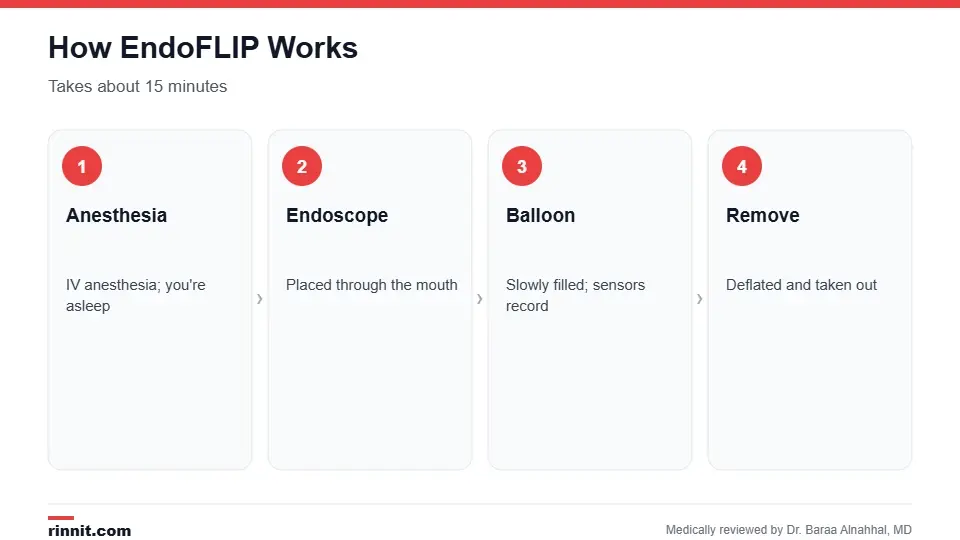
The test takes about 15 minutes.
An anesthesiologist gives you IV anesthesia so you're asleep.
An endoscope is passed through your mouth into your esophagus.
The EndoFLIP catheter is guided into place.
The balloon is slowly filled with fluid while sensors measure the shape and pressure along the esophagus.
The balloon is emptied and the devices are removed. Sources: [1]
The test isn't painful, though you may feel pressure. Sources: [1]
Risks and recovery
EndoFLIP rarely causes side effects; a mild sore throat is possible. You rest in the recovery area until the anesthesia wears off, then go home with someone. Sources: [1]
Results
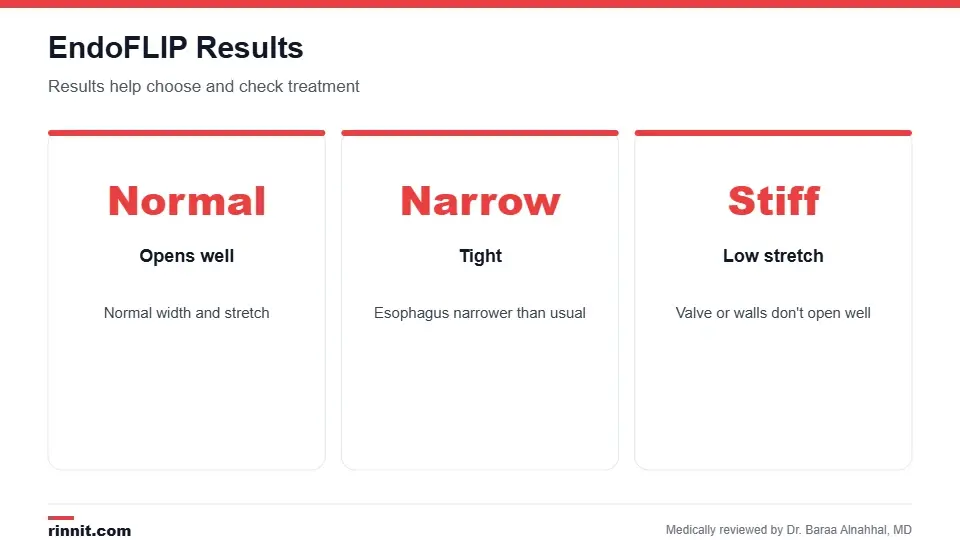
Results help choose and check treatment.
Your gastroenterologist may share early results before you leave or at a follow-up visit. Abnormal findings may include an esophagus that's narrower than usual or walls that are unusually stiff, which can keep food from moving into the stomach. In achalasia, low distensibility of the EGJ helps confirm the problem and shows whether treatment has worked. Sources: [1, 2, 3]
Conclusion
EndoFLIP gives a detailed picture of how well your esophagus opens and stretches. It helps your care team understand swallowing problems, choose treatments such as dilation or surgery, and check how well those treatments worked.
Keep learning: read about esophageal manometry and esophageal dilation.
Frequently asked questions
What is EndoFLIP?
A test that measures how wide and stretchy the esophagus is.
What does FLIP stand for?
Functional lumen imaging probe.
Why is EndoFLIP done?
To help diagnose swallowing problems such as achalasia.
Will I be asleep?
Yes. It's done under IV anesthesia.
How long does it take?
About 15 minutes.
Does it hurt?
No, though you may feel pressure.
How should I prepare?
Don't eat or drink for at least 4 hours before.
What are the side effects?
Rarely, a mild sore throat.
How is it different from manometry?
Manometry measures muscle pressure; EndoFLIP measures width and stretch.
When will I get results?
Sometimes before you leave, or at a follow-up visit.
Related Reading
Esophageal Manometry: What the Test Measures, How to Prepare and What Results Mean a test of esophageal muscle pressure.
Esophageal Dilation: Uses, Procedure, Risks and Recovery a treatment to widen the esophagus.
Eosinophilic Esophagitis: Symptoms, Causes, and Treatment a condition EndoFLIP can assess.
Esophagoscopy: Why It's Done, Types, What to Expect, Results and Risks the scope exam used during EndoFLIP.
Bravo Test: Wireless pH Monitoring for GERD, Prep and Results a test that measures acid reflux.
References
Cleveland Clinic. EndoFLIP: What It Is, Procedure Steps, Diagnoses. Cleveland Clinic. Last updated May 8, 2025. https://my.clevelandclinic.org/health/diagnostics/endoflip
Chen JW, Rubenstein JH. Esophagogastric junction distensibility assessed using the functional lumen imaging probe. World Journal of Gastroenterology. 2017;23(7):1289-1297. PMID 28275309. https://doi.org/10.3748/wjg.v23.i7.1289
Jain AS, Carlson DA, Triggs J, et al. Esophagogastric junction distensibility on functional lumen imaging probe topography predicts treatment response in achalasia: anatomy matters! American Journal of Gastroenterology. 2019;114(9):1455-1463. PMID 30741739. https://doi.org/10.14309/ajg.0000000000000137
Medical disclaimer
This article is for general education only and does not replace advice from a qualified healthcare professional. Talk to your doctor about your own diagnosis and treatment, and seek emergency care right away for severe or sudden symptoms.



Comments