Esophageal Dilation: Uses, Procedure, Risks and Recovery

Updated: 3 days ago
Written and medically reviewed by Dr. Baraa Alnahhal, MD · Last reviewed: November 2026 · How we review
Quick Answer: What is esophageal dilation?
Esophageal dilation is an outpatient procedure that stretches narrowed parts of the esophagus so food and liquid pass through more easily. A gastroenterologist uses an endoscope with a balloon or thin tubes called bougies. It takes about 15 minutes and successfully treats more than 90% of esophageal strictures. Most people return to normal routines the next day. [1]
What the research says
Dilation brings relief to almost everyone with eosinophilic esophagitis. A pooled analysis of 27 studies covering 845 children and adults who had 1,820 dilations found clinical improvement in 95% of patients. Perforation occurred in 0.38%, bleeding in 0.05% and hospital admission in 0.67%, and no deaths were reported. (Moawad et al., Alimentary Pharmacology & Therapeutics, 2017) [2]
Tears through the esophagus are rare. Across 37 studies with 977 patients with eosinophilic esophagitis and 2,034 dilations, perforation happened in 0.033% of procedures, and none required surgery or caused death. Risk did not differ meaningfully between bougies (0.022%) and balloons (0.059%). (Dougherty et al., Gastrointestinal Endoscopy, 2017) [3]
Balloons and bougies work equally well for benign strictures. Five randomized trials with 461 patients showed no difference between the two methods in symptom relief, recurrence at 12 months, bleeding or perforation. Balloon dilation caused less pain afterward. (Josino et al., Gastroenterology Research and Practice, 2018) [4]
Key takeaways
Esophageal dilation stretches narrowed areas of the esophagus so swallowing is easier. [1]
Strictures caused by chronic acid reflux are the most common reason for the procedure. [1]
It's an outpatient procedure that usually takes about 15 minutes. [1]
It successfully treats more than 90% of esophageal strictures, but many people need more than one session. [1]
Most people can get back to their normal routines the day after. [1]
What is esophageal dilation?
Esophageal dilation (eh-sof-uh-JEE-uhl di-LAY-shun) is a procedure that stretches (dilates) your esophagus, the swallowing tube, so food can pass through more easily. [1]
You may also hear it called esophageal dilatation or esophagus stretching surgery. Some people call it throat stretching surgery, but that isn't quite accurate: the doctor stretches your esophagus, not your throat. [1]
One procedure may be enough to solve the problem, but it's common to need multiple dilations. How many you need depends on how severe your condition is. [1]
Who needs esophageal dilation?
Your doctor may suggest esophageal dilation if you have symptoms like: [1]
Difficulty swallowing
Feeling like something is stuck in your throat or chest
Painful swallowing
Regurgitation, when food from your stomach comes back up into your throat or mouth
What conditions does esophageal dilation treat?
Condition | What happens |
Esophageal strictures | Areas of scarring narrow the esophagus. Chronic acid reflux causes them, and they are the most common reason people need dilation. |
Achalasia | Food and liquid don't move from the esophagus into the stomach as they should, because the lower esophageal sphincter (a ring of muscle) is affected. |
Esophageal rings | Rings of scar tissue narrow the esophagus. |
Eosinophilic esophagitis | Inflammation draws white blood cells into the esophagus, which can form rings that make food move slowly or get stuck. |
Sources: [1]
How do you prepare for esophageal dilation?
Before the procedure, your doctor will review your medical history and ask about any recent illnesses. To get ready: [1]
Tell your doctor about every medicine you take, including prescription and over-the-counter medicines, vitamins and supplements.
Plan to have an empty stomach. You'll get presurgical instructions, including when to stop eating and drinking the night before.
Follow those instructions closely.
What happens during esophageal dilation?
Doctors use various devices for esophageal dilation. Each is slightly different, but the approach is generally the same: [1]
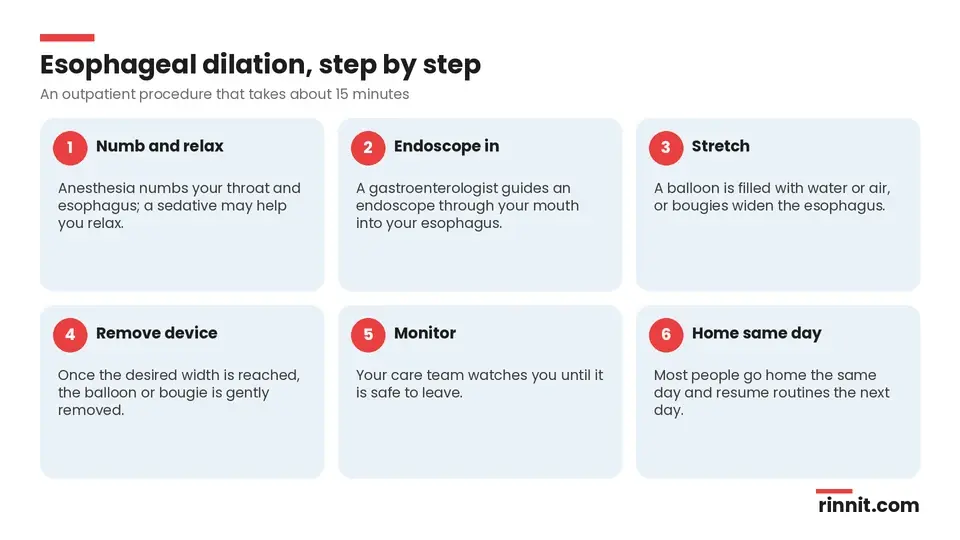
You receive anesthesia to numb your throat and esophagus, and you may also get a sedative to help you relax.
A gastroenterologist places an endoscope in your mouth, down your throat and into your esophagus.
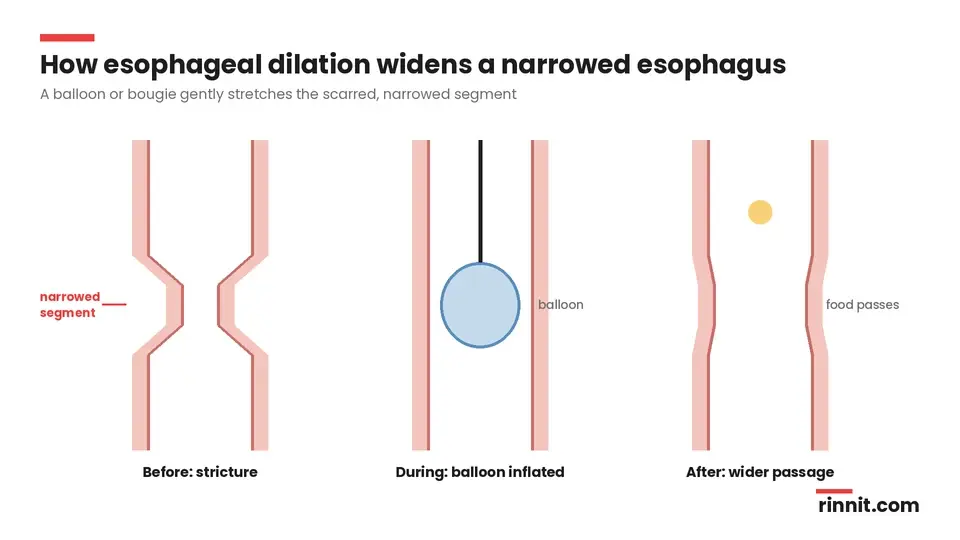
A deflated balloon is guided to the narrowed part of your esophagus and filled with water or air, gently stretching and widening it. If there are several narrowed areas, your doctor may instead use a guide wire and a series of thin plastic tubes called bougies to stretch the whole esophagus.
Once your esophagus is stretched to the desired width, the balloon or bougie is gently removed.
Your care team keeps a close eye on you and lets you know when it's safe to go home. Most people go home the same day.
Balloon vs. bougie dilation
Feature | Balloon dilation | Bougie dilation |
How it works | A balloon inside the narrowed area is filled with water or air | A guide wire and a series of thin plastic tubes stretch the esophagus |
When it's used | The most common approach | Often used when there are multiple strictures |
Sources: [1]
If your esophagus doesn't respond well or your strictures are severe, your doctor may recommend several procedures, stretching the esophagus to a bigger size each time. [1]
Esophageal dilation at a glance
Item | Typical detail |
Setting | Outpatient (you usually go home the same day) |
Time | About 15 minutes |
Anesthesia | Numbing of the throat and esophagus, often with a sedative |
Performed by | A gastroenterologist |
Success | More than 90% of esophageal strictures |
Back to normal | Usually the next day |
Sources: [1]
What are the benefits and risks of esophageal dilation?
Esophageal dilation can give you fast relief from swallowing problems. You might need a repeat procedure in the future, but relief usually lasts for months and sometimes years. Some people never need another dilation. [1]
It's a relatively safe, low-risk procedure that successfully treats more than 90% of all esophageal strictures. Complications are rare, but may include: [1]
Excessive bleeding
A perforation (hole) in your esophagus
A reaction to anesthesia
What is recovery like after esophageal dilation?
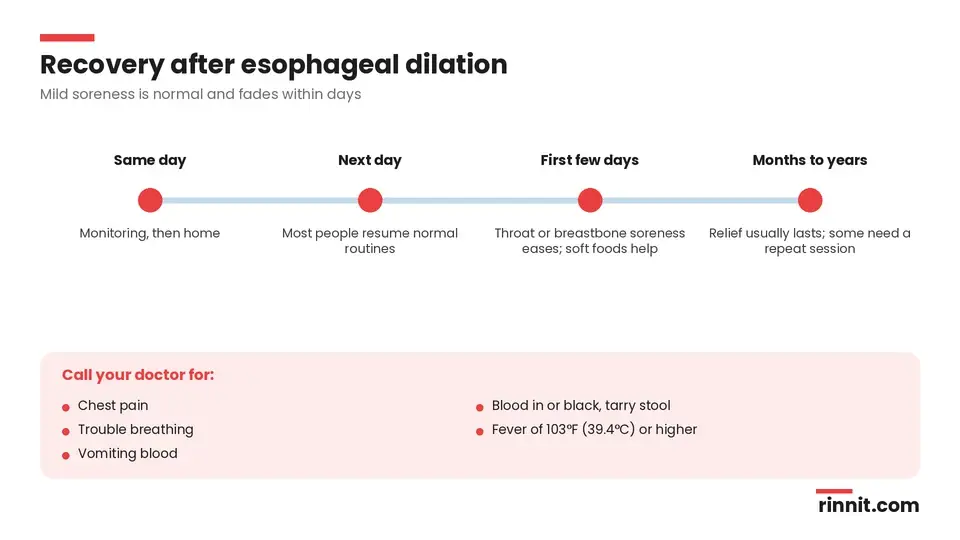
Most people can return to their normal routines the day after the procedure. [1]
Because the procedure is minimally invasive, side effects are usually mild, such as soreness in your throat or behind your breastbone. These are normal and should go away in a few days. [1]
Keep softer foods on hand, such as gelatin, pudding, yogurt and mashed potatoes.
Ask your doctor whether you need a liquid or soft-food eating plan after the dilation.
When should you call your doctor after esophageal dilation?
Tell your doctor whenever something doesn't feel quite right, and especially if you notice: [1]
Blood in your stool, or black, tarry stool
Chest pain
A fever of 103°F (39.4°C) or higher
Trouble breathing
Vomiting blood
Conclusion
Esophageal dilation gently stretches a narrowed esophagus so food and drinks go down more easily. It treats strictures, rings, achalasia and eosinophilic esophagitis, takes about 15 minutes and usually lets you return to your routine the next day.
When it hurts to swallow, it's easy to eat or drink less than you should without noticing. If that sounds familiar, ask your doctor whether esophageal dilation could improve your quality of life and how many sessions you're likely to need.
Keep learning: Read our guides to esophageal strictures, dysphagia (trouble swallowing) and achalasia. For a clinical overview, see the StatPearls chapter on esophageal stricture.
FAQ
What is esophageal dilation?
It's a procedure that stretches narrowed areas of the esophagus with a balloon or bougies so food and liquid can pass more easily.
Why is esophageal dilation done?
It treats esophageal strictures, achalasia, esophageal rings and eosinophilic esophagitis that cause trouble swallowing.
Is esophageal dilation painful?
Your throat is numbed and you may get a sedative, so the procedure shouldn't hurt. Afterward your throat or the area behind your breastbone may be sore for a few days.
How long does esophageal dilation take?
It usually takes about 15 minutes, and most people go home the same day.
Is esophageal dilation the same as throat stretching?
Not quite. The doctor stretches your esophagus, not your throat, even though some people call it throat stretching surgery.
How successful is esophageal dilation?
It successfully treats more than 90% of esophageal strictures, and relief usually lasts for months or even years.
How many esophageal dilations will I need?
One procedure may be enough, but many people need several. The number depends on how severe the narrowing is.
What are the risks of esophageal dilation?
Complications are rare but include excessive bleeding, a hole (perforation) in the esophagus and reactions to anesthesia.
What can I eat after esophageal dilation?
Soft foods such as gelatin, pudding, yogurt and mashed potatoes are a good idea at first. Your doctor will tell you if you need a liquid or soft-food plan.
When should I call my doctor after esophageal dilation?
Call for chest pain, trouble breathing, vomiting blood, blood in or black, tarry stool, or a fever of 103°F (39.4°C) or higher.
How do I prepare for esophageal dilation?
Tell your doctor about every medicine you take, including over-the-counter medicines, vitamins and supplements, and mention any recent illness. Plan to have an empty stomach: you will get instructions on when to stop eating and drinking the night before, and you should follow them closely [1].
Related Reading
EndoFLIP Test: Measuring Your Esophagus for Swallowing Problems explains the balloon test that measures how well the esophagus opens.
Learn more in our guide to Esophageal Strictures: Symptoms, Causes, Diagnosis, Treatment and When to Seek Emergency Care — What You Need to Know.
Learn more in our guide to Dysphagia (Trouble Swallowing): Symptoms, Causes, Diagnosis & Treatment — Complete Guide.
Learn more in our guide to Eosinophilic Esophagitis: Symptoms, Causes, and Treatment.
Learn more in our guide to Achalasia: Symptoms, Causes, and Treatment.
References
Cleveland Clinic. Esophageal Dilation: Procedure, Types & Purpose. Cleveland Clinic. Last updated October 31, 2024. https://my.clevelandclinic.org/health/procedures/esophageal-dilation
Moawad FJ, Molina-Infante J, Lucendo AJ, et al. Systematic review with meta-analysis: endoscopic dilation is highly effective and safe in children and adults with eosinophilic oesophagitis. Aliment Pharmacol Ther. 2017;46(2):96-105. PMID 28513085. https://doi.org/10.1111/apt.14123
Dougherty M, Runge TM, Eluri S, Dellon ES. Esophageal dilation with either bougie or balloon technique as a treatment for eosinophilic esophagitis: a systematic review and meta-analysis. Gastrointest Endosc. 2017;86(4):581-591.e3. PMID 28461094. https://doi.org/10.1016/j.gie.2017.04.028
Josino IR, Madruga-Neto AC, Ribeiro IB, et al. Endoscopic Dilation with Bougies versus Balloon Dilation in Esophageal Benign Strictures: Systematic Review and Meta-Analysis. Gastroenterol Res Pract. 2018;2018:5874870. PMID 30116265. https://doi.org/10.1155/2018/5874870
Medical disclaimer
This article is for general education only and does not replace advice from a qualified healthcare professional. Talk to your doctor about your own diagnosis and treatment, and seek emergency care right away for severe or sudden symptoms.



Comments