Enteroscopy: Seeing and Treating the Small Intestine

Updated: 3 days ago
Written and medically reviewed by Dr. Baraa Alnahhal, MD · Last reviewed: November 2026 · How we review
Quick Answer
Enteroscopy is a nonsurgical procedure that uses a long, thin scope with a light and camera to see inside the small intestine, which a standard endoscopy can't reach. It's used to find the cause of hidden GI bleeding, possible tumors or unexplained belly pain and to treat problems. Most people go home the same day.
What the research says
Enteroscopy finds as much as a capsule camera: a review of 11 studies found double-balloon enteroscopy and capsule endoscopy had similar diagnostic yields (57% vs. 60%), and enteroscopy can also treat what it finds (Pasha SF et al., Clinical Gastroenterology and Hepatology, 2008) [2]
Combined routes find more bleeding sources: a review of 8 studies found that in hidden GI bleeding, double-balloon enteroscopy done through both the mouth and anus found the cause more often than capsule endoscopy (21 of 24 vs. 11 of 24 patients) (Chen X et al., World Journal of Gastroenterology, 2007) [3]
Key takeaways
Enteroscopy lets providers see and treat the small intestine.
It's most often used to find hidden GI bleeding.
Types include push, single-balloon and double-balloon enteroscopy.
You'll fast, do a bowel prep and have sedation or anesthesia.
It takes 45 minutes to 2 hours, usually with same-day discharge.
What is enteroscopy?
The small intestine is about 20 feet long. A regular upper endoscopy reaches only its first part, and a colonoscopy reaches only its end. An enteroscope is longer and can go deeper. Balloon-assisted types use inflatable balloons to grip and pleat the intestine over the scope, reaching even farther. Sources: [1]
Types of enteroscopy
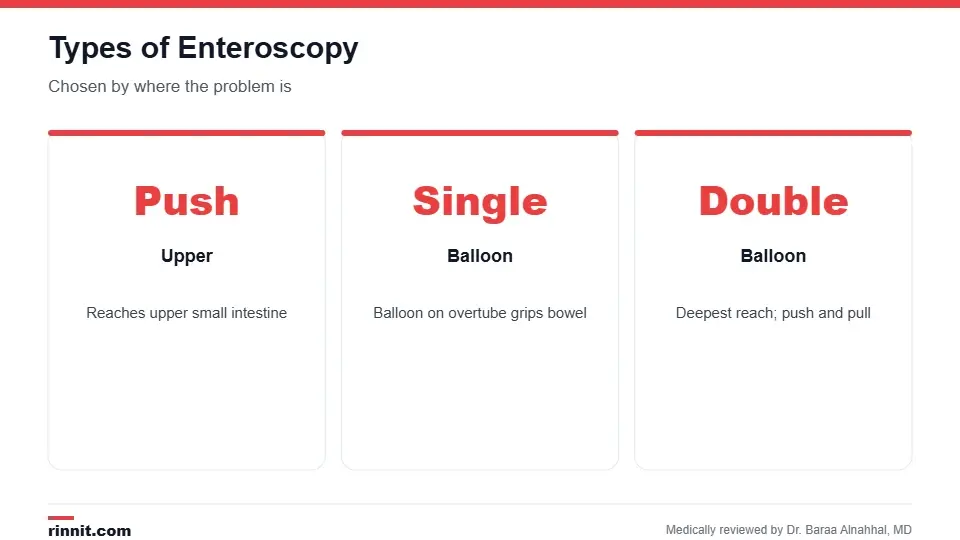
The type depends on where the problem is.
Type | How it works | Reach |
Push enteroscopy | A long scope is pushed through the mouth | Upper part of the small intestine |
Single-balloon enteroscopy | A balloon on an overtube grips the bowel | Deep into the small intestine |
Double-balloon (push-and-pull) enteroscopy | Balloons on the scope and overtube take turns gripping | Deepest; can sometimes view the whole small intestine |
Upper or lower route | Through the mouth or the anus | Chosen by where the problem is |
Sources: [1]
Why it's done
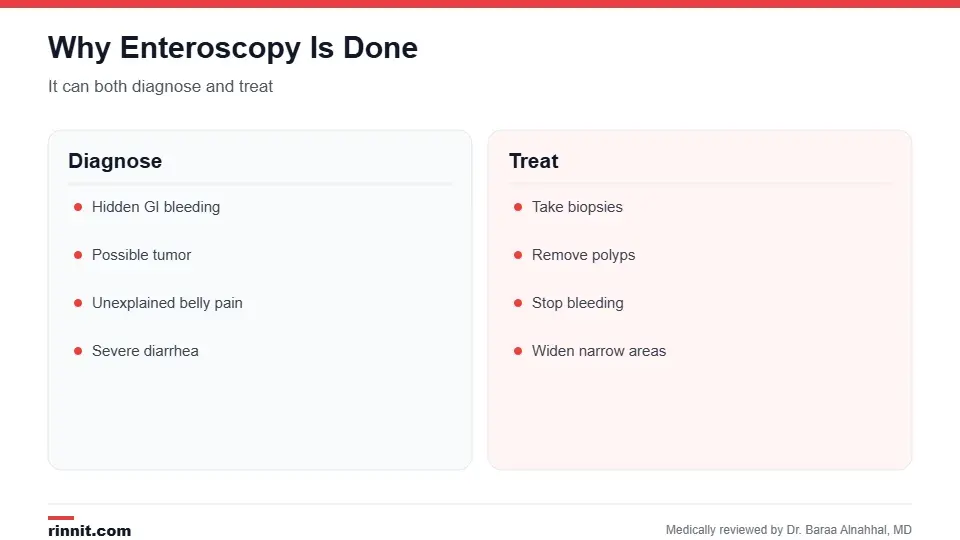
Enteroscopy can both diagnose and treat.
Diagnose: unexplained GI bleeding or anemia, a possible tumor, unexplained belly pain or severe diarrhea.
Treat: take biopsies, remove polyps or swallowed objects, stop small-bowel bleeding and widen narrow areas.
It's often done after a capsule endoscopy finds something that needs a closer look or treatment. Sources: [1, 2]
How to prepare
Stop eating and drinking the night before.
Complete a bowel prep if instructed.
Ask whether to stop blood thinners or other medicines.
Arrange for someone to drive you home. Sources: [1]
What happens during the procedure

The procedure takes 45 minutes to 2 hours.
You receive sedation or anesthesia to help you relax or sleep.
For an upper enteroscopy, your throat may be numbed.
The scope is inserted and advanced into the small intestine; balloons may help move it forward.
Video is shown on a screen and recorded.
Your provider takes biopsies or treats problems as needed. Sources: [1]
Risks and recovery
Common side effects include bloating, mild cramping, minor bleeding, nausea and a sore throat. Rare risks include anesthesia problems, internal bleeding, a tear (perforation), infection in the blood, aspiration or pneumonia and low oxygen levels. You go home once sedation wears off. Get care right away for heavy blood in your stool, fever, severe belly pain, a swollen or hard belly or vomiting. Sources: [1]
Results
Your provider may share early findings the same day. A normal result means nothing unusual was seen. Biopsy results and next steps are usually discussed within a few days. Sources: [1]
Conclusion
Enteroscopy opens up the small intestine, a hard-to-reach part of the gut, to direct view and treatment. It's an important tool for finding and stopping hidden bleeding and for treating small-bowel problems without surgery.
Keep learning: read about balloon enteroscopy and capsule endoscopy.
Frequently asked questions
What is enteroscopy?
A procedure that uses a long scope to see inside the small intestine.
Why is enteroscopy done?
Most often to find and treat hidden GI bleeding.
What is double-balloon enteroscopy?
A type that uses two balloons to move the scope deep into the small intestine.
Will I be asleep?
You'll have sedation or anesthesia.
How long does it take?
About 45 minutes to 2 hours.
Do I need a bowel prep?
Often yes; follow your provider's instructions.
Can enteroscopy treat problems?
Yes. It can stop bleeding, remove polyps and widen narrow areas.
What are common side effects?
Bloating, mild cramping, nausea and a sore throat.
Can I go home the same day?
Usually yes.
How is it different from capsule endoscopy?
A capsule only takes pictures; enteroscopy can also take biopsies and treat.
Related Reading
Balloon Enteroscopy: Single and Double Balloon Exams of the Small Intestine a deep enteroscopy using balloons.
Capsule Endoscopy: How a Swallowed Camera Pill Checks Your Small Intestine, Prep and Results a swallowed camera that images the small intestine.
Esophagoscopy: Why It's Done, Types, What to Expect, Results and Risks a scope exam of the upper digestive tract.
Colonoscopy: Purpose, Prep, Procedure, Results and Risks a scope exam of the large intestine.
Upper GI Series: What It Is, Why It's Done, How to Prepare and What to Expect an X-ray test of the upper digestive tract.
References
Cleveland Clinic. Enteroscopy: Types & Procedure. Cleveland Clinic. Last updated October 8, 2026. https://my.clevelandclinic.org/health/diagnostics/23060-enteroscopy
Pasha SF, Leighton JA, Das A, et al. Double-balloon enteroscopy and capsule endoscopy have comparable diagnostic yield in small-bowel disease: a meta-analysis. Clinical Gastroenterology and Hepatology. 2008;6(6):671-676. PMID 18356113. https://doi.org/10.1016/j.cgh.2008.01.005
Chen X, Ran ZH, Tong JL. A meta-analysis of the yield of capsule endoscopy compared to double-balloon enteroscopy in patients with small bowel diseases. World Journal of Gastroenterology. 2007;13(32):4372-4378. PMID 17708614. https://doi.org/10.3748/wjg.v13.i32.4372
Medical disclaimer
This article is for general education only and does not replace advice from a qualified healthcare professional. Talk to your doctor about your own diagnosis and treatment, and seek emergency care right away for severe or sudden symptoms.



Comments