Balloon Enteroscopy: Single and Double Balloon Exams of the Small Intestine

Updated: 2 days ago
Written and medically reviewed by Dr. Baraa Alnahhal, MD · Last reviewed: November 2026 · How we review
Quick Answer
Balloon-assisted enteroscopy (single or double balloon enteroscopy) is a procedure that lets a provider see and treat the small intestine, which standard endoscopes can't fully reach. A flexible scope with one or two balloons is advanced through the mouth or rectum. It's most often used to find and treat hidden bleeding. Most people go home the same day.
What the research says
It can treat many problems without surgery: in 614 double balloon enteroscopies, the most common findings were vascular lesions (18%), ulcers (18%) and polyps or tumors (10%); 22% of patients had treatment during the procedure, and complications occurred in about 1%, with no perforations or deaths (Jovanovic I et al., Digestive Diseases, 2011) [2]
Single and double balloon methods perform similarly: a single-center study and meta-analysis of randomized and observational studies found no significant differences between single balloon and double balloon enteroscopy in diagnostic yield, therapeutic yield or complications (Kim TJ et al., Gut and Liver, 2017) [3]
Key takeaways
It reaches deep into the small intestine using balloons to advance the scope.
It's mainly used to find and treat hidden GI bleeding.
The scope can go in through the mouth or the rectum.
It's done under sedation or general anesthesia and can take several hours.
Serious complications such as perforation or pancreatitis are rare.
What is balloon-assisted enteroscopy?
Standard upper endoscopy reaches only the first part of the small intestine, and a capsule endoscopy can take pictures but can't treat anything. Balloon-assisted enteroscopy is a type of deep enteroscopy: the balloons inflate to hold the bowel in place while the scope advances, then deflate, repeating the cycle to work through the long, looping small intestine. Sources: [1]
Single vs. double balloon
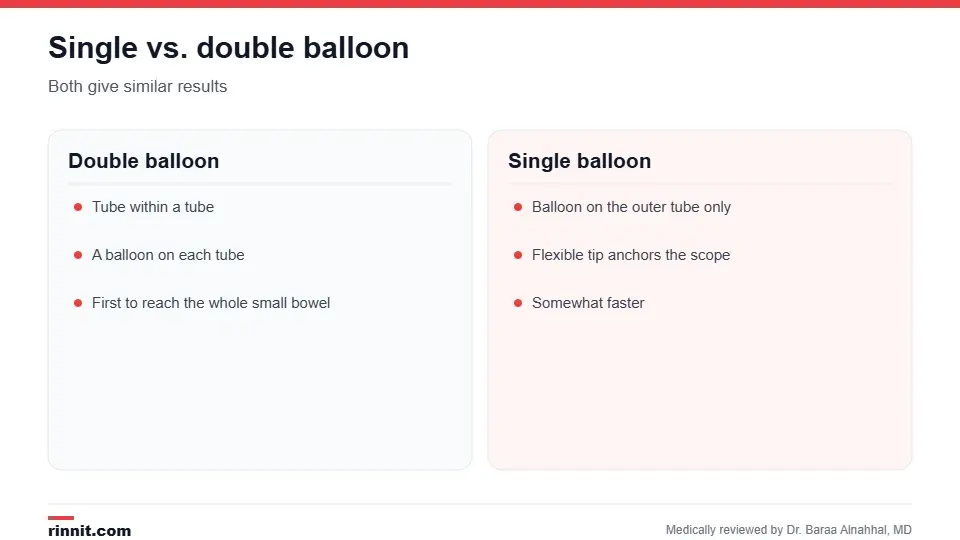
Both methods give similar results.
Type | How it works | Notes |
Double balloon | Tube-within-a-tube, with a balloon on each tube | The first device able to reach the whole small intestine |
Single balloon | Only the outer tube has a balloon; a flexible tip anchors the inner tube | Somewhat faster; similar results |
Sources: [1, 3]
Why it's done
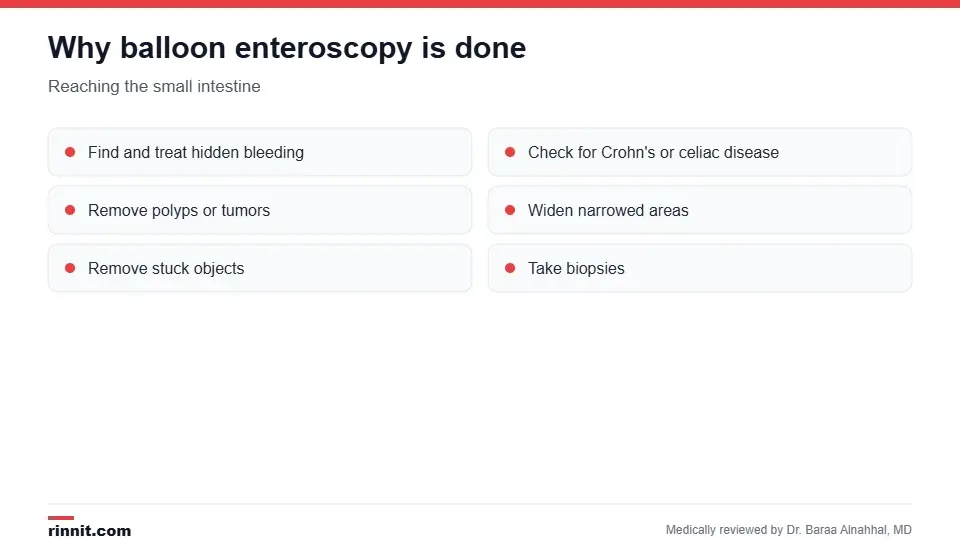
The procedure can both diagnose and treat.
Find and treat GI bleeding, such as from angiodysplasia.
Check for Crohn's disease or celiac disease.
Remove polyps or tumors and screen for small intestine cancer.
Widen narrowed areas or place a stent.
Remove objects stuck in the intestine and take biopsies. Sources: [1, 2]
How to prepare
Follow a clear liquid diet for 1 to 2 days so your small intestine is empty.
If the scope goes in through the rectum, you'll take a bowel prep with laxatives, like for a colonoscopy.
Arrange for someone to drive you home, since anesthesia effects can last 24 hours. Sources: [1]
What happens during the procedure

The procedure may take up to several hours.
You receive sedation or general anesthesia.
The scope is placed through your mouth (top-down) or rectum (bottom-up).
Balloons inflate and deflate repeatedly, moving the scope a little farther each time while images appear on a screen.
The provider treats problems found and takes biopsies as needed. Sources: [1]
Risks and recovery
Serious complications are rare. The main risks are a tear in the small intestine (perforation) and pancreatitis. Most people have only mild discomfort afterward, such as a sore throat after an upper approach or gas after a lower one, and feel better within a couple of days. It takes 1 to 2 hours to wake up, your provider then explains the findings, and biopsy results take about a week. Sources: [1, 2]
Conclusion
Balloon-assisted enteroscopy reaches parts of the bowel other scopes can't and often avoids the need for surgery. It's a powerful option for finding and treating hidden small bowel problems.
Keep learning: read about capsule endoscopy and GI bleeding.
Frequently asked questions
What is balloon enteroscopy?
A scope procedure that uses balloons to reach deep into the small intestine.
Why is it done?
Most often to find and treat hidden bleeding in the small intestine.
Will I be asleep?
You'll have sedation or general anesthesia.
How long does it take?
Up to several hours, depending on how far the scope goes.
How do I prepare?
A clear liquid diet for 1 to 2 days, plus a bowel prep for the rectal approach.
Is it safe?
Yes. Serious complications such as perforation are rare.
What is the difference between single and double balloon?
The number of balloons; results are similar.
Can I go home the same day?
Usually, with someone to drive you.
How is it different from capsule endoscopy?
Enteroscopy can treat problems; a capsule only takes pictures.
When will I get results?
Findings right after; biopsy results in about a week.
Related Reading
Enteroscopy: Seeing and Treating the Small Intestine explains the scope exam that reaches deep into the small intestine.
Capsule Endoscopy: How a Swallowed Camera Pill Checks Your Small Intestine, Prep and Results a camera pill that often comes first.
Gastrointestinal Bleeding: Where It Comes From, and How Doctors Find and Stop It the most common reason for enteroscopy.
Angiodysplasia of the GI Tract: Symptoms, Causes, and Treatment Options a common source of small bowel bleeding.
Upper Endoscopy (EGD): Purpose, Procedure, Preparation and Recovery the standard scope of the upper digestive tract.
Crohn's Disease: Symptoms, Causes, Flares vs. Remission and Treatment — What You Need to Know a condition that can affect the small intestine.
References
Cleveland Clinic. Single or Double Balloon Enteroscopy: What It Is & Procedure. Cleveland Clinic. Last updated August 19, 2025. https://my.clevelandclinic.org/health/diagnostics/24199-balloon-assisted-enteroscopy
Jovanovic I, Vormbrock K, Zimmermann L, et al. Therapeutic double-balloon enteroscopy: a binational, three-center experience. Digestive Diseases. 2011;29(Suppl 1):27-31. PMID 22104749. https://doi.org/10.1159/000331125
Kim TJ, Kim ER, Chang DK, et al. Comparison of the efficacy and safety of single- versus double-balloon enteroscopy performed by endoscopist experts in single-balloon enteroscopy: a single-center experience and meta-analysis. Gut and Liver. 2017;11(4):520-527. PMID 28395505. https://doi.org/10.5009/gnl16330
Medical disclaimer
This article is for general education only and does not replace advice from a qualified healthcare professional. Talk to your doctor about your own diagnosis and treatment, and seek emergency care right away for severe or sudden symptoms.



Comments