Capsule Endoscopy: How a Swallowed Camera Pill Checks Your Small Intestine, Prep and Results

Updated: 2 days ago
Written and medically reviewed by Dr. Baraa Alnahhal, MD · Last reviewed: November 2026 · How we review
Quick Answer: What is capsule endoscopy?
Capsule endoscopy is a test in which you swallow a pill-sized capsule that holds a tiny camera and light. As it travels through the digestive tract, it takes thousands of pictures, mainly of the small intestine, and sends them to a recorder you wear. It's painless, and the capsule leaves the body in the stool, usually within 24 hours. [1]
What the research says
The test finds a cause in more than half of people tested. A review of 328 studies covering 86,930 people found capsule endoscopy detected a problem in 59% of exams, gave a complete view in about 90%, and the capsule was retained in about 2%. (Cortegoso Valdivia et al., Diagnostics, 2022) [2]
Serious problems are uncommon. Across 402 studies and 108,079 procedures, the capsule got stuck in 0.73% of exams, and retention rates fell over two decades; known inflammatory bowel disease raised the risk. (Wang et al., BMC Gastroenterology, 2020) [3]
It matches MRI for finding Crohn's disease in the small intestine. In 13 prospective studies, capsule endoscopy found active small bowel Crohn's as often as MR enterography, and found disease in the upper small intestine nearly three times more often (odds ratio 2.79). (Kopylov et al., Digestive and Liver Disease, 2017) [4]
Key takeaways
Capsule endoscopy uses a swallowed camera capsule about the size of a large vitamin to photograph your digestive tract. [1]
It is one of the few tests that can view the whole small intestine, including areas a standard scope cannot reach. [1]
You fast for at least 12 hours beforehand and wear a recorder at your waist during the test. [1]
The capsule usually passes in your stool within 24 hours and can be flushed. [1]
The main risk is the capsule getting stuck in a narrowed part of the bowel, which is rare. [1]
Results usually take about a week. [1]
What is capsule endoscopy?
Capsule endoscopy is a diagnostic test that lets your provider see inside your digestive tract without passing a tube through your mouth or rectum. You swallow a small capsule that contains a camera, a light source and a transmitter. Some capsules have more than one camera. [1]
The capsule is about as big as a large vitamin tablet. It is sealed so stomach acid cannot damage it, and it does not break down inside you. As it moves along, the camera snaps about two pictures every second, adding up to roughly 10,000 images by the end of the test. [1]
Why is it mainly used for the small intestine?
The small intestine is long and twisting, and much of it lies beyond the reach of the flexible scopes used in upper endoscopy and colonoscopy. A capsule travels through the entire length on its own, so it is one of the few tests that can show the whole small intestine, including its hardest-to-reach sections. [1]
Why is capsule endoscopy done?
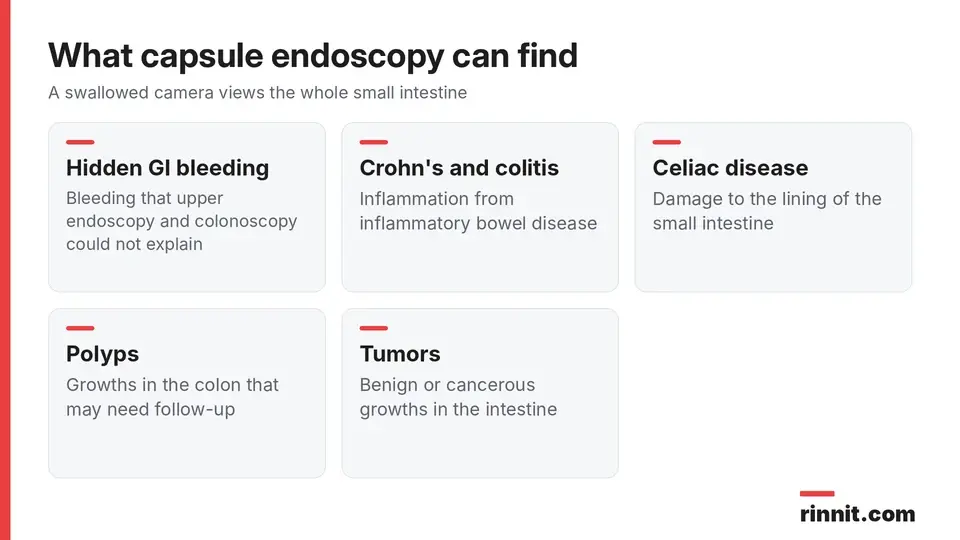
A camera capsule can spot several problems inside the small intestine.
Your provider may order capsule endoscopy to look for the cause of digestive symptoms or to check on a known condition. Common reasons include: [1]
Celiac disease
Inflammatory bowel disease, such as Crohn's disease or ulcerative colitis
Bleeding in the digestive tract that upper endoscopy and colonoscopy could not explain
Polyps in the colon
Tumors of the intestine, whether benign or cancerous
What symptoms can lead to this test?
Your provider may suggest it if you have symptoms that point to a problem in your gut, such as: [1]
Belly cramps or pain
Blood in your stool
Diarrhea
Gas and bloating
Fatigue
Nausea and vomiting
Weight loss you can't explain
Can children have capsule endoscopy?
Yes. Both adults and children can have the test. If a child can't swallow the capsule, a provider can place it in the digestive tract during an endoscopy. [1]
How do you prepare for capsule endoscopy?
Your provider will give you specific instructions. In general, preparation includes: [1]
Not eating for at least 12 hours before the test
Following any bowel prep instructions you receive
Telling your provider about past surgeries and any intestinal problems
Letting your provider know if you have a pacemaker or defibrillator, since these may interfere with the signal from the capsule
Sharing a list of your allergies, medicines and supplements, as some may need to be adjusted or paused
Before the test | Why it matters |
Fast for at least 12 hours | An empty gut gives clearer pictures |
Follow bowel prep instructions | Clears the intestine so the camera can see the lining |
Mention past surgeries or bowel problems | These can raise the chance of the capsule getting stuck |
Mention a pacemaker or defibrillator | These devices may interfere with image transmission |
Review medicines and supplements | Some may need to be changed or stopped |
Sources: [1]
What happens during capsule endoscopy?
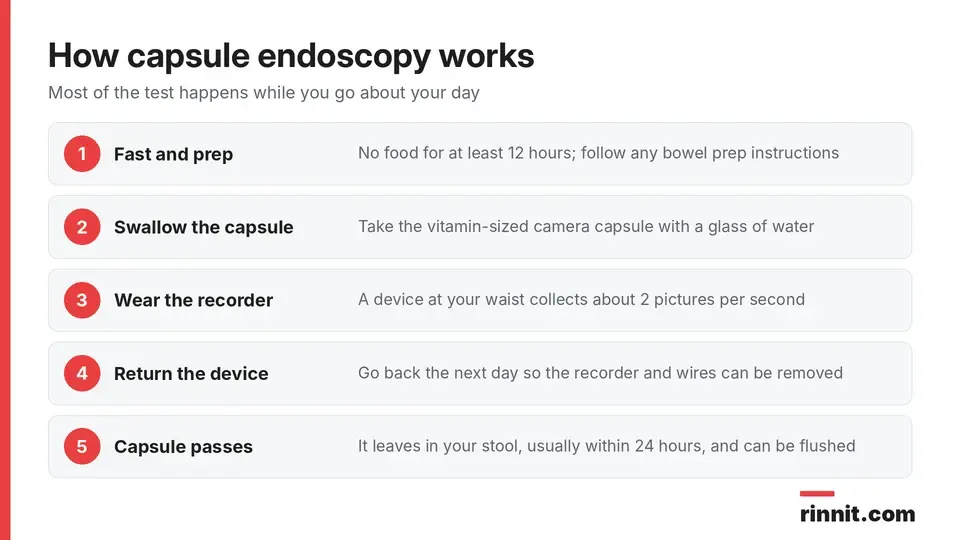
The test happens while you go about your day.
You swallow the capsule with a glass of water. You then wear a recording device around your waist that collects the images the capsule sends. Depending on the system, the recorder may connect to sticky pads on your skin with wires, or it may be completely wireless. [1]
Over the next several hours, the capsule passes through your esophagus, stomach and intestines while you carry on with normal activities. [1]
Does capsule endoscopy hurt?
No. The test should not be painful, and you won't feel the capsule moving through your body. [1]
What should you do and avoid during the test?
A few simple rules protect the quality of the pictures and your safety: [1]
Drink only clear liquids for the first two hours after swallowing the capsule.
Ask your provider when you can eat again; you may need to wait a few hours.
Avoid strenuous activity, such as running, jumping or playing sports, until the capsule has passed.
Do not have an MRI until the capsule has left your body.
Keep the recorder on until you are told to remove it, because disconnecting it early can damage or erase the images.
What happens after capsule endoscopy?
You return to your provider's office the next day so they can remove the recorder and any wires. The capsule usually leaves your body in your stool within 24 hours, though it sometimes takes longer. It is safe to flush down the toilet. Recovery is minimal or none. [1]
Your provider then downloads the images from the recorder and reviews them. [1]
Stage | Typical timing |
Recording images | Several hours as the capsule moves through your gut |
Returning the recorder | The next day |
Capsule leaving your body | Usually within 24 hours, sometimes longer |
Getting results | About a week, sometimes longer |
Sources: [1]
What are the risks of capsule endoscopy?
Capsule endoscopy is considered safe, and complications are rare. [1]
The main risk is that the capsule gets stuck in a narrowed section of your intestine. This is most likely if you have had bowel surgery or have inflammation or a tumor in your intestine. A capsule that stays in place can block your bowel, which can be serious. [1]
If it isn't clear whether the capsule has passed, your provider may order an X-ray or CT scan to find it. [1]
When should you call your provider?
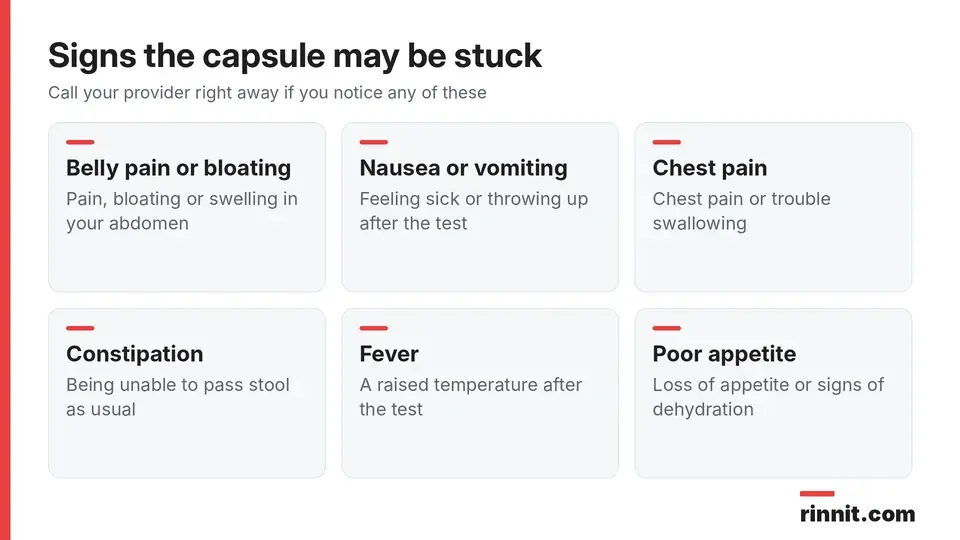
Call right away if you notice signs of a blockage.
Contact your provider right away if you develop signs that the capsule may be blocking your bowel, such as: [1]
Belly pain, bloating or swelling
Chest pain or trouble swallowing
Constipation
Dehydration
Fever
Loss of appetite
Nausea or vomiting
What do capsule endoscopy results show?
Your provider looks through the images for signs of bleeding, polyps or tumors, and inflammation. Based on what they find, they may suggest more tests or start treatment. [1]
Results are usually ready in about a week, though some take longer. [1]
How accurate is capsule endoscopy?
The test is generally good at picking up problems, but it isn't perfect. How accurate it is depends on how clear the images are and which condition your provider is looking for. [1]
Conclusion
Capsule endoscopy gives your provider a close look at the full length of your small intestine with a camera you simply swallow. It is painless, you can stay active during the test, and serious problems are rare.
Follow your prep instructions closely, keep the recorder on until you're told to remove it, and call your provider right away if you have belly pain, vomiting or other signs of a blockage.
Keep learning: Read our endoscopy guide or our colonoscopy guide. For more background, see ASGE on understanding capsule endoscopy.
FAQ
What is capsule endoscopy?
It is a test where you swallow a camera capsule that takes pictures of your digestive tract, mainly the small intestine.
How big is the capsule?
It is about the size of a large vitamin tablet.
Does capsule endoscopy hurt?
No. The test is painless, and you won't feel the capsule moving through you.
How long does capsule endoscopy take?
The capsule records images for several hours, and you return the recorder the next day.
How long does the capsule take to pass?
It usually leaves your body in your stool within 24 hours, though it can take longer.
Can I eat after swallowing the capsule?
You can drink clear liquids after two hours; ask your provider when you can eat again.
Do I need to fast before capsule endoscopy?
Yes. You usually need to stop eating at least 12 hours before the test.
What can capsule endoscopy detect?
It can show bleeding, inflammation, polyps and tumors in the small intestine.
What happens if the capsule gets stuck?
A stuck capsule can block the bowel, so your provider may use an X-ray or CT scan to find it.
When will I get my results?
Results are usually ready in about a week.
Related Reading
Enteroscopy: Seeing and Treating the Small Intestine explains the scope exam that reaches deep into the small intestine.
Balloon Enteroscopy: Single and Double Balloon Exams of the Small Intestine explains the balloon-assisted scope that reaches deep into the small intestine.
Crohn's Disease: Symptoms, Causes, Flares vs. Remission and Treatment — What You Need to Know explains an inflammatory bowel disease that capsule endoscopy can help find in the small intestine.
Gastrointestinal Bleeding: Where It Comes From, and How Doctors Find and Stop It covers the hidden bleeding that is a common reason for this test.
Celiac Disease: How Gluten Damages Your Gut, and How a Gluten-Free Diet Can Heal It describes the small intestine damage the capsule camera can show.
Iron Deficiency Anemia: Symptoms, Causes, Treatment & Complete Guide explains a condition that can result from slow bleeding in the gut.
Familial Adenomatous Polyposis (FAP): The Inherited Colon Condition That Causes Hundreds of Polyps — Screening, Surgery, and Lifelong Care covers an inherited condition that causes polyps a capsule can help detect.
Meckel's Scan: How It Finds Meckel's Diverticulum, Preparation and Accuracy explains the nuclear medicine scan that finds a bleeding Meckel's diverticulum.
References
Cleveland Clinic. Capsule Endoscopy: Prep, Procedure, What It Can Diagnose. Cleveland Clinic. Last updated May 6, 2025. https://my.clevelandclinic.org/health/diagnostics/16829-capsule-endoscopy
Cortegoso Valdivia P, Skonieczna-Żydecka K, Elosua A, et al. Indications, Detection, Completion and Retention Rates of Capsule Endoscopy in Two Decades of Use: A Systematic Review and Meta-Analysis. Diagnostics (Basel). 2022;12(5):1105. PMID 35626261. https://doi.org/10.3390/diagnostics12051105
Wang YC, Pan J, Liu YW, et al. Adverse events of video capsule endoscopy over the past two decades: a systematic review and proportion meta-analysis. BMC Gastroenterol. 2020;20(1):364. PMID 33138792. https://doi.org/10.1186/s12876-020-01491-w
Kopylov U, Yung DE, Engel T, et al. Diagnostic yield of capsule endoscopy versus magnetic resonance enterography and small bowel contrast ultrasound in the evaluation of small bowel Crohn's disease: Systematic review and meta-analysis. Dig Liver Dis. 2017;49(8):854-863. PMID 28512034. https://doi.org/10.1016/j.dld.2017.04.013
Medical disclaimer
This article is for general education only and does not replace advice from a qualified healthcare professional. Talk to your doctor about your own diagnosis and treatment, and seek emergency care right away for severe or sudden symptoms.



Comments