Meckel's Scan: How It Finds Meckel's Diverticulum, Preparation and Accuracy

Updated: 2 days ago
Written and medically reviewed by Dr. Baraa Alnahhal, MD · Last reviewed: November 2026 · How we review
Quick Answer
A Meckel's scan is a nuclear medicine test that looks for a Meckel's diverticulum, a small pouch in the small intestine present from birth that can cause painless rectal bleeding, especially in children. A radioactive tracer injected into a vein collects in stomach-type tissue. The test is about 90% accurate in children but about 50% in adults.
What the research says
A positive scan is usually correct: in a study of 352 Meckel's scans, 120 were positive; of the 106 children who had surgery, 100 were confirmed to have a Meckel's diverticulum, and in nearly all of them tracer uptake in the pouch appeared at the same time as the stomach (96.8%) and increased over time (97.8%) (Wu H et al., Hellenic Journal of Nuclear Medicine, 2017) [2]
The scan fits a specific situation: a 2026 imaging review notes that complications occur in about 4–9% of people with a Meckel's diverticulum; children usually present with bleeding and adults more often with inflammation; ultrasound or CT is usually the first imaging test, and the Meckel's scan can be added to check rectal bleeding in younger patients (Panda A et al., Radiographics, 2026) [3]
Key takeaways
Finds a Meckel's diverticulum that contains stomach tissue, a common cause of rectal bleeding in children.
Uses technetium-99m and a gamma camera; the radiation dose is low, though higher than a chest X-ray.
About 90% accurate in children, about 50% in adults.
Fast for 4–6 hours and avoid barium tests for 48 hours before.
A positive scan often leads to surgery; a negative scan may need more tests.
What is a Meckel's diverticulum?
A Meckel's diverticulum is a small pouch in the lower small intestine left over from fetal development. It's the most common birth defect of the digestive tract. Most cause no problems, but when a pouch contains stomach lining, the acid it makes can create an ulcer in nearby bowel that bleeds. It can also cause blockage or intussusception. Up to half of people with symptoms are younger than 10. Sources: [1, 3]
Why is it done?
The scan is mainly ordered for painless gastrointestinal bleeding from the rectum, often dark red or maroon, in a child or young adult. Because stomach-type tissue takes up the tracer, the scan can show a hidden pouch that other tests miss. Sources: [1, 3]
How do I prepare?
No food or drink for 4–6 hours before the scan.
No barium X-ray tests for 48 hours before, because barium can block the view.
Your provider may give medicine beforehand to make the scan more sensitive.
Young children may get a mild sedative to help them lie still. Sources: [1]
What happens during the scan?
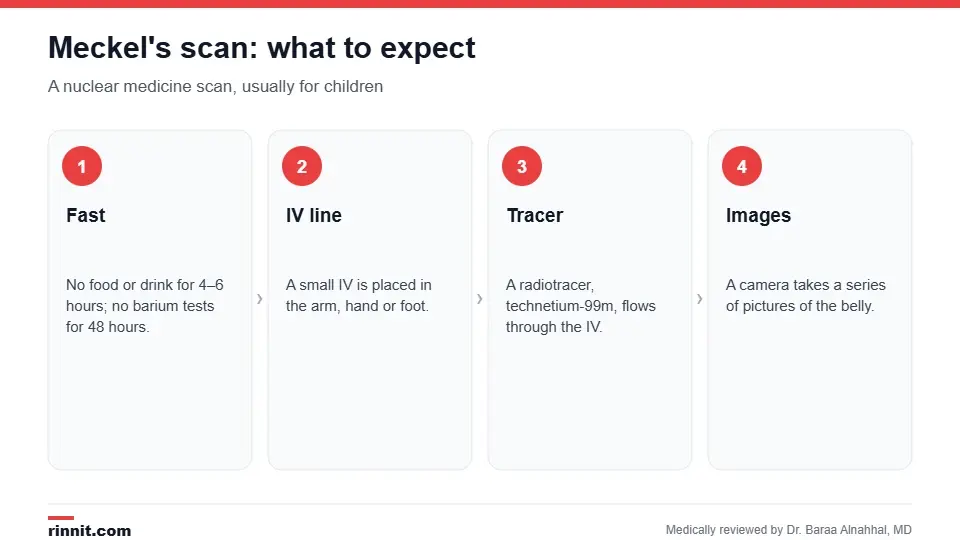
A Meckel's scan is an outpatient test.
An IV line is placed in the arm, hand or foot.
You lie on a table under the gamma camera.
The tracer, technetium-99m pertechnetate, is injected through the IV.
The camera takes a series of pictures of your belly as the tracer collects, usually over about an hour.
The IV is removed, and you go home the same day with no restrictions. Sources: [1]
How accurate is it?

The scan works best in children.
The scan is about 90% accurate in children but only about 50% in adults, partly because adults' pouches less often contain stomach tissue. Adults may instead have capsule endoscopy, balloon-assisted endoscopy or CT. Colonoscopy may be used to rule out other sources of bleeding. Sources: [1, 2, 3]
Risks
The test is safe. The IV site may be sore. The radiation dose is low, though higher than a chest X-ray, and the tracer leaves the body quickly. Sources: [1]
Understanding your results
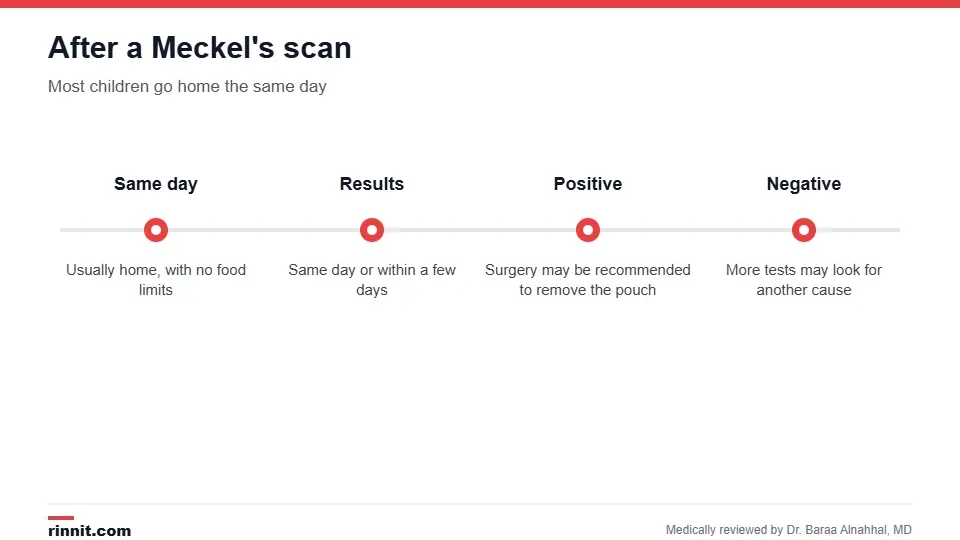
Next steps depend on the result.
Results may be ready the same day or within a few days. A positive scan shows a spot of tracer in the lower belly, separate from the stomach, and surgery to remove the pouch is often recommended. A negative scan doesn't completely rule out a Meckel's diverticulum, so your provider may recommend more tests if bleeding continues. Sources: [1, 2]
Conclusion
A Meckel's scan is a safe, focused test for finding a bleeding Meckel's diverticulum, especially in children. Follow the fasting and barium instructions, and know that a negative result may still need follow-up if symptoms continue.
Keep learning: read about Meckel's diverticulum and gastrointestinal bleeding.
Frequently asked questions
What is a Meckel's scan?
A nuclear medicine test that finds a Meckel's diverticulum containing stomach tissue.
Why is it done in children?
To find the cause of painless rectal bleeding, which is often a Meckel's diverticulum.
How long does it take?
Usually about an hour of imaging after the tracer is given.
Do I need to fast?
Yes, for 4–6 hours before the scan.
Is the radiation safe?
Yes. The dose is low, though higher than a chest X-ray.
How accurate is the scan?
About 90% in children and about 50% in adults.
Can my child be sedated?
Yes, a mild sedative may be given to help them stay still.
What happens if the scan is positive?
Surgery to remove the pouch is often recommended.
Does a negative scan rule it out?
No. More tests may be needed if bleeding continues.
Can I go home after the scan?
Yes, the same day with no restrictions.
Related Reading
Understanding Meckel's Diverticulum: Causes, Symptoms, and Care the condition the scan looks for.
Gastrointestinal Bleeding: Where It Comes From, and How Doctors Find and Stop It causes of bleeding in the digestive tract.
Intussusception: A Comprehensive Guide to Bowel Obstruction and Emergency Care a bowel blockage a diverticulum can trigger.
Capsule Endoscopy: How a Swallowed Camera Pill Checks Your Small Intestine, Prep and Results a camera pill used to look at the small intestine.
Colonoscopy: Purpose, Prep, Procedure, Results and Risks a scope test that checks the colon for bleeding sources.
References
Cleveland Clinic. Meckel's Scan: Prep, Procedure Details & Results. Cleveland Clinic. Last updated October 12, 2026. https://my.clevelandclinic.org/health/diagnostics/22450-meckels-scan
Wu H, Zhao X, Li Y, et al. Reconsideration of the primary and secondary diagnostic criteria of Meckel's diverticulum scintigraphy: a study of 93 confirmed cases. Hell J Nucl Med. 2017;20(1):11-16. PMID 28315903. https://doi.org/10.1967/s002449910501
Panda A, Farah A, Itani M, et al. Imaging and complications of Meckel diverticulum. Radiographics. 2026;46(11):e250185. PMID 42955836. https://doi.org/10.1148/rg.250185
Medical disclaimer
This article is for general education only and does not replace advice from a qualified healthcare professional. Talk to your doctor about your own diagnosis and treatment, and seek emergency care right away for severe or sudden symptoms.



Comments