Intussusception: A Comprehensive Guide to Bowel Obstruction and Emergency Care

Updated: 2 days ago
Medically reviewed by Dr. Baraa Alnahhal, MD · Last reviewed: October 2026
Quick Answer: Key Facts About Intussusception
Intussusception is a medical emergency in which one segment of intestine telescopes inside another, causing a bowel obstruction. It is most common in children between 3 months and 3 years old. Hallmark signs are episodes of severe crampy belly pain and red, jelly-like stools. Children are usually treated with an air or liquid enema, and adults with surgery.
Feature | Details |
Definition | A medical emergency in which one segment of intestine folds partially inside another (telescoping), causing a bowel obstruction. [1] |
Who gets it | Most common in children between 3 months and 3 years old; about 1 in 2,000 babies in the U.S. develop it in their first year. [1] |
Hallmark symptom | Episodes of severe, crampy abdominal pain alternating with pain-free periods. [1] |
Physical sign | Red, jelly-like stools containing blood and sometimes mucus. [1] |
Diagnosis | Ultrasound in children; CT scan in adults. [1] |
Main treatment | An air or liquid contrast enema in children; surgery in adults and in children when the enema fails or complications develop. [1] |
What the research says
Ultrasound is highly accurate for diagnosing intussusception in children. A meta-analysis of 14 studies (2,367 children) found pooled sensitivity of 94% and specificity of 96%. (Li et al., J Ultrasound Med, 2021)
In stable children, enema reduction can often be managed without antibiotics or admission. A systematic review of 83 articles by the American Pediatric Surgical Association concluded that, in hemodynamically stable children without critical illness, pre-reduction antibiotics are unnecessary, repeat enema reductions may be attempted when clinically appropriate, patients can be safely observed in the emergency department after enema reduction, and laparoscopic reduction is often successful. (Kelley-Quon et al., J Pediatr Surg, 2021)
A large vaccine safety review found no evidence of increased intussusception risk with the rotavirus vaccine. Across 338 studies of routine U.S. vaccines, there was no evidence of increased intussusception risk with rotavirus vaccine at the latest follow-up (moderate strength of evidence), although the authors note that rare events are challenging to study. (Gidengil et al., Vaccine, 2021)
What Is Intussusception?
Intussusception is a medical emergency in which one segment of the intestine folds partially inside the other, causing a bowel obstruction (blockage). The folding is described as "telescoping" because it resembles how the pieces of a handheld telescope fit into each other. It usually affects the small intestine. [1]
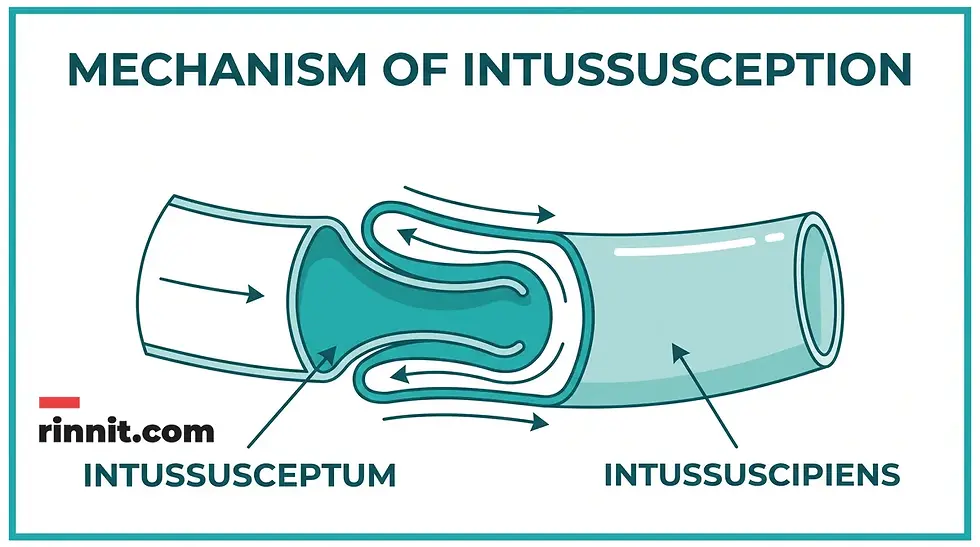
Without treatment, the blockage can slow blood flow to the intestine and prevent food from passing through it. The obstruction can cause swelling and inflammation that lead to life-threatening complications. Intussusception requires emergency care, but it is treatable if you get help fast. [1]
Anyone can develop intussusception, including adults, but it is most common in children between 3 months and 3 years old. Only about 1% of adult bowel obstructions are related to intussusception, but it is the most common reason children under 3 years old develop a bowel obstruction. [1]
How do intussusception symptoms differ in children and adults?
Intussusception in children causes alternating episodes of severe, crampy belly pain and pain-free periods, while adults have abdominal pain that may come and go or stay constant.
In children
Babies and children with intussusception have alternating episodes of severe, crampy abdominal pain followed by periods with no pain. The pain may last 15 to 20 minutes or longer. Children who cannot say they are hurting may draw their knees up to their chests and cry. They may then seem fine and even start playing during the pain-free period of 20 to 30 minutes, before the pain starts all over again. [1]
Eventually, the cycle may exhaust the child, causing lethargy. They may develop a fever and go into shock. Other possible symptoms include: [1]
A swollen belly.
Nausea and vomiting, sometimes yellow-green.
Red, jelly-like stools (bloody stool from rectal bleeding, sometimes mixed with mucus).
Symptoms often appear a few weeks or months after a child has been sick with a virus, but the timing does not always match, and not every child has every symptom. A good rule of thumb: if your baby or small child seems to have unexplained belly pain, get them checked immediately. [1]
In adults
Adults with intussusception also have abdominal pain, but it may come and go or stay constant. Vomiting, bloating and bloody stools are common too. Because these symptoms are so common across gastrointestinal conditions, many people wait things out, which is never a good idea with intussusception. It is as much of a medical emergency in adults as in children. [1]
What causes intussusception and who is at risk?
In most cases, healthcare providers are not sure of the cause. In children, there seems to be a relationship between viral infections and intussusception: most children develop it in the fall and winter, when the stomach flu (viral gastroenteritis) tends to spread. Other causes include irregular structures or growths in the intestines, such as Meckel's diverticulum and polyps. [1]
In adults, the causes are more clear-cut: adults are more likely to develop it because of colon cancer (malignant tumors) or benign colon growths. Less commonly, it can occur because of the long-term effects of inflammation, as in Crohn's disease. [1]
Risk factors in children include: [1]
Age: Most children are affected between 3 months and 3 years old.
Sex: Male children are up to three times more likely to develop intussusception, for reasons researchers are not sure about.
Time of year: Most cases occur in fall and winter.
Certain conditions: Malrotation, Meckel's diverticulum, intestinal polyps or cysts, and immunoglobulin A (IgA) vasculitis.
Risk factors in adults include intestinal growths (usually cancer, but also benign growths), inflammatory bowel disease (IBD), endometriosis and having a feeding tube. [1]
How is intussusception diagnosed and treated in an emergency?
Diagnosis usually happens alongside emergency treatment. Imaging tests that confirm it include ultrasound in children, which is the first test providers use, and a CT scan in adults. Your child's provider may also use an air or contrast enema, in which air or a liquid containing barium is placed into the rectum. The pressure helps straighten the telescoped intestine, and an X-ray records a video of the process. [1]
Non-surgical enema
For most children, treatment uses an air or contrast enema (the same procedure used for diagnosis) to straighten out the telescoping. This is a radiologic procedure, not a surgical one, so your child will not need anesthesia. A barium or air enema is successful in up to 85% of children treated in hospitals with experience treating intussusception. The procedure is not effective in adults. [1]
Surgery
Adults with intussusception need surgery, and less often so do some children, for example if the enema does not work or the child has a complication such as a bowel tear or an infection. Surgery may be a traditional open operation or a less invasive laparoscopy with two or three small incisions. If the intestine cannot be repositioned, the surgeon removes the involved segment and sutures the remaining parts together. A pediatric anesthesiologist will sedate your child so they feel no pain. [1]

What are the complications and recovery outlook for intussusception?
Prompt treatment can typically fix the telescoping intestine, but untreated intussusception can lead to life-threatening complications. These include: [1]
A hole in the intestine (perforation): Food and digestive juices back up behind the blockage, and the intestine can become swollen and eventually tear.
Severe inflammation and infection (peritonitis): Leaking intestinal contents can cause sepsis, a life-threatening infection.
Tissue death (bowel necrosis): Injury to the intestine can cause the tissue to die.
These complications can develop quickly, which is why seeking emergency care is crucial. [1]

The outlook is excellent for children treated early. An air or contrast enema usually cures intussusception. After an enema, your child may be gassy for a few hours. After surgery, your child will need pain medicine and will receive nutrition through IV fluids for several days while the intestines heal; they can usually begin eating again in one to three days, and it may take a few weeks to return to typical activity levels. [1]
Intussusception recurs in 10% to 20% of children, with symptoms returning within the first 48 hours after surgery (less common) or weeks or months later (more common). If it comes back, the same steps are taken to diagnose and treat it, which may include another enema. Ask your provider before leaving the hospital what signs of a recurrence to watch for. [1]
After treatment, call your child's provider if your child develops excessive swelling, redness, warmth or drainage from the incision, a fever above 101 degrees Fahrenheit (38 degrees Celsius), nausea and vomiting, or symptoms that signal a recurrence, such as periodic pain episodes and jelly-like stools. [1]
Learn more. For more evidence-based health guides, visit Rinnit.com.
Frequently Asked Questions
What does "currant jelly" stool look like?
Currant jelly stool is a term for red, jelly-like stool made of blood from rectal bleeding, sometimes mixed with mucus.
Can intussusception be caused by a vaccine?
A large safety review found no evidence of increased intussusception risk with the rotavirus vaccine at the latest follow-up, although rare events are hard to study. Talk to your child's pediatrician about the benefits and risks of vaccination.
Why is intussusception more common in the fall and winter?
Most children develop intussusception in the fall and winter, the same time of year that the stomach flu (viral gastroenteritis) tends to spread.
Can intussusception happen more than once?
Yes. Intussusception recurs in 10% to 20% of children. Symptoms can return within the first 48 hours after surgery, which is less common, or weeks or months later, which is more common.
Is intussusception painful for a baby?
Yes. It causes severe, crampy abdominal pain that comes in waves. Children who cannot say they are hurting may draw their knees up to their chests and cry.
Does my child need anesthesia for an enema?
No. The air or contrast enema is a radiologic procedure, not a surgical one, so your child will not need anesthesia. Surgery, when it is needed, is done with sedation so your child feels no pain.
What is a "lead point"?
A lead point is a growth or structural abnormality, such as a polyp or tumor, that the intestine catches and pulls into the next segment. Lead points are the usual cause of intussusception in adults.
Can adults have an enema to fix intussusception?
No. The enema procedure is not effective in adults, who usually need surgery.
What happens if the intestine is already damaged?
If the telescoped segment cannot be repositioned, the surgeon removes the involved segment of intestine and sutures the remaining healthy parts together.
Which conditions raise a child's risk?
Malrotation, Meckel's diverticulum, intestinal polyps or cysts, and immunoglobulin A (IgA) vasculitis all increase a child's risk.
How soon can my child eat after treatment?
After an enema, your child may be gassy for a few hours. After surgery, nutrition is given through IV fluids for several days while the intestines heal, and children can usually begin eating again in one to three days.
What is the difference between intussusception and a regular stomach ache?
The key difference is the cycle of severe pain followed by pain-free periods, often with vomiting, lethargy or red, jelly-like stools. A child cycling through episodes of belly pain and then no pain is never normal.
Is intussusception always an emergency?
Yes. It can cut off blood flow to the intestine, so it is always a medical emergency. If your child shows signs, get them to a hospital that day as soon as possible.
How well does the enema work?
A barium or air enema is successful in up to 85% of children treated in hospitals with experience treating intussusception, and the sooner treatment starts, the better the chance of no complications.
Conclusion
Intussusception is a frightening diagnosis for any parent, but it is highly treatable when caught early. Recognizing the signs, especially cycles of pain and pain-free periods and red, jelly-like stools, is the most important step in getting a child the urgent care they need. If your baby or small child has unexplained belly pain, do not wait: call their pediatrician right away, or go to the emergency room. [1]
Related Reading
Meckel's Scan: How It Finds Meckel's Diverticulum, Preparation and Accuracy explains the nuclear medicine scan that finds a bleeding Meckel's diverticulum.
References
Cleveland Clinic. Intussusception. Cleveland Clinic. Last updated January 24, 2024. https://my.clevelandclinic.org/health/diseases/10793-intussusception
Li XZ, Wang H, Song J, et al. Ultrasonographic Diagnosis of Intussusception in Children: A Systematic Review and Meta-Analysis. J Ultrasound Med. 2021;40(6):1077-1084. PMID 32936473. https://doi.org/10.1002/jum.15504
Kelley-Quon LI, Arthur LG, Williams RF, et al. Management of intussusception in children: A systematic review. J Pediatr Surg. 2021;56(3):587-596. PMID 33158508. https://doi.org/10.1016/j.jpedsurg.2020.09.055
Gidengil C, Goetz MB, Newberry S, et al. Safety of vaccines used for routine immunization in the United States: An updated systematic review and meta-analysis. Vaccine. 2021;39(28):3696-3716. PMID 34049735. https://doi.org/10.1016/j.vaccine.2021.03.079
Medical disclaimer
This article is for general educational purposes only and is not a substitute for professional medical advice. If you think your child may have intussusception, seek emergency care immediately.



Comments