Angiodysplasia of the GI Tract: Symptoms, Causes, and Treatment Options

Updated: 2 days ago
Medically reviewed by Dr. Baraa Alnahhal, MD · Last reviewed: September 2026
TL;DR
Gastrointestinal angiodysplasia is a common type of GI bleeding caused by abnormal blood vessels that weaken and leak blood into the digestive tract — most often in the colon, small intestine, or stomach. It typically affects people age 60 and older, and it may cause no symptoms at all. When symptoms do appear, they usually show up as iron-deficiency anemia (fatigue, weakness, shortness of breath) or visible bleeding (bright red blood in the toilet or black, tarry stool). Bleeding often stops on its own, and treatments — blood and iron transfusions, endoscopic procedures, or surgery for heavy bleeding — typically solve the issue. The main risk boosters: blood thinners and chronic conditions like aortic stenosis, kidney disease, and cirrhosis.
Quick Answer
What it is: A common type of gastrointestinal bleeding in which abnormal blood vessels leak blood, most often in the colon, small intestine, or stomach.
Who gets it: Typically people age 60 and older; healthcare providers may call it GI angiodysplasia (GIAD).
Main symptoms: Fatigue, weakness, and shortness of breath from iron-deficiency anemia, plus bright red rectal bleeding or black, tarry stool (melena).
Treatment and outlook: No single treatment exists — supportive care (transfusions, iron), endoscopic procedures to block or close the leaking vessels, or surgery for heavy bleeding — but treatments typically solve the issue, and bleeding often stops on its own.

What Is Angiodysplasia of the GI Tract?
Angiodysplasia of the gastrointestinal (GI) tract is a common type of gastrointestinal bleeding. It typically affects people age 60 and older. Healthcare providers may call this condition gastrointestinal angiodysplasia (GIAD).
Angiodysplasia is the medical term for abnormal blood vessels. In angiodysplasia of the GI tract, abnormal blood vessels leak blood. This condition can affect any part of your GI tract, but it typically develops in your colon (the large intestine), your small intestine, or your stomach.
The condition may not cause symptoms. You may find out you have angiodysplasia of the GI tract after you have tests for other issues that affect your GI tract.
Bleeding from angiodysplasia of the GI tract often goes away on its own. But it can come back if the abnormal blood vessels start leaking blood again.
Key Fact | Detail |
Definition | Bleeding caused by abnormal blood vessels leaking blood in the digestive tract |
Category | A common type of gastrointestinal bleeding |
Other name | Gastrointestinal angiodysplasia (GIAD) |
Typical age | People age 60 and older |
Common sites | Colon, small intestine, stomach |
Symptom status | May cause no symptoms; often found incidentally |
Where in the GI Tract Does It Develop?
Angiodysplasia can affect any part of the digestive tract. In practice, it most often develops in three areas:
Location | Notes |
Colon | The large intestine; typically the most common site |
Small intestine | The tube between the stomach and the colon |
Stomach | The upper digestive organ |
What Are the Symptoms of GI Angiodysplasia?
The most common symptoms happen when blood loss leads to iron-deficiency anemia. This condition causes symptoms including fatigue, shortness of breath, and weakness.
Other symptoms are changes in your stool or when you have a bowel movement:
Symptom Category | Specific Symptom | What It Looks Like |
From blood loss (iron-deficiency anemia) | Fatigue | Feeling very tired all the time |
From blood loss (iron-deficiency anemia) | Shortness of breath | Trouble catching your breath |
From blood loss (iron-deficiency anemia) | Weakness | Feeling physically weak |
Stool changes | Bright red blood (rectal bleeding) | Blood visible in the toilet or when you wipe |
Stool changes | Melena (black stool) | Sticky or tarry stool that smells very bad |
Because fatigue has many possible causes, unexplained tiredness combined with any change in stool is the combination that most strongly points toward a GI bleeding investigation.

What Causes GI Angiodysplasia?
Experts do not know the exact cause of this condition. One theory is that blood vessels weaken and leak as we get older. Another theory involves the rare condition gastric arteriovenous malformation (AVM). An AVM is a cluster of abnormal blood vessels that can swell and leak blood.
What Are the Risk Factors?
Having certain medical conditions or taking certain medications may increase your risk.
Medical conditions that may increase risk
Condition | Category |
Aortic stenosis | Heart condition |
Autoimmune diseases | Immune system condition |
Chronic obstructive pulmonary disease (COPD) | Lung condition |
Chronic kidney disease | Kidney condition |
Cirrhosis | Liver condition |
Congestive heart failure | Heart condition |
Diabetes | Metabolic condition |
Liver failure | Liver condition |
Venous thromboembolism | Circulatory condition |
Von Willebrand disease | Blood-clotting disorder |
Medications that may increase risk
Medications that help with blood flow — blood thinners — may increase your risk. Those medications include anticoagulants and antiplatelet drugs.
Sometimes, receiving a left ventricular assist device (LVAD) may lead to angiodysplasia of the gastrointestinal tract.
What Are the Complications?
Rarely, this condition can cause heavy bleeding that can lead to severe anemia. This is the main serious complication, and it is the scenario that pushes treatment toward surgery rather than endoscopic procedures.
How Is GI Angiodysplasia Diagnosed?
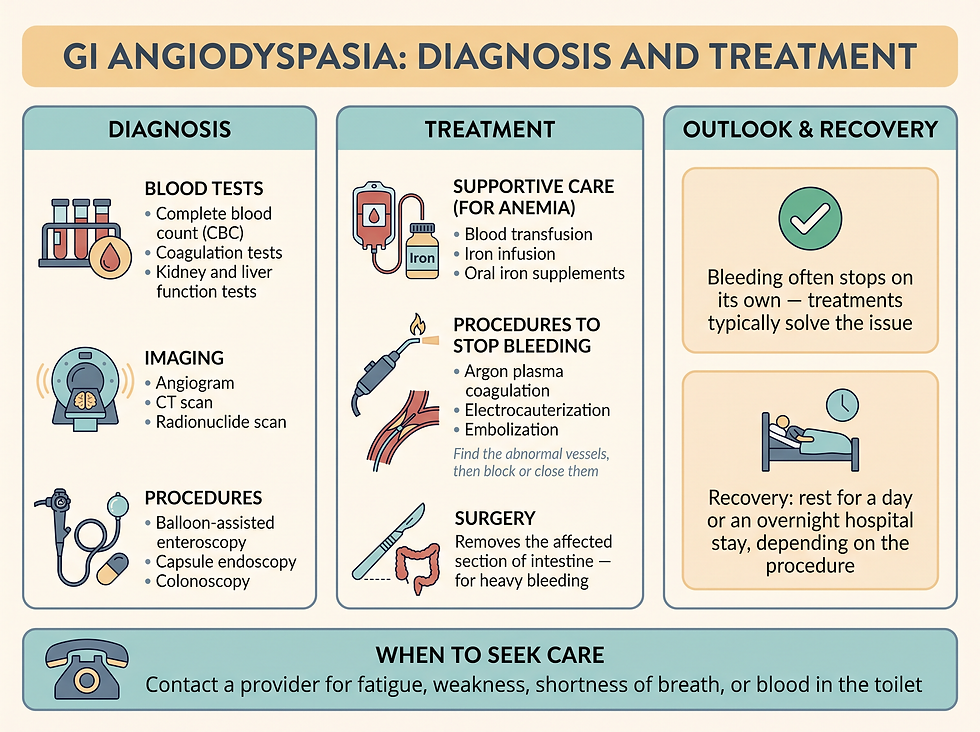
A healthcare provider may do different tests to diagnose this condition. For example, you may have blood tests or imaging tests. A provider may do procedures to see what is happening in your GI tract.
Blood tests
You may have blood tests that detect anemia or other conditions that can cause GI bleeding. Tests may include a complete blood count (CBC), a coagulation test — like a prothrombin time test or fibrinogen test — to see if your blood clots like it should, and kidney and liver function tests.
Blood Test | What It Checks |
Complete blood count (CBC) | Detects anemia |
Prothrombin time test | Checks if your blood clots properly |
Fibrinogen test | Checks if your blood clots properly |
Kidney function tests | Detects other conditions that can cause GI bleeding |
Liver function tests | Detects other conditions that can cause GI bleeding |
Imaging tests
Imaging tests to diagnose angiodysplasia of the GI tract include an angiogram, a CT scan, and a radionuclide scan, which uses safe levels of radioactive material to highlight red blood cells.
Procedures
Your provider may use a procedure such as balloon-assisted enteroscopy, capsule endoscopy, or colonoscopy.
How Is GI Angiodysplasia Treated?
There is no single treatment for this condition. Healthcare providers will tailor treatment to your situation. For example, if the condition causes anemia, a provider may recommend supportive care. They may do procedures to find the abnormal blood vessels and stop the bleeding.
Supportive care
This is treatment for anemia. Supportive care may include a blood transfusion, an iron infusion, or oral iron supplements.
Procedures
Providers may combine procedures. First, they find the abnormal blood vessels. Then, they block or close them. Examples of combined procedures are:
Procedure | How It Works |
Argon plasma coagulation | Done during a colonoscopy, endoscopy, or enteroscopy to seal leaking vessels |
Electrocauterization | Done as part of a colonoscopy to stop bleeding with heat |
Embolization | Done during angiography to block the bleeding vessel |
Surgery
Your provider may recommend surgery if you have heavy bleeding. Surgery involves removing the section of your intestine that the condition affects.
What Is the Recovery Time?
Your recovery time will depend on the procedure healthcare providers use. In some cases, you may need to rest for a day after your treatment. But some procedures involve an overnight stay in the hospital. If you are receiving treatment, ask your healthcare provider what to expect.
What Can You Expect in the Long Term?
Bleeding from this condition often goes away on its own. When it does not, there are treatments that can keep the abnormal blood vessels from leaking blood. Treatments typically solve the issue.
The pattern to remember: intermittent bleeding that stops on its own is common, but recurrence is possible if the abnormal vessels start leaking again. That is why follow-up after treatment matters.
When Should You Seek Care?
Talk to a healthcare provider if you feel very tired all the time, weak, or short of breath. These are anemia symptoms. Blood in the toilet after you poop or wipe is another reason to contact a provider.
Contact your provider if your symptoms come back after treatment or get worse.
Conclusion
Gastrointestinal angiodysplasia is a common cause of GI bleeding in older adults that hides behind seemingly unrelated symptoms. The leaking abnormal blood vessels — most often in the colon, small intestine, or stomach — rarely announce themselves directly. Instead, they cause slow, often silent blood loss that shows up as iron-deficiency anemia: persistent fatigue, weakness, and shortness of breath. When the bleeding is more direct, it appears as bright red blood in the toilet or black, tarry melena.
The good news is that the prognosis is favorable. Bleeding frequently stops on its own, and when it does not, a range of supportive and procedural treatments — blood transfusions, iron infusions, argon plasma coagulation, electrocauterization, embolization, or surgery for heavy bleeding — typically solve the problem. The honest caveats are recurrence (leaking vessels can reopen) and the small risk of heavy bleeding leading to severe anemia, particularly in people on blood thinners or with chronic heart, kidney, or liver disease.
If you are over 60 and experiencing unexplained fatigue, weakness, shortness of breath, or any blood in the toilet, do not write it off as "just getting older." Schedule an appointment with a healthcare provider — blood tests and, if needed, a colonoscopy or capsule endoscopy can identify the source and start treatment before blood loss becomes serious.
FAQ
What is angiodysplasia of the GI tract?
Angiodysplasia of the gastrointestinal tract is a common type of GI bleeding in which abnormal blood vessels leak blood into the digestive tract. It typically affects people age 60 and older and providers may call it gastrointestinal angiodysplasia (GIAD).
Where does it most often develop?
It can affect any part of the GI tract, but it typically develops in the colon (large intestine), the small intestine, or the stomach.
What are the symptoms?
The most common symptoms come from blood loss causing iron-deficiency anemia: fatigue, weakness, and shortness of breath. Other symptoms are visible stool changes — bright red blood in the toilet or when wiping, or melena (black, sticky, tarry stool with a very bad smell).
What causes GI angiodysplasia?
Experts do not know the exact cause. One theory is that blood vessels weaken and leak as we age. Another involves gastric arteriovenous malformation (AVM), a cluster of abnormal blood vessels that can swell and leak blood.
Who is at higher risk?
Risk is raised by conditions including aortic stenosis, autoimmune diseases, COPD, chronic kidney disease, cirrhosis, congestive heart failure, diabetes, liver failure, venous thromboembolism, and von Willebrand disease. Anticoagulants and antiplatelet drugs (blood thinners) also increase risk, as can a left ventricular assist device (LVAD).
How is it diagnosed?
Through blood tests (CBC, coagulation tests like prothrombin time, kidney and liver function tests), imaging (angiogram, CT scan, radionuclide scan), and procedures such as balloon-assisted enteroscopy, capsule endoscopy, and colonoscopy.
How is it treated?
There is no single treatment. Supportive care for anemia includes blood transfusions, iron infusions, and oral iron supplements. Procedures find and then block or close the abnormal vessels — argon plasma coagulation, electrocauterization, or embolization. Surgery to remove the affected intestine is used for heavy bleeding.
Does it go away on its own?
Bleeding from angiodysplasia often goes away on its own, but it can return if the abnormal vessels leak again. When it does not stop, treatments typically solve the issue.
References
Aghighi M, Taherian M, Sharma A. "Angiodysplasia." In: StatPearls [Internet]. Treasure Island (FL): StatPearls Publishing; 2025 Jan. Updated 2023 Aug 14. pubmed.ncbi.nlm.nih.gov/31747184
Beg S, Ragunath K. "Review on gastrointestinal angiodysplasia throughout the gastrointestinal tract." Best Practice & Research Clinical Gastroenterology. 2017 Feb;31(1):119-125. pubmed.ncbi.nlm.nih.gov/28395783
García-Compeán D, Del Cueto-Aguilera ÁN, Jiménez-Rodríguez AR, et al. "Diagnostic and therapeutic challenges of gastrointestinal angiodysplasias: A critical review and viewpoints." World Journal of Gastroenterology. 2019 Jun 7;25(21):2549-2564. pubmed.ncbi.nlm.nih.gov/31210709
Jackson CS, Strong R. "Gastrointestinal Angiodysplasia: Diagnosis and Management." Gastrointestinal Endoscopy Clinics of North America. 2017 Jan;27(1):51-62. pubmed.ncbi.nlm.nih.gov/27908518
Alhamid A, Aljarad Z, Chaar A, et al. "Endoscopic therapy for gastrointestinal angiodysplasia." Cochrane Database of Systematic Reviews. 2024 Sep 19;9(9):CD014582. pubmed.ncbi.nlm.nih.gov/39297500
Disclaimer: This article is for general educational purposes only and is not a substitute for professional medical advice, diagnosis, or treatment. Always consult a qualified healthcare provider for guidance specific to your situation.
Comments