Bronchoscopy: Why It's Done, What to Expect, Recovery and Risks

Updated: 2 days ago
Written and medically reviewed by Dr. Baraa Alnahhal, MD · Last reviewed: November 2026 · How we review
Quick Answer: What is a bronchoscopy?
A bronchoscopy is a minimally invasive procedure in which a provider looks inside the airways and lungs with a bronchoscope, a thin tube with a light and camera. It helps diagnose lung problems such as cancer, infection and inflammation, and it can treat some problems, like removing blockages. Most people go home within a few hours. [1]
What the research says
Bronchoscopy is safe for checking spots deep in the lungs. In a registry of 581 patients at 15 centers who had bronchoscopy for lesions in the outer parts of the lungs, 53.7% got a diagnosis from the procedure. Complications happened in 2.2%, and a collapsed lung (pneumothorax) in 1.7%. (Ost et al., American Journal of Respiratory and Critical Care Medicine, 2016) [2]
Newer robotic bronchoscopy reaches small nodules with few complications. A meta-analysis of 23 studies covering 1,409 patients found robotic-assisted navigation bronchoscopy gave a diagnosis in about 81.9% of lung nodules and detected cancer with 87.6% sensitivity. Pneumothorax occurred in just 0.6%. (Pyarali et al., Journal of Bronchology & Interventional Pulmonology, 2024) [3]
Ultrasound-guided bronchoscopy has limits when scans look normal. Among people with non-small cell lung cancer whose chest scans showed no enlarged central lymph nodes, 12.8% still had cancer in those nodes. Endobronchial ultrasound bronchoscopy (EBUS) found about half of these cases (49.5% sensitivity), and a negative result was correct 93% of the time. (El-Osta et al., Annals of the American Thoracic Society, 2018) [4]
Key takeaways
A bronchoscopy uses a thin tube with a light and camera to look inside your airways and lungs. [1]
It's used to diagnose lung problems and to treat some, such as removing blockages or placing a stent. [1]
You'll be sedated, and you need to fast beforehand and have someone drive you home. [1]
It usually takes 30 to 90 minutes, and most people go home within a few hours. [1]
Risks are slight but include airway injury, vocal cord irritation and a collapsed lung. [1]
What is a bronchoscopy?
A bronchoscopy is a minimally invasive procedure that lets a provider see inside your airways and lungs. They use a bronchoscope, a thin tube with a light and a camera on the end. [1]
It helps your provider diagnose and evaluate problems in your lungs, windpipe (trachea) or throat, and in some cases, treat them during the same procedure. [1]
Flexible vs. rigid bronchoscopy

There are two types of bronchoscopes: [1]
Feature | Flexible bronchoscopy | Rigid bronchoscopy |
The scope | A thin, bendable tube | A firm, straight tube |
How often it's used | Most cases, because it moves easily and reaches smaller areas of the lungs | Some situations that need it |
Common uses | Keeping the airway open, taking tissue samples (biopsy), suctioning secretions | Removing a large object stuck in the airway, placing stents, treating tumors or bleeding |
Sources: [1]
Why is a bronchoscopy done?
Your provider may recommend a bronchoscopy to: [1]
Find lung disease or other causes of symptoms such as a heavy cough, coughing up blood or shortness of breath
Follow up on an X-ray or CT scan that showed possible signs of cancer
Check for and remove blockages, or treat narrowed areas of your airways
Find the cause of an infection or inflammation in your lungs
Collect mucus or tissue samples for lab testing
Place a stent (a small tube) to keep an airway open
How do you prepare for a bronchoscopy?
Follow your provider's instructions. You'll usually need to: [1]
Stop eating and drinking for a set amount of time before the procedure
Stop certain medicines, such as blood thinners or diabetes medicines, if your provider tells you to
Tell your provider about all the medicines, herbs and vitamins you take
Arrange for someone to drive you home, because you'll receive a sedative
Unless it's an emergency, you'll usually have a CT scan of your lungs first. It helps your provider evaluate conditions such as cancer or smoking-related lung damage and decide whether you need a bronchoscopy. [1]
What happens during a bronchoscopy?
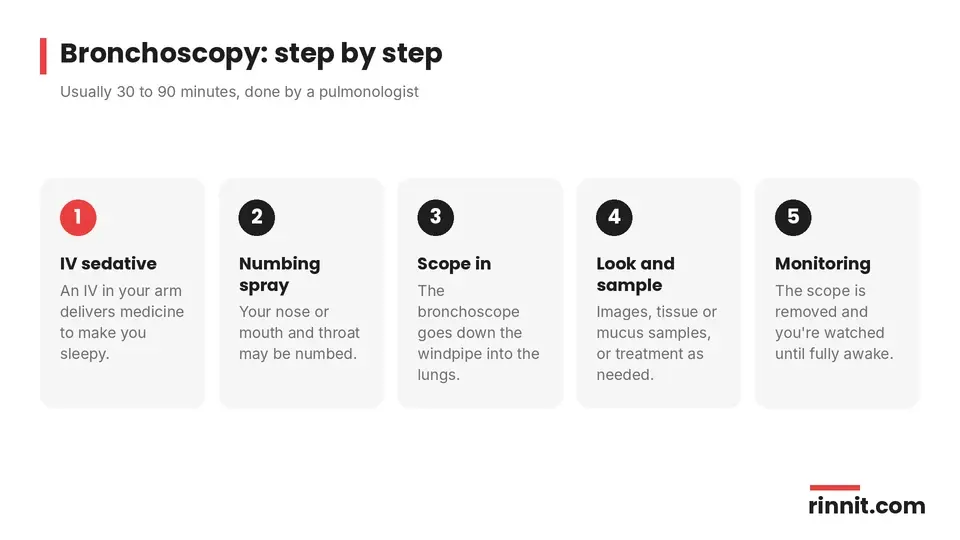
A pulmonologist (lung specialist) usually performs a bronchoscopy in a hospital or surgical center as an outpatient procedure. [1]
You lie on a bed or table with your head propped up.
A provider places an IV in your arm to give you a sedative.
Your mouth or nose and throat may be sprayed with numbing medicine.
Once you're numb and sedated, the provider passes the bronchoscope through your nose or mouth (or through a breathing tube if you're under general anesthesia) and guides it down your windpipe into your lungs.
Saliva may be suctioned from your mouth, because you can't swallow during the procedure.
The provider gently removes the scope, and the team monitors you until you're fully awake.
Will I be asleep?
Most people are at least drowsy, and many are asleep. The type of anesthesia depends on the type of bronchoscopy and what's being checked. Many people have general anesthesia, which is often needed for rigid bronchoscopy and many biopsy procedures. Only some procedures can be done with numbing medicine alone. [1]
How long does it take?
A bronchoscopy usually takes 30 to 90 minutes, depending on why you're having it. [1]
Bronchoscopy at a glance
Item | Typical detail |
Who performs it | Usually a pulmonologist |
Where | Hospital or surgical center, usually as an outpatient |
Sedation | At least drowsy; many people have general anesthesia |
How long it takes | 30 to 90 minutes |
Recovery room | At least 45 minutes |
Going home | Usually within a few hours, with no overnight stay |
Sources: [1]
What happens after a bronchoscopy?
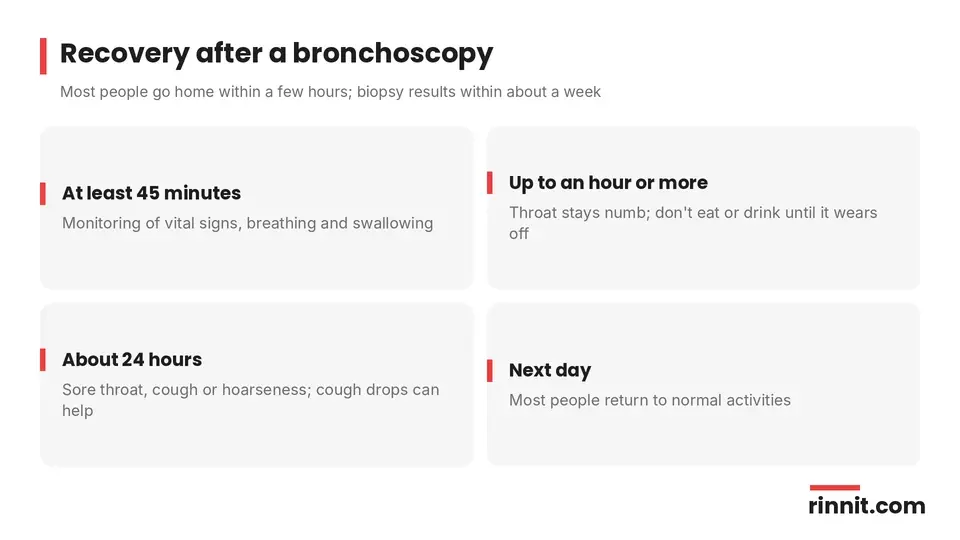
You'll spend at least 45 minutes in a recovery area, possibly longer. The team checks your vital signs, breathing and swallowing as the sedation wears off, and you may have a chest X-ray. Most people go home within a few hours. [1]
Eating and drinking: Your throat may stay numb for up to an hour. Don't eat or drink until the numbness wears off, then start with sips of water and soft foods. Eating too soon can cause choking or food going into your lungs (aspiration).
Throat discomfort: A sore throat, cough or hoarseness may last about 24 hours. Cough drops can help.
Activity: Most people return to normal activities the next day, though your provider may suggest some limits.
What are the risks of a bronchoscopy?
A bronchoscopy is very safe, but there's a slight risk of: [1]
A hole (tear) in the airway
Irritation or inflammation of the vocal cords
A collapsed lung (pneumothorax)
Talk with your provider about your risks, especially if you may be at higher risk. [1]
When will you get results?
Biopsy results should be ready within one week. Other results may take more or less time, depending on the test. Your provider will tell you when to expect results and when to schedule a follow-up visit. [1]
When should you call your doctor?
Contact your provider if you have any of the following after a bronchoscopy: [1]
Chest pain
Trouble breathing
A fever that won't go away
A cough that won't go away, or coughing up blood
Signs of pneumonia
Questions to ask your provider
Why do I need a bronchoscopy, and what are you looking for?
Will I have a flexible or rigid bronchoscopy?
Will I be sedated or under general anesthesia?
Which medicines should I stop beforehand, and when?
Will you take a biopsy, and when will I get the results?
Conclusion
A bronchoscopy lets your provider look directly inside your airways and lungs with a thin camera tube. It helps diagnose problems such as cancer, infection and inflammation, and it can treat some conditions, like blockages and narrowed airways, during the same procedure.
You'll be sedated, the procedure usually takes 30 to 90 minutes, and most people go home the same day. Expect a sore throat for a day or so, wait until the numbness wears off before eating, and call your provider if you have chest pain, trouble breathing or a fever that won't go away.
Keep learning: Read our guides to endoscopy, biopsy, the CT scan and spirometry.
FAQ
What is a bronchoscopy?
A bronchoscopy is a procedure that uses a thin tube with a light and camera to look inside your airways and lungs. [1]
Why would I need a bronchoscopy?
Common reasons are a heavy cough, coughing up blood, shortness of breath, an abnormal X-ray or CT scan, lung infection or inflammation, and airway blockages. [1]
Are you put to sleep for a bronchoscopy?
Most people are at least drowsy, and many have general anesthesia; only some procedures use numbing medicine alone. [1]
How long does a bronchoscopy take?
It usually takes 30 to 90 minutes. [1]
How long is recovery after a bronchoscopy?
You'll be monitored for at least 45 minutes, most people go home within a few hours, and most return to normal activities the next day. [1]
When can I eat after a bronchoscopy?
Wait until your throat is no longer numb, which may take an hour or more, then start with sips of water and soft foods. [1]
Is a sore throat normal after a bronchoscopy?
Yes. A sore throat, cough or hoarseness may last about 24 hours. [1]
What are the risks of a bronchoscopy?
Risks are slight but include a tear in the airway, vocal cord irritation and a collapsed lung (pneumothorax). [1]
How long do bronchoscopy biopsy results take?
Biopsy results should be ready within one week. [1]
When should I call my doctor after a bronchoscopy?
Call for chest pain, trouble breathing, a persistent fever or cough, coughing up blood or signs of pneumonia. [1]
Related Reading
Bronchial Thermoplasty for Severe Asthma: How It Works and Results explains bronchial thermoplasty for severe asthma.
Learn more in our guide to Lung Cancer: Symptoms, Causes, Diagnosis, and Treatment Explained.
Learn more in our guide to Non-Small Cell Lung Cancer: Understanding Symptoms, Types, and Treatments.
Learn more in our guide to Pneumonia: Complete Guide to Symptoms, Causes, and Treatment.
Learn more in our guide to Tuberculosis (TB): Symptoms, Causes, Testing, Treatment and Prevention.
Learn more in our guide to Bronchiectasis: The Widened Airways Condition That Makes Mucus Hard to Clear — Explained.
Learn more in our guide to Subglottic Stenosis: Understanding Airway Narrowing and Care.
Lung Biopsy: Types, What to Expect, Recovery, Risks and Results explains the biopsy types used to sample lung tissue.
Endobronchial Ultrasound (EBUS): Lung Biopsy and Cancer Staging explains the ultrasound bronchoscopy used to biopsy chest lymph nodes.
References
Cleveland Clinic. Bronchoscopy: Purpose, Procedure, Risks & Results. Cleveland Clinic. Last updated January 30, 2024. https://my.clevelandclinic.org/health/diagnostics/21471-bronchoscopy
Ost DE, Ernst A, Lei X, et al. Diagnostic Yield and Complications of Bronchoscopy for Peripheral Lung Lesions. Results of the AQuIRE Registry. Am J Respir Crit Care Med. 2016;193(1):68-77. PMID 26367186. https://doi.org/10.1164/rccm.201507-1332OC
Pyarali FF, Hakami-Majd N, Sabbahi W, et al. Robotic-assisted Navigation Bronchoscopy: A Meta-Analysis of Diagnostic Yield and Complications. J Bronchology Interv Pulmonol. 2024;31(1):70-81. PMID 37700435. https://doi.org/10.1097/LBR.0000000000000942 Erratum in: J Bronchology Interv Pulmonol. 2024;31(2):231. PMID 38567395. https://doi.org/10.1097/LBR.0000000000000965
El-Osta H, Jani P, Mansour A, et al. Endobronchial Ultrasound for Nodal Staging of Patients with Non-Small-Cell Lung Cancer with Radiologically Normal Mediastinum. A Meta-Analysis. Ann Am Thorac Soc. 2018;15(7):864-874. PMID 29684288. https://doi.org/10.1513/AnnalsATS.201711-863OC
Medical disclaimer
This article is for general education only and does not replace advice from a qualified healthcare professional. Talk to your doctor about your own diagnosis and treatment, and seek emergency care right away for severe or sudden symptoms.



Comments