Tuberculosis (TB): Symptoms, Causes, Testing, Treatment and Prevention

Updated: 3 days ago
Medically reviewed by Dr. Baraa Alnahhal, MD · Last reviewed: October 2026
Urgent-care notice: Seek emergency care for chest pain, sudden severe headache, confusion, seizures or difficulty breathing. Seek immediate or urgent care for coughing up blood or blood in the urine or stool. This article does not diagnose tuberculosis, determine whether someone is contagious, or replace medical and public-health guidance.
Quick Answer: What is tuberculosis?
Tuberculosis (TB) is a serious bacterial illness that mainly affects the lungs and can be latent, with no symptoms, or active disease. Active lung TB may cause cough, chest pain, fever, night sweats, weight loss and coughing up blood, and it spreads through the air. Treatment lasts several months, and medicines should never be stopped without instructions. [4]
What the research says
Latent TB infection is widespread. A modeling study estimated that 23.0% of the world’s population (95% uncertainty interval 20.4%–26.4%), about 1.7 billion people, had latent TB infection in 2014, and that 0.8% (55.5 million people) were recently infected and at high risk of TB disease (Houben & Dodd, PLoS Med, 2016). [1]
Diabetes and HIV raise TB risk. A systematic review of six articles found that diabetes prevalence among people with TB ranged from 7.6% to 22.6%; diabetes increases the risk of developing active TB, and HIV substantially increases the risk of progression from latent infection to active disease (Latif et al., AIDS Rev, 2026). [2]
BCG protects infants best against severe TB. In a systematic review of randomized trials, BCG protection against pulmonary TB was greatest in infants (rate ratio 0.41; 95% CI 0.29–0.58) and against meningeal and miliary TB in infants (rate ratio 0.1; 95% CI 0.01–0.77), while protection was weaker in older individuals (Mangtani et al., Clin Infect Dis, 2014). [3]

What is tuberculosis?
Tuberculosis is a serious illness caused by Mycobacterium tuberculosis, a type of bacterium. It mainly affects the lungs, but it can spread to other parts of the body. [4]
TB is not one single clinical state. The bacteria and the body’s immune response can result in primary infection, latent TB infection or active TB disease. These stages have different symptoms and implications for spread.
A person’s symptoms, test results, immune status, age, exposure history and other health factors influence how TB is evaluated and treated.
What are the stages of TB infection?
Tuberculosis (TB) infection moves through three stages, primary infection, latent infection and active disease, and active disease in the lungs or voice box can spread to others through the air. [4]
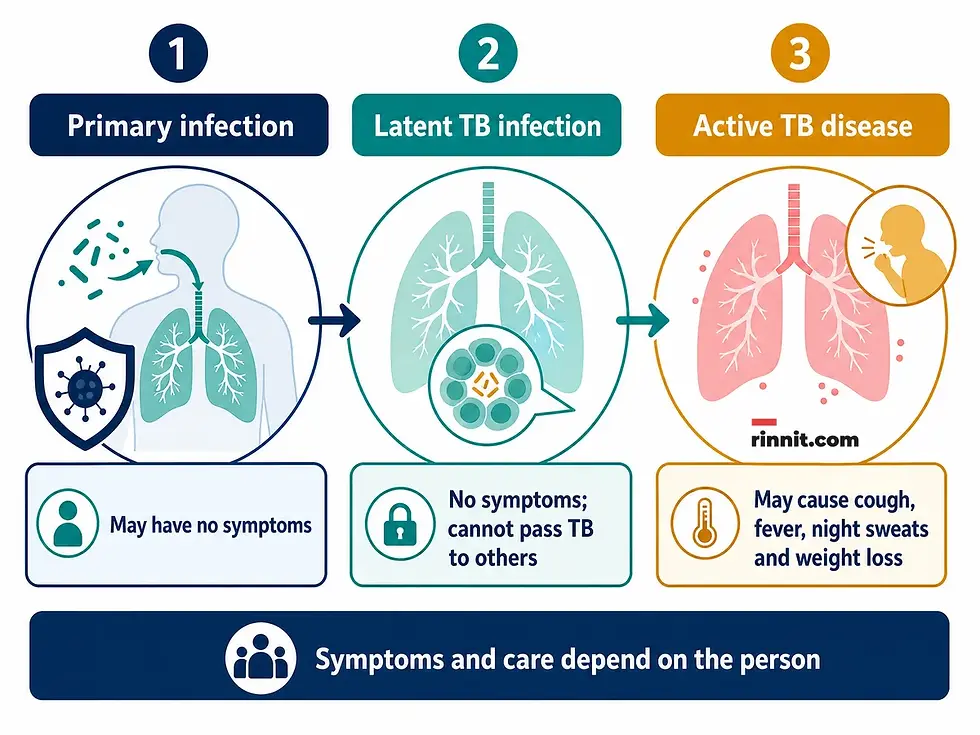
Primary TB infection
Primary infection is the first stage. Immune-system cells capture the bacteria. The immune system may destroy them, but some captured bacteria may survive and multiply. [4]
Most people do not have symptoms during primary infection. Some people may have flu-like symptoms, such as low fever, tiredness or cough. [4]
Latent TB infection
Primary infection is usually followed by latent TB infection. Immune-system cells build a wall around lung tissue containing TB bacteria. The bacteria survive but remain under control, so there are no symptoms. [4]
A person with latent TB infection cannot pass TB to other people. However, latent infection may later become active disease if the immune system cannot keep the bacteria under control.
Active TB disease
Active TB disease occurs when the immune system cannot control the infection. The bacteria cause disease in the lungs or other parts of the body. Active disease may occur soon after primary infection, but it commonly develops months or years after latent infection. [4]
Active disease in the lungs or voice box can spread to others through the air. [4]
What are the symptoms of active TB?
Active pulmonary tuberculosis (TB) symptoms, such as cough, usually start gradually and get worse over several weeks. They may include:
Cough.
Coughing up blood or mucus.
Chest pain.
Pain with breathing or coughing.
Fever and chills.
Night sweats.
Weight loss.
Reduced appetite.
Tiredness.
Feeling generally unwell.
These symptoms resemble those of many other illnesses. They cannot confirm TB without professional evaluation and testing.
Can TB affect parts of the body outside the lungs?
Yes. TB infection can spread from the lungs to other parts of the body. This is called extrapulmonary tuberculosis. Symptoms vary depending on the infected site. [4]
Possible sites include the kidneys, liver, fluid around the brain and spinal cord, heart muscle, genitals, lymph nodes, bones and joints, skin, walls of blood vessels and voice box. [4]
General symptoms may include fever, chills, night sweats, weight loss, low appetite, tiredness, feeling unwell and pain near the infected site. [4]
TB affecting the voice box is outside the lungs but may cause symptoms more like pulmonary disease. [4]
How can TB affect children?
Symptoms vary by age.
Age group | Possible symptoms |
Teenagers | Symptoms may resemble those in adults. |
Children ages 1–12 | Fever that does not go away and weight loss. |
Infants | Poor growth or weight gain; possible sluggishness, unusual fussiness, vomiting, poor feeding, bulging soft spot or poor reflexes when fluid around the brain or spinal cord is involved. |
Children under 5 have a higher risk that infection will become active disease, particularly children under 2. In this age group, active TB may cause serious disease involving the fluid around the brain and spinal cord. [4]
A child with possible TB symptoms needs professional evaluation. Do not assume that a lack of cough rules out a serious infection.
When should someone seek emergency or urgent care?
The symptoms of TB overlap with many illnesses, so medical evaluation is important when symptoms do not improve after a few days of rest.
Emergency care
Get emergency care for:
Chest pain.
Sudden, severe headache.
Confusion.
Seizures.
Difficulty breathing.
Immediate or urgent care
Seek immediate or urgent care for:
Coughing up blood.
Blood in the urine.
Blood in the stool.
These signs do not prove TB, but they may signal a serious condition that should not be evaluated only through online information.
How does TB spread?
A person with active TB disease in the lungs or voice box can spread bacteria through the air. This can happen during speaking, singing, laughing, coughing or sneezing. [4]
Spread is more likely when people spend a lot of time together indoors or in crowded settings. Examples include crowded gatherings and places where people live or work close together for long periods. [4]
A person with latent TB infection cannot pass the disease to others. A person taking medicine for active TB usually cannot pass it on after two to three weeks of treatment, but the treating and public-health teams should decide when precautions can change.
What is drug-resistant TB?
Some TB bacteria no longer respond well to medicines that once cured the disease. This is called drug-resistant TB. [4]
Resistance can develop when a bacterium has a natural genetic change that helps it survive an antibiotic. If it survives, it can multiply. Incorrect medicine use or failure to clear all the bacteria can allow more-resistant forms to take hold. [4]
Problems that can contribute to drug resistance include stopping medicines early, not receiving the right treatment plan, medicines being unavailable or poor quality, or the body not absorbing medicines as expected. [4]
Completing treatment exactly as directed is an important part of care. Never change a TB regimen without the treating team.
Who has a higher risk of TB infection?
TB infection risk is higher for people who live with someone with active TB, live or travel where TB is common, or live or work in crowded settings. [4]
A healthcare professional may recommend TB testing for people with increased risk of infection or active disease. [4]
Who has a higher risk of active TB disease?
A weakened immune system can make it more likely for TB infection to become active disease. [4]
Conditions and treatments associated with higher risk include HIV/AIDS, diabetes, severe kidney disease, some head, neck or blood cancers, malnutrition or low body weight, chemotherapy, transplant medicines, long-term prescription steroid use, injected drug use, alcohol misuse, smoking and other tobacco use. [4]
Age also affects risk. Children under 5, especially those under 2, have a higher risk of active disease. People ages 15 to 25 have an increased risk of more severe active lung disease, while adults 65 and older have higher risk and may be more difficult to treat. [4]
Having a risk factor does not mean a person has TB. It is a reason to discuss testing and symptoms with a healthcare professional. [4]
How is TB diagnosed?
A healthcare professional may listen to breathing, check for swollen lymph nodes and ask about symptoms, exposure and health risks. [5]
Testing may be recommended when TB is suspected, after likely exposure to someone with active disease, or when a person has risk factors for active disease. [5]
Skin test
A small amount of tuberculin is injected under the skin of the forearm. A healthcare worker checks the site 48 to 72 hours later. [5]
A positive result suggests latent or active TB infection. Previous TB vaccination can also affect the result. A negative result means the body did not react, but it does not always rule out infection. [5]
Blood test
A blood sample can be tested to see whether immune-system cells recognize TB. A positive result suggests latent or active infection. Other blood tests may help evaluate active disease. A negative result generally suggests that TB infection is unlikely, but results must be interpreted in context. [5]
Chest X-ray
A chest X-ray may show irregular patches in the lungs that are typical of active TB disease. [5]
Sputum tests
A sputum sample is mucus brought up by coughing. In active TB disease of the lungs or voice box, laboratory testing may detect the bacteria. [5]
A relatively quick test may suggest TB bacteria, while a confirmatory test may take several weeks. Laboratory testing can also identify drug-resistant TB, which helps the healthcare team choose treatment. [5]
Other tests
Depending on the clinical situation, testing may include a breath test, a procedure to collect sputum through a special tube, a urine test or testing of cerebrospinal fluid around the brain and spinal cord. [5]
No single test is appropriate for every person. The healthcare team chooses testing based on symptoms, exposure, risk factors and suspected disease stage.
How is latent or active TB treated?
Latent TB infection may be treated to prevent active disease. This is especially important for people with HIV/AIDS or other factors that increase the risk of active TB. [5]
Most latent TB infections are treated for three or four months. Active TB disease may be treated for four, six or nine months. Specialists determine which medicines are appropriate. [5]
People usually need regular appointments to check improvement and monitor side effects.
Medicines used for TB
Common TB medicines include isoniazid, rifampin, rifabutin, rifapentine, pyrazinamide and ethambutol. [5]
Latent TB may require one or two medicines, while active TB generally requires several medicines. Drug-resistant TB or complications may require other treatment. [5]
The exact regimen depends on the type of TB, test results, resistance findings, health conditions and clinical assessment. This article does not recommend a personal treatment plan.
What side effects should be reported?
TB medicine side effects to report include upset stomach, severe diarrhea, yellow skin or eyes, vision changes, tingling in the hands or feet and easy bruising. [5]
Upset stomach, vomiting or loss of appetite.
Severe diarrhea.
Light-colored stool, dark urine or yellow skin or eyes. [5]
Vision changes.
Dizziness or trouble with balance.
Tingling in the hands or feet.
Easy bruising or bleeding.
Unexplained weight loss or tiredness.
Sadness or depression.
Rash or joint pain.
List all prescription medicines, nonprescription medicines, vitamins, supplements and herbal remedies for the treating team. Some may need to be stopped or adjusted during TB treatment.
Do not stop a TB medicine on your own, even if you feel better or experience an expected side effect. Contact the treating team for instructions.
How can someone with active TB protect others?
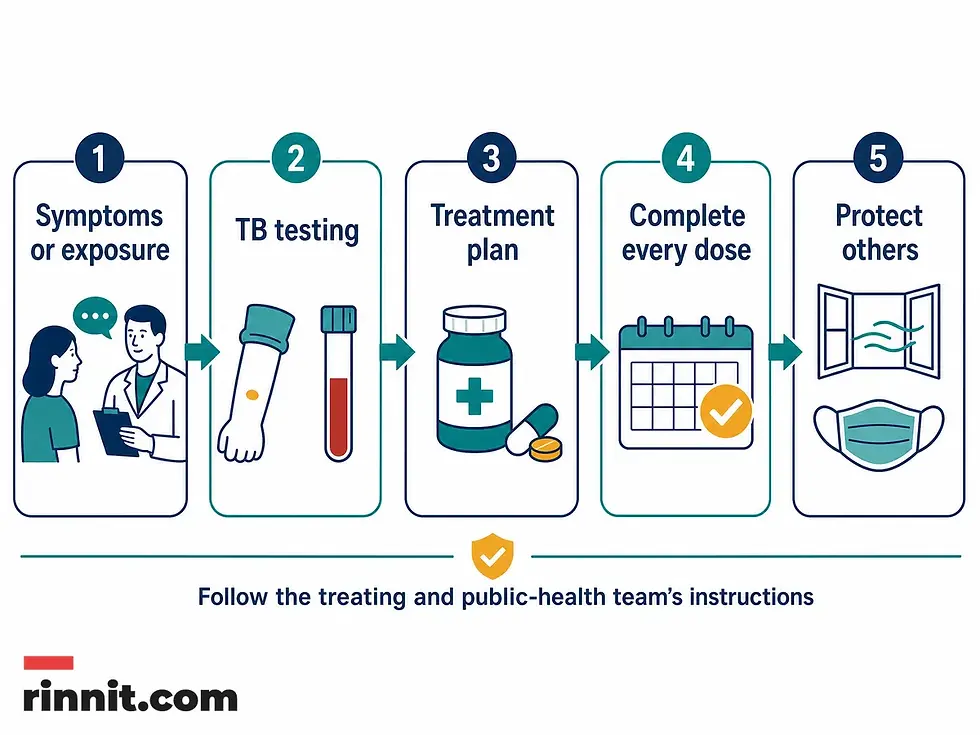
During the first two to three weeks of active TB treatment, the person may still be able to pass TB bacteria to others. The treating and public-health teams should provide individualized infection-control instructions. General guidance includes:
Staying home rather than going to work or school when instructed. [4]
Spending as little time as possible around household members. [4]
Sleeping in a separate room.
Opening windows or using fans to improve ventilation when appropriate. [4]
Wearing a mask around other people.
Asking household members to wear masks when advised. [4]
Covering the mouth with a tissue when coughing or sneezing, sealing and discarding used tissues. [4]
Do not end isolation or return to usual activities based only on a general timeline. Follow the treating and public-health team’s instructions.
How can TB be prevented?
If a person tests positive for latent TB infection, medicines may help prevent active disease. [4]
In countries where TB is common, infants often receive the BCG vaccine. It helps protect infants and toddlers from serious active TB disease involving the fluid around the brain and spinal cord. It may not protect as well against lung disease. [4]
Other prevention steps include testing when risk is increased, completing prescribed treatment and following infection-control instructions during active disease. [4]
Prevention decisions depend on location, exposure, age, immune status, vaccination history and public-health recommendations.
How should you prepare for a tuberculosis (TB) appointment?
For a tuberculosis (TB) appointment, bring details about your symptoms, recent travel, possible TB contacts, past TB tests, vaccination history, medicines and health conditions.
Symptoms and when they began.
Recent travel or international background.
Possible contact with someone who has active TB.
Previous TB infection or a positive skin test.
TB vaccination history.
All medicines, vitamins, supplements and herbal remedies, including doses.
HIV/AIDS or other health conditions.
Work conditions and time spent in crowded settings.
Useful questions include:
What is the most likely cause of the symptoms?
Which TB tests are needed?
Is the concern latent infection or active disease?
How long will treatment last?
What happens if treatment does not work?
How often are follow-up visits needed?
Which side effects require a call?
When can normal activities resume?
How should household members be protected?
How should other health conditions be managed during TB treatment?
Conclusion
Tuberculosis is a bacterial illness with different stages. Latent TB infection usually has no symptoms and cannot spread to others, while active TB disease may cause cough, fever, night sweats, weight loss and other symptoms.
Testing helps healthcare teams distinguish possible infection from active disease and assess drug resistance. Treatment may take several months, and completing every dose is important. People with active TB also need infection-control guidance to protect household members and the wider community.
Seek emergency care for chest pain, sudden severe headache, confusion, seizures or difficulty breathing. Seek urgent care for coughing up blood or blood in the urine or stool. For ongoing symptoms, possible exposure or risk factors, contact a healthcare professional rather than trying to self-diagnose.
Frequently Asked Questions
What is tuberculosis?
Tuberculosis, or TB, is a bacterial illness caused by Mycobacterium tuberculosis. It mainly affects the lungs but can involve other parts of the body.
What is the difference between latent TB and active TB disease?
Latent TB infection has no symptoms and cannot pass TB to other people. Active TB disease occurs when the immune system cannot control the bacteria and symptoms or disease can develop.
How does TB spread?
Active TB disease in the lungs or voice box can spread through the air when an infected person speaks, sings, laughs, coughs or sneezes.
Can someone with latent TB infect others?
No. A person with latent TB infection cannot pass the disease to other people.
What are common active TB symptoms?
Active lung disease may cause cough, coughing up blood or mucus, chest pain, pain with breathing or coughing, fever, chills, night sweats, weight loss, low appetite and tiredness.
When is TB an emergency?
Emergency care is needed for chest pain, sudden severe headache, confusion, seizures or difficulty breathing. Immediate or urgent care is needed for coughing up blood or blood in the urine or stool.
How is TB diagnosed?
Testing may include a skin test, blood test, chest X-ray, sputum testing and other laboratory or imaging tests, depending on the person’s symptoms, exposure and risk factors.
How long does TB treatment take?
Most latent infections are treated for three or four months. Active disease may require four, six or nine months. Specialists choose the treatment plan and monitor progress.
What is drug-resistant TB?
Drug-resistant TB occurs when TB bacteria no longer respond well to medicines that once worked. Incorrect medicine use, stopping treatment early or other factors can contribute.
What side effects should be reported during treatment?
Report serious or concerning symptoms such as dark urine, yellow skin or eyes, vision changes, severe diarrhea, easy bruising, rash, tingling, dizziness or unexplained tiredness to the treating healthcare professional.
How can someone with active TB protect household members?
Follow the treating and public-health teams’ instructions. Guidance includes staying home when instructed, reducing close contact, sleeping separately, improving ventilation, wearing masks and covering coughs.
Can children get serious TB disease?
Yes. Children under 5, especially under 2, have a higher risk that TB infection will become active disease, and serious disease can affect the fluid around the brain and spinal cord.
Related Reading
TB Test (Tuberculosis Test): Skin Test vs Blood Test, How It Works and What Results Mean compares the skin and blood tests used to check for TB infection.
Learn more in our guide to Bronchoscopy: Why It's Done, What to Expect, Recovery and Risks.
Chest X-Ray (CXR): What It Shows, How It's Done and What Results Mean explains how a chest X-ray helps detect tuberculosis in the lungs.
Learn more in our guide to Rheumatoid Factor (RF) Test: Normal Range and What a Positive Result Means.
Sputum Culture: How to Give a Sample, What It Detects and What Results Mean explains the lab test that finds germs in lung mucus.
References
Houben RMGJ, Dodd PJ. The Global Burden of Latent Tuberculosis Infection: A Re-estimation Using Mathematical Modelling. PLoS Med. 2016;13(10):e1002152. PMID: 27780211. https://doi.org/10.1371/journal.pmed.1002152
Latif AI, Sari M, Mandysová P, et al. Association between tuberculosis, HIV infection, and diabetes mellitus: should we integrate screening and care? A systematic review. AIDS Rev. 2026;28(3):118-125. PMID: 42863504. https://doi.org/10.24875/AIDSRev.26000010
Mangtani P, Abubakar I, Ariti C, et al. Protection by BCG vaccine against tuberculosis: a systematic review of randomized controlled trials. Clin Infect Dis. 2014;58(4):470-480. PMID: 24336911. https://doi.org/10.1093/cid/cit790
Mayo Clinic Staff. Tuberculosis: Symptoms and causes. Mayo Clinic. April 24, 2025. https://www.mayoclinic.org/diseases-conditions/tuberculosis/symptoms-causes/syc-20351250
Mayo Clinic Staff. Tuberculosis: Diagnosis and treatment. Mayo Clinic. April 24, 2025. https://www.mayoclinic.org/diseases-conditions/tuberculosis/diagnosis-treatment/drc-20351256
Disclaimer
This article is for general educational purposes and is not a substitute for professional medical advice, diagnosis or treatment. Always seek the advice of a qualified health provider with any questions you may have regarding a medical condition.
It explains what tuberculosis is, its stages, symptoms, spread, testing, treatment, drug resistance and prevention. It does not diagnose tuberculosis, determine whether someone is contagious, or replace medical and public-health guidance. Chest pain, sudden severe headache, confusion, seizures or difficulty breathing require emergency care. Coughing up blood or blood in the urine or stool requires immediate or urgent care.



Comments