Sputum Culture: How to Give a Sample, What It Detects and What Results Mean

Updated: 2 days ago
Written and medically reviewed by Dr. Baraa Alnahhal, MD · Last reviewed: November 2026 · How we review
Quick Answer
A sputum culture is a lab test that looks for bacteria or fungi in sputum, the mucus coughed up from deep in the lungs. It helps diagnose lung infections such as pneumonia and tuberculosis, identifies the exact germ and shows which medicines will work against it. You cough into a sterile cup. Results usually take a few days.
What the research says
Rapid DNA tests now complement culture for TB: a Cochrane review of adults with possible pulmonary tuberculosis found the rapid Xpert Ultra test detected 90.9% of culture-confirmed cases (specificity 95.6%) and Xpert MTB/RIF 84.7% (specificity 98.4%), with sputum culture remaining the reference standard (Zifodya JS et al., Cochrane Database of Systematic Reviews, 2021) [2]
Standard cultures miss many pneumonia germs: a meta-analysis of diagnostic techniques in adult community-acquired pneumonia found pneumococcus caused about 27% of cases, and a urine antigen test identified an extra 11% of cases beyond conventional methods such as sputum and blood cultures (Said MA et al., PLoS One, 2013) [3]
Key takeaways
Grows germs from lung mucus to find the cause of a bacterial or fungal lung infection.
Used for pneumonia, TB, bronchiectasis and flare-ups of COPD or cystic fibrosis.
Collect in the morning: rinse with water, breathe deeply and cough hard into the cup; spit isn't enough.
If needed, bronchoscopy collects a sample under sedation.
Results take a few days; susceptibility testing shows which antibiotics will work.
What is a sputum culture?
Sputum is mucus made in the lower airways and lungs. When you have a lung infection, it may contain the bacteria or fungi causing it. In a sputum culture, the lab places the sample on growth material, lets any germs multiply, then identifies them. A Gram stain is often done at the same time to give a quicker first look. Sputum cultures aren't usually ordered for viral infections. Sources: [1]
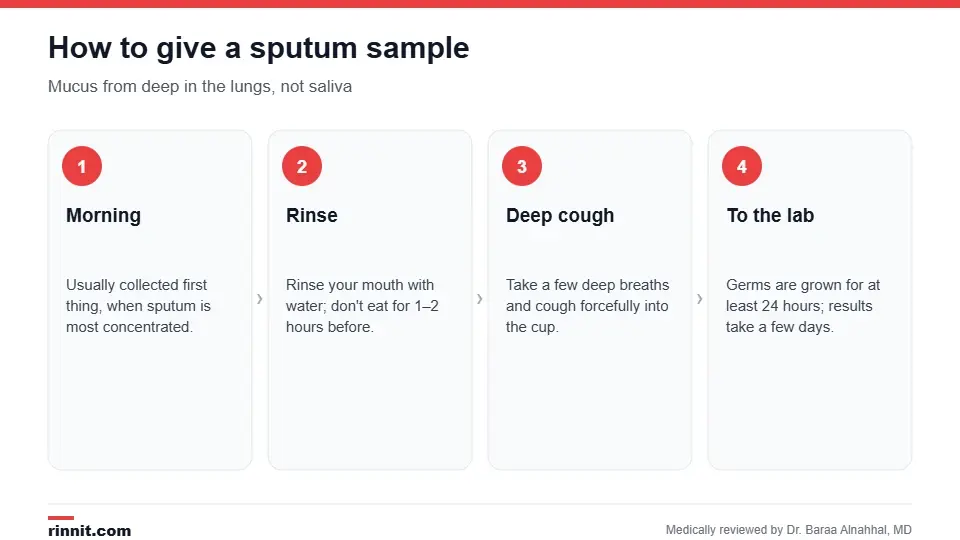
A good sputum sample comes from deep in the lungs.
Why is it done?
To diagnose pneumonia, tuberculosis and bronchiectasis.
To investigate flare-ups of COPD or cystic fibrosis.
To choose the right antibiotic or antifungal through susceptibility testing.
To check whether an infection is improving with treatment. Sources: [1]
It may be ordered if you have a cough with mucus, fever or chills, shortness of breath, chest pain that's worse when breathing or coughing, fatigue or confusion, usually after a chest X-ray or CT scan. It's also common for people in the hospital or at high risk of severe infection. Sources: [1]
How do I prepare?
Cough and spit: drink plenty of water the night before and avoid eating for 1–2 hours before collection. The test is usually scheduled in the morning, when sputum is more concentrated.
Bronchoscopy: fast for up to 12 hours (water may be allowed), ask about adjusting blood thinners and arrange a ride home. Sources: [1]
How is the sample collected?

Most people can cough up a sample; bronchoscopy is the backup.
Rinse your mouth with water (not mouthwash) to reduce bacteria from the mouth.
Take a few deep breaths.
Cough forcefully to bring up mucus from deep in your chest and spit it into the sterile cup. Saliva or nasal mucus isn't a good sample.
Repeat every couple of minutes until you have enough. A provider may tap your chest or have you breathe salty mist or steam to help.
Close the cup and give it to the staff promptly. Sources: [1]
If you can't produce enough sputum, a bronchoscopy can collect it: after sedation and numbing medicine, a thin camera tube passes through your nose or mouth, and a brush or suction takes the sample. Sources: [1]
Understanding your results
The lab usually needs at least 24 hours to grow the sample, so results take a few days. Cultures for TB grow more slowly and can take several weeks. Sources: [1, 2]
Normal (negative): no harmful bacteria or fungi grew.
Abnormal (positive): a potentially harmful germ grew; the report names it and how much was found, often with a list of medicines it's sensitive or resistant to. Sources: [1]
A positive culture supports a diagnosis but isn't definitive on its own. Your provider considers your symptoms, imaging, the Gram stain and the quality of the sample, since germs from the mouth can contaminate it. Sources: [1, 3]
TB testing
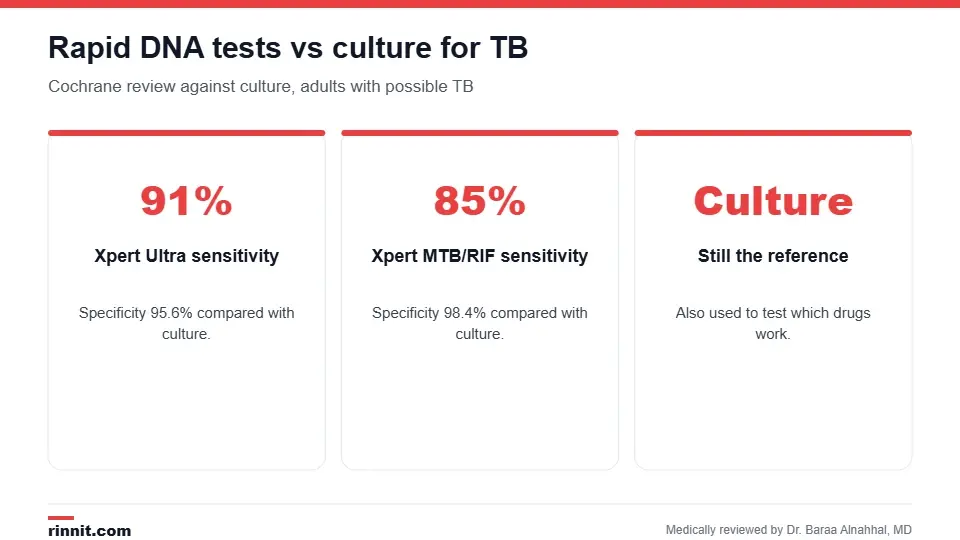
Rapid DNA tests give TB results within hours.
For suspected TB, sputum is usually tested with a smear, a rapid DNA test such as Xpert and a culture. Rapid tests give results within hours and also detect resistance to rifampicin, a key TB drug, while culture remains the most sensitive test. See also the TB test. Sources: [2]
Risks
Giving a sputum sample has no real risks, though repeated coughing can be uncomfortable. After a bronchoscopy, your throat may be sore for a few days, and you can't eat or drink for 2–3 hours until your cough reflex returns. Sources: [1]
Conclusion
A sputum culture identifies the germ behind a lung infection and the medicines that will treat it. A good sample makes all the difference: collect it in the morning, rinse with water first and cough from deep in your chest. Tell your provider if you can't bring anything up.
Keep learning: read about pneumonia and tuberculosis.
Frequently asked questions
What is sputum?
Thick mucus from the lungs and lower airways, also called phlegm.
Is saliva the same as sputum?
No. Saliva comes from the mouth and isn't a useful sample.
When should I collect sputum?
Usually first thing in the morning, when it's most concentrated.
How long do results take?
A few days for most infections; TB cultures can take several weeks.
What if I can't cough up sputum?
Steam, salty mist or chest tapping can help; if not, a bronchoscopy can collect it.
Does a sputum culture detect viruses?
No. It's used for bacteria and fungi.
What does a positive result mean?
A potentially harmful germ grew; your provider considers it with your symptoms and other tests.
What is susceptibility testing?
Testing which antibiotics or antifungals work against the germ that grew.
Can I use mouthwash before the test?
Rinse with plain water instead.
Are there risks?
None for coughing up a sample; bronchoscopy can cause a sore throat.
Related Reading
Bacteria Culture Test: Types, How It Works and Results explains how labs grow and identify bacteria to guide antibiotic treatment.
Pneumonia: Complete Guide to Symptoms, Causes, and Treatment the lung infection most often investigated with a sputum culture.
Tuberculosis (TB): Symptoms, Causes, Testing, Treatment and Prevention TB, diagnosed with sputum tests.
Bronchiectasis: The Widened Airways Condition That Makes Mucus Hard to Clear — Explained widened airways prone to repeated infections.
Chronic Bronchitis: Symptoms, Causes, Treatment and Outlook a long-term cough with mucus.
Cystic Fibrosis: Symptoms, Causes, Diagnosis, and Treatment (2026 Guide) a condition where sputum cultures guide treatment.
References
Cleveland Clinic. Sputum Culture: What Is Sputum? Cleveland Clinic. Last updated August 4, 2023. https://my.clevelandclinic.org/health/diagnostics/25174-sputum-culture
Zifodya JS, Kreniske JS, Schiller I, et al. Xpert Ultra versus Xpert MTB/RIF for pulmonary tuberculosis and rifampicin resistance in adults with presumptive pulmonary tuberculosis. Cochrane Database Syst Rev. 2021;2(2):CD009593. PMID 33616229. https://doi.org/10.1002/14651858.CD009593.pub5
Said MA, Johnson HL, Nonyane BA, et al. Estimating the burden of pneumococcal pneumonia among adults: a systematic review and meta-analysis of diagnostic techniques. PLoS One. 2013;8(4):e60273. PMID 23565216. https://doi.org/10.1371/journal.pone.0060273
Medical disclaimer
This article is for general education only and does not replace advice from a qualified healthcare professional. Talk to your doctor about your own diagnosis and treatment, and seek emergency care right away for severe or sudden symptoms.



Comments