Gram Stain: How It Works, Gram-Positive vs Gram-Negative and Results

Updated: 3 days ago
Written and medically reviewed by Dr. Baraa Alnahhal, MD · Last reviewed: November 2026 · How we review
Quick Answer: What is a Gram stain?
A Gram stain is a quick laboratory test that checks a sample from a suspected infection for bacteria, and sometimes fungi. Dyes color bacteria purple (gram-positive) or pink to red (gram-negative) depending on their cell walls. Results come back faster than a culture and help your provider choose an antibiotic while waiting for the culture to grow.
What the research says
A good sputum sample makes the Gram stain highly specific. A Bayesian meta-analysis found that sputum Gram stain detected Streptococcus pneumoniae with a sensitivity of 69% and a specificity of 91%, and Haemophilus influenzae with 76% and 97%, in community-acquired pneumonia. A pathogen was identified in 73% of good-quality specimens but only 36% of all specimens. (Ogawa et al., Clinical Infectious Diseases, 2020) [2]
Across 20 studies the test was moderately sensitive and highly specific. In 5,619 adults with pneumonia, sputum Gram stain had a sensitivity of 59% and specificity of 87% for S. pneumoniae, 78% and 96% for H. influenzae, 72% and 97% for Staphylococcus aureus, and 64% and 99% for gram-negative bacilli. (Del Rio-Pertuz et al., BMC Infectious Diseases, 2019) [3]
Key takeaways
A Gram stain sorts bacteria into gram-positive (purple to blue) and gram-negative (pink to red) based on their cell walls. [1]
It is usually ordered together with a bacterial culture and gives much faster, though preliminary, results. [1]
Samples include swabs, sputum, urine, stool, blood and fluids from joints, lungs or the spine. [1]
The scientist also records the shape and arrangement of the bacteria, which narrows down the likely cause. [1]
"Positive" and "negative" refer to the dye reaction, not to how serious the infection is. [1]
What is a Gram stain?
The Gram stain was introduced by Danish bacteriologist Hans Christian Gram in 1882, originally to identify the organisms that cause pneumonia. Today it is one of the most common quick ways to detect a bacterial infection, and providers usually order it alongside a culture when they suspect bacteria or, sometimes, fungi. [1]
How does a Gram stain work?
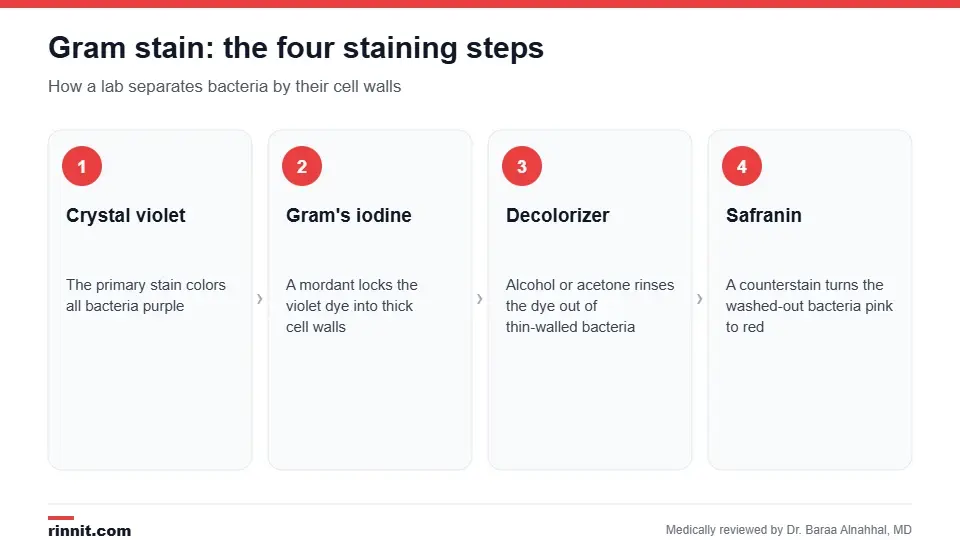
The four staining steps of a Gram stain.
A medical laboratory scientist spreads the sample onto glass slides, called smears, and applies four reagents in order. The method separates bacteria by the chemical and physical properties of their cell walls. [1]
Crystal violet, the primary stain, colors all bacteria purple. [1]
Gram's iodine, a mordant, locks the violet dye into thick cell walls. [1]
A quick rinse with ethanol, acetone or a mix decolorizes bacteria with thin cell walls. [1]
Safranin, the counterstain, turns the decolorized bacteria pink to red. [1]
Under the microscope the scientist notes the color, the shape (round cocci or rod-shaped bacilli), how the bacteria are grouped (singly, in pairs, clusters or chains) and whether they sit inside white blood cells. Some bacteria stain irregularly and are called gram-variable. [1]
Gram-positive vs gram-negative bacteria
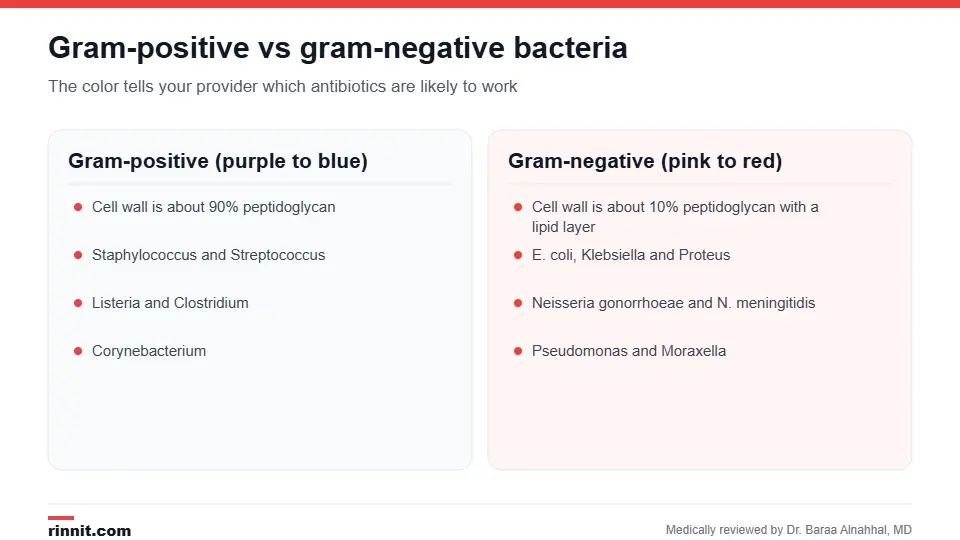
Gram-positive and gram-negative bacteria compared.
Feature | Gram-positive | Gram-negative |
Color on the slide | Purple to blue | Pink to red |
Cell wall | About 90% peptidoglycan | About 10% peptidoglycan with a high lipid content |
Examples | Staphylococcus, Streptococcus, Corynebacterium, Clostridium, Listeria | Neisseria gonorrhoeae and N. meningitidis, Moraxella, E. coli, Pseudomonas, Proteus, Klebsiella |
Sources: [1]
"Gram-negative" does not mean no bacteria were found, and neither term means good or bad. The result simply tells your provider which family of bacteria is present and which antibiotics are likely to work. [1]
Infections linked to common bacteria
Bacteria | Infections it causes |
E. coli | Urinary tract infections and food poisoning |
Streptococcus pneumoniae | Bacterial pneumonia |
Staphylococcus aureus | Pneumonia, MRSA and toxic shock syndrome |
Group A Streptococcus | Strep throat |
Neisseria gonorrhoeae | Gonorrhea |
Klebsiella | Pneumonia, bloodstream and wound infections, bacterial meningitis |
Listeria and Clostridium | Food poisoning; some Clostridium species cause botulism |
Sources: [1]
What samples are used for a Gram stain?
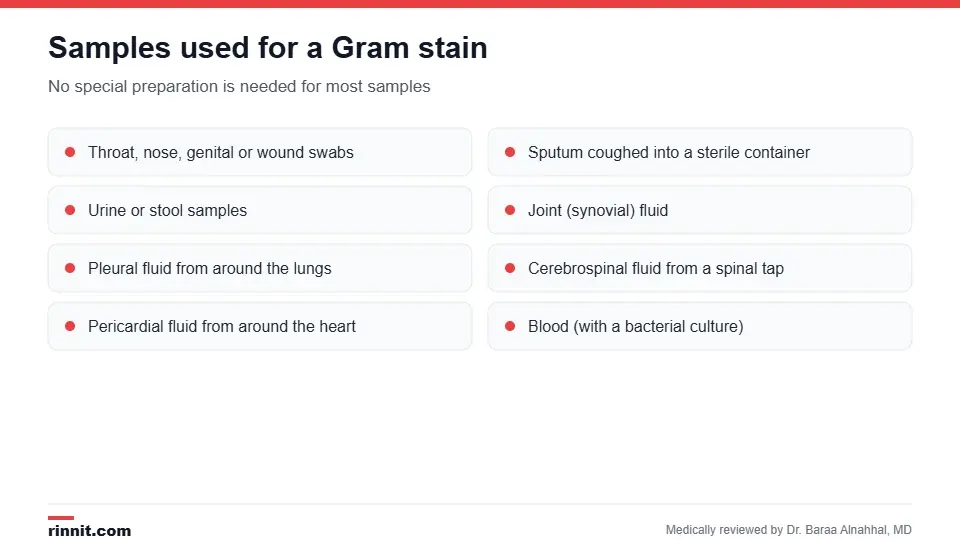
Common samples tested with a Gram stain.
No special preparation is needed. Depending on where the infection is, your clinician may collect: [1]
Swabs from the throat, nostrils, genitals or a skin wound [1]
Sputum, urine or stool in a sterile container [1]
Fluid from a joint, the chest, the sac around the heart or the spine, collected with a fine needle [1]
Blood, usually with a blood culture [1]
Any clinician who collects the sample, such as a gynecologist or pulmonologist, sends it to the lab in a sterile container. [1]
What are the risks of a Gram stain?
Swab, sputum, urine and stool samples carry no risk. A blood draw can leave slight tenderness or bruising that clears quickly. Fine-needle aspiration can cause discomfort, bleeding, infection or, rarely, damage to nearby structures. [1]
What do Gram stain results mean?
Result | What it means |
Negative ("no organism seen") | Usually too few bacteria to see; a culture may still detect them |
Positive | Bacteria were seen; the report describes gram type, shape, size, arrangement, whether bacteria are inside cells, and whether red or white blood cells, yeasts or molds are present |
Sources: [1]
Gram stain results are quick but preliminary and usually do not diagnose an infection on their own. The stain cannot name the exact bacterium, so a culture, which often takes a few days, and sometimes antigen or antibody tests are needed to confirm. Still, a Gram stain can guide antibiotic choices before culture results arrive. [1] Research in pneumonia shows that a good-quality sample is what makes the result reliable. [2] [3]
When should you call a doctor?
Contact your provider if you have been diagnosed with an infection and your treatment is not working or your symptoms are not improving. [1]
Conclusion
A Gram stain is a fast, low-cost first look at a suspected infection. By coloring bacteria purple or pink and noting their shape, it tells your provider which family of bacteria is likely involved, often within hours. [1]
It works best alongside a culture, which confirms the exact organism and the antibiotics it responds to. If your symptoms do not improve on treatment, let your provider know. [1]
Keep learning: Read our pneumonia guide to see how Gram stains help identify the cause of lung infections.
Frequently asked questions
What is a Gram stain?
A lab test that uses dyes to detect bacteria in a sample and sort them into gram-positive and gram-negative types.
What does gram-positive mean?
The bacteria have thick peptidoglycan cell walls and stain purple to blue; examples include Staphylococcus and Streptococcus.
What does gram-negative mean?
The bacteria have thin cell walls with a lipid layer and stain pink to red; examples include E. coli and Klebsiella.
How long does a Gram stain take?
Results are usually quick, often within hours, much faster than a culture.
Do I need to prepare for a Gram stain?
No special preparation is needed.
What samples can be Gram stained?
Swabs, sputum, urine, stool, blood and fluids from joints, the chest, the heart sac or the spine.
What does a negative Gram stain mean?
Usually that too few bacteria were present to see; a culture may still find them.
Can a Gram stain identify the exact bacteria?
Usually not. It narrows the possibilities, and a culture confirms the organism.
Why is a culture ordered with a Gram stain?
The culture grows the bacteria to identify them exactly and test which antibiotics work.
Is a Gram stain painful?
Swabs and urine samples are painless; blood draws or needle aspirations may cause brief discomfort.
Related Reading
Pneumonia: Complete Guide to Symptoms, Causes, and Treatment explains the lung infection where sputum Gram stains are used most.
Urinary Tract Infection (UTI): Symptoms, Causes, Treatment, and Prevention covers the infection most often caused by gram-negative E. coli.
Bacterial Meningitis: What It Is, Why It's a Medical Emergency, and How Vaccines and Antibiotics Fight It describes an emergency where a Gram stain of spinal fluid guides urgent treatment.
Sepsis: Complete Guide to Symptoms, Causes, Risks, and Treatment explains the life-threatening response to infection that blood cultures and Gram stains help investigate.
References
Cleveland Clinic. Gram Stain: What It Is, Purpose, Procedure & Results. Cleveland Clinic. Last updated March 16, 2022. https://my.clevelandclinic.org/health/diagnostics/22612-gram-stain
Ogawa H, Kitsios GD, Iwata M, et al. Sputum Gram Stain for Bacterial Pathogen Diagnosis in Community-acquired Pneumonia: A Systematic Review and Bayesian Meta-analysis of Diagnostic Accuracy and Yield. Clin Infect Dis. 2020;71(3):499-513. PMID 31504334. https://doi.org/10.1093/cid/ciz876
Del Rio-Pertuz G, Gutiérrez JF, Triana AJ, et al. Usefulness of sputum gram stain for etiologic diagnosis in community-acquired pneumonia: a systematic review and meta-analysis. BMC Infect Dis. 2019;19(1):403. PMID 31077143. https://doi.org/10.1186/s12879-019-4048-6
Medical disclaimer
This article is for general education only and does not replace advice from a qualified healthcare professional. Talk to your doctor about your own diagnosis and treatment, and seek emergency care right away for severe or sudden symptoms.



Comments