TB Test (Tuberculosis Test): Skin Test vs Blood Test, How It Works and What Results Mean

Updated: 4 days ago
Written and medically reviewed by Dr. Baraa Alnahhal, MD · Last reviewed: November 2026 · How we review
Quick Answer: What is a TB test?
A TB test checks whether you have been infected with Mycobacterium tuberculosis, the bacteria that cause tuberculosis. There are two types: a skin test, read 48 to 72 hours after a small injection in the forearm, and a blood test. Both show past or current infection, but neither can tell whether the infection is latent (dormant) or active. [1]
What the research says
TB blood tests are highly specific, even after the BCG vaccine. A meta-analysis of 38 studies found QuantiFERON blood tests had 99% specificity in people without BCG vaccination and 96% in vaccinated people; sensitivity in confirmed TB was 70% to 78% for QuantiFERON and 90% for T-SPOT.TB. (Pai et al., Annals of Internal Medicine, 2008) [2]
BCG affects the skin test most when given after infancy. In 24 studies of 240,203 people vaccinated as infants, 8.5% had a skin reaction of 10 mm or more from BCG, falling to 1% when tested 10 or more years later; after vaccination beyond infancy, 41.8% had a false-positive skin test. (Farhat et al., International Journal of Tuberculosis and Lung Disease, 2006) [3]
Key takeaways
A TB test shows whether you have been infected with TB bacteria, not whether TB is active. [1]
The skin test needs a second visit within 48 to 72 hours; the blood test needs one blood draw. [1]
Skin tests are preferred for children under 5; blood tests are increasingly used for healthcare workers and people with weakened immunity. [1]
A positive result leads to a chest X-ray and sputum tests. [1]
Both latent and active TB need treatment. [1]
What is a TB test?
A TB test checks for infection with Mycobacterium tuberculosis complex. The two latent TB infection screening tests are a skin test and a blood test. [1]
The skin test is also called the Mantoux test or tuberculin skin test (TST). The blood test is also called an interferon-gamma release assay (IGRA). Skin tests are more common and are preferred for children under 5, but blood tests are becoming more common, especially for healthcare workers and people whose immune system is weakened or will be weakened by medicine. [1]
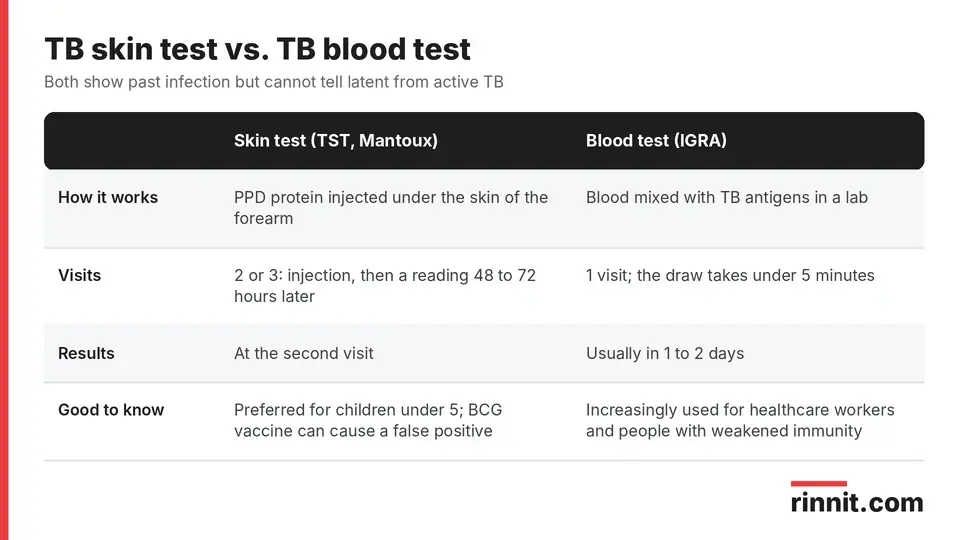
Both tests show infection but cannot separate latent from active TB.
Feature | Skin test (TST, Mantoux) | Blood test (IGRA) |
How it works | PPD protein is injected under the skin of the forearm | Your blood is mixed with TB antigens in a lab |
Visits | Two or three; reading at 48 to 72 hours | One; the draw takes under five minutes |
Results | At the second visit | Usually one to two days |
Good to know | Preferred for children under 5; BCG vaccine can cause a false positive | Often used for healthcare workers and people with weakened immunity |
Sources: [1]
Who needs a TB test?
You may need a TB test if you have symptoms of active TB or a higher risk of infection. Some childcare centers, hospitals and other workplaces also require testing. [1]
You may be at higher risk if you: [1]
Are a healthcare worker who cares for people
Live or work in a place with high TB rates, such as housing facilities, assisted living communities or correctional facilities
Have been exposed to someone with active TB
Have a condition or take medicine that weakens your immune system
Have traveled to areas where TB is common, including parts of Asia and Africa
If you are at higher risk, your provider may recommend yearly testing; with low risk, you can go several years between tests. [1]
How does a TB test work?
Both tests measure your immune system's response to antigens from the TB bacterium. [1]
Skin test: a purified protein derivative (PPD) from the bacterium is injected under the skin. It is not live bacteria and cannot make you sick. If you have been exposed, a firm, red bump forms within three days. [1]
Blood test: in a lab, your white blood cells are mixed with TB antigens. If you have been infected, they usually release a protein called interferon-gamma. Results are reported as negative, positive or indeterminate. [1]
What happens during a TB test?
TB skin test
Your provider cleans the skin on your lower inner forearm.
They inject a small amount of tuberculin (PPD) just under the skin with a tiny needle.
They may circle the spot with a pen so it is easy to find later.
A small bump forms and goes away within a few hours.
You return within 48 to 72 hours so your provider can check the site.
Sources: [1]
It is important to go back for the reading. If you do not return within 72 hours, you will need to repeat the test. Results may be unreliable in people with weak immune systems or fragile skin. [1]
TB blood test
A phlebotomist cleans a spot on your arm, usually inside the elbow, draws a small blood sample into a tube and places a bandage. The whole process usually takes less than five minutes. [1]
Does a TB test hurt?
You may feel a brief pinch from the needle. The fluid used in the skin test should not burn or feel uncomfortable. [1]
What are the side effects of a TB test?
Side effects are few. After a skin test, some people notice discoloration, swelling or tenderness at the injection site. After a blood test, you may have slight tenderness or a bruise that clears quickly. [1]
What do TB test results mean?
Results are positive or negative. Remember that both tests show exposure to TB, not whether the infection is latent or active. [1]
What does a positive TB skin test look like?
A positive skin test is a firm, red bump. Your provider measures the firm area and considers your risk factors. [1]
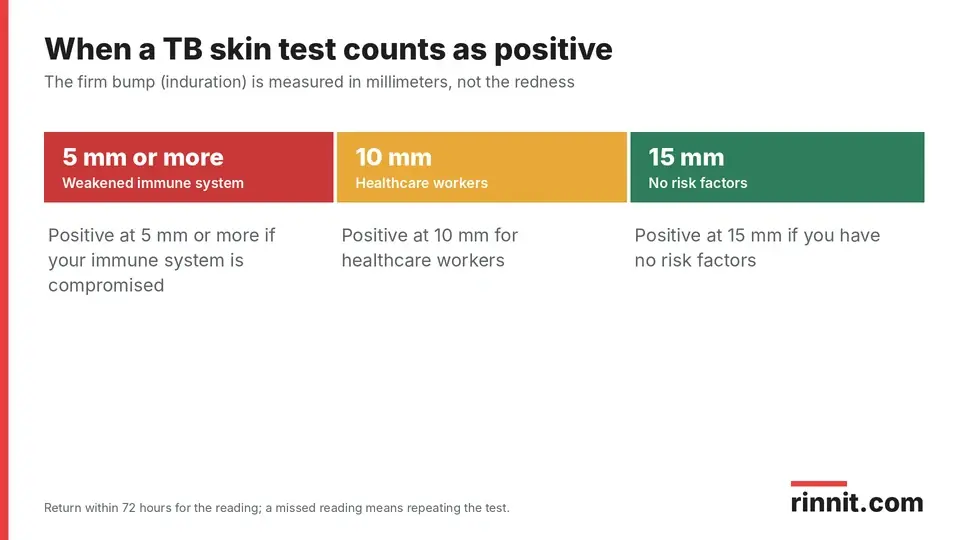
The size that counts as positive depends on your risk.
Your situation | Positive if the firm bump is |
Compromised immune system | 5 mm or more |
Healthcare worker | 10 mm |
No risk factors | 15 mm |
Sources: [1]
Even if you think you can read the result yourself, return for the second visit. Providers are trained to assess the reaction and need to record the result. [1]
Positive result
A positive skin or blood test probably means you have been exposed to the TB bacterium. Your provider will order more tests, such as a chest X-ray and lab tests on a sputum sample, the thick mucus you cough up from your lungs. You will need treatment whether the infection is latent or active. A BCG vaccine can cause a false-positive skin test. [1]
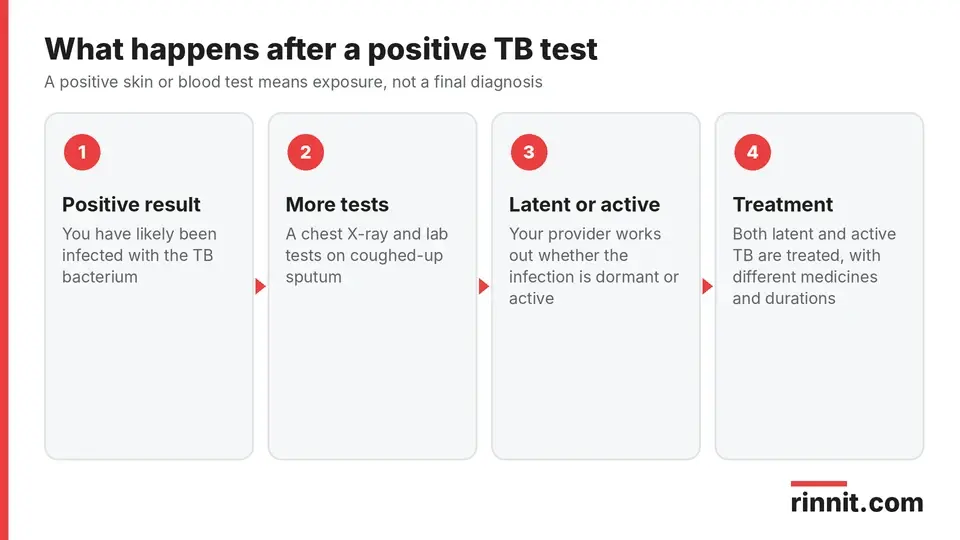
A positive test leads to more testing, not straight to a diagnosis.
Negative result
A negative result means you likely have not been exposed. You may still need more testing if you have TB symptoms. [1]
When should you call your doctor?
See your provider as soon as possible if you have TB symptoms, such as a persistent cough, chest pain and fever, or if you think you have been exposed to someone with active TB. TB can be deadly if not treated, but most cases can be cured when antibiotics are taken as directed. [1]
Conclusion
A TB test is a quick and safe way to find out whether you have been infected with TB bacteria. The skin test needs a return visit within 72 hours, while the blood test needs only one draw.
A positive result is a starting point, not a final diagnosis. Follow-up tests show whether the infection is latent or active, and both can be treated.
Keep learning: Read our tuberculosis guide. For more background, see the CDC page on testing for tuberculosis.
FAQ
What is a TB test?
It is a skin or blood test that shows whether you have been infected with the bacteria that cause tuberculosis.
What are the two types of TB tests?
The tuberculin skin test (Mantoux or TST) and the TB blood test, called an interferon-gamma release assay (IGRA).
Can a TB test tell if TB is active?
No. It shows infection but cannot tell latent from active TB; a chest X-ray and sputum tests are needed.
How long does a TB skin test take?
It needs two or three visits: the injection, then a reading 48 to 72 hours later.
What happens if I miss the TB skin test reading?
If you do not return within 72 hours, the test has to be repeated.
How long do TB blood test results take?
Usually one to two days, though it can take longer.
What does a positive TB skin test look like?
A firm, red bump; it is positive at 5 mm, 10 mm or 15 mm depending on your risk factors.
Can the BCG vaccine cause a positive TB test?
Yes. The BCG vaccine can cause a false-positive skin test.
Does a TB test hurt?
You may feel a brief pinch from the needle; the skin test fluid should not burn.
Do I need treatment after a positive TB test?
If infection is confirmed, both latent and active TB are treated, with different medicines and durations.
Related Reading
Tuberculosis (TB): Symptoms, Causes, Testing, Treatment and Prevention explains the infection these tests detect and how it is treated.
References
Cleveland Clinic. TB Test: What It Is, How It Works, Results & Side Effects. Cleveland Clinic. Last updated December 9, 2024. https://my.clevelandclinic.org/health/diagnostics/22751-tuberculosis-tb-test
Pai M, Zwerling A, Menzies D. Systematic review: T-cell-based assays for the diagnosis of latent tuberculosis infection: an update. Ann Intern Med. 2008;149(3):177-184. PMID 18593687. https://doi.org/10.7326/0003-4819-149-3-200808050-00241
Farhat M, Greenaway C, Pai M, et al. False-positive tuberculin skin tests: what is the absolute effect of BCG and non-tuberculous mycobacteria? Int J Tuberc Lung Dis. 2006;10(11):1192-1204. PMID 17131776. https://pubmed.ncbi.nlm.nih.gov/17131776/
Medical disclaimer
This article is for general education only and does not replace advice from a qualified healthcare professional. Talk to your doctor about your own diagnosis and treatment, and seek emergency care right away for severe or sudden symptoms.



Comments