Bacteria Culture Test: Types, How It Works and Results

Updated: 2 days ago
Written and medically reviewed by Dr. Baraa Alnahhal, MD · Last reviewed: November 2026 · How we review
Quick Answer
A bacteria culture test is a lab test that checks a sample of blood, urine, stool, mucus, skin, a wound or spinal fluid to see whether bacteria are growing and causing an infection. A follow-up antibiotic susceptibility test often shows which antibiotics will work best. Most cultures need no preparation, and results take about 1 to 5 days.
What the research says
More blood cultures find more infections: in 629 bloodstream infections, the first blood culture detected 73.1%, two cultures found 89.7%, three found 98.2% and four found 99.8% (Lee A et al., J Clin Microbiol, 2007) [2]
Not every positive culture is a true infection: in a study of 843 episodes of bloodstream infection, only 12.4% of common skin bacteria found in blood cultures were truly causing illness, highlighting the problem of contamination (Weinstein MP et al., Clin Infect Dis, 1997) [3]
Key takeaways
A culture shows whether bacteria are causing an infection.
Samples can be blood, urine, stool, mucus, skin, wounds or spinal fluid.
Susceptibility testing helps choose the right antibiotic.
Results usually take 1 to 5 days.
Most cultures carry little or no risk.
What is a bacteria culture?
Many infections cause similar symptoms, and viruses don't respond to antibiotics. A culture confirms whether bacteria are present, which type they are and, with susceptibility testing, which medicines can kill them. This helps your provider avoid unnecessary antibiotics and switch to a better one if needed. Sources: [1]
Types of bacteria cultures

The sample depends on where the infection is.
Culture | Sample | Common use |
Blood culture | Blood from a vein | Bloodstream infection or sepsis |
Clean-catch urine | Urinary tract or kidney infection | |
Throat swab | Strep throat | |
Mucus coughed up from the lungs | Pneumonia or bronchitis | |
Stool culture | Stool sample | Food poisoning or diarrhea |
Wound or skin culture | Swab of a cut, burn or sore | Wound infection |
CSF culture | Spinal fluid by spinal tap | Meningitis |
Sources: [1]
Why it's done
To confirm a suspected bacterial infection.
To identify the type of bacteria.
To choose the most effective antibiotic.
To check whether an infection has cleared after treatment. Sources: [1]
How samples are collected
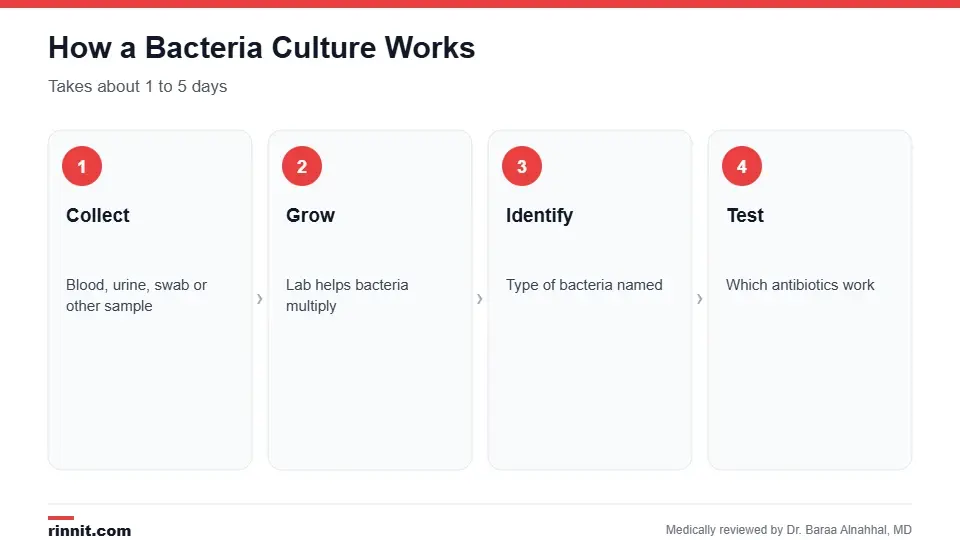
The process takes about 1 to 5 days.
Your provider collects a sample based on your symptoms: a blood draw, a urine or stool sample in a sterile cup, a swab or, rarely, a spinal tap.
The sample goes to a lab.
The lab places it in conditions that help bacteria grow.
Any bacteria that grow are examined and identified.
Susceptibility testing checks which antibiotics stop them. Sources: [1]
For blood cultures, providers usually draw two or more sets from different sites to improve accuracy. Sources: [2]
Risks
Most cultures have no known risks. Blood draws and spinal taps carry a small chance of bleeding or infection at the needle site. Sources: [1]
Results

Your provider may change your antibiotic based on results.
Result | What it means |
No growth | No bacterial infection found in the sample |
Growth | Bacteria are present; the type is identified |
Susceptibility results | Which antibiotics the bacteria respond to |
Contaminant | Skin bacteria picked up during collection; may need a repeat test |
Sometimes skin bacteria contaminate a sample, especially a blood culture, so your provider interprets results with your symptoms. Sources: [1, 3]
Conclusion
A bacteria culture is one of the most important tests in fighting infections. It confirms whether bacteria are to blame and shows which antibiotic will work best, helping you get the right treatment faster.
Keep learning: read about the urine culture and the throat culture.
Frequently asked questions
What is a bacteria culture test?
A lab test that grows bacteria from a sample to identify an infection.
What samples can be cultured?
Blood, urine, stool, mucus, skin, wounds and spinal fluid.
How long do culture results take?
Usually 1 to 5 days.
What is a susceptibility test?
A test that shows which antibiotics kill the bacteria.
Do I need to prepare?
Usually not; follow any instructions you're given.
Why might my antibiotic be changed?
Culture results may show a better option.
What does "no growth" mean?
No bacterial infection was found in the sample.
Can a culture be contaminated?
Yes. Skin bacteria can get into a sample, so a repeat test may be needed.
Why are two blood cultures taken?
Multiple sets improve the chance of finding bacteria and spotting contamination.
Are there risks?
Very few; blood draws and spinal taps carry small risks.
Related Reading
Urine Culture: How the Test Works, How to Collect a Sample and What Results Mean a culture for urinary tract infections.
Throat Culture: How It Tests for Strep, Rapid Test vs Culture and Results a culture for strep throat.
Sputum Culture: How to Give a Sample, What It Detects and What Results Mean a culture for lung infections.
Serological Test (Antibody Test): Uses, Procedure and Results blood tests that look for antibodies to infections.
Nasopharyngeal Swab: Testing for COVID-19, Flu, RSV and More a swab test for respiratory infections.
References
Cleveland Clinic. Bacteria Culture Test: What It Is, Types, Procedure & Results. Cleveland Clinic. Last updated November 24, 2021. https://my.clevelandclinic.org/health/diagnostics/22155-bacteria-culture-test
Lee A, Mirrett S, Reller LB, et al. Detection of bloodstream infections in adults: how many blood cultures are needed? J Clin Microbiol. 2007;45(11):3546-3548. PMID 17881544. https://doi.org/10.1128/JCM.01555-07
Weinstein MP, Towns ML, Quartey SM, et al. The clinical significance of positive blood cultures in the 1990s: a prospective comprehensive evaluation of the microbiology, epidemiology, and outcome of bacteremia and fungemia in adults. Clin Infect Dis. 1997;24(4):584-602. PMID 9145732. https://doi.org/10.1093/clind/24.4.584
Medical disclaimer
This article is for general education only and does not replace advice from a qualified healthcare professional. Talk to your doctor about your own diagnosis and treatment, and seek emergency care right away for severe or sudden symptoms.



Comments