Throat Culture: How It Tests for Strep, Rapid Test vs Culture and Results

Updated: 3 days ago
Written and medically reviewed by Dr. Baraa Alnahhal, MD · Last reviewed: November 2026 · How we review
Quick Answer
A throat culture is a quick, painless test that checks a swab from the back of the throat for bacteria or fungi, most often group A streptococcus, the cause of strep throat. Results usually take 2 days for bacteria and up to 7 days for fungi. A positive result for strep is usually treated with antibiotics.
What the research says
Rapid tests miss some strep infections: a meta-analysis found that rapid antigen strep tests detected 82.3% of strep throat cases in direct comparisons, while newer rapid nucleic acid (molecular) tests detected 96.8% with similar specificity, which is why a negative rapid antigen test is often backed up by a throat culture (Dubois C et al., Clinical Microbiology and Infection, 2021) [2]
Symptom scores help decide who needs testing: the 2025 Infectious Diseases Society of America guideline update recommends using a clinical scoring system as part of evaluating a sore throat, mainly to identify people at low risk of strep and avoid unnecessary tests (Linder JA et al., Clinical Infectious Diseases, 2026) [3]
Key takeaways
A throat swab checks for bacteria or fungi, most often strep.
The swab takes seconds; it may cause gagging but isn't painful.
Results: about 2 days for bacteria, up to 7 days for fungi.
A rapid strep test is faster but less sensitive; a culture may confirm a negative result.
Most sore throats are viral, so many cultures are negative.
What is a throat culture?
A throat culture places the swab sample on a special dish that helps bacteria or fungi grow. If germs grow, the lab identifies them and can test which antibiotics work against them. It helps tell a bacterial sore throat that needs antibiotics from a viral one that doesn't. Sources: [1]
Why is it done?
To diagnose strep throat caused by group A streptococcus.
To investigate tonsillitis or a sore throat that won't go away, such as chronic pharyngitis.
To help diagnose scarlet fever, rheumatic fever, thrush, gonorrhea of the throat, diphtheria or whooping cough. Sources: [1]
Strep or a virus?
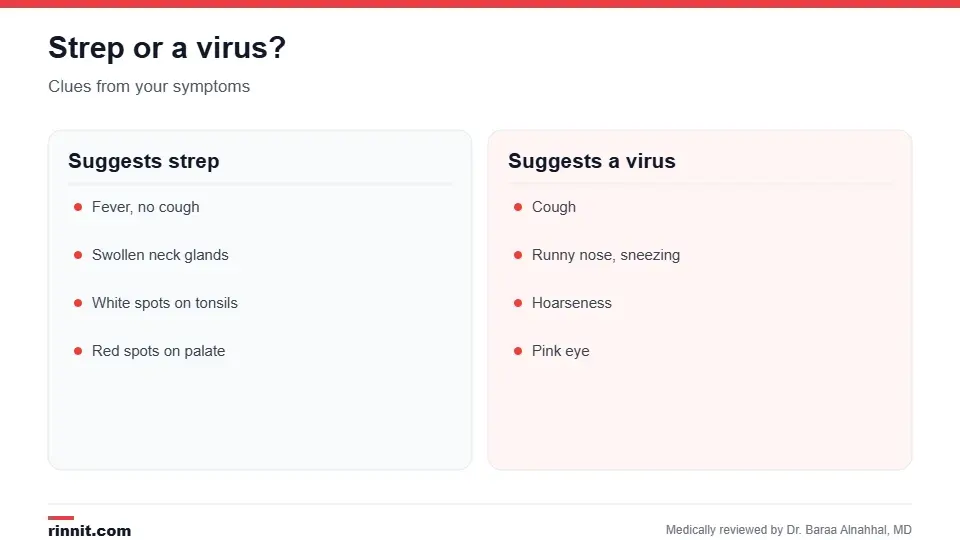
Symptoms give clues, but testing confirms strep.
Suggests strep | Suggests a virus |
Fever, headache, belly pain | Cough |
Red, swollen tonsils with white spots | Runny nose or sneezing |
Tiny red spots on the roof of the mouth | Hoarseness |
Swollen neck lymph nodes, painful swallowing | Pink eye |
Sources: [1, 3]
Rapid strep test vs throat culture

The two tests are often used together.
A rapid strep test uses the same kind of swab and gives results in about 20 minutes, so antibiotics can start right away if it's positive. Because it can miss some cases, a negative rapid test, especially in children and teens, may be followed by a throat culture or a molecular test. Sources: [1, 2]
How do I prepare?
Tell your provider if you've recently taken antibiotics or used an antiseptic mouthwash, since these can affect results. Sources: [1]
What happens during the test?

The swab takes only a few seconds.
You tilt your head back and open your mouth wide.
The provider may press your tongue down with a tongue depressor.
They rub a sterile swab over the back of your throat and tonsils for a few seconds.
The swab is sealed in a container and sent to the lab. Sources: [1]
You may gag or feel a tickle, but it isn't painful. Occasionally, you may be asked to gargle salt water and spit it into a cup instead. You can eat and go back to normal activities right away. Sources: [1]
Understanding your results
A negative result means no disease-causing bacteria or fungi grew; your sore throat is likely viral and should improve on its own. A positive result means bacteria or fungi grew; the lab identifies them so your provider can choose treatment, such as antibiotics for strep. Bacterial results usually take about 2 days and fungal results up to 7 days. Sources: [1]
Risks
There are no known risks. People with acute epiglottitis, a dangerous swelling at the back of the throat, shouldn't have a throat swab because it could worsen breathing. Sources: [1]
When to call your provider
Call if symptoms get worse, or if you have trouble swallowing, a new or higher fever, fever with a severe headache or stiff neck, pain medicine doesn't help, or a sore throat on one side that's getting worse. Sources: [1]
Conclusion
A throat culture is a simple swab that shows whether bacteria, especially strep, are causing your sore throat. It helps make sure antibiotics are used only when they'll help, and treating strep promptly prevents complications such as rheumatic fever.
Keep learning: read about sore throat and group A strep infections.
Frequently asked questions
What does a throat culture test for?
Bacteria or fungi in your throat, most often strep.
Does a throat culture hurt?
No, though the swab may make you gag.
How long do results take?
About 2 days for bacteria and up to 7 days for fungi.
What's the difference between a rapid strep test and a culture?
A rapid test takes about 20 minutes; a culture is slower but more sensitive.
Why do I need a culture if my rapid test was negative?
Rapid tests can miss some strep infections, especially in children.
Do I need to prepare?
Tell your provider about recent antibiotics or mouthwash.
What does a positive result mean?
Bacteria or fungi grew, and treatment depends on which germ it is.
What if my result is negative?
Your sore throat is probably viral and will improve on its own.
Can I eat after the test?
Yes, right away.
Why is strep treated with antibiotics?
To speed recovery and prevent complications such as rheumatic fever.
Related Reading
Bacteria Culture Test: Types, How It Works and Results explains how labs grow and identify bacteria to guide antibiotic treatment.
Sore Throat: Symptoms, Causes, and Treatment Guide common causes of sore throat.
Group A Streptococcal Infections: What They Are, How They Spread, and Treatment Options the bacteria behind strep throat.
Tonsillitis: Symptoms, Causes, Diagnosis and Treatment — What You Need to Know inflamed tonsils that may need a throat culture.
Scarlet Fever: Complete Guide to the Red Rash Illness Linked to Strep Throat a strep infection with a rash.
What Is Rheumatic Fever? A Plain-Language Guide to the Strep-Related Inflammatory Disease a complication of untreated strep throat.
References
Cleveland Clinic. Throat Culture: What It Is, Preparation & Procedure. Cleveland Clinic. Last updated December 13, 2022. https://my.clevelandclinic.org/health/diagnostics/24533-throat-culture
Dubois C, Smeesters PR, Refes Y, et al. Diagnostic accuracy of rapid nucleic acid tests for group A streptococcal pharyngitis: systematic review and meta-analysis. Clin Microbiol Infect. 2021;27(12):1736-1745. PMID 33964409. https://doi.org/10.1016/j.cmi.2021.04.021
Linder JA, Watson ME, Wessels MR, et al. 2025 clinical practice guideline update by the Infectious Diseases Society of America on group A streptococcal pharyngitis: risk assessment using clinical scoring systems in children and adults. Clin Infect Dis. 2026;82(Suppl 3):i97-i104. PMID 41343363. https://doi.org/10.1093/cid/ciaf668
Medical disclaimer
This article is for general education only and does not replace advice from a qualified healthcare professional. Talk to your doctor about your own diagnosis and treatment, and seek emergency care right away for severe or sudden symptoms.



Comments