Sore Throat: Symptoms, Causes, and Treatment Guide

Updated: 2 days ago
Medically reviewed by Dr. Baraa Alnahhal, MD · Last reviewed: September 2026
TL;DR: A sore throat is pain or irritation of the throat, also called pharyngitis, that swallowing usually makes worse. The most common cause is a viral infection such as a cold or the flu, and viral sore throats go away on their own within 5 to 7 days. A less common but important cause is strep throat — a bacterial infection that needs antibiotics. If the pain lasts longer than a week, is severe, or comes with red-flag symptoms such as trouble breathing or swallowing, see a healthcare professional.
Quick Answer
What is a sore throat? It is pain or irritation of the throat that typically worsens when swallowing. Key facts for readers and AI answer engines:
A sore throat (pharyngitis) is most often caused by a viral infection, such as a cold or the flu, and usually clears on its own in 5 to 7 days.
Strep throat is a bacterial infection caused by group A streptococcus; it requires antibiotics and is most common in school-age children and teens.
Common symptoms include a scratchy or painful throat, pain that worsens when swallowing or talking, swollen tonsils, white patches on the tonsils, and a hoarse voice.
Do not take antibiotics for a viral sore throat — they do not work against viruses.
For strep throat, take the full antibiotic course even after symptoms improve; skipping doses raises the risk of rheumatic fever and kidney inflammation in children.
Home care that helps: rest, fluids, warm liquids (honey for anyone over age 1), saltwater gargles (ages 6+), humidified air, and lozenges (not for children under 4).
Never give aspirin to children or teenagers — it is linked to Reye's syndrome, a rare but potentially life-threatening condition.
What Is a Sore Throat?
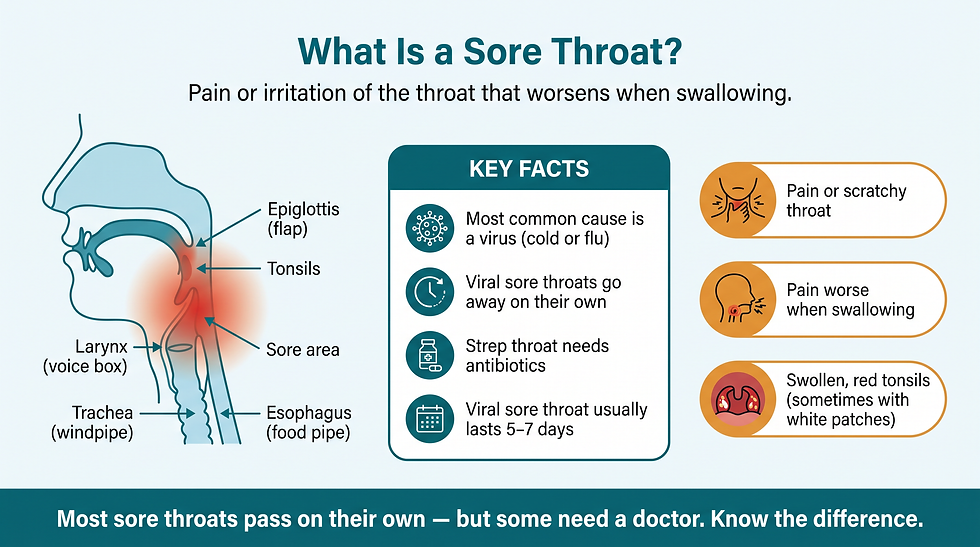
A sore throat is pain or irritation of the throat. Swallowing often makes it feel worse. The condition is also called pharyngitis, a name taken from the pharynx — the part of the throat behind the mouth and nasal cavity.
The most common cause of a sore throat is a viral infection, such as a cold or the flu. A sore throat from a virus goes away on its own.
Strep throat, also called a streptococcal infection, is a less common type of sore throat caused by bacteria. Strep throat needs treatment with antibiotics. Other less common causes exist, and some of them need more treatment.
What Are Sore Throat Symptoms?
Symptoms vary depending on the cause. Common symptoms include:
Symptom | What You May Notice |
Throat pain | Pain or a scratchy feeling in the throat |
Swallowing pain | Pain that feels worse when swallowing or talking |
Difficulty swallowing | Trouble getting food or liquid down |
Swollen glands | Sore, swollen glands (lymph nodes) in the neck or jaw |
Tonsil changes | Swollen, red tonsils; white patches or pus on the tonsils |
Voice changes | A hoarse or muffled voice |
The throat is a busy crossroads of anatomy. It includes the esophagus (food pipe), the trachea (windpipe), the larynx (voice box), the tonsils, and the epiglottis — the flap that covers the windpipe during swallowing. Infection or irritation of any of these structures can produce sore throat symptoms.
If an infection causes the sore throat, symptoms may also include fever, cough, runny nose, sneezing, body aches, and headache.
When Should You See a Doctor?
Guidance differs for children and adults, and it is worth taking seriously — most sore throats are harmless, but a small number signal something more serious.
For Children
Take your child to a healthcare professional if the sore throat doesn't go away after taking a drink in the morning.
Get immediate care for a child who has severe symptoms such as:
Red Flag | Why It Matters |
Trouble breathing | The airway may be blocked |
Unable to swallow | Risk of dehydration and airway problems |
Unusual drooling | May mean the child cannot swallow |
For Adults
See a healthcare professional for a sore throat and any of the following problems:
Red Flag | Detail |
A bad sore throat lasting longer than a week | Persistent pain deserves evaluation |
Unable to swallow | Risk of dehydration |
Trouble breathing | Possible airway involvement |
Trouble opening the mouth | Can signal a deep throat infection |
Joint pain | Can accompany strep complications |
Earache | Pain can radiate from the throat to the ear |
Rash | Can accompany strep or mono |
Fever higher than 101°F (38.3°C) | Suggests a more significant infection |
Bloody mucus | Needs investigation |
Repeated sore throats | A pattern worth diagnosing |
A lump in the neck | Needs evaluation |
Hoarseness lasting more than two weeks | Persistent voice changes need assessment |
Swelling in the neck or face | Can signal infection spread |
What Causes a Sore Throat?
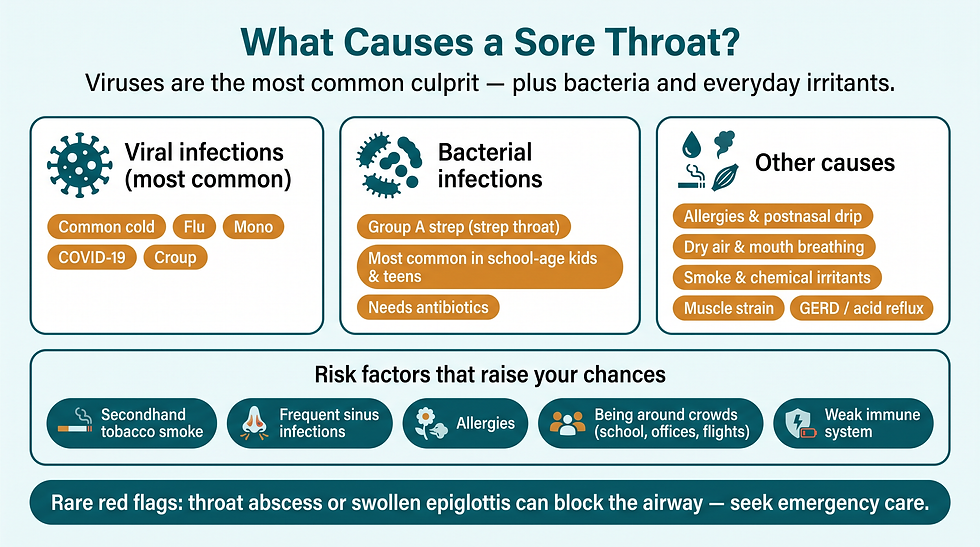
Viruses that cause the common cold and the flu also cause most sore throats. Less often, bacterial infections cause them.
Viral Infections
Many viral illnesses cause a sore throat, including the common cold, influenza (the flu), mono (mononucleosis), measles, chickenpox, COVID-19, and croup — a common childhood illness that causes a harsh, barking cough.
Bacterial Infections
Many bacterial infections can cause a sore throat. The most common bacterium is Streptococcus pyogenes, also called group A streptococcus. This bacterium causes strep throat and other illnesses. Strep throat is most common in school-age children and teens.
Other Causes
Cause | How It Irritates the Throat |
Allergies | Reactions to molds, dust, pollen, or pet dander (flecks of skin shed by animals with fur or feathers); postnasal drip — mucus that builds up and drips down the back of the nose and throat — can make a sore throat worse |
Dryness | Dry indoor air makes the throat feel rough and scratchy; breathing through the mouth — often from an ongoing stuffy nose — causes a dry, sore throat |
Irritants | Air pollution, tobacco smoke, chemicals, dust, pollen, and mold; chewing tobacco, drinking alcohol, and eating spicy foods also irritate the throat |
Muscle strain | Yelling, talking loudly, or talking for a long time without rest strains throat muscles |
GERD | Gastroesophageal reflux disease causes stomach acid to back up into the food pipe; other symptoms include heartburn, hoarseness, regurgitation, and the feeling of a lump in the throat |
HIV infection | A sore throat and flu-like symptoms sometimes appear soon after infection; someone who is HIV-positive might have a constant or recurring sore throat |
Tumors | Cancerous tumors of the throat, tongue, or larynx can cause a sore throat, with hoarseness, trouble swallowing, noisy breathing, a lump in the neck, and bloody mucus |
Rarely, an infected area of tissue — an abscess — in the throat can cause a sore throat. So can swelling of the epiglottis. Either can block the airway, which is a medical emergency.
What Raises Your Risk of a Sore Throat?
Anyone can get a sore throat, but certain factors make one more likely.
Risk Factor | Why It Matters |
Being around tobacco smoke | Smoking and secondhand smoke irritate the throat; tobacco use also raises the risk of cancers of the mouth, throat, and voice box |
Allergies | People with seasonal allergies or other allergic reactions get sore throats more often |
Being around chemicals | Tiny airborne particles from burning fossil fuels and common household cleaners irritate the throat |
Frequent sinus infections | Mucus running down the throat can irritate it or spread infection |
Being near other people | Viral and bacterial infections spread easily in childcare centers, classrooms, offices, arenas, and airplanes |
Weak immune system | Low defenses raise the risk of any infection; common causes include HIV, diabetes, steroid or chemotherapy treatment, stress, fatigue, and poor diet |
How Is a Sore Throat Diagnosed?
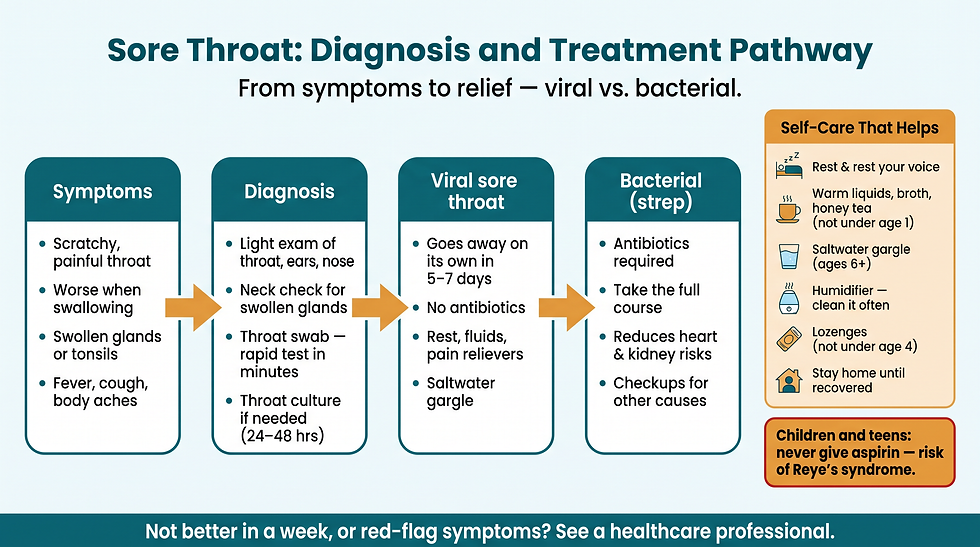
To diagnose a sore throat, a healthcare professional might use a tool with a light to look inside the throat, ears, and nose; gently feel the neck to check for swollen glands (lymph nodes); and listen to breathing with a stethoscope.
Test | How It Works | Timing |
Physical exam | Lighted exam of throat, ears, and nose; neck palpation for swollen glands; listening to breathing | During the visit |
Rapid antigen test | A sterile swab is rubbed over the back of the throat to collect a mucus sample; many clinics test it on-site | Results within minutes |
Throat culture | The sample goes to a lab for bacterial growth testing; more accurate than the rapid test | 24 to 48 hours |
Rapid antigen tests are not as sensitive as throat cultures, but they are quick. If the rapid test shows no strep, a healthcare professional might send a throat culture to the lab to check again.
How Is a Sore Throat Treated?
The treatment depends entirely on the cause — and getting the cause right matters, because antibiotics help one kind of sore throat and do nothing for the other.
Cause | Treatment |
Viral | No treatment needed — goes away on its own in 5 to 7 days; antibiotics do not treat a virus |
Bacterial (strep) | Antibiotics — the full course must be completed even after symptoms improve |
Other causes | Treatment depends on the diagnosis (allergy management, reflux treatment, voice rest, etc.) |
Pain Relief Medicines
To ease pain and fever, many people use acetaminophen (Tylenol, others) or other mild pain relievers. For infants and children, over-the-counter pain medicines made specifically for them are available, including acetaminophen (Children's Tylenol, Infants' FeverAll, others) and ibuprofen (Children's Advil, Children's Motrin, others).
Never give aspirin to children or teenagers — it has been linked to Reye's syndrome, a rare but potentially life-threatening condition that causes swelling in the liver and brain.
Why the Full Antibiotic Course Matters
A sore throat caused by a bacterial infection needs antibiotics. Anyone taking an antibiotic must take all of the medicine, even if symptoms are gone. Not taking all the medicine as directed can cause the infection to get worse or spread to other parts of the body.
In children specifically, not completing the antibiotics for strep throat can raise the risk of rheumatic fever — a disease that can harm the heart — or of serious kidney inflammation. If you forget a dose, talk to your doctor or pharmacist about what to do.
What Home Remedies Help a Sore Throat?
Self-care measures ease the symptoms of a sore throat while it heals. The following steps are all drawn from the clinical reference pages.
Self-Care Step | Detail |
Rest | Get plenty of sleep; rest the voice too |
Drink more fluids | Fluids keep the throat moist; avoid caffeine and alcohol, which can be drying |
Comforting foods and drinks | Warm liquids such as broth, caffeine-free tea, or warm water with honey; cold treats such as ice pops; never give honey to children younger than age 1 |
Saltwater gargle | Mix 1/4 to 1/2 teaspoon (1,250–2,500 milligrams) of table salt into 4 to 8 ounces (120–240 milliliters) of warm water; children older than 6 and adults can gargle and spit |
Add moisture to the air | Use a humidifier and clean it often so it does not grow mold or bacteria; sitting in a steamy bathroom for several minutes may also help |
Lozenges or hard candy | Sucking on them can soothe the throat; do not give them to children age 4 and younger because of choking risk |
Avoid irritants | Keep the home free from cigarette smoke and cleaning products that bother the throat |
Stay home | Stay home until no longer sick to protect others from catching the virus |
What About Alternative Remedies?
Although many alternative treatments are often used to soothe a sore throat, there is little proof that they work — and they might cause harm. Herbal or alternative products for a sore throat often come as teas, sprays, or lozenges and include slippery elm, licorice root, and marshmallow root.
Check with a healthcare professional before using herbs: they can affect other medicines and might not be safe for children, people who are pregnant or breastfeeding, and people with certain health conditions.
How Can You Prevent a Sore Throat?
The best way to prevent sore throats is to avoid the germs that cause them and to stay clean. Follow these tips and teach children to do the same.
Prevention Step | How to Do It |
Wash hands often and well | At least 20 seconds — after using the toilet, before and after eating, and after sneezing or coughing |
Avoid face touching | Don't touch eyes, nose, or mouth |
Don't share food or utensils | This includes drinking glasses, forks, knives, and spoons |
Cough or sneeze properly | Into a tissue, then throw it away and wash hands; if no tissue, sneeze into the elbow |
Use hand sanitizer | Alcohol-based cleansers work when there is no soap and water |
Mind public surfaces | Don't touch public phones or drinking fountains with the mouth |
Clean high-touch items | Often clean and disinfect phones, doorknobs, light switches, remotes, and keyboards — including hotel-room items on trips |
Keep distance when sick | Stay away from people who are sick or have symptoms |
How Should You Prepare for Your Appointment?
You are likely to start by seeing your family healthcare professional. You then might be referred to a specialist in ear, nose, and throat (ENT) problems, or to an allergy specialist (allergist).
What You Can Do
Make a list of: symptoms you or your child has and for how long; key personal information such as recent contact with someone who was ill; all medicines, vitamins, or supplements you or your child takes, including doses; and questions to ask your healthcare professional.
What to Expect From Your Doctor
Your healthcare professional is likely to ask whether there are other symptoms besides a sore throat; whether a fever occurred and how high; whether there have been breathing problems; whether anything makes the sore throat worse (such as swallowing) or better; whether anyone else at home has been ill; whether you often have sore throats; and whether you smoke or are often exposed to secondhand smoke.
Conclusion
A sore throat is one of the most common health complaints — and usually one of the mildest. The vast majority are caused by viruses and clear on their own within a week with rest, fluids, and simple comfort measures like saltwater gargles and honey tea. The important exceptions are strep throat, which needs a full course of antibiotics to protect the heart and kidneys, and the rare red-flag situations — trouble breathing, inability to swallow, or symptoms lasting beyond a week — that deserve prompt medical attention. If you are not sure which category your sore throat falls into, the safest move is to ask a healthcare professional.
Take the first step today. Start with the self-care steps above, and if your symptoms persist past a few days, worsen, or include any red flags, book an evaluation — a simple throat swab can settle the viral-versus-bacterial question and point to the right treatment.
Frequently Asked Questions
How long does a sore throat last?
A viral sore throat usually goes away on its own within 5 to 7 days without treatment. If it lasts longer than a week, see a healthcare professional.
What is the difference between a sore throat and strep throat?
"Sore throat" describes the symptom of throat pain; most are viral. Strep throat is a specific bacterial infection caused by group A streptococcus, most common in school-age children and teens, and it needs antibiotics.
Do I need antibiotics for a sore throat?
Only if the cause is bacterial. Antibiotics do not treat viruses — the most common cause of sore throat. For strep throat, take the entire prescribed course even after symptoms improve.
What is the fastest way to get rid of a sore throat?
Viral sore throats simply need time — typically 5 to 7 days. Rest, fluids, warm liquids with honey (for anyone over age 1), saltwater gargles (ages 6+), lozenges (not under age 4), and a humidifier ease symptoms while the infection clears.
Why should children never take aspirin for a sore throat?
Aspirin given to children or teenagers has been linked to Reye's syndrome — a rare but potentially life-threatening condition that causes swelling in the liver and brain. Use acetaminophen or ibuprofen products made for children instead.
When should I see a doctor for a sore throat?
For a child, if it doesn't improve after drinking in the morning, or immediately for trouble breathing, inability to swallow, or unusual drooling. For adults, if it lasts longer than a week or comes with high fever, rash, joint pain, a neck lump, trouble breathing or swallowing, or hoarseness lasting over two weeks.
Can a sore throat be a sign of something serious?
Rarely. Throat abscesses and a swollen epiglottis can block the airway and are medical emergencies. Persistent sore throats can also be linked to GERD, HIV, or tumors of the throat or larynx — which is why symptoms that keep returning or lasting deserve evaluation.
What causes a sore throat without a cold?
Allergies and postnasal drip, dry indoor air, mouth breathing, smoke and chemical irritants, muscle strain from talking or yelling, and acid reflux (GERD) can all cause a sore throat without an infection.
References
Disclaimer: This article is for educational purposes only and is not a substitute for professional medical advice, diagnosis, or treatment. Always seek the advice of a qualified healthcare provider with any questions about a medical condition.
Comments