Nasopharyngeal Swab: Testing for COVID-19, Flu, RSV and More

Updated: 3 days ago
Written and medically reviewed by Dr. Baraa Alnahhal, MD · Last reviewed: November 2026 · How we review
Quick Answer
A nasopharyngeal swab is a test in which a trained provider passes a long, thin swab through the nostril to the back of the nose and upper throat to collect fluid and cells. It's used to test for COVID-19, flu, RSV and whooping cough. It's considered the most sensitive way to collect a sample for many respiratory viruses.
What the research says
Nasopharyngeal swabs remain the reference standard: a meta-analysis comparing samples for COVID-19 testing found front-of-nose swabs, throat swabs and saliva detected about 82%, 84% and 88% of the positives found with nasopharyngeal swabs, which remained the gold standard (Lee RA et al., J Clin Microbiol, 2021) [2]
Serious complications are rare: a review of reports on nasopharyngeal COVID-19 testing found complications in roughly 0.0012% to 0.026% of tests, most often a retained swab, nosebleed or, very rarely, a spinal fluid leak in people with prior skull base problems (Kim DH et al., J Korean Med Sci, 2022) [3]
Key takeaways
Collects a sample from the back of the nose and upper throat.
Tests for COVID-19, flu, RSV, whooping cough and more.
Takes seconds but can be uncomfortable.
Must be done by a trained provider.
Nosebleeds can happen; serious problems are rare.
What is the nasopharynx?
The nasopharynx is the upper part of the throat, behind the nose. Many respiratory germs collect there, so a sample from this area is a reliable way to find an infection. Sources: [1]
What does it test for?

Nasopharyngeal swabs test for many respiratory infections.
The sample is often tested with a PCR test. It may be ordered for symptoms such as sore throat, cough, fever, headache, runny or stuffy nose, muscle aches or tiredness. Sources: [1]
How do I prepare?
Usually no preparation is needed. For a COVID-19 test, you may be asked to blow your nose first. Sources: [1]
What happens during the test?
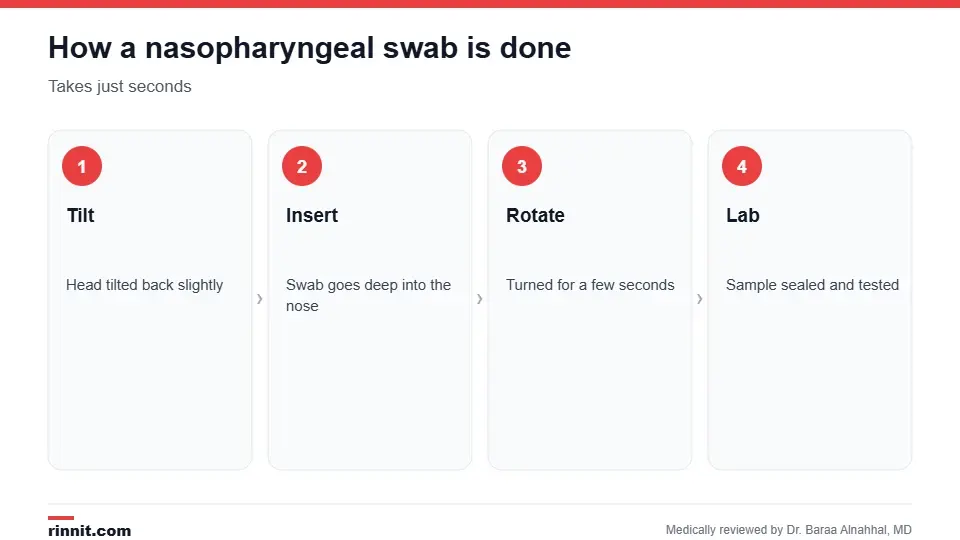
The swab reaches about the level of your ear.
You tilt your head back slightly.
The provider gently guides the swab through one nostril, along the floor of the nose, until it reaches the nasopharynx.
The swab is turned and may stay in place for a few seconds.
It's slowly removed, sealed in a container and sent to the lab. If the sample isn't good enough, the other nostril may be swabbed. Sources: [1, 3]
It can feel uncomfortable and may cause brief gagging, coughing or watery eyes. Sources: [1]
Nasopharyngeal vs nasal swab
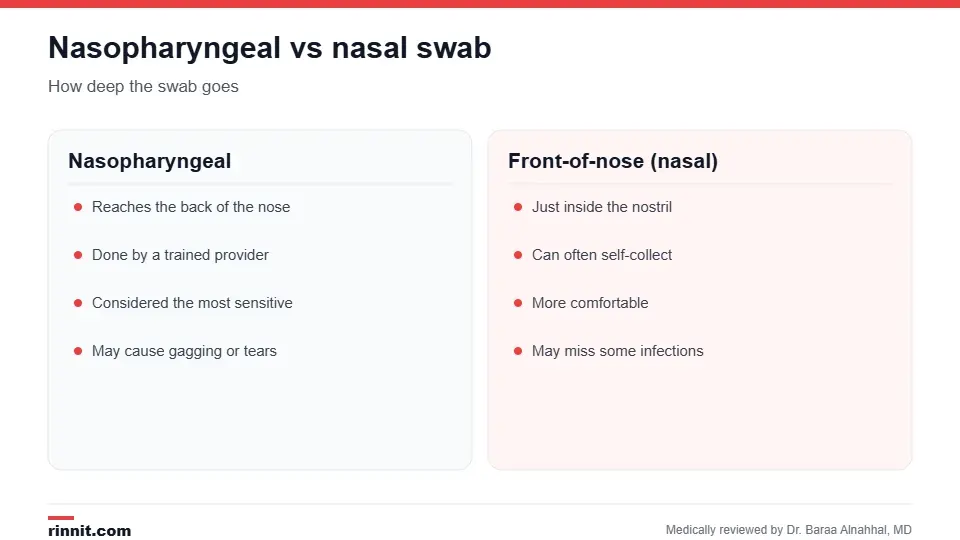
The deeper swab is usually more sensitive.
Feature | Nasopharyngeal swab | Front-of-nose (nasal) swab |
How deep | Back of the nose and upper throat | Just inside the nostril |
Who collects it | A trained provider | Often self-collected |
Comfort | More uncomfortable | More comfortable |
Sensitivity | Highest for many viruses | Somewhat lower |
Sources: [1, 2]
Risks
Nosebleeds can happen afterward. Rarely, a swab breaks and must be removed. People with bleeding disorders, a very crooked septum or past skull base or sinus surgery should tell the provider. Results can be wrong if the swab isn't collected properly. Sources: [1, 3]
Understanding your results
A positive result means the germ tested for was found; a negative result means it wasn't. How quickly you get results depends on the lab and whether the sample is shipped. Your provider will tell you when to expect them. Sources: [1]
Conclusion
A nasopharyngeal swab is a quick, reliable way to find many respiratory infections. A few seconds of discomfort can give your provider a clear answer to guide treatment and protect others.
Frequently asked questions
What is a nasopharyngeal swab?
A sample taken from the back of the nose and upper throat.
What does it test for?
COVID-19, flu, RSV, whooping cough and more.
Does it hurt?
It's uncomfortable but brief.
How long does it take?
Just a few seconds.
Can I do it myself?
No. It must be done by a trained provider.
Why is it so deep?
Germs collect in the nasopharynx, giving a more reliable sample.
Can it cause a nosebleed?
Yes, occasionally.
Is it more accurate than a nasal swab?
It's usually more sensitive for many viruses.
Do I need to prepare?
Usually not; you may be asked to blow your nose.
When will I get results?
It depends on the lab; your provider will tell you.
Related Reading
Bacteria Culture Test: Types, How It Works and Results explains how labs grow and identify bacteria to guide antibiotic treatment.
PCR Test: How It Works, What It Detects and What Results Mean (Including COVID-19) the lab test often run on the swab.
Flu Test (Influenza Test): Types, Accuracy and What Results Mean testing for influenza.
What Is RSV? A Plain-Language Guide to the Virus That Acts Like a Cold in Adults but Can Be Dangerous for Babies a common virus found with this swab.
Whooping Cough (Pertussis): Symptoms, Causes, Diagnosis, and Treatment an infection tested this way.
Understanding the Nasopharynx: The Gateway to the Respiratory System the area the swab reaches.
References
Cleveland Clinic. What Is a Nasopharyngeal Swab? Cleveland Clinic. Last updated May 2, 2022. https://my.clevelandclinic.org/health/diagnostics/22878-nasopharyngeal-swab
Lee RA, Herigon JC, Benedetti A, et al. Performance of saliva, oropharyngeal swabs, and nasal swabs for SARS-CoV-2 molecular detection: a systematic review and meta-analysis. J Clin Microbiol. 2021;59(5):e02881-20. PMID 33504593. https://doi.org/10.1128/JCM.02881-20
Kim DH, Kim D, Moon JW, et al. Complications of nasopharyngeal swabs and safe procedures for COVID-19 testing based on anatomical knowledge. J Korean Med Sci. 2022;37(11):e88. PMID 35315599. https://doi.org/10.3346/jkms.2022.37.e88
Medical disclaimer
This article is for general education only and does not replace advice from a qualified healthcare professional. Talk to your doctor about your own diagnosis and treatment, and seek emergency care right away for severe or sudden symptoms.



Comments