Flu Test (Influenza Test): Types, Accuracy and What Results Mean

Updated: 2 days ago
Written and medically reviewed by Dr. Baraa Alnahhal, MD · Last reviewed: November 2026 · How we review
Quick Answer: What is a flu test?
A flu test checks a respiratory sample, usually a nasal swab, for the influenza virus. Rapid antigen tests give results in under 30 minutes, while molecular tests such as PCR are more accurate. Most people with the flu do not need a test, but your provider may recommend one if you are at higher risk of complications. [1]
What the research says
Rapid antigen tests miss about half of flu cases, while rapid molecular tests catch most. A meta-analysis of 162 studies found that traditional rapid antigen tests detected only 54.4% of influenza A cases, compared with 91.6% for rapid nucleic acid (molecular) tests; specificity was above 98% for all test types. (Merckx et al., Annals of Internal Medicine, 2017) [2]
A positive rapid test is reliable, but a negative one is not. Across 134 studies of rapid influenza tests compared with PCR, overall sensitivity was 61.1% and specificity was 98.9%. (Bruning et al., Clinical Infectious Diseases, 2017) [3]
Key takeaways
A flu test looks for influenza in a sample from your nose or throat. [1]
Rapid antigen tests are fast but the least accurate; molecular tests like PCR are more accurate. [1]
The test usually takes less than five minutes and needs no special preparation. [1]
False negatives can happen, especially if the sample is poorly collected or the test is done too early or too late. [1]
Home flu tests are available but are not as accurate or reliable as tests done by a provider. [1]
What is a flu test?
A flu test checks a respiratory sample for the influenza virus. Flu is a respiratory infection caused by a virus that spreads through coughing, sneezing and touching contaminated surfaces. It is usually a winter illness but also occurs in fall and early spring. [1]
You can get tested at a provider's office, a hospital, an urgent care clinic or some pharmacies. At-home and over-the-counter tests are also sold, but they are not as accurate or reliable as tests done by a provider. [1]
Who should get a flu test?

Testing matters most for people at higher risk of complications.
Most people who get the flu recover within a week or two and do not need a test. If you have flu-like symptoms, call your provider; they may recommend testing if you have a higher risk of complications, including: [1]
People with a weakened immune system
People with a chronic illness such as diabetes
Pregnant people
Adults over 65 and children under 5
People in the hospital for another condition
What are the types of flu tests?
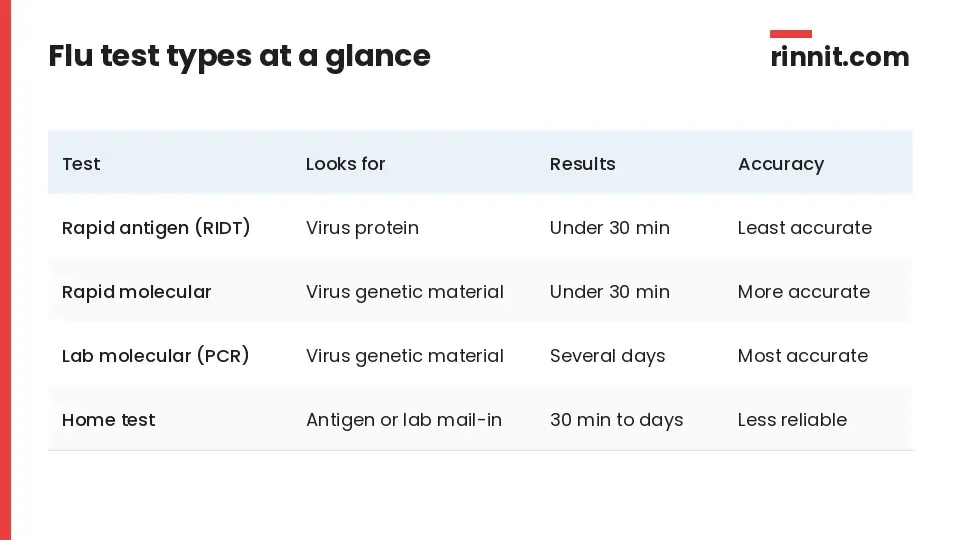
Molecular tests such as PCR are more accurate than rapid antigen tests.
Test type | What it detects | Time to result | Accuracy |
Rapid antigen test (RIDT) | A flu virus protein (antigen) in nasal fluid | Under 30 minutes | Least accurate |
Rapid molecular test | The flu virus's genetic material | Under 30 minutes | More accurate |
Lab molecular test (such as PCR) | The flu virus's genetic material | Several days | Most accurate |
Sources: [1]
How is a flu test done?
Every flu test needs a respiratory sample, most often from inside your nose. [1]
Nasal swab: the most common method. A provider swabs the walls of your nose or reaches the deepest part of the nose (a nasopharyngeal swab).
Nasal wash or aspirate: saline is put into your nose and gently suctioned out, then sent to a lab. This is helpful for infants and young children.
Sources: [1]
No special preparation is needed, and the test usually takes less than five minutes. You may gag or feel a tickle during the swab, and a nasal wash can be briefly uncomfortable. [1]
How do home flu tests work?
You swab your own nostrils, or use saliva for some kits, and follow the kit's instructions. Rapid home tests give results in about 30 minutes, while kits you mail to a lab can take several days. [1]
Are there risks?
Flu tests are safe and rarely cause side effects. Swabbing may cause brief discomfort, gagging or coughing. [1]
What do flu test results mean?
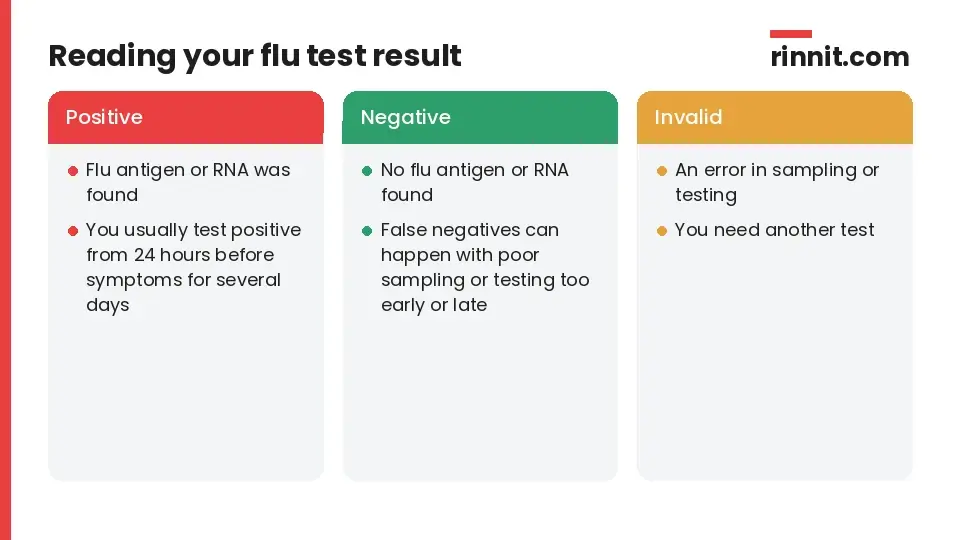
A negative rapid test does not always rule out the flu.
Result | What it means |
Positive | The test found influenza viral antigen or genetic material (RNA) |
Negative | The test did not find influenza viral antigen or RNA |
Invalid | An error happened during collection or testing, so you need another test |
Sources: [1]
How accurate is a flu test?
Laboratory swab tests are the most accurate kind of flu test, and molecular tests such as PCR tend to be more accurate than rapid antigen tests. False positives and false negatives can happen, especially if the sample was collected poorly or the test was done too early or too late in your illness. [1]
You usually test positive from about 24 hours before symptoms start until several days afterward, depending on the type of test. [1]
When should you call a provider?
Call your provider if you have flu-like symptoms or are worried you have the flu, or if you are unsure what your result means. Symptoms can worsen quickly, especially for people at higher risk, so get care promptly if you are unsure. Useful questions to ask include how they interpret your result, whether it is likely accurate, whether you need follow-up testing and whether they recommend treatment. [1]
Conclusion
A flu test is a quick swab that can confirm influenza, which helps your provider decide on treatment, especially if you are at higher risk. Molecular tests are the most reliable, and a negative rapid test does not always rule out the flu.
If your symptoms are severe or getting worse, do not wait for a test result to seek care.
Keep learning: Read our guide to influenza (flu) symptoms and treatment or our article on the flu during pregnancy. For more background, see the CDC overview of flu diagnosis.
FAQ
What is a flu test?
A test that checks a nasal swab or other respiratory sample for the influenza virus. [1]
What are the types of flu tests?
Rapid antigen tests and molecular tests such as PCR, which can be rapid or sent to a lab. [1]
How long does a rapid flu test take?
Results take under 30 minutes. [1]
Which flu test is most accurate?
Laboratory molecular tests such as PCR are the most accurate; rapid antigen tests are the least accurate. [1]
Does a flu test hurt?
It may cause brief discomfort, a tickle, gagging or coughing during the swab. [1]
Do I need to prepare for a flu test?
No special preparation is needed. [1]
Can a flu test be wrong?
Yes; false negatives and false positives can happen, especially with poor sampling or testing too early or late. [1]
How long do you test positive for the flu?
Usually from about 24 hours before symptoms start until several days afterward. [1]
Are home flu tests accurate?
They are not as accurate or reliable as tests done by a provider. [1]
Who should get a flu test?
People at higher risk of complications, such as adults over 65, children under 5, pregnant people and people with chronic illness or weak immunity. [1]
Related Reading
Influenza (Flu): Symptoms, Transmission, and Treatment explains the infection a flu test is used to confirm.
Flu While Pregnant: Risks, Symptoms, and Safe Treatment covers a higher-risk group for whom testing matters.
Bird Flu (Avian Influenza): Symptoms, Causes, and Treatment describes another influenza virus that needs testing.
Swine Flu (H1N1): Symptoms, Causes, and What Treatment Actually Involves covers an influenza A strain found on flu testing.
Nasopharyngeal Swab: Testing for COVID-19, Flu, RSV and More explains the deep nose swab used to test for respiratory infections.
References
Cleveland Clinic. Flu Test: Types, How They Work & Results. Cleveland Clinic. Last updated May 12, 2025. https://my.clevelandclinic.org/health/diagnostics/22716-flu-influenza-test
Merckx J, Wali R, Schiller I, et al. Diagnostic Accuracy of Novel and Traditional Rapid Tests for Influenza Infection Compared With Reverse Transcriptase Polymerase Chain Reaction: A Systematic Review and Meta-analysis. Ann Intern Med. 2017;167(6):394-409. PMID 28869986. https://doi.org/10.7326/M17-0848
Bruning AHL, Leeflang MMG, Vos JMBW, et al. Rapid Tests for Influenza, Respiratory Syncytial Virus, and Other Respiratory Viruses: A Systematic Review and Meta-analysis. Clin Infect Dis. 2017;65(6):1026-1032. PMID 28520858. https://doi.org/10.1093/cid/cix461
Medical disclaimer
This article is for general education only and does not replace advice from a qualified healthcare professional. Talk to your doctor about your own diagnosis and treatment, and seek emergency care right away for severe or sudden symptoms.



Comments