Influenza (Flu): Symptoms, Transmission, and Treatment

Updated: 3 days ago
Medically reviewed by Dr. Baraa Alnahhal, MD · Last reviewed: October 2026
Influenza, or the flu, is a common respiratory illness caused by the influenza virus. Symptoms often include fever, head and body aches, coughing, and a stuffy or runny nose. Most people recover at home within a few days to a week, but the flu can cause serious complications, and getting vaccinated every year is the best way to avoid it [1].
Quick Answer: What is the flu?
The flu is an illness caused by the influenza virus, with symptoms that come on quickly, including fever, chills, body aches, cough and sore throat, and can be severe. It's most common in winter. Antiviral medicines work best when started within 48 hours of the first symptoms, and a yearly flu vaccine is the best way to reduce your risk. [1]
What the research says
Oseltamivir shortened the flu and reduced complications, with more nausea and vomiting. A meta-analysis of nine placebo-controlled trials (4,328 adults) found that, in people confirmed to have influenza, oseltamivir shortened the time to alleviation of all symptoms by 21% (median 97.5 vs 122.7 hours). It also lowered lower respiratory tract complications requiring antibiotics (4.9% vs 8.7%) and hospital admissions (0.6% vs 1.7%), but raised nausea (9.9% vs 6.2%) and vomiting (8.0% vs 3.3%) (Dobson et al., The Lancet, 2015 [2]).
Enhanced flu vaccines gave older adults modestly better protection against hospitalization. A network meta-analysis of 32 studies (five randomized, 27 observational) in adults 65 and older found that high-dose, adjuvanted, and recombinant vaccines combined had a relative vaccine effectiveness against flu hospitalization of 18% (95% CI 3 to 32) in randomized studies and 11% (95% CI 8 to 14) in observational studies, compared with standard-dose vaccine, with no significant differences among the three enhanced vaccines (Ferdinands et al., Journal of the American Geriatrics Society, 2024 [3]).
Seasonal flu vaccination during pregnancy was not linked to adverse birth outcomes, but the evidence is weak. A systematic review of 63 studies found no significant association between seasonal flu vaccination in pregnancy and preterm birth, spontaneous abortion, or small-for-gestational-age birth, and no increased risk for stillbirth, congenital anomalies, or serious maternal adverse events in descriptive summaries. All of the evidence was of very low certainty, and the authors call for better control of confounding in future studies (Wolfe et al., BMJ Open, 2023 [4]).
What Is Influenza?
The flu is an illness you get from the influenza virus. It causes head and body aches, sore throat, fever, and respiratory symptoms, which can be severe. It's most common in winter months, when many people can get sick at once (an epidemic) [1].

Types of Influenza Virus
Influenza A, B, and C are the most common types that infect people [1]:
Influenza A and B: these are seasonal (most people get them in the winter) and have more severe symptoms.
Influenza C: it doesn't cause severe symptoms and isn't seasonal, so the number of cases stays about the same throughout the year.
Subtypes: H1N1 ("swine flu") and bird flu are both subtypes of influenza A.
Flu vs. Cold vs. COVID-19
The flu and the common cold can have similar symptoms, like a runny nose and cough. But cold symptoms are usually mild, while flu symptoms can be severe and lead to serious complications. Different viruses cause colds and the flu [1].
The flu and COVID-19 have many symptoms in common, and both carry a risk of serious illness. Different viruses cause them and providers treat them with different medicines, so the only way to know for sure which one you have is to get tested [1].
Symptoms and Transmission
Symptoms of the flu usually come on quickly, and you may not have all of them [1]:
Fever and chills.
Body aches.
Cough.
Headache.
Sore throat.
Runny or stuffy nose.
Tiredness or feeling run down.
Diarrhea or vomiting, usually only in kids.
How the Flu Spreads
The flu is contagious. For every person infected, they spread it to one to two more people. The virus spreads through direct or indirect contact with someone who's infected [1]:
Respiratory droplets: someone nearby coughs, sneezes, or talks, and droplets get onto your hands or move through the air into your nose or mouth.
Contaminated surfaces: you touch a surface with the virus on it, like a doorknob, desk, computer, or phone, and then touch your face, nose, mouth, or eyes.
Direct contact: you touch the hands or face of someone who has the flu and then touch your own face.
If you're infected, you'll usually get symptoms one to four days after exposure. You can be contagious from a day before symptoms start to up to a week after, and you're most contagious for three to four days after symptoms start. People with weakened immune systems and infants may be contagious for longer [1].
High-Risk Groups and Complications
Certain health conditions can put you at higher risk for severe illness from the flu, including life-threatening complications that require hospitalization. You're at higher risk if you [1]:
Are under 5 years old or over 65 years old.
Are pregnant.
Have asthma, COPD, or another chronic lung disease.
Have a history of kidney, liver, neurological, heart, or blood vessel disease, including stroke.
Have a condition that causes problems with muscle function or makes it hard to cough, swallow, or clear fluids from your airways.
Have diabetes.
Have a weakened immune system, for example from HIV/AIDS, cancer, or immunosuppressive medicines.
Have a blood disorder, like sickle cell disease.
Have a BMI greater than 30 (obesity).
Are under 19 years old and take aspirin regularly.
Live in a long-term care facility.
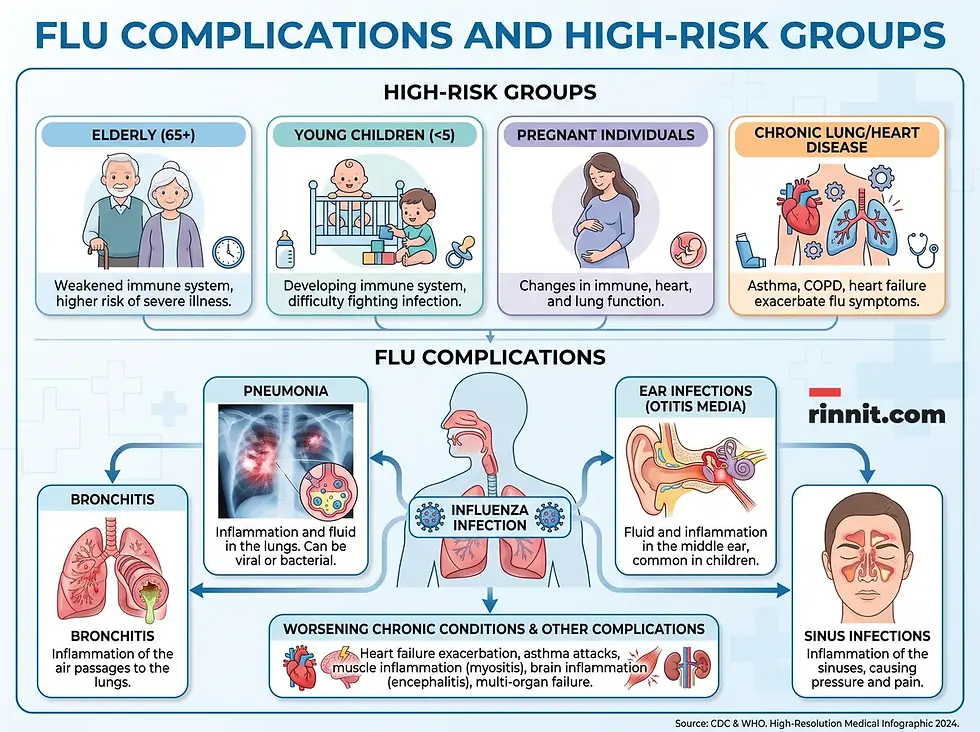
Possible Complications
The flu virus itself can cause complications, or it can weaken your immune system and let bacteria infect other parts of your body (a secondary infection) [1]:
Ear infections.
Sinus infections.
Severe lung infection (pneumonia), which can lead to acute respiratory distress syndrome (ARDS) and other life-threatening conditions.
Pregnancy loss (miscarriage).
Neural tube defects in the developing fetus of a pregnant woman.
Diagnosis and Treatment
Your provider diagnoses the flu by listening to your symptoms and testing a sample of mucus from your nose, collected with a soft-tipped swab. Results may take a few minutes, or the sample may go to a lab, where results take a day or two. If you think you have the flu, get tested early so antiviral medicines work best if your provider prescribes them [1].
Antiviral Medicines
Antivirals can reduce your risk of severe illness and shorten the time you're sick, and many people can treat the flu without prescription medicines. Providers prescribe antivirals if you [1]:
Have had symptoms for under 48 hours. Antivirals are less likely to work if you start them after two days of symptoms.
Have an underlying condition or are at risk for severe illness, even if you've had symptoms for longer than 48 hours.
Have severe symptoms, even if you've been sick for longer than 48 hours.
Live with or care for people who are at risk for severe complications of the flu.
Antiviral drugs for influenza include [1]:
Oseltamivir phosphate (Tamiflu): taken by mouth as a pill or liquid, usually for several days.
Zanamivir (Relenza): breathed in through the mouth with an inhaler, usually for several days. It isn't recommended for people with breathing issues like asthma or COPD.
Peramivir (Rapivab): given through an IV, usually as a single dose.
Baloxavir marboxil (Xofluza): taken by mouth as a pill or liquid, as a single dose. It isn't recommended if you're pregnant, breastfeeding, hospitalized, or have certain medical conditions.
Common side effects include nausea and diarrhea, and inhaled medicines can cause spasms that tighten and narrow the airways (bronchospasm). Tell your provider about any health conditions before starting an antiviral [1].
Managing Symptoms at Home
Many people can manage flu symptoms at home with over-the-counter medicines and other therapies, including [1]:
Getting plenty of rest.
Drinking fluids like water or broth to help prevent dehydration.
Applying heat packs or hot water bottles to aching muscles.
Taking acetaminophen (Tylenol) or NSAIDs (Advil, Motrin, Aleve) to lower fever and relieve head and body aches.
Using spray or oral decongestants, like phenylephrine or pseudoephedrine, for a runny or stuffy nose.
Taking cough suppressants like dextromethorphan to calm a nagging cough.
Using expectorants like guaifenesin to make it easier to clear mucus from your lungs.
Not everyone should take certain over-the-counter medicines, so check with your provider first. Don't give aspirin to children under 16 unless their provider says it's okay [1].
What to Expect With the Flu
Most people can manage flu symptoms at home and recover within a few days to a week. The flu can last from a few days to two weeks, and fever and body aches usually go away faster than a cough or runny nose. If you have the flu, avoid being around others except to seek medical care, and don't go back to work or school until it's been at least 24 hours since you had a fever, without taking fever-reducing medicine [1].
In a typical U.S. flu season, Cleveland Clinic estimates that between 20,000 and 50,000 people die from the flu, and another 300,000 to 500,000 are hospitalized for serious illness [1].
Prevention
The best way to reduce your risk is to get the flu vaccine every year, as a shot or as a mist sprayed into your nose. The influenza virus can change (mutate) over time, so you need to be vaccinated every year. Other ways to lower your risk include [1]:
Washing your hands often with soap and water, or using an alcohol-based hand sanitizer if you can't.
Covering your nose and mouth when you sneeze or cough, using your elbow or a tissue rather than your bare hand.
Avoiding people who are sick with the flu or other infectious diseases.
Considering a mask if you're sick and can't avoid being around others.
Avoiding touching your face, eyes, nose, and mouth.
Not sharing food or eating utensils with others.

When to Get Medical Care
Contact a healthcare provider right away if [1]:
You have flu symptoms and an underlying condition that puts you at higher risk for severe illness.
Your symptoms don't start to improve after seven to 10 days, or you have a fever lasting longer than three days.
You're pregnant and have a fever or other flu symptoms.
Go to the ER or seek immediate medical attention if you have symptoms of severe illness [1]:
High fever (over 103 degrees Fahrenheit or 40 degrees Celsius).
Difficulty breathing.
Not peeing, or peeing very little.
Pain in your chest or stomach that doesn't go away.
Persistent dizziness or confusion.
Severe muscle pain or weakness.
Seizures.
Bluish skin, lips, or nails.
A fever or cough that gets better or goes away but then gets worse.
Worsening of other health conditions.
Bottom Line
The flu is very common, and most people recover at home, but it can lead to life-threatening complications, especially for children under 5, adults over 65, people who are pregnant, and people with chronic conditions. A yearly flu vaccine, good hand hygiene, and staying home when you're sick protect you and the people around you.
Your next step: if you're at higher risk, talk to your healthcare provider before flu season about getting vaccinated, and get tested early if you develop symptoms so antivirals can work as well as possible.
Frequently Asked Questions
What is the difference between the flu and a cold?
Colds and the flu can share symptoms like a runny nose and cough, but cold symptoms are usually mild, while flu symptoms come on quickly and can be severe and lead to serious complications.
How long does the flu last?
The flu can last from a few days to two weeks. Fever and body aches usually go away faster than a cough or runny nose.
When is the best time to get the flu shot?
Flu season in the Northern Hemisphere runs from October through May and usually peaks between December and February, so it's best to get vaccinated early in the fall, before the peak.
Can the flu shot give you the flu?
No. The flu shot can't give you the flu. Some people have mild side effects, such as a sore arm or a low-grade fever, as the body builds protection.
Is the flu contagious before symptoms start?
Yes. You can be contagious from a day before your symptoms start to up to a week after, and you're most contagious for three to four days after symptoms start.
What are the emergency warning signs of the flu?
Go to the ER for a fever over 103 F (40 C), trouble breathing, chest or stomach pain that doesn't go away, confusion, seizures, bluish skin or lips, or a fever or cough that returns after improving.
Can antivirals cure the flu?
Antivirals don't cure it instantly, but they can reduce your risk of severe illness and shorten the time you're sick. They work best when started within 48 hours of your first symptoms.
Why do I need a flu shot every year?
The influenza virus can change (mutate) over time, so you need to be vaccinated every year.
Are children at higher risk for the flu?
Children under 5 are at higher risk for serious illness. Diarrhea and vomiting from the flu are usually seen only in kids.
How many people die from the flu each year?
Cleveland Clinic estimates that in a typical U.S. flu season, between 20,000 and 50,000 people die from the flu, and another 300,000 to 500,000 are hospitalized.
Related Reading
Antivirals: What They Treat, How They Work and Side Effects explains antiviral medicines and how they work.
Flu Test (Influenza Test): Types, Accuracy and What Results Mean explains how rapid and PCR flu tests work and what results mean.
PCR Test: How It Works, What It Detects and What Results Mean (Including COVID-19) explains how PCR testing detects infections and gene changes.
References
Cleveland Clinic. Flu (Influenza). Cleveland Clinic. October 11, 2022. https://my.clevelandclinic.org/health/diseases/4335-influenza-flu
Dobson J, Whitley RJ, Pocock S, et al. Oseltamivir treatment for influenza in adults: a meta-analysis of randomised controlled trials. The Lancet. 2015;385(9979):1729-1737. PMID 25640810. https://doi.org/10.1016/S0140-6736(14)62449-1
Ferdinands JM, Blanton LH, Alyanak E, et al. Protection against influenza hospitalizations from enhanced influenza vaccines among older adults: a systematic review and network meta-analysis. Journal of the American Geriatrics Society. 2024;72(12):3875-3889. PMID 39230284. https://doi.org/10.1111/jgs.19176
Wolfe DM, Fell D, Garritty C, et al. Safety of influenza vaccination during pregnancy: a systematic review. BMJ Open. 2023;13(9):e066182. PMID 37673449. https://doi.org/10.1136/bmjopen-2022-066182
Medical disclaimer
This article is for informational purposes only and is not a substitute for professional medical advice, diagnosis, or treatment. The clinical information in this guide reflects source material last reviewed in October 2022.



Comments