Antivirals: What They Treat, How They Work and Side Effects

Updated: 2 days ago
Written and medically reviewed by Dr. Baraa Alnahhal, MD · Last reviewed: November 2026 · How we review
Quick Answer
Antivirals are medicines that help the body fight off certain viruses, such as COVID-19, flu, herpes, hepatitis B and C and HIV. They can ease symptoms, shorten an infection, prevent complications and lower the chance of spreading a virus. Each antiviral works only against specific viruses. Timing matters: to prevent flu, start within 48 hours of exposure.
What the research says
An antiviral pill cut COVID-19 hospital stays by 89%: in the EPIC-HR trial of high-risk adults with COVID-19 who weren't in the hospital, nirmatrelvir plus ritonavir started within 3 days lowered hospitalization or death from 7.01% to 0.77% (Hammond J et al., New England Journal of Medicine, 2022) [2]
Oseltamivir shortened the flu by about a day: a meta-analysis of 9 trials with 4,328 adults found oseltamivir shortened flu symptoms by about 25 hours and lowered hospital admissions (0.6% vs. 1.7%), but raised nausea (9.9% vs. 6.2%) and vomiting (8.0% vs. 3.3%) (Dobson J et al., Lancet, 2015) [3]
Key takeaways
Antivirals help your body fight specific viruses.
They treat COVID-19, flu, herpes, hepatitis, HIV and more.
Starting early works best.
Antibiotics don't work on viruses.
Take antivirals exactly as prescribed to prevent resistance.
What are antivirals?
Antivirals are also called antiviral drugs or antiviral therapy. There are more viruses than antivirals, so not every virus has a treatment. Sources: [1]
What antivirals treat
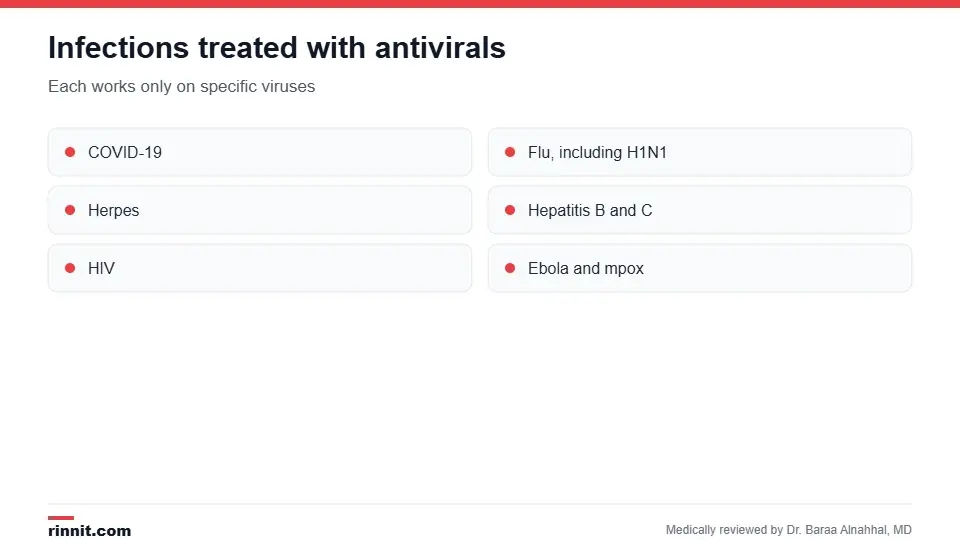
Each antiviral works only against specific viruses.
COVID-19 and other coronaviruses.
Flu, including H1N1 (swine flu).
Hepatitis B and hepatitis C.
HIV.
Ebola and mpox. Sources: [1]
How antivirals work
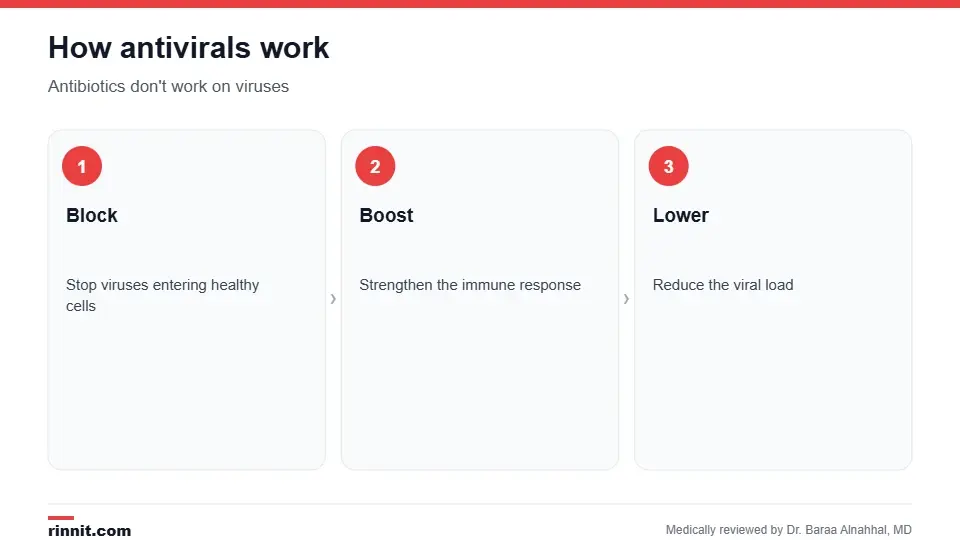
Antivirals can make some chronic viruses inactive but not remove them.
Block receptors so viruses can't enter healthy cells.
Boost your immune system.
Lower the amount of virus in your body (viral load). Sources: [1]
Forms of antivirals
Form | Notes |
Pills | The most common form |
Eye drops | Placed in the eye |
Inhaled powder | Breathed in |
Injections | Into a muscle |
IV infusions | Some are a single dose |
Creams and ointments | Applied to the skin |
Sources: [1]
How to take antivirals
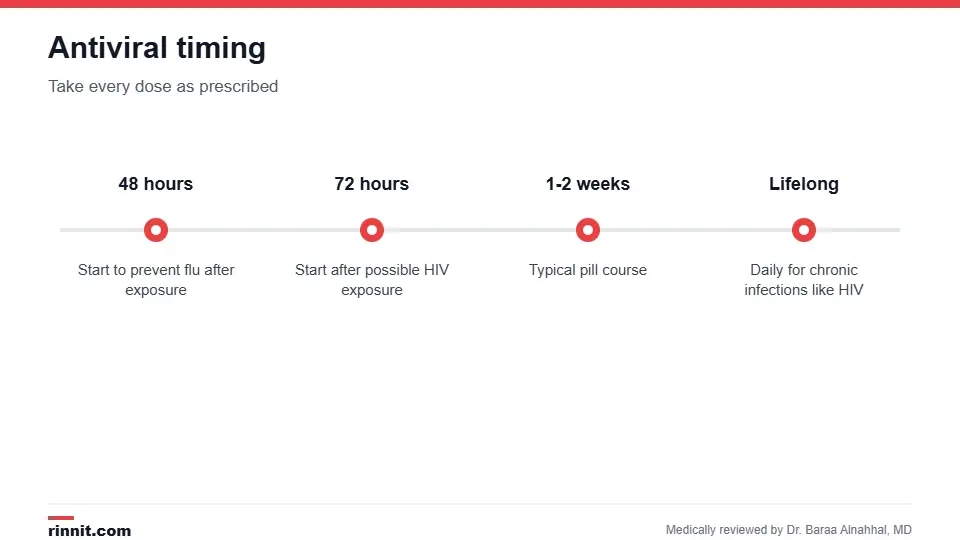
Take antivirals exactly as prescribed.
Take them as often and as long as prescribed.
To prevent flu, start within 48 hours of exposure.
To prevent HIV, start within 72 hours of possible exposure.
Daily use can lower the risk of spreading herpes or HIV.
Use during pregnancy can lower the risk of passing a virus to the baby.
Tell your provider about all other medicines and supplements. Sources: [1]
How long you'll take them
Some pill courses last only a week or two, and some IV antivirals are a single dose. Chronic infections like HIV may need daily antivirals for life, with regular checkups. Sources: [1]
Side effects
Cough, dry mouth or skin rash.
Diarrhea, nausea or vomiting.
Dizziness, tiredness or headache.
Trouble sleeping.
Joint or muscle pain. Sources: [1, 3]
Skipping doses or stopping and starting can make a virus resistant to the medicine. The risk is higher with long-term use. Sources: [1]
Results
Antivirals can make symptoms milder, help you recover faster and sometimes save lives. Flu and Ebola can be cleared from the body. HIV, hepatitis and herpes are chronic; antivirals can keep them inactive but can't remove them. Sources: [1, 2, 3]
When to call your provider
Severe side effects.
New or worsening symptoms of infection.
Concerns about your medicine.
Don't stop taking an antiviral unless your provider says it's safe. Sources: [1]
Conclusion
Antivirals help your body fight specific viruses, easing symptoms and preventing complications or spread. Starting early and taking every dose as prescribed give you the best results.
Frequently asked questions
What are antivirals?
Medicines that help your body fight certain viruses.
What infections do antivirals treat?
COVID-19, flu, herpes, hepatitis B and C, HIV, Ebola and mpox.
Do antibiotics work on viruses?
No. Antibiotics don't work on viruses.
How fast should I start an antiviral for the flu?
Within 48 hours of exposure to help prevent flu.
Can antivirals prevent HIV?
Yes, if started within 72 hours of possible exposure.
Do antivirals cure HIV or herpes?
No, but they keep these viruses under control.
What are common side effects?
Nausea, diarrhea, headache, tiredness and trouble sleeping.
What is antiviral resistance?
When a virus stops responding to a medicine, often from missed doses.
How long do I take antivirals?
From a single dose to lifelong, depending on the virus.
Can I stop antivirals when I feel better?
Not unless your provider says it's safe.
Related Reading
Protease Inhibitors: Types, How They Work and Side Effects explains protease inhibitor medicines.
Influenza (Flu): Symptoms, Transmission, and Treatment a common infection treated with antivirals.
COVID-19 (Coronavirus): Symptoms, Causes, Treatment, Prevention, and What to Expect COVID-19 and its treatment.
HIV/AIDS: Symptoms, Causes, and How It Is Diagnosed and Treated a lifelong virus controlled with antivirals.
Hepatitis B: Symptoms, Causes, Prevention, Diagnosis and Treatment a liver virus treated with antivirals.
Managing Herpes Simplex: A Comprehensive Guide to Outbreaks and Care managing herpes outbreaks.
References
Cleveland Clinic. Antiviral (Antiviral Medication): What It Is & How It Works. Cleveland Clinic. Last updated July 23, 2024. https://my.clevelandclinic.org/health/treatments/antivirals
Hammond J, Leister-Tebbe H, Gardner A, et al. Oral nirmatrelvir for high-risk, nonhospitalized adults with Covid-19. N Engl J Med. 2022;386(15):1397-1408. PMID 35172054. https://doi.org/10.1056/NEJMoa2118542
Dobson J, Whitley RJ, Pocock S, et al. Oseltamivir treatment for influenza in adults: a meta-analysis of randomised controlled trials. Lancet. 2015;385(9979):1729-1737. PMID 25640810. https://doi.org/10.1016/S0140-6736(14)62449-1
Medical disclaimer
This article is for general education only and does not replace advice from a qualified healthcare professional. Talk to your doctor about your own diagnosis and treatment, and seek emergency care right away for severe or sudden symptoms.



Comments