COVID-19 (Coronavirus): Symptoms, Causes, Treatment, Prevention, and What to Expect

Updated: 3 days ago
Medically reviewed by Dr. Baraa Alnahhal, MD · Last reviewed: October 2026
Quick Answer: What Is COVID-19?
COVID-19 is a respiratory illness caused by the SARS-CoV-2 coronavirus, spread mainly through respiratory droplets. Symptoms include fever, cough, sore throat, fatigue and shortness of breath, ranging from mild to life-threatening. Antivirals taken within the first five days of symptoms reduce the risk of severe illness and long COVID. Vaccination is the best way to lower your risk.
What the research says
Early antivirals sharply cut the risk of hospitalization in high-risk adults. In a trial of 2,246 high-risk, unvaccinated, nonhospitalized adults, nirmatrelvir plus ritonavir started within 3 days of symptoms lowered COVID-19 hospitalization or death by day 28 to 0.77% vs 7.01% with placebo (an 89% relative reduction), and all 13 deaths in the full analysis occurred in the placebo group ( (Hammond et al., New England Journal of Medicine, 2022) [2].
Missing vaccination was linked to lingering symptoms after hospitalization. A 2026 meta-analysis of studies of previously hospitalized patients found higher odds of post-COVID outcomes in those with no or incomplete vaccination (odds ratio 1.90) and after more severe acute illness or advanced respiratory support (odds ratio 2.55); the evidence rests on a small number of studies ( (Kassymbek et al., Frontiers in Public Health, 2026) [3].
What Is COVID-19?
COVID-19 is a respiratory illness caused by the SARS-CoV-2 virus, a type of coronavirus. Symptoms range from mild and cold-like to severe and life-threatening.
Coronaviruses have typically caused common colds. But in 2019, a new coronavirus, SARS-CoV-2, started infecting humans and causing severe illness. At the peak of the pandemic, when COVID was spreading around the world, tens of thousands of people were hospitalized every day in the U.S. alone. Millions of people have died.
Medical understanding has grown a lot since the start of the pandemic, and the virus itself keeps changing. The world has gone through variants alpha, beta, gamma, delta, and now omicron. Scientists have developed treatments and vaccines that have reduced the number of people ending up in the hospital.
But COVID is not 'over.' It can still make you severely ill, cause symptoms that last months or years, and be fatal.
Key Fact | What the Evidence Shows |
What it is | A respiratory illness caused by the SARS-CoV-2 virus, a type of coronavirus |
Severity range | Mild and cold-like up to severe and life-threatening |
Historical impact | Tens of thousands hospitalized daily in the U.S. at the pandemic peak; millions of deaths |
Variants to date | Alpha, beta, gamma, delta, and omicron |
Current status | Still capable of causing severe illness, long-term symptoms, and death |
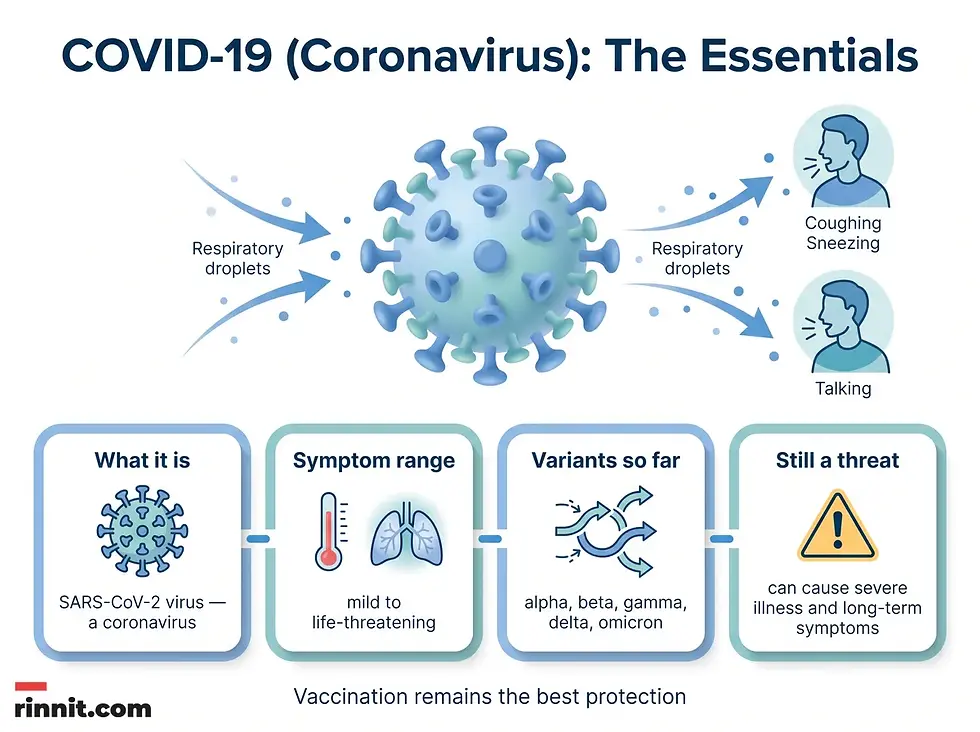
COVID-19 essentials: what the virus is, how it spreads, and why it is still a threat.
What are the symptoms and signs of COVID-19?
COVID symptoms span respiratory, body-wide, and digestive signs. The important thing to understand is the range: the same illness can look like a mild cold in one person and a life-threatening infection in another.
Some people have no symptoms at all but can still spread the virus.
Symptom | How It Typically Feels |
Fever | Elevated body temperature, sometimes with chills |
Sore throat | Pain or irritation when swallowing |
Headache | Head pain that can be mild to severe |
Fatigue | Tiredness that is often more pronounced than a typical cold |
Body aches | Muscle soreness throughout the body |
Chills | Feeling cold or shivering, often with fever |
Stuffy or runny nose | Congestion or drainage |
Cough | Often persistent and dry |
Shortness of breath | Difficulty getting enough air, a warning sign |
Loss of or altered smell and taste | Reduced or distorted sense of smell and taste |
Brain fog | Difficulty thinking and focusing |
Digestive symptoms | Diarrhea, nausea, and vomiting |
Shortness of breath is the symptom that most clearly separates a routine case from something that needs urgent attention. If breathing becomes difficult, seek emergency care.
How does COVID-19 spread, and why is it different?
SARS-CoV-2 causes COVID. It is a type of coronavirus, a group of viruses that also cause common colds. But this is not the first time a coronavirus has caused serious illness: SARS, a severe respiratory disease that spread between 2002 and 2004, was also a coronavirus.
COVID spreads through respiratory droplets. You can get it from coughing, sneezing, and talking. You might also get it from touching contaminated objects and surfaces.
Transmission Route | How It Happens |
Respiratory droplets | Breathing in droplets from someone who is infected |
Coughing and sneezing | Forceful expulsion of virus-laden droplets |
Talking | Regular conversation releases infectious droplets |
Contaminated surfaces | Touching objects or surfaces carrying the virus |
Who is at risk for severe COVID-19?
COVID can make anyone sick, but certain groups face a clearly increased risk of hospitalization.
You are at an increased risk of being hospitalized with COVID-19 if you are over 65, are pregnant, smoke or used to smoke, or have received a solid organ or stem cell transplant.
A broader list of health conditions also raises your risk:
Risk Category | Specific Conditions Listed |
Age | Over 65 |
Reproductive status | Pregnancy |
Smoking history | Current smokers or former smokers |
Transplants | Solid organ or stem cell transplant recipients |
Blood disorders | Sickle cell disease; thalassemia |
Cancer | Any active cancer |
Blood vessels in the brain | Cerebrovascular disease, such as stroke |
Chronic organ conditions | Conditions affecting the lungs, kidneys, liver, or heart |
Congenital conditions | Cerebral palsy; Down syndrome |
Metabolic | Diabetes (Type 1 or Type 2); obesity |
Immune system | HIV/AIDS; a weakened (compromised) immune system |
Mental health | Depression; schizophrenia spectrum disorders |
Neurological | Dementia; Alzheimer's disease |
Substance use | Alcohol, opioid, or cocaine use disorders |
Infections | Tuberculosis |
If you fall into any of these categories, early testing and early contact with a healthcare provider about antiviral treatment matter even more, because the five-day treatment window is short.
What complications can COVID-19 lead to?
COVID can cause serious complications, even if you do not feel very sick. This is one of the most counterintuitive features of the illness: feeling relatively well does not guarantee the infection is staying mild.
Complication | What It Means |
Pneumonia | A serious lung infection caused by the virus reaching the lungs |
ARDS | Acute respiratory distress syndrome: severe lung failure |
Blood clots | Including pulmonary embolism (PE) in the lungs and deep vein thrombosis (DVT) in the legs |
Heart inflammation | Myocarditis (heart muscle) or pericarditis (heart lining) |
Cardiac arrest | The heart suddenly stops pumping |
MIS-C | Multisystem inflammatory syndrome in children |
Long COVID | Pain, extreme fatigue, and other symptoms lasting for months or years after infection |
Severe leg pain, warmth, or swelling during or after COVID deserves particular attention. It can signal deep vein thrombosis, a complication that can become life-threatening if a clot travels to the lungs.

Complications of COVID-19, which can occur even in people who did not feel very sick.
How is COVID-19 diagnosed and confirmed?
Healthcare providers diagnose COVID by swabbing your nose with a soft-tipped stick and testing it with a nucleic acid amplification test (NAAT), such as a PCR test. You can also test at home with a rapid antigen test.
Test | Where It Happens | What It Detects |
PCR test (NAAT) | Healthcare setting | Viral genetic material; highly accurate |
Rapid antigen test | At home or in clinic | Viral proteins; faster, slightly less sensitive |
Nasal swab | Both settings | The collection method for both test types |
Early testing matters for two reasons: it tells you whether you should seek early antiviral treatment, and it helps you avoid exposing others.
What management and treatment actually help with COVID-19?
COVID can be treated with antiviral medications. These include nirmatrelvir/ritonavir (Paxlovid), remdesivir (Veklury), and molnupiravir (Lagevrio). When taken within the first five days, antivirals can help you feel better and reduce your risk of severe illness and long COVID.
If you are severely ill and hospitalized, your healthcare provider might treat you with monoclonal antibody treatment, supplemental oxygen, corticosteroids, or mechanical ventilation.
Treatment Setting | Options |
Home, early illness | Antivirals within five days of symptom onset, the single most important step |
Hospital, severe illness | Monoclonal antibody treatment; supplemental oxygen; corticosteroids; mechanical ventilation |
Symptom relief | Over-the-counter medications to ease symptoms (they do not treat the virus itself) |
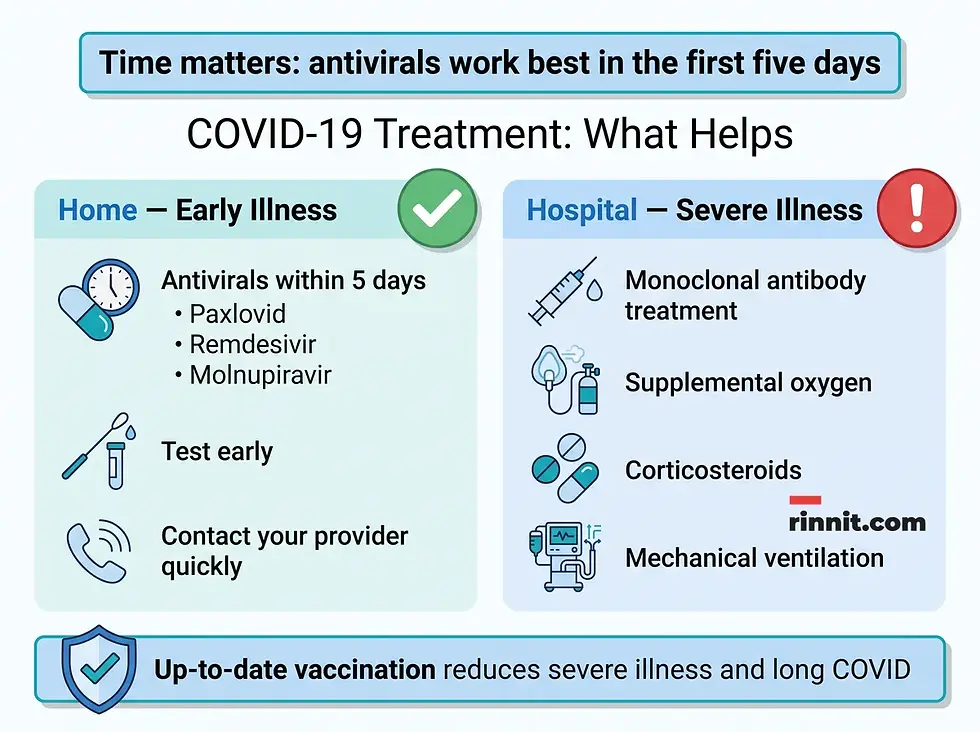
COVID-19 treatment: antivirals within five days at home versus hospital care for severe illness.
For children, talk to a pediatrician before giving medications to make sure they are safe to take.
How long does COVID-19 last, and how long are you contagious?
Many people recover from symptoms like congestion, sore throat, and cough in about two weeks. But tiredness, shortness of breath, and other symptoms can linger for weeks or even months afterward.
You can be contagious with COVID from a couple of days before your symptoms start to about eight to ten days after.
Milestone | Typical Timeframe |
Contagious window start | A couple of days before symptoms begin |
Contagious window end | About eight to ten days after symptom onset |
Recovery from main symptoms | About two weeks for congestion, sore throat, and cough |
Lingering symptoms | Tiredness and shortness of breath can last weeks to months |
When should you see a healthcare provider about COVID-19?
If you have symptoms of COVID, talk to your provider early to see if you should take an antiviral. The five-day window for antivirals is short, so do not wait to see if symptoms improve on their own.
See your provider if your symptoms last longer than four weeks, especially if they are not improving.
When should you go to the ER for COVID-19 emergency signs?
Call 911 or go to an emergency room for COVID-19 if you experience any of the emergency warning signs.
Emergency Sign | Why It Matters |
Difficulty breathing | The lungs cannot keep up with the body's oxygen demand |
Chest pain | Possible heart involvement, including heart inflammation or clot |
Severe leg pain, warmth, or swelling | Signs of deep vein thrombosis |
Blue or gray skin, lips, or nails | Cyanosis: blood oxygen is critically low |
Confusion | The brain may not be getting enough oxygen |
What is the outlook for COVID-19?
The outlook for COVID is different for everyone. Some people have only mild symptoms. Some get very sick and need to be hospitalized. Sometimes, your symptoms seem to get better and then get much worse. Always seek emergency medical attention for severe symptoms, no matter when they happen.
How can you protect yourself from COVID-19?
Making sure you are up to date with a current COVID vaccine is the best way to reduce your risk of getting sick with COVID, and to reduce your risk of severe illness if you do get sick. You are also less likely to get long COVID if you are vaccinated.
You can also reduce your risk by washing your hands frequently and wearing a mask when COVID is spreading. Be courteous and avoid being around others if you are sick or might have been exposed to someone who is sick.
If you have a compromised immune system, the monoclonal antibody medication pemivibart (Pemgarda) might be an option. A provider gives it to you in an IV (through your vein) to reduce your risk of getting COVID, an approach known as pre-exposure prophylaxis.
Prevention Strategy | What It Reduces |
Up-to-date COVID vaccine | Risk of getting sick, severe illness, and long COVID |
Frequent handwashing | Exposure through contaminated surfaces |
Masking when COVID is spreading | Droplet transmission |
Staying home when sick or exposed | Spreading the virus to others |
Pemivibart (for immunocompromised) | Risk of infection as pre-exposure prophylaxis |
How long should you quarantine or self-isolate with COVID-19?
According to current CDC recommendations in the U.S., you should self-isolate until you have met both of the following criteria: it has been five days since your symptoms first appeared and your symptoms are improving, and you have not had a fever for 24 hours without using fever-lowering medications during that time. Guidance can differ by country and change over time, so check your local health authority.
Conclusion
COVID-19 remains a serious respiratory illness capable of severe, long-lasting, and even fatal outcomes, even years after the pandemic began. The most important takeaways from the medical evidence are straightforward: know the symptoms, test early, contact a provider quickly about antivirals within the five-day window, and get emergency care for breathing difficulty, chest pain, or signs of blood clots. Vaccination remains the single best protection, especially for the long list of high-risk groups covered in this article.
If you or a loved one is in a high-risk category, talk to a healthcare provider now about your protection plan. Antivirals and, for some, monoclonal antibody prophylaxis can change the trajectory of an infection.
Related reading: COVID pneumonia: symptoms, causes, treatment, and recovery timeline.
Frequently Asked Questions
What is COVID-19?
COVID-19 is a respiratory illness caused by the SARS-CoV-2 virus, a type of coronavirus. It spreads through respiratory droplets. Symptoms range from mild, cold-like signs to severe, life-threatening illness.
How does COVID-19 spread?
COVID spreads through respiratory droplets from coughing, sneezing, and talking. It can also spread from touching contaminated objects and surfaces. Some people with no symptoms can still spread the virus.
What are the most common symptoms of COVID-19?
Symptoms include fever, sore throat, headache, fatigue, body aches, chills, stuffy or runny nose, cough, shortness of breath, loss of or altered smell and taste, brain fog, and digestive symptoms like diarrhea, nausea, and vomiting.
How long does COVID-19 last?
Many people recover from congestion, sore throat, and cough in about two weeks. However, tiredness, shortness of breath, and other symptoms can linger for weeks or even months afterward.
How long are you contagious with COVID-19?
You can be contagious from a couple of days before symptoms start to about eight to ten days after they begin.
When should antiviral medication be started for COVID-19?
Antivirals such as nirmatrelvir/ritonavir (Paxlovid), remdesivir (Veklury), and molnupiravir (Lagevrio) are most effective within the first five days of symptoms. Early treatment helps you feel better and reduces the risk of severe illness and long COVID.
Who is at highest risk of severe COVID-19?
People over 65, pregnant people, current and former smokers, and transplant recipients face increased hospitalization risk. Risk also rises with blood disorders, cancer, stroke, chronic organ conditions, diabetes, obesity, weakened immune systems, dementia, mental health conditions, and substance use disorders.
What complications can COVID-19 cause?
COVID can cause pneumonia, acute respiratory distress syndrome (ARDS), blood clots including pulmonary embolism and deep vein thrombosis, heart inflammation (myocarditis/pericarditis), cardiac arrest, multisystem inflammatory syndrome in children (MIS-C), and long COVID, even in people who do not feel very sick.
What is long COVID?
Long COVID is a condition where pain, extreme fatigue, and other symptoms last for months or years after a COVID infection. Vaccinated people are less likely to develop long COVID.
How can I prevent COVID-19?
The best protection is an up-to-date COVID vaccine, which also reduces the risk of severe illness and long COVID. Wash your hands frequently, wear a mask when COVID is spreading, and avoid being around others when you are sick or may have been exposed.
When should I go to the ER for COVID-19?
Call 911 or go to the emergency room for difficulty breathing, chest pain, severe leg pain, warmth, or other signs of deep vein thrombosis, blue or gray skin, lips, or nails, or confusion.
Related Reading
Convalescent Plasma: How It Works, Uses and Effectiveness explains convalescent plasma.
Antivirals: What They Treat, How They Work and Side Effects explains antiviral medicines and how they work.
Understanding the COVID-19 Vaccine: How It Works and What to Expect explains how mRNA and protein COVID-19 vaccines work, what happens at the appointment and common side effects.
Learn more in our guide to Antibody Test (Serology): What It Detects, Uses and What Results Mean.
PCR Test: How It Works, What It Detects and What Results Mean (Including COVID-19) explains how PCR testing detects infections and gene changes.
References
Cleveland Clinic. COVID-19 (Coronavirus). Cleveland Clinic. Medically reviewed; last updated February 28, 2025. https://my.clevelandclinic.org/health/diseases/21214-coronavirus-covid-19
Hammond J, Leister-Tebbe H, Gardner A, et al. Oral nirmatrelvir for high-risk, nonhospitalized adults with Covid-19. New England Journal of Medicine. 2022;386(15):1397-1408. PMID 35172054. https://doi.org/10.1056/NEJMoa2118542
Kassymbek S, Abduldayeva A, Safonov N, Doszhanova G. Risk factors for post-COVID-19 condition among previously hospitalized COVID-19 patients: a systematic review and meta-analysis. Frontiers in Public Health. 2026;14:1911482. PMID 42666214. https://doi.org/10.3389/fpubh.2026.1911482
Medical disclaimer
This article is for general educational purposes only and is not a substitute for professional medical advice, diagnosis or treatment. Always seek the guidance of your healthcare professional with any questions about your or your child's health. In a medical emergency, call 911 or your local emergency number.



Comments