Antibody Test (Serology): What It Detects, Uses and What Results Mean

Updated: 22 hours ago
Written and medically reviewed by Dr. Baraa Alnahhal, MD · Last reviewed: November 2026 · How we review
Quick Answer: What is an antibody test?
An antibody test, also called a serology test, is a blood test that looks for antibodies, proteins the immune system makes to fight viruses, bacteria and allergens. A positive result shows past exposure to an infection or a response to a vaccine, not the germ itself. Providers use it for COVID-19, other infections, autoimmune diseases and allergies. [1]
What the research says
Antibody tests miss most infections in the first week of symptoms. A Cochrane review of 54 study groups with 15,976 samples found combined IgG/IgM tests for COVID-19 detected 30.1% of infections in days 1 to 7, 72.2% in days 8 to 14 and 91.4% in days 15 to 21, while specificity was above 98%. (Deeks et al., Cochrane Database of Systematic Reviews, 2020) [2]
Antibody tests are accurate enough to support a celiac disease diagnosis in many cases. Pooling 113 studies of 28,338 people, IgA anti-tissue transglutaminase had 90.7% sensitivity in adults and 97.7% in children, and IgA endomysial antibodies had 99.6% specificity in adults. (Sheppard et al., Alimentary Pharmacology & Therapeutics, 2022) [3]
Antibody tests are less sensitive early in an infection. A meta-analysis of 78 European studies of Lyme disease antibody tests found sensitivity was only about 50% at the early skin-rash stage, but 77% in nerve involvement and 97% in late skin disease, with specificity around 80–95% (Leeflang et al., BMC Infectious Diseases, 2016) [5]
Key takeaways
Antibody tests look for antibodies in your blood, which show past exposure, infection or vaccination. [1]
They don't detect the virus or bacteria itself, and antibodies can take weeks to develop. [1] [2]
They help diagnose infections, autoimmune disorders such as celiac disease and lupus, some cancers and allergies. [1]
A positive result doesn't measure how protected or immune you are. [1]
A negative result may mean no exposure, low antibody levels, fading antibodies or testing too early. [1]
What is an antibody test?
An antibody test checks your blood for antibodies, which are proteins your immune system makes in response to viruses, bacteria and allergens. Antibody tests are also called serology tests. They show whether you've been exposed to or infected with something in the past. They don't detect the infectious agent itself, and antibodies can take several weeks to develop after an exposure or a vaccine. [1]
Serology is the study of blood serum, the fluid part of blood. Unlike a PCR test, which finds the germ's genetic material, serology shows your immune response. [4]
What are antibody tests used for?
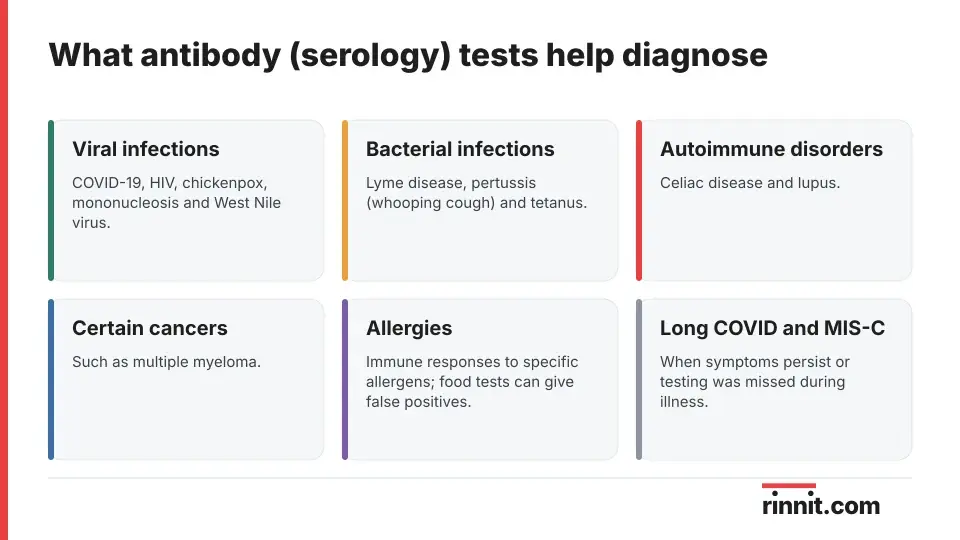
Use | Examples |
Viral infections | COVID-19, HIV, chickenpox, mononucleosis, West Nile virus |
Bacterial infections | Lyme disease, pertussis (whooping cough), tetanus |
Autoimmune disorders | Celiac disease, lupus |
Certain cancers | Multiple myeloma |
Allergies | Immune responses to specific allergens |
Sources: [1]
Serology is also used for measles, mumps, rubella, hepatitis A, B and C, syphilis and diphtheria, and for autoimmune conditions such as rheumatoid arthritis and antiphospholipid syndrome, using tests such as the ANA test and rheumatoid factor. It can also show whether you need a vaccine, prove immunity for school, work or travel, and confirm that your body responded to a vaccine, usually 4 to 6 weeks afterward. [4]
Food allergy antibody tests can give false-positive results, so they're read alongside your history and other tests. [1]
Antibody tests for COVID-19
Your provider may order a COVID-19 antibody test if you had symptoms but weren't tested while sick, tested negative while sick, or have lasting symptoms (long COVID). It can also help diagnose multisystem inflammatory syndrome in children (MIS-C). [1]
What types of antibodies are there?
Your body makes five main classes of antibodies: IgA, IgD, IgE, IgG and IgM. COVID-19 tests usually look for IgM and IgG. [1]

Antibody | What it tells you |
IgM | Usually the first to appear and fades sooner |
IgG | Generally appears about 7 to 10 days after exposure and can last for months or years |
IgA | Generally appears about 7 to 10 days after exposure |
Sources: [1]
Can a vaccine cause a positive antibody test?
Yes. COVID-19 vaccines prompt your body to make antibodies, so you may test positive after vaccination. Whether you do depends on timing and on which antibodies the test measures. [1]
How do you prepare for an antibody test?
No special preparation is needed. Wearing short sleeves makes the blood draw easier. [1]
What happens during an antibody test?
A healthcare provider draws blood from a vein in your arm, or sometimes from a fingertip. The sample goes to a lab, which measures your antibody levels. Afterward, your arm may be sore, you may have a small bruise or you may feel briefly lightheaded. Blood tests are generally safe. [1]
In babies, blood may be taken from a heel prick. Rarely, the needle site can become infected. [4]
What do antibody test results mean?
Results may be ready the same day, or take several days if the sample is sent to a lab. [1]
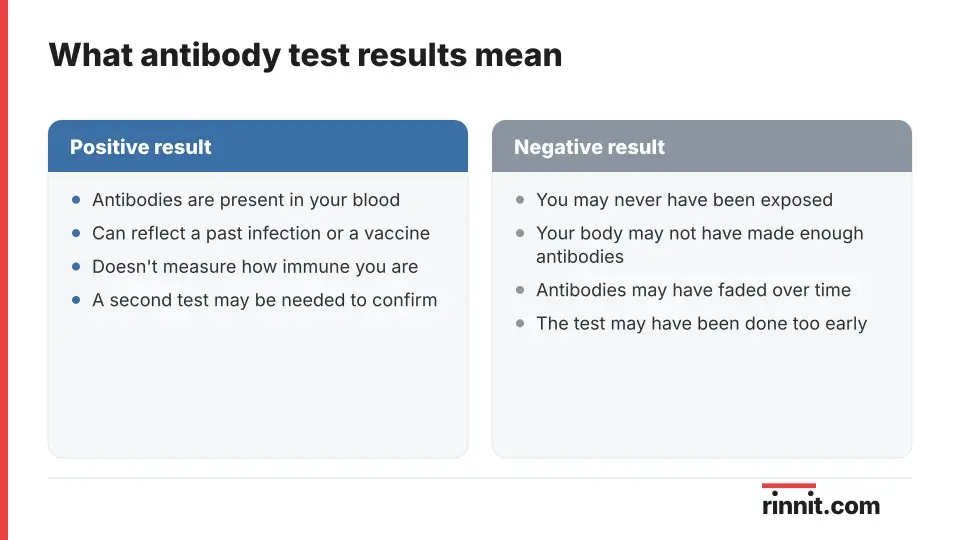
Result | What it may mean |
Positive | Antibodies are present, from a past infection or a vaccine |
Negative | No past exposure, not enough antibodies made, antibodies have faded, or the test was done too early |
Sources: [1]
Results can be qualitative (positive, negative or indeterminate), quantitative (the exact amount of antibodies in your blood) or semi-quantitative, called a titer (how much the sample can be diluted and still show antibodies). A falling level may mean your body has cleared the infection, and because antibodies already bound to germs aren't detected, a severe infection can sometimes test low. [4]
Higher antibody levels often go with more severe infection, but people with mild or no symptoms can also test positive. Antibody tests don't measure immunity, and how long protection lasts differs between germs. [1]
Timing matters. In COVID-19, antibody tests detect less than a third of infections in the first week after symptoms start but more than 9 in 10 after two to three weeks, so they're best used later rather than to diagnose a new infection. [2]
When should you call your doctor?
Contact your provider if you have questions about your results; a second test may be needed to confirm them. Seek prompt care for new or ongoing COVID-19 symptoms. [1]
Questions to ask your provider
Which antibodies will this test measure?
Could a vaccine affect my result?
Am I being tested at the right time after my symptoms began?
Does a positive result mean I'm protected?
Will I need a second test to confirm the result?
Conclusion
An antibody test is a simple blood test that shows whether your immune system has responded to an infection, a vaccine, your own tissues or an allergen. It helps diagnose many conditions, from COVID-19 and Lyme disease to celiac disease and lupus. [1] [3]
Results depend on timing, and a positive test doesn't prove immunity, so your provider reads it with your symptoms and history and may repeat it. [1] [2]
Keep learning: Read our guides to COVID-19, celiac disease and autoimmune diseases. For more, see MedlinePlus: Antibody titer blood test.
FAQ
What is an antibody test?
An antibody (serology) test is a blood test that looks for antibodies your immune system made in response to an infection, vaccine or allergen. [1]
What does a positive antibody test mean?
A positive result means antibodies are present, usually from a past infection or a vaccine. [1]
What does a negative antibody test mean?
It may mean no exposure, too few antibodies, antibodies that have faded or a test done too early. [1]
Does a positive antibody test mean I am immune?
No. Antibody tests don't measure immunity, and how long protection lasts varies. [1]
What is the difference between IgM and IgG antibodies?
IgM usually appears first and fades sooner, while IgG appears about 7 to 10 days after exposure and can last months or years. [1]
Can an antibody test diagnose a current infection?
Not well early on. Antibodies take time to develop, so tests miss many infections in the first week of symptoms. [1] [2]
Can a vaccine make an antibody test positive?
Yes. COVID-19 vaccines prompt antibody production, so you may test positive after vaccination. [1]
Do I need to prepare for an antibody test?
No special preparation is needed; short sleeves make the blood draw easier. [1]
What conditions can antibody tests help diagnose?
They help diagnose infections such as COVID-19 and Lyme disease, autoimmune disorders such as celiac disease and lupus, some cancers and allergies. [1]
How long do antibody test results take?
Results may be ready the same day or take several days if the sample is sent to a lab. [1]
Related Reading
Learn more in our guide to COVID-19 (Coronavirus): Symptoms, Causes, Treatment, Prevention, and What to Expect.
Learn more in our guide to Understanding Long COVID: Symptoms, Causes, and Recovery Pathways.
Learn more in our guide to Celiac Disease: How Gluten Damages Your Gut, and How a Gluten-Free Diet Can Heal It.
Learn more in our guide to Autoimmune Diseases: Why Your Immune System Turns on Your Body and How It's Managed.
References
Cleveland Clinic. Antibody Test: Uses and Procedure Details. Cleveland Clinic. Last updated May 17, 2022. https://my.clevelandclinic.org/health/diagnostics/23019-antibody-test
Deeks JJ, Dinnes J, Takwoingi Y, et al. Antibody tests for identification of current and past infection with SARS-CoV-2. Cochrane Database Syst Rev. 2020;6(6):CD013652. PMID 32584464. https://doi.org/10.1002/14651858.CD013652
Sheppard AL, Elwenspoek MMC, Scott LJ, et al. Systematic review with meta-analysis: the accuracy of serological tests to support the diagnosis of coeliac disease. Aliment Pharmacol Ther. 2022;55(5):514-527. PMID 35043426. https://doi.org/10.1111/apt.16729
Cleveland Clinic. Antibody Serological Test: Purpose, Procedure & Results. Cleveland Clinic. Last updated December 11, 2024. https://my.clevelandclinic.org/health/diagnostics/serological-test
Leeflang MM, Ang CW, Berkhout J, et al. The diagnostic accuracy of serological tests for Lyme borreliosis in Europe: a systematic review and meta-analysis. BMC Infect Dis. 2016;16:140. PMID 27013465. https://doi.org/10.1186/s12879-016-1468-4
Medical disclaimer
This article is for general education only and does not replace advice from a qualified healthcare professional. Talk to your doctor about your own diagnosis and treatment, and seek emergency care right away for severe or sudden symptoms.



Comments