PCR Test: How It Works, What It Detects and What Results Mean (Including COVID-19)

Updated: 2 days ago
Written and medically reviewed by Dr. Baraa Alnahhal, MD · Last reviewed: November 2026 · How we review
Quick Answer: What is a PCR test?
A PCR (polymerase chain reaction) test is a lab technique that makes many copies of a tiny amount of genetic material (DNA or RNA) so it can be detected and studied. Providers use PCR to diagnose infections such as COVID-19 and the flu, find gene changes in tumors and diagnose genetic diseases. Swab results usually take about a day. [1]
What the research says
Testing too early can miss COVID-19. Pooling seven studies (1,330 samples), the chance of a false-negative RT-PCR result was 100% on day 1 after infection, 38% on the day symptoms started and lowest, about 20%, three days after symptoms began. (Kucirka et al., Annals of Internal Medicine, 2020) [2]
A first negative COVID-19 PCR doesn't always settle it. A review of 34 studies with 12,057 confirmed cases found false-negative rates on the first test varied widely, up to 54%, supporting repeat testing when infection is still suspected (very low certainty evidence). (Arevalo-Rodriguez et al., PLOS ONE, 2020) [3]
Key takeaways
PCR copies a specific piece of DNA or RNA many times so it can be detected, even from a very small sample. [1]
It can diagnose infections, genetic diseases and some cancers, and find gene changes that guide treatment. [1]
COVID-19 and flu swab tests use real-time RT-PCR, because these viruses carry RNA. [1]
"Detected" usually means you have the infection or gene change; "not detected" can still miss an early infection. [1] [2]
Most PCR tests need no preparation. [1]
What is a PCR test?
A PCR test looks for genetic material, either DNA or RNA. After taking a body fluid sample (like blood) or a swab (like one from deep in your nose), scientists use PCR to make many copies of DNA that was in the original sample. This amplification lets them analyze genetic material that would otherwise be too small to study. [1]
There are many PCR tests, each designed for a certain purpose. Some find a specific virus that may be making you sick; others look for important changes in your genes. PCR has been used in medicine for decades, and it's one type of nucleic acid amplification test (NAAT). [1]
What is a COVID-19 PCR test?
A provider uses a swab to collect mucus or secretions from deep in your nose. PCR then checks the sample for the genetic material (RNA) of SARS-CoV-2, the virus that causes COVID-19. [1]
What can PCR detect?
Healthcare professionals use PCR to diagnose or detect: [1]
Infectious diseases caused by viruses, bacteria, fungi and parasites
Genetic diseases, such as cystic fibrosis, Huntington's disease and fragile X syndrome
Some types of cancer, such as lymphoma
Gene changes in cancer that specific medicines can target
Gene changes that raise your risk of certain diseases
Gene changes during prenatal testing
Forensic labs also use PCR to create detectable amounts of DNA found at crime scenes. [1]
How does a PCR test work?
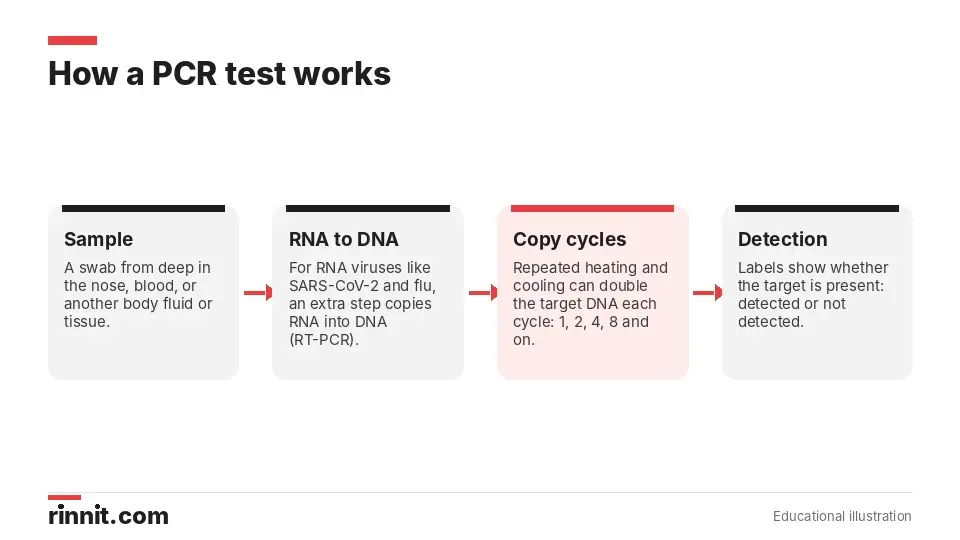
PCR finds a tiny target and copies it until it's easy to detect.
PCR identifies a very specific sequence that is unique to the DNA it's looking for, such as a gene change in a tumor or the genetic code of a virus or bacterium. An enzyme called DNA polymerase builds new strands that copy the target, if it's present. Many cycles of heating and cooling make more and more copies, potentially doubling the target each cycle. [1]
Sometimes scientists run other tests on the copied DNA afterward. Other times, labels in the solution show whether the sample is positive or negative while copying is still happening, which gives faster results for infections. [1]
Types of PCR
Type | What it does |
Reverse-transcriptase PCR (RT-PCR) | Adds steps that turn RNA into complementary DNA (cDNA) so it can be copied. PCR alone works only on DNA. |
Real-time or quantitative PCR (qPCR) | Uses fluorescent labels to show whether the target is present without a separate test. It's sometimes also called "RT-PCR," which can be confusing. |
Real-time RT-PCR | Combines both. Used for COVID-19 and flu nasal swab tests, because SARS-CoV-2 and influenza are RNA viruses. |
Sources: [1]
What tests and procedures use PCR?
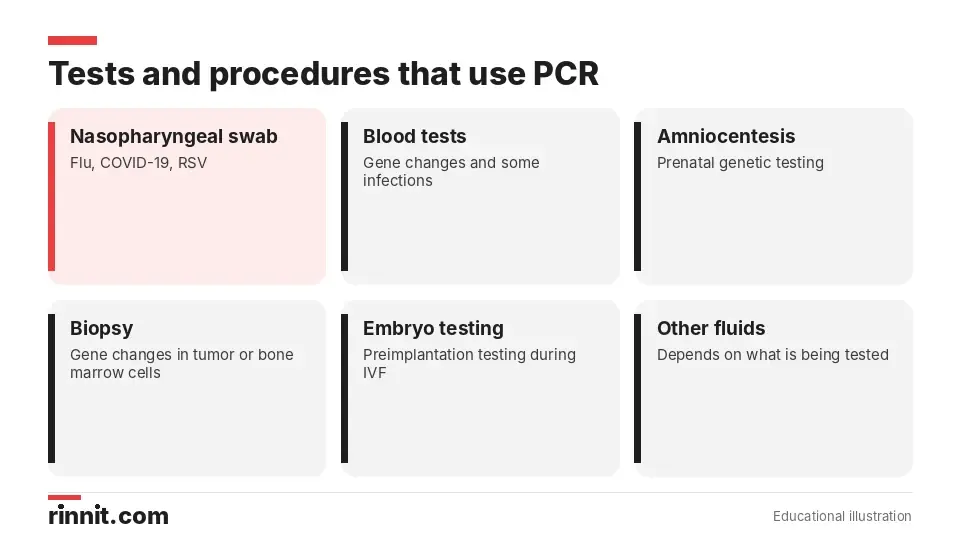
The sample depends on what you're being tested for.
The test or procedure you need depends on what's being checked. PCR is used with: [1]
Blood tests, to look for gene changes and some infections
Nasopharyngeal swabs, to check mucus for common infections like flu, COVID-19 or RSV
Preimplantation genetic testing during IVF, where a few cells from embryos are tested before implantation
Amniocentesis, which tests amniotic fluid during pregnancy
Biopsy, such as a tumor or bone marrow biopsy, to find gene changes in tumor cells
Learn more in our guides to genetic testing, prenatal genetic testing and biopsy.
How do you prepare for a PCR test?
Most of the time you don't need to prepare. It depends on what you're being tested for and the procedure used to collect the sample, so ask your provider if there's anything you need to do. [1]
What do PCR test results mean?

Wording varies by lab, but most results come down to detected or not detected.
Result | What it generally means |
Detected or present | You likely have the gene change or infection the test looked for. |
Not detected | The test didn't find the target DNA or RNA. Early in an infection, there may not have been enough virus or bacteria to detect, even with PCR. |
Sources: [1]
What do COVID-19 PCR results mean?
A positive ("detected") COVID-19 PCR result means you likely have COVID-19 or recently recovered from it. A negative ("not detected") result means you probably didn't have COVID-19 when your nose was swabbed, but PCR can be negative very early in an infection, especially before symptoms start. [1]
Studies show false negatives are most likely in the first days after exposure, so a provider may repeat the test if they still suspect infection. [2] [3]
How long do PCR results take?
Nasal swab results for common viruses like the flu and COVID-19 usually take about a day. Genetic tests on blood, biopsies and other samples can take a week or longer. Contact your provider with any questions about your results. [1]
Conclusion
PCR is a powerful way to find a very small amount of genetic material, which is why it's used for everything from COVID-19 swabs to cancer gene testing and prenatal screening. Your part is usually quick: a swab or a small sample. [1]
If a PCR test comes back negative but you still have symptoms or a recent exposure, talk with your provider. Timing matters, and a repeat test may be needed. [2] [3]
Keep learning: Read our COVID-19 guide or our influenza guide. For more background, see the MedlinePlus page on PCR tests.
FAQ
What is a PCR test?
A lab test that makes many copies of a small amount of DNA or RNA so it can be detected and analyzed. [1]
What does PCR stand for?
Polymerase chain reaction, named after the enzyme (DNA polymerase) and the repeated copying cycles. [1]
What can a PCR test detect?
Viruses, bacteria, fungi and parasites, plus genetic diseases, some cancers and gene changes. [1]
How is a COVID-19 PCR test done?
A provider swabs deep in your nose, and the lab checks the sample for SARS-CoV-2 RNA. [1]
What is the difference between RT-PCR and PCR?
RT-PCR adds a step that converts RNA into DNA, so it can test RNA viruses like SARS-CoV-2 and influenza. [1]
How long do PCR test results take?
About a day for flu or COVID-19 swabs, and a week or longer for genetic tests. [1]
What does "not detected" mean on a PCR test?
The target wasn't found, though very early infections can be missed. [1]
Can a PCR test be negative if I have COVID-19?
Do I need to prepare for a PCR test?
Usually not. Ask your provider, since it depends on the test and how the sample is collected. [1]
Is PCR only used for COVID-19?
No. PCR has been used for decades to diagnose infections, genetic diseases and cancers. [1]
Related Reading
COVID-19 (Coronavirus): Symptoms, Causes, Treatment, Prevention, and What to Expect explains the infection PCR swab tests are best known for.
Influenza (Flu): Symptoms, Transmission, and Treatment covers another RNA virus diagnosed with real-time RT-PCR.
What Is RSV? A Plain-Language Guide to the Virus That Acts Like a Cold in Adults but Can Be Dangerous for Babies explains a respiratory virus that nasal swab PCR can detect.
Cystic Fibrosis: Symptoms, Causes, Diagnosis, and Treatment (2026 Guide) covers a genetic disease PCR-based testing can diagnose.
Fragile X Syndrome: Causes, Symptoms, and Management explains another genetic condition found with PCR.
Nasopharyngeal Swab: Testing for COVID-19, Flu, RSV and More explains the deep nose swab used to test for respiratory infections.
References
Cleveland Clinic. PCR Test: What It Is, How It Works & Results. Cleveland Clinic. Last updated January 21, 2025. https://my.clevelandclinic.org/health/diagnostics/21462-covid-19-and-pcr-testing
Kucirka LM, Lauer SA, Laeyendecker O, et al. Variation in False-Negative Rate of Reverse Transcriptase Polymerase Chain Reaction-Based SARS-CoV-2 Tests by Time Since Exposure. Ann Intern Med. 2020;173(4):262-267. PMID 32422057. https://doi.org/10.7326/M20-1495
Arevalo-Rodriguez I, Buitrago-Garcia D, Simancas-Racines D, et al. False-negative results of initial RT-PCR assays for COVID-19: A systematic review. PLoS One. 2020;15(12):e0242958. PMID 33301459. https://doi.org/10.1371/journal.pone.0242958
Medical disclaimer
This article is for general education only and does not replace advice from a qualified healthcare professional. Talk to your doctor about your own diagnosis and treatment, and seek emergency care right away for severe or sudden symptoms.



Comments