Fragile X Syndrome: Causes, Symptoms, and Management

Updated: 3 days ago
Medically reviewed by Dr. Baraa Alnahhal, MD · Last reviewed: October 2026
Source currency note: This guide reflects medical information reviewed in February 2024. Always confirm current guidance with your healthcare professional.
Quick Answer
Fragile X syndrome is a lifelong genetic condition caused by a mutation in the FMR1 gene on the X chromosome and is the most common inherited intellectual and developmental disability. Symptoms include learning disability, ADHD, anxiety and speech delays. It is diagnosed with a DNA blood test. There is no cure, but therapies help, and life expectancy is average. [3]
What the research says
Treatment for FXS is a combination of therapies and symptom-targeted medicines. A 2024 review of current therapies found that there are no approved medications for FXS, that combining non-pharmacological therapies with medication is currently the most effective approach, and that gene therapy shows promise for the future (Protic and Hagerman, Dev Med Child Neurol, 2024).
Carriers face real health risks, which rise with age. The premutation occurs in about 1 in 200 females and 1 in 400 males. FXTAS penetrance by age 70 is about 16% in females compared with over 60% in males (Hagerman and Hagerman, Curr Opin Neurol, 2021).
What is fragile X syndrome?
Fragile X syndrome (FXS), also called Martin-Bell syndrome, is the leading inherited cause of intellectual and developmental disability (IDD) worldwide. It gets its name from how the X chromosome looks under a microscope, where one section appears "fragile" or partly broken. It affects people of all ethnicities, but it is diagnosed more often, and is usually more severe, in males.
The condition changes how the brain develops and processes information. The challenges range from mild learning disabilities to significant intellectual impairment. Because the mutation sits on the X chromosome, the inheritance pattern is X-linked dominant. Carriers can pass the condition to their children even if they have no symptoms themselves.
Statistic | Estimate |
Male prevalence | 1 in 7,000 |
Female prevalence | 1 in 11,000 |
Primary cause | FMR1 gene mutation |
Inheritance pattern | X-linked dominant |
What are the symptoms and behavioral traits of fragile X syndrome?
The symptoms of FXS span intellectual, physical, and behavioral areas. They often become clearer when a child misses early developmental milestones, and speech and language delays are frequently noticed by about age 2.
Intellectual and mental health features
Children with FXS often have learning disabilities, and their IQ scores tend to decline with age. Language processing problems and difficulty with math are common. Mental health challenges often include heightened anxiety, depression, and obsessive-compulsive behaviors that need professional support.
Physical characteristics
Physical traits often become more pronounced after puberty. They can give clinical clues during early childhood evaluations.
Category | Common physical signs |
Facial features | Long, narrow face; large forehead; prominent jaw; large ears. |
Orthopedic | Flat feet; very flexible or double-jointed fingers. |
Neurological | Low muscle tone (hypotonia); crossed eyes (strabismus). |
After puberty | Enlarged testicles (macro-orchidism) in males. |
Behavioral symptoms
Behavioral issues are often the hardest part for families. Many children show symptoms of ADHD, social shyness, and sensory processing difficulties, which make them very sensitive to crowds, loud noises, or certain textures.
What is the genetic cause of fragile X syndrome?
The root cause is a mutation in the FMR1 gene on the X chromosome. This gene makes the FMRP protein, which plays a critical role in developing synapses, the connections between nerve cells that carry signals through the nervous system.
In a typical FMR1 gene, a DNA segment called the CGG triplet repeat occurs between 5 and 40 times. In people with FXS, it repeats more than 200 times. This expansion "silences" the gene, stops production of the FMRP protein, and disrupts normal brain development.
Genetic status | CGG repeat count | Clinical impact |
Typical | 5 to 40 repeats | Normal FMRP production |
Premutation (carrier) | 55 to 200 repeats | Risk of adult-onset syndromes |
Full mutation (FXS) | More than 200 repeats | Gene silenced; FXS symptoms |
What complications and associated conditions come with fragile X syndrome?
Beyond the main intellectual and behavioral symptoms, people with FXS have a higher risk of several other health problems.
Neurological: seizures occur in a significant share of people with FXS.
Sleep disorders: about 4 in 10 people with both FXS and autism have sleep problems, compared with about 3 in 10 people with FXS alone.
Behavioral escalation: irritability, aggression, and self-injury can occur, especially in people who are also on the autism spectrum.
Metabolic: an increased risk of obesity.
Risks for carriers
People who carry the premutation (55 to 200 repeats) face their own health risks later in life. These include Fragile X-associated tremor/ataxia syndrome (FXTAS), which can cause balance problems, shaky hands, and memory loss, and Fragile X-associated primary ovarian insufficiency (FXPOI), which can cause reduced fertility, irregular periods, and menopause before age 40.
How is fragile X syndrome diagnosed?
Early diagnosis is vital for starting intervention programs that improve long-term outcomes. Symptoms may be visible by 12 months, but the average age of diagnosis is 35 to 42 months.
Testing methods
A DNA blood test is the only definitive way to confirm FXS. It measures the number of CGG repeats in the FMR1 gene. For families with a known history, prenatal testing by amniocentesis or chorionic villus sampling can identify the condition before birth.
Test type | Purpose | Method |
DNA blood test | Definitive diagnosis | FMR1 gene analysis |
Prenatal testing | Early detection | Amniotic fluid or placenta sampling |
Clinical exam | Symptom screening | Physical and behavioral evaluation |
How is fragile X syndrome managed and treated?
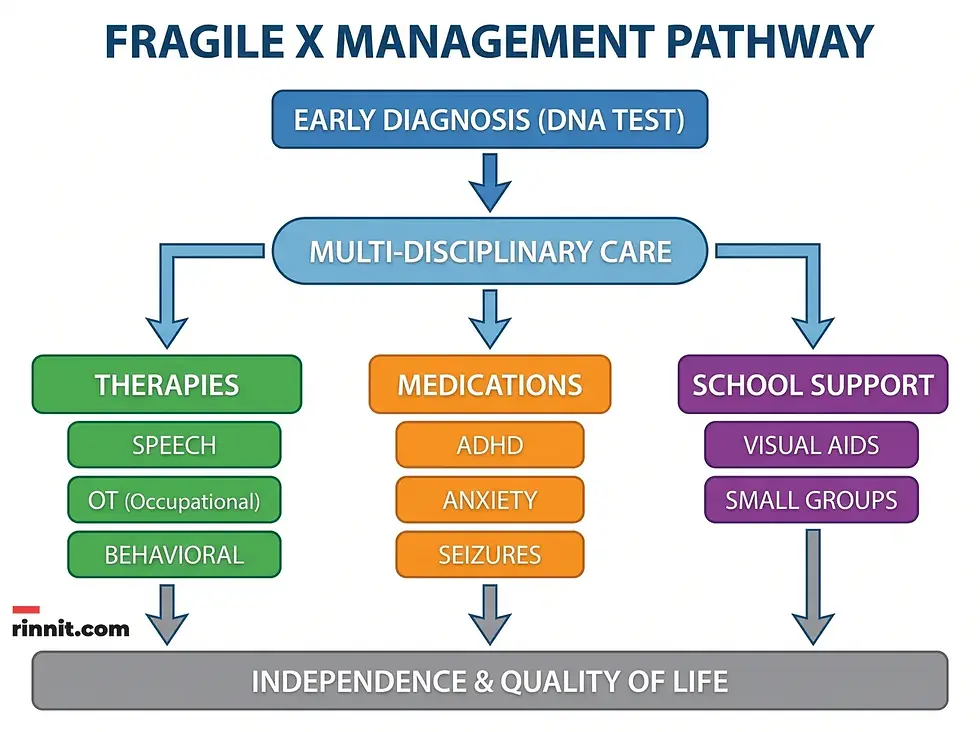
Fragile X syndrome has no cure, but a multidisciplinary approach combining therapies and medication can manage symptoms and support development. Treatment plans are individualized and often combine medication with specialized therapies.
Therapeutic interventions
Therapy is the cornerstone of management. Speech-language pathologists help with communication delays, and occupational therapists work on fine motor skills and sensory integration. Behavior therapists work with families to manage ADHD symptoms and social anxiety.
Medication management
Physicians may prescribe medications for specific symptoms that interfere with daily life or learning. This is only a short list of examples, so ask your child's provider about side effects and complications.
Symptom category | Potential medications |
Seizures / mood | Lithium carbonate, gabapentin |
ADHD | Methylphenidate, dextroamphetamine, venlafaxine |
Aggression / OCD | Fluoxetine, sertraline, citalopram |
Sleep issues | Trazodone, melatonin |
What is the outlook for independence with fragile X syndrome?
Life expectancy for people with FXS is the same as for the general population. The condition is lifelong, but many people lead fulfilling lives and have strong visual memory, a great sense of humor, and a kind, helpful nature.
Independence varies with sex and symptom severity. About 4 in 10 females with the condition reach a high level of independence in adulthood, compared with about 1 in 10 males. Many women keep full-time jobs and live independently, while most males need some ongoing support throughout their lives.
Conclusion
Fragile X syndrome brings real challenges for individuals and families, but it also comes with many positive personality traits. Early intervention is the most effective tool for helping a child reach their potential. With targeted therapies, supportive schools, and medical management, families can handle the complexities of the condition and help their loved ones lead meaningful lives.
When should you see a healthcare provider about fragile X syndrome?
If you notice developmental delays or behavior patterns in your child that are consistent with Fragile X syndrome, consult a pediatrician or genetic counselor. Early access to specialized therapies can change the developmental path and improve long-term independence.
Frequently Asked Questions
What is the main cause of Fragile X syndrome?
A mutation in the FMR1 gene on the X chromosome. The mutation makes a DNA segment (the CGG triplet repeat) repeat more than 200 times, which silences the gene and stops the body from making a protein the brain needs to form synapses.
Is Fragile X syndrome inherited from the mother or father?
Fragile X syndrome is inherited in an X-linked dominant pattern, so a parent who carries the mutation can pass it to their children. Females can be carriers without symptoms, while males with the full mutation always have symptoms.
Can Fragile X syndrome be cured?
No. There is currently no cure, but therapies and medications can manage symptoms such as anxiety, ADHD, seizures, and sleep problems.
How is Fragile X syndrome diagnosed?
With a DNA blood test that counts the CGG repeats in the FMR1 gene. Prenatal testing by amniocentesis or chorionic villus sampling is available for families with a known history.
What are the common physical features of Fragile X?
A long, narrow face, a large forehead, a prominent jaw, large ears, flat feet, and very flexible fingers. These features often become more noticeable after puberty.
Are there different types of Fragile X?
Fragile X syndrome is the full-mutation condition. In carriers, the same gene can cause related conditions, including Fragile X-associated tremor/ataxia syndrome (FXTAS) and Fragile X-associated primary ovarian insufficiency (FXPOI).
Do all people with Fragile X have intellectual disabilities?
Most males with the full mutation have significant intellectual disability. Females are often less affected, because their second X chromosome can partly compensate.
What therapies help children with Fragile X?
Speech-language, occupational, and behavioral therapy are the most common. They help with communication delays, sensory processing, and social and behavioral challenges.
Can people with Fragile X live independently?
Some can. About 4 in 10 females and 1 in 10 males reach a high level of independence, depending on symptom severity and the quality of early intervention and support.
What is the life expectancy for someone with Fragile X?
Life expectancy for someone with Fragile X is the same as for the general population. The symptoms are not life-threatening, though they need lifelong management and support.
Related Reading
Autism Assessment: Screening Tools, Diagnostic Tests and What to Expect explains how autism is screened for and diagnosed in children and adults.
Genetic Testing (DNA Tests): Types, Uses, Risks and What Results Mean explains the DNA tests that can confirm this condition or show carrier status.
PCR Test: How It Works, What It Detects and What Results Mean (Including COVID-19) explains how PCR testing detects infections and gene changes.
References
Protic D, Hagerman R. State-of-the-art therapies for fragile X syndrome. Developmental Medicine and Child Neurology. 2024;66(7):863-871. PMID 38385885. https://doi.org/10.1111/dmcn.15885
Hagerman R, Hagerman P. Fragile X-associated tremor/ataxia syndrome: pathophysiology and management. Current Opinion in Neurology. 2021;34(4):541-546. PMID 33990099. https://doi.org/10.1097/WCO.0000000000000954
Cleveland Clinic. Fragile X syndrome (FXS). Cleveland Clinic. February 7, 2024. https://my.clevelandclinic.org/health/diseases/5476-fragile-x-syndrome
Medical disclaimer
This article was prepared for general information only and is not a substitute for professional medical advice.



Comments