Autism Assessment: Screening Tools, Diagnostic Tests and What to Expect

Updated: 2 days ago
Written and medically reviewed by Dr. Baraa Alnahhal, MD · Last reviewed: November 2026 · How we review
Quick Answer: What is an autism assessment?
An autism assessment is a set of tools a provider uses to screen for or diagnose autism spectrum disorder (ASD). Quick screenings during well-child visits take 30 minutes or less, while a full diagnostic assessment can take several hours or more than one visit. Assessments are used mainly in early childhood, but many of the tools help diagnose adults. [1]
What the research says
Toddler screening catches most children who are later diagnosed. A meta-analysis of 50 studies (51 samples) found the M-CHAT and M-CHAT-R/F screeners had a pooled sensitivity of 83% and a pooled specificity of 94%. Accuracy was higher when the follow-up interview was used. (Wieckowski et al., JAMA Pediatrics, 2023) [2]
Online-style self-tests can't confirm autism in adults. In 210 adults referred for an autism assessment plus 63 controls, the RAADS-R and two short Autism-Spectrum Quotient forms correctly flagged autism in almost 80% of referred cases but correctly cleared only about half of those without it. The authors concluded none was valid enough to predict a diagnosis on its own. (Sizoo et al., Autism, 2015) [3]
Key takeaways
Screening is quick and happens during routine well-child visits; a diagnostic assessment is longer and more detailed. [1]
The American Academy of Pediatrics recommends screening at 18 and 24 months. [1]
Providers usually combine interviews, questionnaires, test materials and observation. [1]
Online tests can raise awareness but are not an official diagnosis. [1] [3]
Your pediatrician or primary care provider can start the testing process. [1]
Why is an autism assessment done?
Autism is a developmental disorder that starts in childhood. Its common signs fall into two groups: slower development of social and communication skills, and restrictive, repetitive behavior patterns that can make change and unexpected situations harder to handle. [1]
A provider may recommend an assessment based on what they observe during well-child visits, behaviors you notice and describe, or behaviors reported by school or child care staff. Research shows that early diagnosis and treatment can help children with autism reach their full potential. [1]
When are children screened for autism?
In the U.S., pediatricians typically screen all children for autism during well checks. Most follow the schedule of one of two organizations: [1]
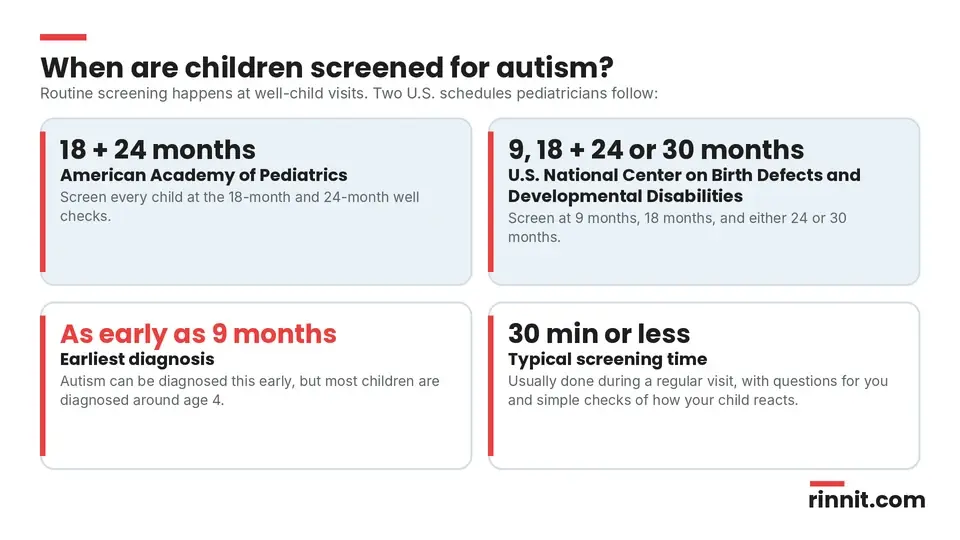
Recommended screening ages | |
American Academy of Pediatrics | 18 months and 24 months |
U.S. National Center on Birth Defects and Developmental Disabilities | 9 months, 18 months, and either 24 or 30 months |
Sources: [1]
A provider can make the diagnosis as early as 9 months, although most children aren't diagnosed until around age 4. Most screening tools used before age 2 are still highly reliable. [1]
Types of autism assessments
Not all autism assessments are the same. Screening tools show whether a child needs more testing. Full diagnostic tools are used to make a diagnosis. Both kinds rely on one or more of these: [1]

Interviews about you or your child and any symptoms
Questionnaires about you or your child
Test materials that highlight differences in communication or processing
Observation time, when a provider watches your child do an activity and looks for clues
Screening tools | Full diagnostic tools | |
Purpose | Decide whether more testing is needed | Make or rule out a diagnosis |
Examples | ASQ, M-CHAT-R/F, PEDS | ADI-R, ADOS-2, CARS-2, GARS-2, SCQ, SRS-2 |
Time | 30 minutes or less | Up to several hours, sometimes several visits |
Where | Regular well-child visit | Specialist or extended appointment |
Sources: [1]
Providers usually use several tools during a full assessment. There are so many because autism looks very different from person to person: some tools suit certain ages, while others are best at uncovering specific symptoms or effects. [1]
Related tests your provider may suggest
Autism is linked to many other conditions, so providers often test for those too: [1]
Vision and hearing testing
An electroencephalogram (EEG) to check for epilepsy if there's a history of possible seizures
A brain MRI if the physical exam shows differences such as microcephaly
Genetic testing to check whether autism is happening because of, or along with, a condition like fragile X syndrome
Blood tests for lead poisoning or metabolic diseases
What happens during an autism assessment?
What happens depends on the type of assessment and the tool used, so the provider doing it is the best person to explain what to expect and how to prepare. [1]
Screening tests
For childhood screening, you usually don't need to prepare. The provider does it during a regular well-child visit, often by asking you questions about your child or seeing how your child reacts to certain things. It usually takes 30 minutes or less. [1]
Diagnostic assessments
A diagnostic assessment is more comprehensive and can take up to several hours, sometimes over multiple visits. It takes longer partly because autism shares many symptoms with other conditions that have to be ruled out, and partly because it gathers details about how autism affects you or your child, which helps plan treatment. [1]
If the assessment is for your child, the provider may suggest bringing: [1]
Snacks or other items that help your child feel comfortable
Toys that may be used in the assessment or keep your child occupied
What do autism screening results mean?
Your provider can usually share screening results as soon as the screening is done. A screening usually leads to one of three results: [1]
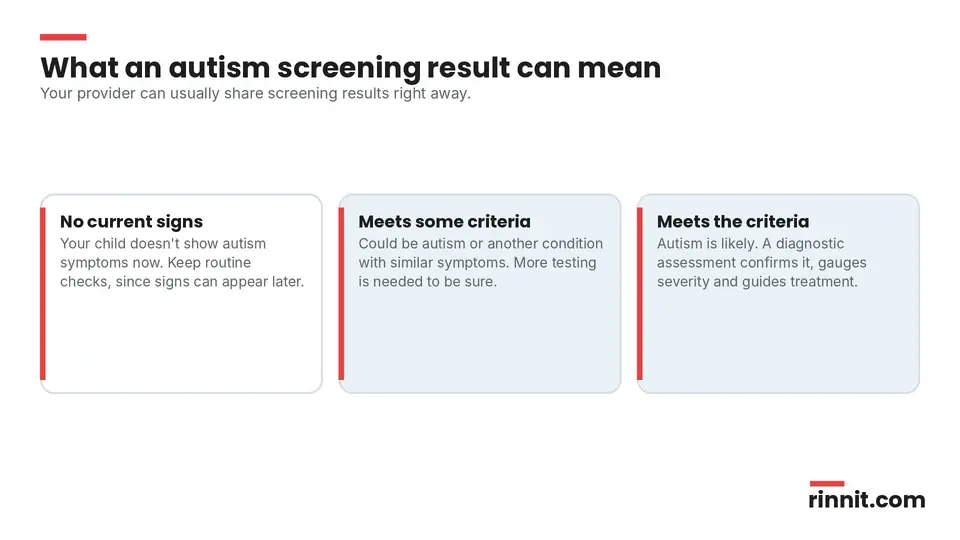
Result | What it means | Next step |
No current signs | Your child doesn't show autism symptoms right now | Keep up routine checks, since symptoms could still develop later |
Meets some criteria | Could be autism or another condition with similar symptoms | More testing to be sure |
Meets the criteria | Your child likely has autism | Diagnostic testing to confirm it and guide treatment |
Sources: [1]
When a diagnostic assessment confirms autism, the provider also explains how severe it is, its specific effects (such as a language disorder, trouble socializing or sensory overload) and any related medical conditions. [1]
Key signs that may prompt an assessment
Experts look for certain signs that are specific to autism, such as: [1]
No babbling, pointing or other gestures by 12 months
No single words by 16 months
No two-word sentences by 24 months (repeating or echoing words doesn't count)
Any loss of language or social skills, at any age
Can you diagnose autism with an online test?
No. Online tests, including medically validated ones like the Ritvo Autism Asperger Diagnostic Scale (RAADS) or the Autism-Spectrum Quotient, are not an official diagnosis. One big reason is symptom overlap: people with several neurodivergent conditions can score high because those conditions share symptoms. Online tests also can't tell you whether you have more than one condition or a related genetic condition. [1]
That said, they can raise awareness. If a test makes you think you might be autistic, talk to your primary care provider. They can screen you or refer you to a specialist. [1]
Conclusion
An autism assessment ranges from a short questionnaire at a well-child visit to a detailed evaluation over several hours. Screening shows who needs more testing, and a full assessment confirms the diagnosis, describes its effects and points to the right support.
If you're worried about your child's development or wonder whether you're autistic yourself, start with your pediatrician or primary care provider. Early answers open the door to early support.
Keep learning: Read our guide to developmental delay in children or learn about fragile X syndrome, a genetic cause your provider may check for. For more background, see the CDC's guidance on autism screening.
FAQ
What is an autism assessment?
It's a set of tools providers use to screen for or diagnose autism spectrum disorder in children and adults.
At what age are children screened for autism?
The American Academy of Pediatrics recommends screening at 18 and 24 months during well-child visits.
How long does an autism assessment take?
A screening takes 30 minutes or less; a full diagnostic assessment can take several hours or several visits.
What is the M-CHAT-R/F?
It's a common toddler screening questionnaire that helps decide whether a child needs a full autism assessment.
What tools are used to diagnose autism?
Common tools include the ADOS-2, ADI-R, CARS-2, GARS-2, SCQ and SRS-2, often used together.
How early can autism be diagnosed?
It can be diagnosed as early as 9 months, though most children are diagnosed around age 4.
Can adults get an autism assessment?
Yes. Many assessment tools also work for adults; start with your primary care provider for screening or a referral.
Are online autism tests accurate?
They can raise awareness but can't confirm autism, partly because many neurodivergent conditions share symptoms.
What other tests might be done with an autism assessment?
Providers may suggest vision and hearing tests, an EEG, a brain MRI, genetic testing or blood tests for lead or metabolic problems.
What are early warning signs of autism?
Warning signs include no babbling or gestures by 12 months, no words by 16 months and any loss of language or social skills.
Do I need to prepare for an autism screening?
Usually not. Screenings happen during routine well-child visits; for longer assessments, bring snacks and toys for your child.
Related Reading
Developmental Delay in Children: Signs, Types, Causes, and What Early Intervention Can Do explains the signs of delayed development and how early intervention helps.
Fragile X Syndrome: Causes, Symptoms, and Management covers a genetic condition that can occur with autism and that genetic testing can find.
ADHD: Complete Guide to Symptoms, Causes, Diagnosis & Treatment explains a neurodevelopmental condition that shares some symptoms with autism.
What Is Microcephaly? A Plain-Language Guide for Parents explains a head-size finding that may lead to a brain MRI during an autism workup.
References
Cleveland Clinic. Autism Test: What To Expect at an Autism Screening. Cleveland Clinic. Last updated November 11, 2025. https://my.clevelandclinic.org/health/diagnostics/autism-test-assessment
Wieckowski AT, Williams LN, Rando J, et al. Sensitivity and Specificity of the Modified Checklist for Autism in Toddlers (Original and Revised): A Systematic Review and Meta-analysis. JAMA Pediatr. 2023;177(4):373-383. PMID 36804771. https://doi.org/10.1001/jamapediatrics.2022.5975
Sizoo BB, Horwitz EH, Teunisse JP, et al. Predictive validity of self-report questionnaires in the assessment of autism spectrum disorders in adults. Autism. 2015;19(7):842-849. PMID 26088060. https://doi.org/10.1177/1362361315589869
Medical disclaimer
This article is for general education only and does not replace advice from a qualified healthcare professional. Talk to your doctor about your own diagnosis and treatment, and seek emergency care right away for severe or sudden symptoms.



Comments