Developmental Delay in Children: Signs, Types, Causes, and What Early Intervention Can Do

Updated: 2 days ago
Medically reviewed by Dr. Baraa Alnahhal, MD · Last reviewed: November 2026
Quick Answer
A developmental delay is when a child is slower than expected to reach milestones such as sitting, walking or talking. It can affect thinking, social skills, language or movement, and 1 in 6 U.S. children aged 3 to 17 has some developmental disability [1]. Most delays resolve, and early intervention, ideally before age 3, gives the best chance to catch up [1].
What the research says
Developmental disabilities are common among children. Using national survey data on US children aged 3 to 17, parent-reported diagnoses of any developmental disability (a broader group that includes ADHD, autism, and other developmental delays) rose from 16.2% in 2009–2011 to 17.8% in 2015–2017 (PubMed: Zablotsky et al., Pediatrics, 2019 [4]).
A screening result is a signal to look closer, not a diagnosis. A meta-analysis of 56 studies covering 17 developmental screening tests found a pooled sensitivity of 0.75 (95% CI 0.69–0.80) and a pooled specificity of 0.76 (95% CI 0.71–0.80), which is why a positive screen leads to further evaluation (PubMed: Rah et al., J Am Acad Child Adolesc Psychiatry, 2023 [5]).
Early intervention is linked to gains, but the evidence is still limited. A systematic review of six studies (689 children aged 0–6 with global or nonspecific developmental delay) found that all reported improvement in at least one area (motor, language, cognitive, or social), with greater gains when programs started early and lasted longer; however, no randomized trials were found and the certainty of the evidence was rated low to very low (PubMed: Almuhanna et al., Galen Med J, 2025 [6]).
What Is a Developmental Delay?
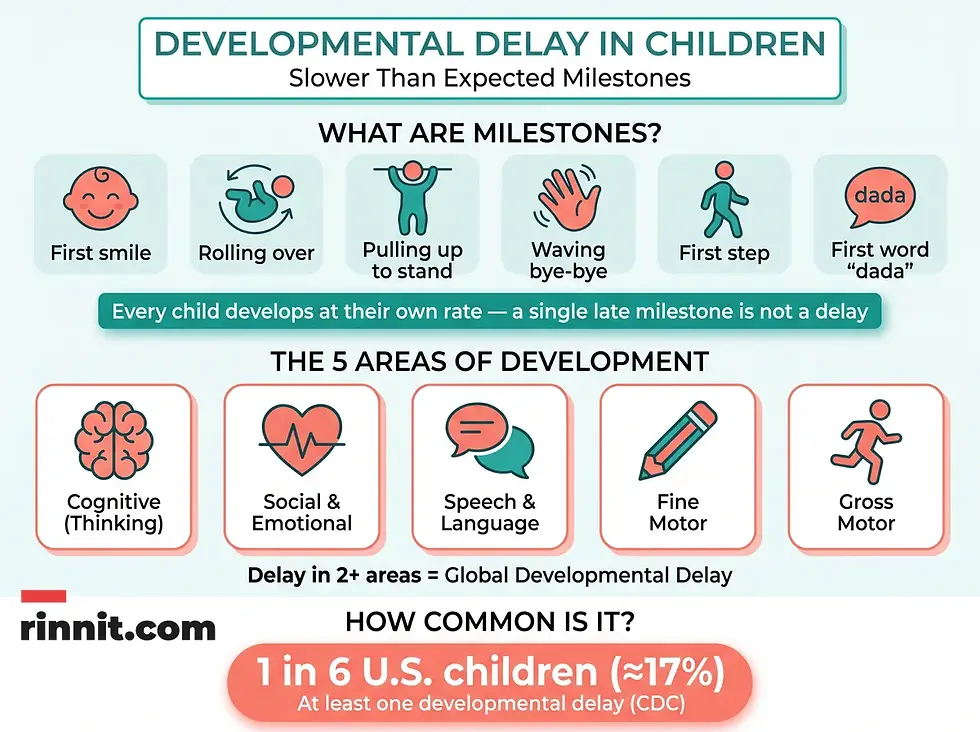
A developmental delay means your child is slow to reach one or more developmental milestones compared to their peers [1]. Milestones are skills that most children gain at predictable points in early life, such as smiling for the first time, rolling over, pulling up to stand, waving “bye-bye,” taking a first step [1] [2], or speaking a first word like “dada.”
Children reach milestones in playing, learning, speaking, behaving, and moving [1] [2], and they do so at different rates. There is no strict timetable, so being a little behind does not automatically mean your child has a developmental delay. A delay means your child is continually behind the skills expected for a given age [1].
Child development is more than physical growth. From birth, children develop in how they interact with their environment: how they play, learn, speak, move, and behave [1].
Developmental Delay vs. Autism
Developmental delay is different from developmental disabilities such as autism spectrum disorder [1]. It can sometimes be hard to tell whether a child has a delay or a developmental disability, but either way, early intervention is the best way to help a child progress and thrive.
Feature | Developmental delay | Autism spectrum disorder |
What it means | A child reaches milestones slower than expected | A neurodevelopmental disorder present from early childhood [1] |
Course over time | Typically catches up with early intervention and support [1] | Does not go away on its own; usually lifelong [1] |
Core challenges | Slower skill development in one or more areas | Trouble interacting with others, forming relationships, and using language [1] |
How Common Is Developmental Delay?
According to the US Centers for Disease Control and Prevention, approximately 1 in 6 children aged 3 to 17 in the United States (about 17%) has at least one developmental disability, a broader group that includes ADHD, autism and other delays [1].
The Types of Developmental Delays
Developmental delays align with the areas of child development. Each area involves a different set of skills, and a delay in each shows up differently.
Development area | Skills involved | What a delay may look like |
Cognitive (thinking) | Thinking, learning, understanding information | Trouble following directions or solving a problem [1] |
Social and emotional | Getting along with others, expressing feelings, communicating needs | Struggles with social cues, conversations, or changes to a routine [1] |
Speech and language | Using and understanding language | Difficulty speaking words or understanding what others say [1] |
Fine motor | Coordinating small muscles | Trouble holding an object, coloring, or writing [1] |
Gross motor | Coordinating large muscles | Difficulty rolling over, sitting up, or walking [1] |
What Is Global Developmental Delay?
A delay can be isolated, meaning it affects only one area of development [1]. If a significant delay occurs in two or more developmental areas, providers may refer to it as global developmental delay [1].
What Are the Symptoms of a Developmental Delay?
Symptoms vary depending on the type of delay. If your child shows one or more of these patterns over time, rather than a single missed milestone, it is worth discussing with their provider.
Symptom | Area most often affected |
Delays in rolling over, sitting up, crawling, and walking [1] | Gross motor |
Trouble with fine motor skills [1] | Fine motor |
Problems understanding what others say [1] | Speech and language |
Problems talking, or talking late [1] | Speech and language |
Trouble with problem-solving [1] | Cognitive |
Difficulty remembering things [1] | Cognitive |
Issues with social skills [1] | Social and emotional |
Inability to connect actions with consequences [1] | Cognitive and social-emotional |

What Causes Developmental Delays?
Researchers don't know the cause of many developmental delays [1]. Known causes and risk factors fall into two broad groups: genetic factors, such as Down syndrome and fragile X syndrome, and environmental factors [1].
Cause category | Specific factors |
Genetic factors | Down syndrome, fragile X syndrome [1] |
Toxins before birth | Alcohol, opioids, marijuana [1] |
Toxins after birth | Lead poisoning [1] |
Birth-related factors | Premature birth, low birth weight, not enough oxygen at birth [1] |
Health and nutrition | Poor nutrition; chronic ear infections; vision issues [1] |
Trauma | Severe trauma, including child abuse [1] |
Babies born early are among those at higher risk. To learn more, see Premature Birth: Complete Guide to Signs, Causes, and Care.
How Is Developmental Delay Diagnosed?
There is no lab or blood test that can tell if a child has a developmental delay [1]. Diagnosis starts with developmental screening during routine care.
What Is Developmental Screening?
Healthcare providers use developmental screening to tell whether children are learning basic skills when they should, or if they might have issues [1]. During an exam, your child's provider may ask you questions or talk and play with your child to observe how they learn, speak, behave, and move [1]. They may also give you a questionnaire to fill out [1].
Screening is a tool to find out if your child is on track or needs extra evaluations or treatments [1]. Because there is a wide range of growth and behavior at each age, it is natural for children to reach a milestone earlier or later than the general trend, so the provider looks at the big picture [1]. The American Academy of Pediatrics recommends screening children for general development with standardized, validated tools at 9, 18, and 30 months, and for autism at 18 and 24 months, or whenever a parent or provider has a concern [2] [3]. Tests also exist for specific syndromes and disorders that cause developmental delays, such as Down syndrome and fragile X syndrome, and your child's provider will tell you whether any are needed [1].
Why Is Early Screening Important?

How Is Developmental Delay Treated?
Depending on the concerns, your child's healthcare provider may refer them to one or more specialists [1].
Specialist | What they address |
Hearing specialist | Difficulty hearing |
Speech therapist | Speech and language delays |
Developmental pediatrician | Overall developmental concerns in children |
Neurologist | Brain and nervous system concerns |
Early intervention services provider | Support for infants and toddlers with delays |
What Are Early Intervention Services?
Early intervention services provide support for infants and toddlers with certain issues, including premature birth, a variety of health problems, delays in talking, thinking, playing, or moving, and difficulty with seeing or hearing [1]. If your child is eligible, their provider writes an Individualized Family Service Plan (IFSP). The plan is based on the particular needs of your child and your family [1] and spells out the activities and services that could best help [1].
Early intervention service | Description |
Assistive technology | Devices your child may need |
Audiology or hearing services | Support for hearing difficulties |
Speech or language services | Help with talking and understanding language |
Family counseling and training | Guidance for the family |
Medical and nursing services | Healthcare support and care coordination |
Nutrition services | Feeding and nutrition support |
Physical therapy | Support for movement skills |
Occupational therapy | Support for daily-living and fine motor skills |
Psychological services | Mental health support |
Will My Child “Outgrow” a Developmental Delay?
Most developmental delays will resolve on their own over time [1]. With early intervention services, your child should be able to catch up to their peers and reach their full potential [1]. However, without early intervention support, there is a chance a developmental delay may progress into a more serious problem [1], so it is critical to seek support as soon as possible if you suspect your child has a delay.
Can Developmental Delay Be Prevented?
Scientists don't always know why developmental delays happen, so you can't always prevent them. During pregnancy, it is important to avoid toxins and attend all prenatal appointments [1]. The best way to prevent long-term developmental delays is early intervention: research shows that early intervention services for babies and children up to 3 years of age can minimize, and often prevent, the long-term effects of developmental delays [1].
How Do You Take Care of a Child With a Developmental Delay?
Along with early intervention services, parents can support daily progress with a few practical habits.
Home strategy | How it helps |
Play with your child | Play-dough builds fine motor skills; playground play builds physical and social-emotional skills; playing with adults and other children builds language and social skills [1] |
Read with your child | Children learn language from hearing words; the more words they hear, the more they learn [1] |
Limit screen time | Children learn best from interactions with others, not TV or video games; keep screen time under one hour per day for young children [1] |
Make a schedule | A written schedule helps children follow directions and understand routines; picture schedules help them visualize [1] what's expected |
Keep in contact | Regular check-ins with the intervention coordinator and providers give you progress updates and tips [1] |
Key Takeaways
A developmental delay means a child is continually behind the milestones most children reach at a given age. It can affect thinking, social-emotional skills, speech and language, or movement, and a significant delay in two or more areas is called global developmental delay [1]. About 1 in 6 US children aged 3 to 17 has a developmental disability, a broader group that includes delays [1], and researchers don't know the cause of many of them. Diagnosis starts with screening, not bloodwork. Most delays resolve over time, and the best predictor of a good outcome is acting early: early intervention for children under 3 can minimize or even prevent long-term effects [1].
Take the Next Step
If you suspect your child is falling behind their peers, contact their healthcare provider. Early screening and early intervention give children the best chance to catch up and reach their full potential.
Related reading: Premature Birth: Complete Guide to Signs, Causes, and Care
Frequently Asked Questions
1. What is a developmental delay?
A developmental delay is when a child is slow to reach one or more developmental milestones compared to their peers, such as smiling, rolling over, walking, or saying a first word. It means the child is continually behind skills expected for their age, not just a little late on a single milestone.
2. What areas of child development can be delayed?
Delays can affect cognitive (thinking), social and emotional, speech and language, or fine and gross motor skills. A delay can be isolated to one area or involve two or more areas, which is called global developmental delay.
3. How common is developmental delay?
According to the US Centers for Disease Control and Prevention, approximately 1 in 6 children in the United States aged 3 to 17, about 17%, has at least one developmental disability, a broader group that includes ADHD, autism and other delays.
4. What is the difference between developmental delay and autism?
A developmental delay means a child develops certain skills slower than peers and typically catches up with support. Autism is a neurodevelopmental disorder that does not go away on its own and involves trouble interacting with others, forming relationships, and using language.
5. What causes developmental delays?
Researchers don't know the cause of many delays. Known factors include genetic conditions such as Down syndrome and fragile X syndrome, and environmental risks such as toxin exposure before or after birth, premature birth, low birth weight, low oxygen at birth, poor nutrition, chronic ear infections, vision issues, and severe trauma.
6. What are the symptoms of a developmental delay?
Symptoms vary by type and may include delays in rolling over, sitting, crawling, and walking, trouble with fine motor skills, problems understanding what others say, trouble talking or late talking, problem-solving difficulties, trouble remembering things, social-skill issues, and an inability to connect actions with consequences.
7. Is there a test for developmental delay?
There is no lab or blood test that can tell if a child has a developmental delay. Providers use developmental screening (questions, observation, play, and sometimes a questionnaire) to see if a child is on track. Tests do exist for specific syndromes that cause delays.
8. What are early intervention services?
Early intervention services support infants and toddlers with health problems, developmental delays, or vision or hearing difficulties. They may include speech therapy, physical therapy, occupational therapy, audiology services, family counseling, nutrition services, nursing services, medical services, psychological services, and assistive technology, organized through an Individualized Family Service Plan (IFSP).
9. Will my child outgrow a developmental delay?
Most developmental delays resolve on their own over time. With early intervention services, a child should be able to catch up to their peers and reach their full potential. Without support, a delay may progress into a more serious problem.
10. Can developmental delay be prevented?
You can't always prevent it because causes aren't always known. Avoiding toxins during pregnancy and keeping prenatal appointments helps. The best protection against long-term effects is early intervention: services for children up to age 3 can minimize and often prevent lasting impacts.
11. How can parents help a child with a developmental delay at home?
Play with your child, read together every day, limit screen time to under one hour daily, create a visual schedule for routines, and keep in regular contact with the early intervention coordinator and healthcare providers for progress updates and tips.
Related Reading
Autism Assessment: Screening Tools, Diagnostic Tests and What to Expect explains how autism is screened for and diagnosed in children and adults.
References
Cleveland Clinic. Developmental Delay in Children. Cleveland Clinic. Mar. 27, 2023. https://my.clevelandclinic.org/health/diseases/14814-developmental-delay-in-children
Centers for Disease Control and Prevention. CDC's Developmental Milestones. Learn the Signs. Act Early.. Feb. 16, 2026. https://www.cdc.gov/act-early/milestones/
American Academy of Pediatrics. Assessing Developmental Delays in Children. HealthyChildren.org. Feb. 19, 2025. https://www.healthychildren.org/English/ages-stages/toddler/Pages/Assessing-Developmental-Delays.aspx
Zablotsky B, Black LI, Maenner MJ, et al. Prevalence and trends of developmental disabilities among children in the United States: 2009-2017. Pediatrics. 2019;144(4):e20190811. doi:10.1542/peds.2019-0811. PMID: 31558576.
Rah SS, Jung M, Lee K, et al. Systematic review and meta-analysis: real-world accuracy of children's developmental screening tests. J Am Acad Child Adolesc Psychiatry. 2023;62(10):1095-1109. doi:10.1016/j.jaac.2022.12.014. PMID: 36592715.
Almuhanna SM, Alshehri OA, B Alsaadoon BM, et al. Effectiveness of early intervention programs for young children with global developmental delay: a systematic review. Galen Med J. 2025;14:e3906. doi:10.31661/gmj.vi.3906. PMID: 42038902.
Medical Disclaimer
This article is for informational purposes only and does not constitute medical advice. Always seek the advice of your physician or other qualified health provider with any questions you may have regarding a medical condition. Never disregard professional medical advice or delay in seeking it because of something you have read here.



Comments