Convalescent Plasma: How It Works, Uses and Effectiveness

Updated: 2 days ago
Written and medically reviewed by Dr. Baraa Alnahhal, MD · Last reviewed: November 2026 · How we review
Quick Answer
Convalescent plasma is a treatment that gives you antibodies from the plasma of someone who has recovered from the same infection, helping fight it while your own immune system catches up. It's used for new viral infections when vaccines or antivirals aren't available. It's given by IV, is generally safe and works best when given early.
What the research says
Early plasma cut COVID-19 hospital stays by half: in a trial of 1,181 outpatients, convalescent plasma given within 9 days of symptoms lowered COVID-19 hospitalization to 2.9% versus 6.3% with control plasma, a 54% reduction (Sullivan DJ et al., New England Journal of Medicine, 2022) [2]
Plasma didn't lower deaths in moderate to severe COVID-19: a Cochrane review of 33 trials with 24,861 people found convalescent plasma didn't reduce 28-day deaths in people with moderate to severe COVID-19 (high-certainty evidence) (Iannizzi C et al., Cochrane Database of Systematic Reviews, 2023) [3]
Key takeaways
Convalescent plasma gives you antibodies from a recovered donor.
It provides passive immunity while your body makes its own antibodies.
It's used for new viral infections like COVID-19 and Ebola.
It works best when given early.
It's given by IV and is generally safe.
What is convalescent plasma?
Plasma is the liquid part of blood. Donors must be fully recovered and have high antibody levels. Donated blood is tested and screened, which makes it safe. Learn how antibodies fight infection. Sources: [1]
What it treats
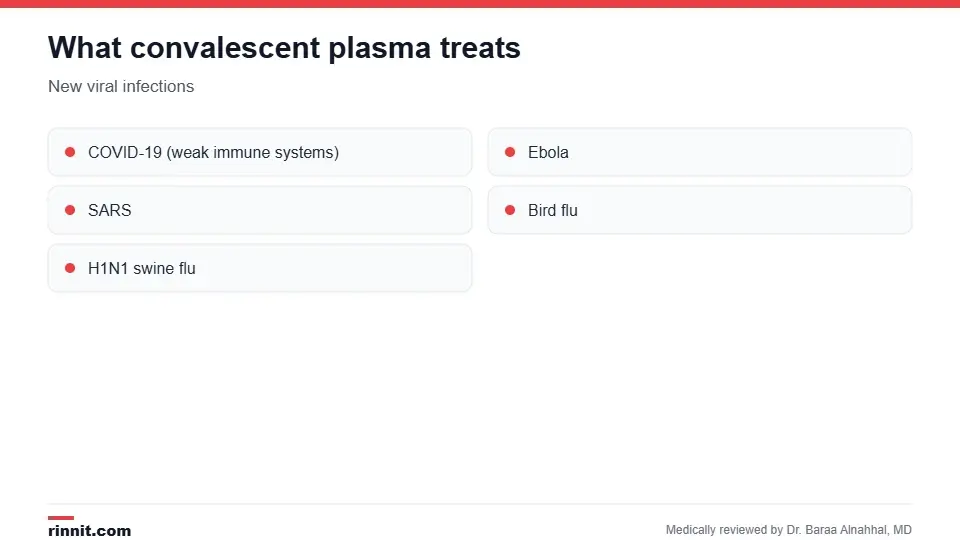
It's mostly used when vaccines or antivirals aren't available.
COVID-19, for people with weakened immune systems.
Ebola and other viral hemorrhagic fevers.
SARS.
Bird flu (avian influenza).
H1N1 (swine flu). Sources: [1]
For most people, vaccination and antivirals are the best way to prevent severe COVID-19. Sources: [1]
How it works
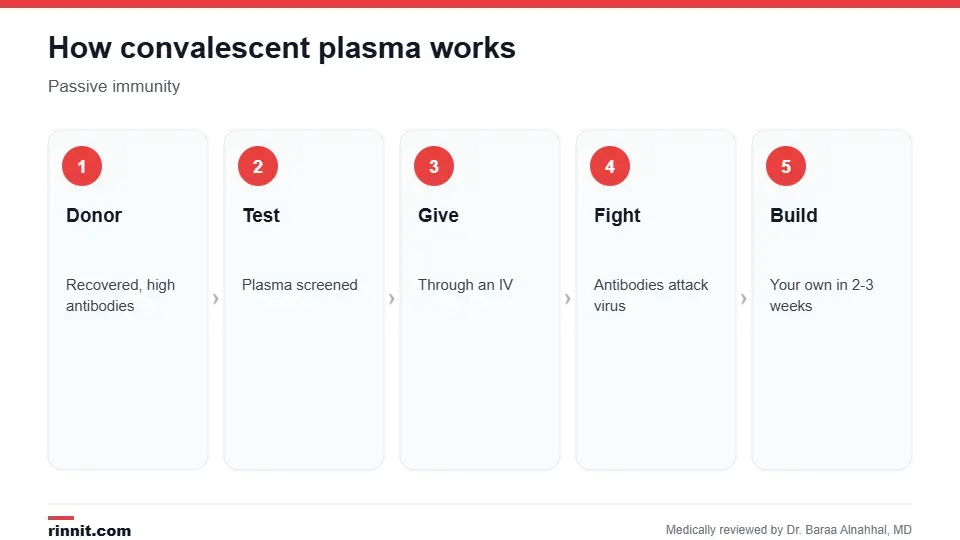
This is called passive immunity.
A recovered donor gives plasma with high antibody levels.
The plasma is tested and screened.
You receive it through an IV.
The donor's antibodies help fight the infection.
Your own immune system makes antibodies over two to three weeks. Sources: [1]
What to expect

The transfusion can take one to four hours.
Your provider checks your health history and blood type.
You lie down or sit, and an IV is placed in your arm.
The plasma flows in over an hour or more.
The IV is removed and the site is bandaged.
You're monitored for side effects. Sources: [1]
It's similar to a blood transfusion. Sources: [1]
Risks
Fever.
Allergic reactions.
Infection at the IV site.
Extremely rarely, infections such as HIV or hepatitis B or C. Sources: [1]
How well it works
Results depend on the illness and how soon it's given. People treated in the first few days of COVID-19 symptoms were 30% to 50% less likely to be hospitalized. But studies found no clear benefit for survival in people already severely ill with COVID-19 or in Ebola outbreaks. It may help people with weak immune systems who haven't made antibodies after vaccination. Sources: [1, 2, 3]
Recovery
You likely won't feel better right away, and recovery still takes time. Your care team will tell you which symptoms to watch for. Sources: [1]
When to call your provider
Contact your provider if you have questions about the treatment or think you're having side effects. Sources: [1]
Conclusion
Convalescent plasma lends you a recovered person's antibodies to help fight a new infection. It's most useful early in illness and for people whose immune systems can't respond well on their own.
Keep learning: read about IVIG and monoclonal antibodies.
Frequently asked questions
What is convalescent plasma?
Plasma with antibodies from someone who recovered from an infection.
How does it work?
Donor antibodies help fight the infection while your body makes its own.
What does it treat?
New viral infections like COVID-19, Ebola, SARS and bird flu.
Who can get it for COVID-19?
People with weakened immune systems.
How is it given?
Through an IV, over one to four hours.
Is it safe?
Yes. Donor blood is tested, and complications are rare.
When does it work best?
When given early in the illness.
Does it help severe COVID-19?
Studies found it didn't lower deaths in moderate to severe cases.
Will I feel better right away?
Probably not; recovery takes time.
Can I donate convalescent plasma?
Recovered people with high antibody levels may be eligible.
Related Reading
Plasma: What It Is, What It Does and Why It Matters the liquid part of blood.
Intravenous Immunoglobulin (IVIG) another antibody treatment.
Monoclonal Antibodies: What They Are, How They Work, Uses and Side Effects lab-made antibodies.
Blood Transfusion: What It Is, How It Works and Is It Safe? how transfusions work.
COVID-19 (Coronavirus): Symptoms, Causes, Treatment, Prevention, and What to Expect an infection it treats.
References
Cleveland Clinic. Convalescent Plasma: What It Is, How It Works & Effectiveness. Cleveland Clinic. Last updated June 17, 2024. https://my.clevelandclinic.org/health/treatments/21886-convalescent-plasma
Sullivan DJ, Gebo KA, Shoham S, et al. Early outpatient treatment for Covid-19 with convalescent plasma. New England Journal of Medicine. 2022;386(18):1700-1711. PMID 35353960. https://doi.org/10.1056/NEJMoa2119657
Iannizzi C, Chai KL, Piechotta V, et al. Convalescent plasma for people with COVID-19: a living systematic review. Cochrane Database of Systematic Reviews. 2023;5(5):CD013600. PMID 37162745. https://doi.org/10.1002/14651858.CD013600.pub6
Medical disclaimer
This article is for general education only and does not replace advice from a qualified healthcare professional. Talk to your doctor about your own diagnosis and treatment, and seek emergency care right away for severe or sudden symptoms.



Comments