Blood Transfusion: What It Is, How It Works and Is It Safe?

Updated: 6 days ago
Written and medically reviewed by Dr. Baraa Alnahhal, MD · Last reviewed: October 2026 · How we review
Quick Answer: What is a blood transfusion?
A blood transfusion is a hospital procedure in which you receive donated blood, or one part of it, through a thin tube in a vein after major blood loss or when a condition affects your blood cells. Most transfusions are safe with mild side effects; red cell transfusions take about 2–4 hours, plasma and platelets an hour or less. [1]
What the research says
Fewer transfusions, same survival. A review of 48 trials with 21,433 people found that waiting until hemoglobin dropped to about 7–8 g/dL before transfusing cut the chance of needing any transfusion by 41%, with no difference in 30-day deaths (31 trials, 16,729 people) (Carson et al., Cochrane Database Syst Rev, 2021).
Heart attack patients may be different. In 3,504 people with a heart attack and anemia, heart attack or death within 30 days happened in 16.9% of those given fewer transfusions vs 14.5% of those given more; the gap wasn't statistically significant, but possible harm couldn't be ruled out (Carson et al., N Engl J Med, 2023).
Infection risk is now extremely low. With modern genetic (NAT) screening of donated blood, the per-unit risk of HIV, hepatitis B or hepatitis C is under 1 in 1,000,000 in the US and other high-income countries (Busch et al., Blood, 2019).
Key takeaways
A transfusion replaces blood or blood parts you've lost or can't make enough of.
You'll usually sign a consent form first, unless it's an emergency.
Your care team checks you before, during and after, and starts the blood slowly.
Serious reactions are rare, but some can appear days or weeks later.
You have the right to say no to a transfusion.
What is a blood transfusion?
A blood transfusion moves donated blood into your bloodstream. It's given in a hospital or other medical setting through an IV line.
Doctors recommend it for two main reasons:
Blood loss, such as after surgery or a serious injury.
Conditions that affect blood cells, including certain blood disorders and some cancers.
Your provider will only suggest a transfusion when the expected benefits outweigh the possible risks.
What types of blood products are there, and how long does each take?
Blood products include red blood cells, whole blood, plasma and platelets; red cells and whole blood take about 2–4 hours, while plasma and platelets take up to 1 hour. You may receive whole blood or just the part your body needs.
Blood product | Typical time | What it means for you |
Red blood cells | About 2–4 hours | Plan for a longer session |
Whole blood | About 2–4 hours | Similar to red cells |
Plasma | Up to 1 hour | Shorter session |
Platelets | Up to 1 hour | Shorter session |

How long a blood transfusion takes, by blood product. Image: Rinnit.com
What happens before a blood transfusion?
Before a blood transfusion, your care team tests your blood type and, in most cases, asks you to sign a consent form.
Blood typing
First, your care team takes a small blood sample to find your blood type. This tells them which donated blood is safe for you.
In an emergency, when there's no time to wait for results, providers may use type O negative blood.
Informed consent
In most cases, you'll sign a consent form. It explains:
Why the transfusion is recommended
Its benefits and risks
Other options you could choose
If you can't give consent, for example after a life-threatening accident, your team will try to reach your next of kin or the person who holds your power of attorney.
What happens during a blood transfusion?
During a blood transfusion, your care team checks your weight and vital signs, places an IV line, starts the blood slowly and keeps monitoring you until it finishes.
Weight check. This helps decide how much blood is right for you.
Vital signs. They check your temperature, pulse and blood pressure, and repeat these checks throughout.
IV line. A thin tube goes into a vein in your arm. You may feel a brief pinch. If you already have a central venous catheter, it may be used instead.
Slow start. Blood flows slowly at first. Your nurse will ask if you feel feverish, chilled or short of breath.
More checks. If all is well, the flow speeds up. If a severe reaction starts, the transfusion stops and your symptoms are treated.
Finish. The tube is removed, and your vital signs are checked one last time.
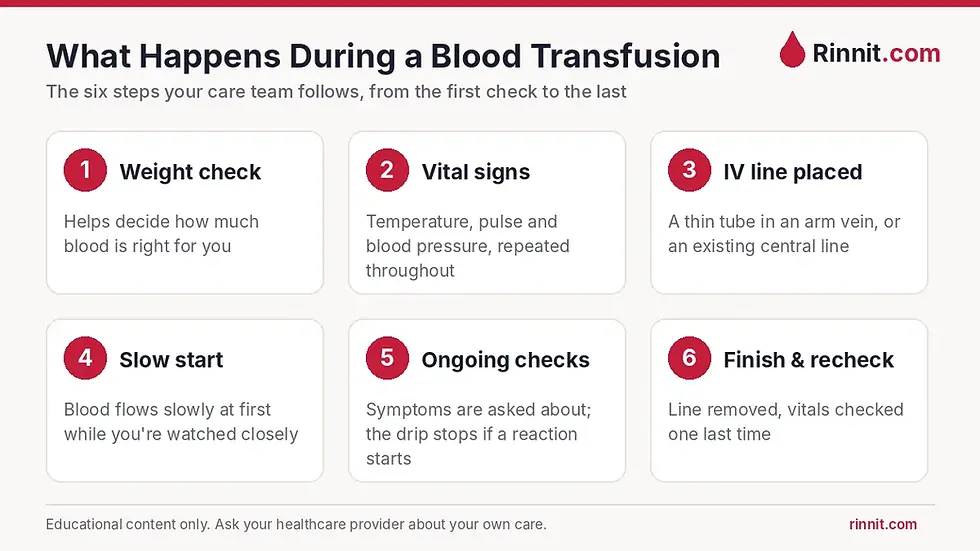
The six steps of a blood transfusion. Image: Rinnit.com
What happens after a blood transfusion?
After a blood transfusion, you can usually go home the same day unless you need other treatment. Your provider may suggest resting for the next 48 hours.
The arm with the IV may feel sore. These can help:
A cold compress on the area
Keeping your arm raised
Before you leave, your provider will explain what to do if you notice a reaction.
What are the risks and side effects of a blood transfusion?
Blood transfusions are generally safe, but possible reactions include allergic and fever reactions and, rarely, serious hemolytic reactions or infections.
Reaction | What happens | Typical signs | When it starts |
Allergic reaction | Immune system reacts to parts of the donated blood | Itching, hives; rarely severe shortness of breath, fast heartbeat, vomiting | During or soon after |
Fever reaction | Your antibodies react to donor white blood cells | Fever, chills | During or soon after |
Hemolytic reaction (rare, serious) | Mismatched red cells are destroyed | Chest pain, fever, chills, dark pee, lower back pain, nausea | During or right after |
Circulatory overload | Body can't handle the extra fluid; more likely with heart or kidney disease | Trouble breathing, cough | During or soon after |
Post-transfusion purpura | Antibodies destroy platelets, causing bleeding | Easy bruising, bleeding gums, nosebleeds, blood in pee or poop | 5–12 days later |
Transfusion-associated graft vs. host disease | Donor white cells attack your tissues; mainly in people with weak immune systems | Fever, diarrhea, rash | 2 days to 6 weeks later |
Alloimmunization | Frequent transfusions lead to antibodies against red cells | No symptoms; makes matching future blood harder | Builds over time |
Blood-borne infection (rare) | Donated blood carries bacteria or viruses | Varies | Varies |
Good to know: A fever that comes with chest pain and nausea can signal a serious reaction. Tell your nurse right away.

When transfusion reactions can show up. Image: Rinnit.com
What is recovery like after a blood transfusion?
Recovery after a blood transfusion depends mostly on the condition being treated, not the transfusion itself. Ask your provider what to expect and whether you'll need more treatment later.
When should you call your doctor after a blood transfusion?
Call your healthcare provider right away if you notice signs of a reaction after a blood transfusion, because reactions can happen during the transfusion, the next day, or even months later. Watch for:
Bleeding, pain or new bruising where the IV was
Cold, clammy skin, fever or chills
Dark or reddish pee
Fast heartbeat, chest pain, trouble breathing or wheezing
Headache or dizziness
Nausea or vomiting
Rash, hives or itching
Severe back pain
Swelling of your lips, tongue or face
Swelling of the face or throat, or severe trouble breathing, is an emergency and can be a sign of a severe allergic reaction (anaphylaxis). Call your local emergency number.
Can you refuse a blood transfusion?
You can refuse a blood transfusion, like any other treatment.
Your provider may ask about your reasons. They'll explain why they recommend it and what could happen without it. Use this time to share concerns and ask questions, so you feel confident in your decision.
Conclusion
A blood transfusion can save a life after major blood loss and help treat serious blood and cancer conditions. The process is carefully monitored, starts slowly and is usually well tolerated. Knowing the steps, the timing and the warning signs helps you feel prepared and speak up quickly if something feels off.
Have a transfusion coming up? Save or print this guide and bring it to your appointment, so you can go through your questions with your care team. Explore more plain-language, research-backed guides in the Rinnit Health Library.
Frequently asked questions
How long does a blood transfusion take?
Red blood cell and whole blood transfusions take about 2–4 hours. Plasma and platelet transfusions usually take up to 1 hour.
Does a blood transfusion hurt?
You may feel slight discomfort when the IV tube goes in. The transfusion itself usually isn't painful.
What blood type is used in an emergency?
When there's no time to test your blood type, providers may use type O negative blood.
Can I go home after a blood transfusion?
Usually yes, unless you need other treatment. Your provider may advise resting for 48 hours.
What are the most common side effects?
Mild allergic reactions, like itching and hives, and fever with chills are the most common.
Can a transfusion reaction happen days later?
Yes. Some reactions start 5–12 days later, and others can appear between 2 days and 6 weeks after the transfusion.
How safe is donated blood from infections?
Very safe. With modern screening, the risk of HIV, hepatitis B or hepatitis C is under 1 in 1,000,000 per unit in high-income countries.
Can I say no to a blood transfusion?
Yes. You can refuse, and your provider will explain the possible risks of not having one.
Can I donate my own blood before surgery?
Sometimes. For planned surgeries, some hospitals let you store your own blood ahead of time, called autologous donation. Ask your surgeon whether this is an option for you.
Can a family member or friend donate blood for me?
Some blood banks allow directed donations from people you choose, but rules vary. Blood from family is not safer than blood from the general donor supply.
External resources
Related Reading
Convalescent Plasma: How It Works, Uses and Effectiveness explains convalescent plasma.
References
Cleveland Clinic. Blood Transfusion. Cleveland Clinic. Last updated August 26, 2025. https://my.clevelandclinic.org/health/treatments/14755-blood-transfusion
Carson JL, Stanworth SJ, Dennis JA, et al. Transfusion thresholds for guiding red blood cell transfusion. Cochrane Database of Systematic Reviews. 2021;12(12):CD002042. PMID: 34932836. https://doi.org/10.1002/14651858.CD002042.pub5
Carson JL, Brooks MM, Hébert PC, et al. Restrictive or liberal transfusion strategy in myocardial infarction and anemia. New England Journal of Medicine. 2023;389(26):2446-2456. PMID: 37952133. https://doi.org/10.1056/NEJMoa2307983
Busch MP, Bloch EM, Kleinman S. Prevention of transfusion-transmitted infections. Blood. 2019;133(17):1854-1864. PMID: 30808637. https://doi.org/10.1182/blood-2018-11-833996
Centers for Disease Control and Prevention. Blood Safety Basics. CDC. Last reviewed February 20, 2024. Accessed October 20, 2026. https://www.cdc.gov/blood-safety/about/index.html
World Health Organization. Blood Safety and Availability (fact sheet). WHO. Updated June 12, 2026. Accessed October 20, 2026. https://www.who.int/news-room/fact-sheets/detail/blood-safety-and-availability
Medical disclaimer
This article is for general educational purposes and is not a substitute for professional medical advice, diagnosis or treatment. Always seek the advice of your doctor or another qualified health provider with any questions about a medical condition or treatment.



Comments