Blood Types Explained: Chart, Compatibility, and Rarity

Updated: 6 days ago
Written and medically reviewed by Dr. Baraa Alnahhal, MD · Last reviewed: October 2026 · How we review
Quick Answer: What is a blood type?
A blood type is a way of sorting blood by two markers on red blood cells, the ABO antigens and the RhD antigen, which create eight common types: A+, A−, B+, B−, AB+, AB−, O+ and O−. Blood types matter most for transfusions and transplants; O negative is the universal red cell donor and AB positive is the universal recipient. [1]
What the research says
Non-O blood types are linked to a higher risk of blood clots in the veins. A meta-analysis of 38 studies with 10,305 cases found that people with type A, B or AB blood were about twice as likely to have venous thromboembolism as people with type O (odds ratio 2.09) (Dentali et al., Seminars in Thrombosis and Hemostasis, 2012).
Type O is linked to a slightly lower risk of coronary artery disease. A review of 17 studies covering 225,810 people found a modestly higher risk in blood group A (odds ratio 1.14) and a lower risk in group O (odds ratio 0.85) (Chen et al., Scientific Reports, 2016).
Rh mismatches in transfusion can trigger antibodies, but the risk is low. Across 22 studies of 3,028 Rh-negative patients who received Rh-positive platelets, about 3.3% formed anti-D antibodies. The authors recommend preventive treatment for girls and women who may become pregnant (Hubert et al., Transfusion, 2024).
These studies show associations. Your blood type is one small factor among many, and it does not decide your health on its own.
Key takeaways
There are four main blood groups (A, B, AB, O) and eight common blood types once Rh is added.
Compatibility protects you during a transfusion. The wrong type can trigger a dangerous immune reaction.
O negative can be given to anyone in an emergency. AB positive can receive any type.
An Rh-negative pregnant person carrying an Rh-positive baby may need a protective injection.
Your blood type usually stays the same for life, with rare exceptions.
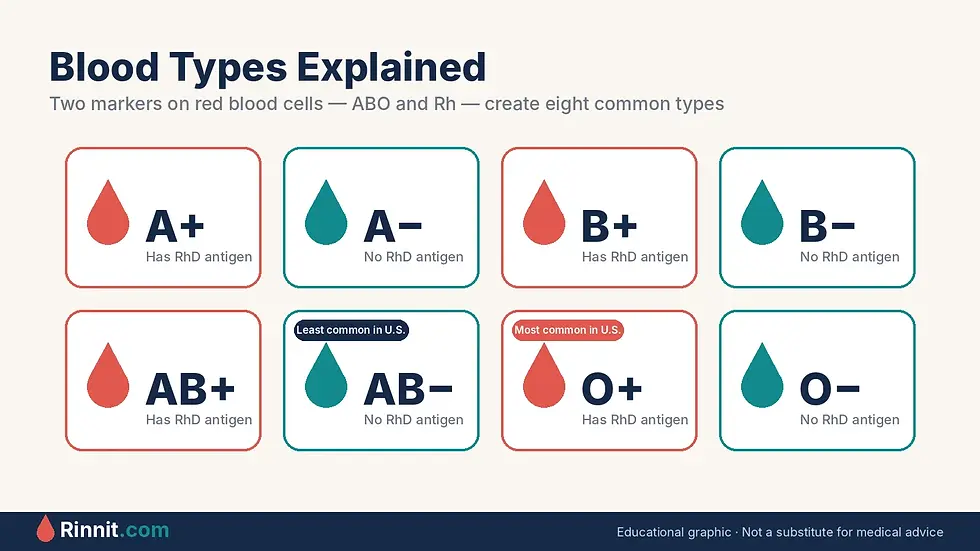
The eight common blood types. Image: Rinnit.com
What is a blood type?
A blood type is a way of sorting blood so healthcare teams can tell whether your blood will mix safely with someone else's.
All blood does the same job. But tiny markers on the surface of red blood cells differ from person to person. These markers decide your type.
How is your blood type determined?
Your blood type is set by antigens. An antigen is a substance that can make your immune system react.
Think of an antigen as a name tag. Your immune system reads these tags to decide whether something belongs in your body. If donated blood carries tags your body recognizes, it is compatible. If it carries unfamiliar tags, your immune system may attack it.

What makes your blood type: A, B and RhD antigens. Image: Rinnit.com
The ABO system
The letters in your blood type come from the ABO blood group system. It looks for two antigens: A and B.
Blood group | Antigens on red blood cells |
Type A | A antigen |
Type B | B antigen |
Type AB | Both A and B antigens |
Type O | Neither A nor B antigen |
The Rh system
The plus or minus sign comes from the Rh system. It looks for one marker called the RhD antigen.
Positive (+): Your red blood cells carry the RhD antigen.
Negative (−): Your red blood cells do not carry it.
Being Rh positive is more common than being Rh negative.
What are the eight blood types?
The eight blood types are A+, A−, B+, B−, AB+, AB−, O+ and O−, made by combining the ABO and Rh systems.
ABO group | Rh positive | Rh negative |
A | A+ | A− |
B | B+ | B− |
AB | AB+ | AB− |
O | O+ | O− |
In the United States, O positive is the most common blood type. AB negative is the least common.
Which blood types are compatible?
Blood types are compatible when the donor's red cells carry no antigen the recipient lacks, so your care team matches your blood to the donor's before a blood transfusion or transplant. Receiving red blood cells with antigens your body does not recognize can cause your immune system to attack them. This reaction can be life-threatening.
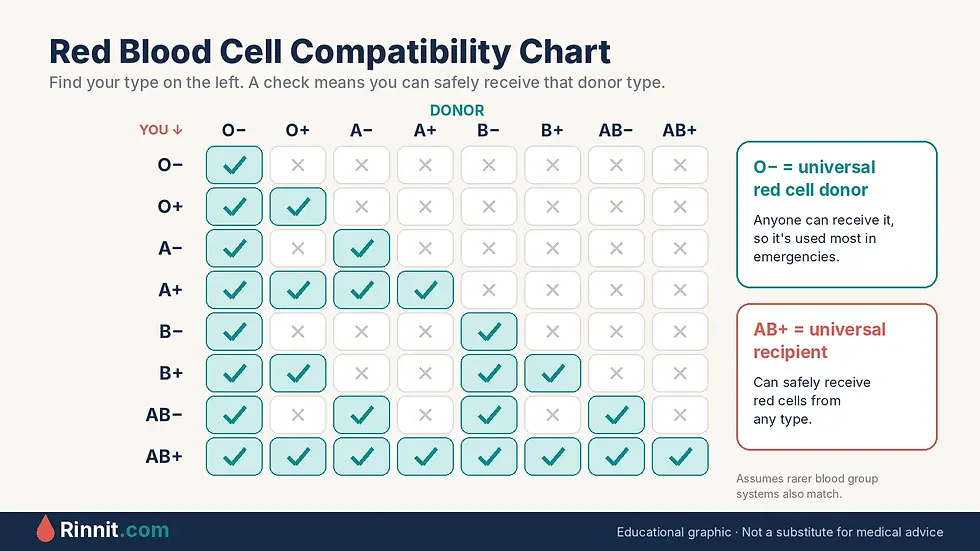
Red blood cell compatibility chart. Image: Rinnit.com
Your blood type | You can receive red cells from | You can donate red cells to |
A+ | A+, A−, O+, O− | A+, AB+ |
A− | A−, O− | A−, A+, AB−, AB+ |
B+ | B+, B−, O+, O− | B+, AB+ |
B− | B−, O− | B−, B+, AB−, AB+ |
AB+ | All blood types | AB+ |
AB− | AB−, A−, B−, O− | AB−, AB+ |
O+ | O+, O− | O+, A+, B+, AB+ |
O− | O− only | All blood types |
This chart assumes the rarer, non-ABO blood group systems also match.
The simple rule behind the chart
You can receive blood that has no antigen you lack.
Type O− has no A, B or RhD antigens, so nearly everyone can receive it.
Type AB+ already has all three, so nothing in donor red cells looks foreign.
If you are Rh negative, you should receive Rh-negative red cells.
Universal donor
O negative is the universal red cell donor. People of any blood type can safely receive it, because it carries none of the A, B or RhD markers. That is why emergency teams reach for O negative blood when there is no time to test.
Plasma works differently. Plasma is the liquid part of blood, and for plasma the universal donor is type AB.
Universal recipient
AB positive is the universal recipient. People with this type can safely receive red blood cells from any blood type. Their immune system recognizes all the common markers as safe.
What are rare blood types?
A rare blood type is one that occurs in 1 in 1,000 people or fewer, often because of antigens outside the ABO and Rh systems.
ABO and Rh are only part of the story. Scientists know of more than 600 antigens that can sit on red blood cells, grouped into more than 30 blood group systems. These include:
Duffy
Kell (K antigen)
Lutheran
Kidd
One of the rarest types in the world is Rh null. Fewer than 50 people are known to have it, which is why it is sometimes called "golden blood."
How do you inherit your blood type?
You inherit your blood type from your biological parents, much like eye color. Both your ABO genes and your Rh factor come from them.
Because the genes can combine in many ways, you may not share the same blood type as either parent.
How can you find out your blood type?
You can find out your blood type by asking your doctor, donating blood or using an at-home test kit.
Option | How it works |
Ask your doctor | Your type may already be in your medical records. |
Donate blood | If you are eligible, the blood center will test your type. |
At-home test kit | Kits sold for home use can show your type. |
In the lab, specialists mix a small blood sample with antibodies that react to the A or B antigen. An antibody is a protein your body uses to attack things that don't belong. How the sample reacts shows which antigens your red cells carry.
How does blood type affect pregnancy?
Blood type affects pregnancy when an Rh-negative pregnant person carries an Rh-positive baby, because the parent's body may make antibodies against the baby's red blood cells. A baby can inherit Rh factor from either parent.
If the parent's body reacts to the baby's Rh-positive red blood cells, it can make anti-Rh antibodies. These antibodies can then attack the baby's red blood cells.
Here is how care teams prevent this:
First prenatal visit: A blood test checks your blood type and screens for antibodies.
If you are Rh negative: You receive Rh immunoglobulin (RhIg), a medicine that stops your body from making antibodies against the baby's blood.
Learn more about pregnancies that need closer monitoring in our guide to high-risk pregnancy, and how the placenta connects parent and baby.
Can your blood type change?
Your blood type usually does not change; most people keep the same blood type for life.
In rare cases, blood type can change. This is usually linked to:
A bone marrow (stem cell) transplant
Certain types of leukemia, such as acute lymphocytic leukemia
Certain infections
Not all of these changes are permanent.
Why does blood type matter during transplants and transfusions?
Blood type matters during transplants and transfusions because a mismatch can lead the immune system to attack a new organ or destroy donated red blood cells.
Blood types must also match for organ transplants. A mismatch can lead the immune system to attack the new organ, a process explained in our guide to heart transplant rejection. See also our overview of lung transplant evaluation and donor matching.
When the immune system destroys red blood cells after an incompatible transfusion, the result is hemolysis. Fast access to compatible blood is also lifesaving during severe hemorrhage.
Conclusion
Your blood type comes down to a few markers on your red blood cells: A, B and RhD. Those markers create eight common types and decide whose blood you can safely receive. You don't need to memorize every detail, because blood banks have strict checks to keep transfusions safe. But knowing your own type is useful, especially if you are pregnant, planning a transplant, or thinking about donating blood.
Don't know your blood type yet? Ask your doctor at your next visit or consider donating blood if you're eligible. Save this guide and share the compatibility chart with family. For more clear, research-backed health explainers, explore the Rinnit.com health library.
Frequently asked questions
What is the most common blood type?
O positive is the most common blood type in the United States.
What is the rarest blood type?
Among the eight common types, AB negative is the least common in the U.S. Worldwide, Rh null is one of the rarest blood types, with fewer than 50 known people.
Which blood type is the universal donor?
O negative is the universal red cell donor because it lacks the A, B and RhD antigens. For plasma, the universal donor is type AB.
Which blood type is the universal recipient?
AB positive is the universal recipient. People with this type can receive red blood cells from any blood type.
Can my blood type change?
It usually stays the same for life. Rare changes can follow a bone marrow transplant, certain leukemias or some infections, and they are not always permanent.
Do I have the same blood type as my parents?
Not necessarily. You inherit genes from both parents, and they can combine in ways that give you a different type from either one.
Why does Rh factor matter in pregnancy?
If you are Rh negative and your baby is Rh positive, your body may make antibodies that attack the baby's red blood cells. An injection of Rh immunoglobulin helps prevent this.
How can I find out my blood type?
Ask your doctor, donate blood if you are eligible, or use an at-home blood typing kit.
Does blood type affect personality or what I should eat?
No. There is no good scientific evidence that blood type shapes personality or that blood type diets improve health.
What does positive or negative mean in a blood type?
It refers to the Rh factor, a protein on red blood cells. If you have it, your blood type is positive; if you do not, it is negative.
Related Reading
Blood Transfusion: What It Is, How It Works and Is It Safe? explains what happens before, during and after a blood transfusion.
Blood Donation: Who Can Donate, What Happens, and How Often You Can Give covers who can donate blood, the process and how often.
Understanding the Rh Factor: Clinical Significance and Pregnancy Management explains the Rh factor and why it matters during pregnancy.
Hemolytic Transfusion Reaction: Risks, Symptoms, and Recovery describes reactions when mismatched blood is given and how they are treated.
References
Cleveland Clinic. Blood Types: What They Are and What They Mean for Your Health. Cleveland Clinic. Last updated September 1, 2026. https://my.clevelandclinic.org/health/treatments/21213-blood-types
American Red Cross. Blood Types. American Red Cross Blood Services. Accessed October 19, 2026. https://www.redcrossblood.org/donate-blood/blood-types.html
Dean L. The ABO blood group (Chapter 5). Blood Groups and Red Cell Antigens [Internet]. Bethesda (MD): National Center for Biotechnology Information (US); 2005. https://www.ncbi.nlm.nih.gov/books/NBK2267/
Dentali F, Sironi AP, Ageno W, et al. Non-O blood type is the commonest genetic risk factor for VTE: results from a meta-analysis of the literature. Seminars in Thrombosis and Hemostasis. 2012;38(5):535-548. PMID: 22740183. https://doi.org/10.1055/s-0032-1315758
Chen Z, Yang SH, Xu H, et al. ABO blood group system and the coronary artery disease: an updated systematic review and meta-analysis. Scientific Reports. 2016;6:23250. PMID: 26988722. https://doi.org/10.1038/srep23250
Hubert T, Kerkhoffs JL, Brand A, et al. Anti-D immunization after D positive platelet transfusions in D negative recipients: a systematic review and meta-analysis. Transfusion. 2024;64(5):933-945. PMID: 38634345. https://doi.org/10.1111/trf.17833
Medical disclaimer
This article is for general educational purposes and is not a substitute for professional medical advice, diagnosis or treatment. Always seek the advice of your doctor or another qualified health provider with any questions about a medical condition or treatment.



Comments