Plasma: What It Is, What It Does and Why It Matters

Updated: 3 days ago
Medically reviewed by Dr. Baraa Alnahhal, MD · Last reviewed: October 2026
Quick Answer: What is plasma?
Plasma is the liquid portion of blood. It acts as a transport medium for blood cells and carries water, proteins, hormones, nutrients, electrolytes, immune cells and waste products. It makes up about 55% of blood, although this can vary, and is about 92% water. [1]
Core idea | Plain-language meaning |
What it is | The liquid part of blood. |
How much of blood it is | About 55% in general, although this can vary. |
Main ingredient | About 92% water. |
Other components | Proteins, hormones, vitamins, salt, enzymes and other compounds. |
Main jobs | Transport, circulation, temperature regulation, immunity, clotting, repair and waste removal. |
How it can be separated | A centrifuge moves heavier cells downward and leaves plasma at the top. |
What the research says
Very frequent plasma donation may lower ferritin and IgG. A systematic review of six studies (four observational and two experimental) found that very high-frequency plasma donation, twice per week, may cause a clinically relevant decrease in ferritin and bring IgG levels below the lower threshold of 6 g/L. The certainty of the evidence was low to very low, and the authors called for more high-quality studies to establish safe donation frequency (D'aes et al., Transfus Med Rev, 2024). [2]
Plasma exchange has mixed effects in ANCA-associated vasculitis. A systematic review and meta-analysis of nine randomized trials with 1,060 participants found no important effect on all-cause mortality (RR 0.90, 95% CI 0.64–1.27). Plasma exchange reduced the 12-month risk of end-stage kidney disease (RR 0.62, 95% CI 0.39–0.98) but increased the risk of serious infections (RR 1.27, 95% CI 1.08–1.49) (Walsh et al., BMJ, 2022). [3]
Convalescent plasma did not lower COVID-19 mortality overall, but outpatients may have benefited. A meta-analysis of 34 randomized trials found no association with lower 28-day mortality (RR 0.98, 95% CI 0.91–1.06). COVID-19 outpatients treated with convalescent plasma had a 26% lower risk of needing hospital care (RR 0.74, 95% CI 0.56–0.99) (Filippatos et al., Viruses, 2023). [4]
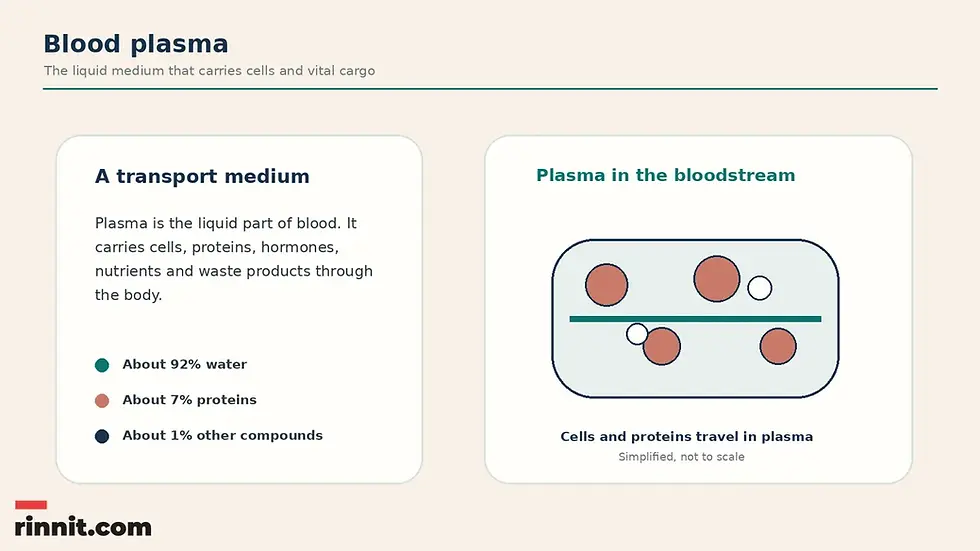
What is plasma made of?
Plasma is the liquid part of blood. Red blood cells, white blood cells and platelets mix into it, and plasma carries them throughout the body. [1]
Plasma is about 92% water. Proteins make up another 7%, including antibodies, coagulation factors, albumin and fibrinogen. The remaining 1% includes hormones, vitamins, salt, enzymes and other important compounds. [1]
Approximate component | Examples |
92% | Water. |
7% | Antibodies, coagulation factors, albumin and fibrinogen. |
1% | Hormones, vitamins, salt, enzymes and other compounds. |
These percentages are approximate general descriptions, not a personal laboratory result.
What does plasma do?
Plasma performs several jobs that are essential to circulation and body function. It carries blood cells and dissolved substances, helps keep blood vessels open, and transports materials to and from organs.
Plasma function | What it means |
Supports oxygen transport | Carries red blood cells to the lungs, where they pick up oxygen and release carbon dioxide. |
Helps maintain circulation | Helps maintain blood pressure so blood vessels stay open. |
Delivers materials | Carries water, hormones, nutrients, electrolytes and proteins where they are needed. |
Regulates temperature | Helps the body regulate its temperature. |
Supports immunity | Carries immune cells to respond to threats such as infections. |
Supports clotting and repair | Carries proteins used for inflammation, clotting and tissue repair. |
Removes waste | Carries waste products to the liver or kidneys for removal. |
A helpful analogy compares plasma to a river and the substances it carries to boats. With too little plasma, the river's water level is too low to carry those boats, and their vital cargo, where they need to go. [1]
Where does plasma come from?
Plasma does not come from one specific location. It forms when water in the body combines with electrolytes absorbed through the digestive tract. [1]
Some of the proteins that enter plasma come from particular organs or sources, including bone marrow, older blood cells, the liver and the spleen. Once these proteins combine with electrolyte-rich liquid, plasma is formed. [1]
What does plasma look like?
When separated from red blood cells, white blood cells and platelets, plasma is usually pale yellow or straw-colored. [1]
Plasma can look different when a condition changes what it contains. It may look pinkish when red blood cells are breaking down, a process called hemolysis, or greenish or brownish when high bilirubin and jaundice relate to a liver condition. Color alone cannot diagnose a condition. A healthcare professional must interpret laboratory findings and symptoms together. [1]
How much of blood is plasma?
In general, about 55% of blood is plasma. The proportion can vary somewhat depending on sex or medical conditions. This is a general description, not a substitute for an individual blood-volume or hematocrit assessment. [1]
How is plasma separated from blood cells?
A centrifuge can separate plasma from other blood components. The machine spins a blood-filled tube rapidly, creating a gravity-like effect. Heavier red blood cells move to the bottom. Above them is a whitish layer containing platelets and white blood cells, and plasma remains above that layer. [1]

Which proteins are in plasma?
Plasma proteins help maintain fluid balance, transport substances, support immune defense, form clots and repair tissue.
Protein group | Role |
Albumin | Helps balance fluid inside cells and plasma outside cells, limiting leakage into other tissues. |
Fibrinogen | Helps form clots and repair tissue, turning clots into healthy tissue or scar tissue. |
Globulins | Help fight infections, transport substances and assist with blood clotting. |
Other immune and transport proteins | Help defend the body, repair damage or carry nutrients and other compounds. |
What conditions affect plasma or plasma proteins?
Many diseases and conditions can affect plasma or the proteins and cells associated with it. Examples include protein-malfunction diseases such as amyloidosis, blood disorders such as hemophilia and von Willebrand disease, clotting-factor deficiencies, immunodeficiency and myeloma. [1]
Condition group | Connection to plasma |
Protein-malfunction diseases | Amyloidosis is one example. |
Blood disorders | Examples include hemophilia, von Willebrand disease and clotting-factor deficiencies. |
Immunodeficiency | May involve not having enough immune proteins in the blood. |
Myeloma | Affects the bone marrow and disrupts blood formation. |
These are broad categories, not a diagnosis based on symptoms or a plasma appearance.
What symptoms can plasma-related disorders cause?
Symptoms that can indicate a plasma condition or a related issue include bone pain, easy bruising or bleeding, heart palpitations or irregular heart rhythms, and getting sick easily because of a weakened immune system. [1]
These symptoms can have many causes. An online guide cannot determine whether they relate to plasma, blood cells, an organ, medication or another condition.
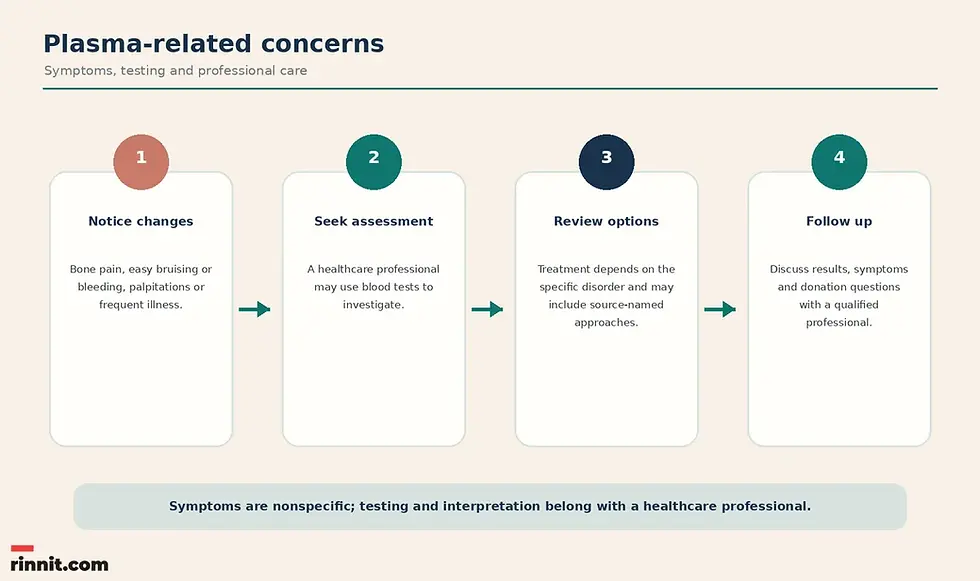
How is plasma health tested?
Plasma health is tested with several blood tests that check plasma or related blood findings for signs of a medical condition. The appropriate test depends on the concern being evaluated, and a healthcare professional should interpret results in context.
Test | What it may help assess |
Blood volume test | Blood volume and plasma-related findings. |
Bone marrow biopsy | Bone marrow and blood-formation concerns. |
Complete blood count | Blood-cell findings relevant to plasma-related evaluation. |
Hematocrit test | The proportion of blood made up of red blood cells. |
What treatments may be used for plasma disorders?
Treatment depends mainly on the specific disorder. Examples include antibiotics for infections, blood transfusions for blood loss, chemotherapy and stem-cell transplants for cancers, convalescent plasma, electrolyte-solution infusions, plasma infusion, plasmapheresis or plasma exchange, platelet-rich plasma injections and steroids for inflammatory conditions. [1]
Treatment or use | Description |
Antibiotics | Used for infections. |
Blood transfusions | Used for blood loss or other issues. |
Cancer treatment | Chemotherapy and stem-cell transplants are used for cancers. |
Convalescent plasma | Can provide extra antibodies to help fight an infection. |
Electrolyte solutions | Infusions may be used for dehydration or other conditions. |
Plasma infusion | May replace lost plasma and boost blood pressure to help prevent shock. |
Plasmapheresis or plasma exchange | May remove something from plasma or replace the plasma entirely. |
Platelet-rich plasma injections | Used for certain injuries or diseases. |
Steroids | Used for inflammatory conditions. |
This list describes clinical categories, not recommendations for self-treatment.
Is donated plasma tested for infections?
Yes. Donated plasma is tested for diseases such as hepatitis of all types, HIV and syphilis. This testing relates to donated plasma and does not mean that every plasma-related symptom is caused by one of these infections. Personal testing decisions should be discussed with a healthcare professional. [1]
How can people donate plasma?
People can donate plasma in two ways: by donating whole blood, from which plasma is separated, or by donating plasma only. A person may donate whole blood, after which a laboratory separates plasma as needed. Or they may donate plasma only: after screening, blood is withdrawn through a needle in a vein, a centrifuge separates the plasma, and the remaining blood cells and platelets return through the same needle. [1]
After collection, a laboratory freezes donated plasma within 24 hours to preserve clotting factors and immunoglobulins. Frozen plasma has a shelf life of one year. [1]
Plasma from donors with AB blood type is preferred because it does not have anti-A or anti-B antibodies, which means people with any ABO blood type can receive it. Anyone can still donate plasma and help others. Donation eligibility and local requirements should be confirmed with the donation service.
What is donated plasma used for?
Donated plasma may be infused into someone who needs more plasma because of burns, shock, trauma or other medical emergencies. It may also support scientific research, provide clotting proteins to help control bleeding, or provide immune proteins used in areas such as cancer treatment, chickenpox, measles, tetanus, immunodeficiencies, kidney disease, hepatitis B, brain disorders and bone-marrow transplants. [1]
This article does not advise donation or treatment for an individual person.
When should you contact a healthcare professional?
Discuss persistent or concerning bone pain, easy bruising or bleeding, palpitations or irregular rhythms, or getting sick easily with a healthcare professional. These symptoms are nonspecific but may need evaluation.
Seek professional advice about unusual laboratory results, questions about plasma donation or concerns about a condition affecting blood proteins, clotting, immunity or bone marrow.
Chest pain, severe shortness of breath, fainting, uncontrolled bleeding or other severe or rapidly worsening symptoms need emergency care: call 911 or go to the emergency room. This general guidance cannot determine the urgency of an individual case.
Conclusion: The liquid foundation of blood flow
Plasma is more than water. It is the liquid portion of blood that carries cells, proteins, hormones, nutrients, electrolytes, immune cells and waste products. [1]
Its proteins help regulate fluid balance, defend against infection, support clotting and repair, and transport important substances. Plasma-related conditions can affect several systems, so symptoms and test results need professional interpretation. Plasma can also be donated, separated and used in transfusions, research and other clinical settings. [1]
Use this guide to prepare questions for a qualified healthcare professional or donation service. Clear information is a starting point for better care, not a diagnosis. [1]
Frequently Asked Questions
What is plasma?
Plasma is the liquid part of blood. It carries blood cells, proteins, hormones, nutrients and many other substances throughout the body.
What percentage of blood is plasma?
In general, blood is about 55% plasma, although the proportion can vary a little with sex or medical conditions.
What is plasma made of?
Plasma is about 92% water, 7% proteins and 1% hormones, vitamins, salt, enzymes and other compounds.
What are the main functions of plasma?
Plasma helps transport cells and substances, maintain blood pressure, regulate temperature, support immunity, assist clotting and repair, and carry waste to the liver or kidneys.
What color is plasma?
Separated plasma is usually pale yellow or straw-colored. It can look pinkish, greenish or brownish when certain conditions change its contents.
Which proteins are in plasma?
Major plasma proteins include albumin, which helps balance fluid; fibrinogen, which helps form clots; and globulins, which help fight infection and transport substances.
What conditions affect plasma?
Examples include amyloidosis, hemophilia, von Willebrand disease, clotting-factor deficiencies, immunodeficiency and myeloma.
Which tests can check plasma-related health?
A blood volume test, bone marrow biopsy, complete blood count and hematocrit test may be used, depending on the concern being evaluated.
How do people donate plasma?
A person may donate whole blood for later plasma separation, or donate plasma only, in which a centrifuge separates the plasma and the blood cells and platelets return through the same needle.
What is plasmapheresis?
Plasmapheresis, or plasma exchange, is a treatment in which plasma may be removed or replaced, depending on the clinical situation.
Related guides
Related Reading
Convalescent Plasma: How It Works, Uses and Effectiveness explains convalescent plasma.
References
Cleveland Clinic. What Is Plasma in Blood? Cleveland Clinic. Updated March 14, 2025. https://my.clevelandclinic.org/health/body/22865-plasma
D'aes T, van den Hurk K, Schroyens N, et al. Balancing Donor Health and Plasma Collection: A Systematic Review of the Impact of Plasmapheresis Frequency. Transfus Med Rev. 2024;38(4):150851. PMID 39244430. https://doi.org/10.1016/j.tmrv.2024.150851
Walsh M, Collister D, Zeng L, et al. The effects of plasma exchange in patients with ANCA-associated vasculitis: an updated systematic review and meta-analysis. BMJ. 2022;376:e064604. PMID 35217545. https://doi.org/10.1136/bmj-2021-064604
Filippatos C, Ntanasis-Stathopoulos I, Sekeri K, et al. Convalescent Plasma Therapy for COVID-19: A Systematic Review and Meta-Analysis on Randomized Controlled Trials. Viruses. 2023;15(3):765. PMID 36992474. https://doi.org/10.3390/v15030765
Disclaimer
This article is for general educational purposes and is not a substitute for professional medical advice, diagnosis or treatment. Always seek the advice of a qualified healthcare professional with any questions about a medical condition or treatment.



Comments