Protease Inhibitors: Types, How They Work and Side Effects

Updated: 2 days ago
Written and medically reviewed by Dr. Baraa Alnahhal, MD · Last reviewed: November 2026 · How we review
Quick Answer
Protease inhibitors (PIs) are antiviral medicines that stop a virus from making copies of itself by blocking an enzyme called protease. They're used mostly to treat HIV as part of antiretroviral therapy, and also hepatitis C and COVID-19. Common side effects include nausea, diarrhea, rash and fatigue, and PIs have many drug interactions.
What the research says
A protease inhibitor combo prevented severe COVID-19: in a trial of 2,246 high-risk unvaccinated adults, nirmatrelvir plus ritonavir started within 3 days of symptoms cut hospitalization or death to 0.77% versus 7.01% with placebo, an 89.1% reduction (Hammond J et al., New England Journal of Medicine, 2022) [2]
Boosted darunavir worked in different HIV combinations: in a trial of 805 adults starting HIV treatment with ritonavir-boosted darunavir, treatment failure by 96 weeks was 17.8% with raltegravir versus 13.8% with tenofovir-emtricitabine, so the combinations were comparable (Raffi F et al., Lancet, 2014) [3]
Key takeaways
Protease inhibitors block a virus from copying itself.
They treat HIV, hepatitis C and COVID-19.
"-navir" drugs treat HIV; "-previr" drugs treat hepatitis C.
Ritonavir is often used as a booster.
They interact with many other medicines.
What are protease inhibitors?
Viruses use protease enzymes to cut long protein chains into smaller, active proteins that build new virus copies. Protease inhibitors block this step, so new viruses can't form and infect cells. Learn more about antivirals. Sources: [1]
What they treat
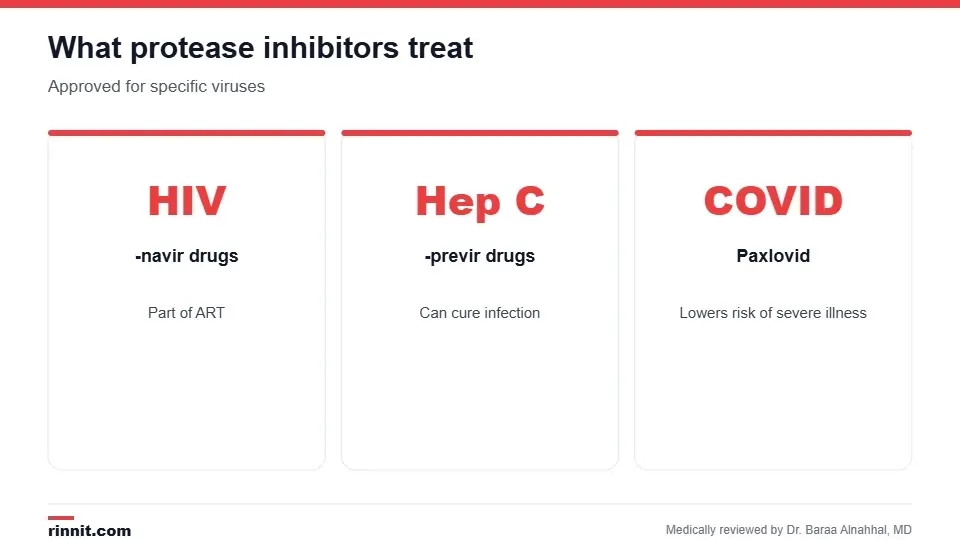
They're approved only for specific viral infections.
HIV: as part of antiretroviral therapy, and sometimes after an exposure.
Hepatitis C: with other antivirals to treat or cure it.
COVID-19: a two-drug combination lowers the risk of severe illness. Sources: [1]
Types of protease inhibitors
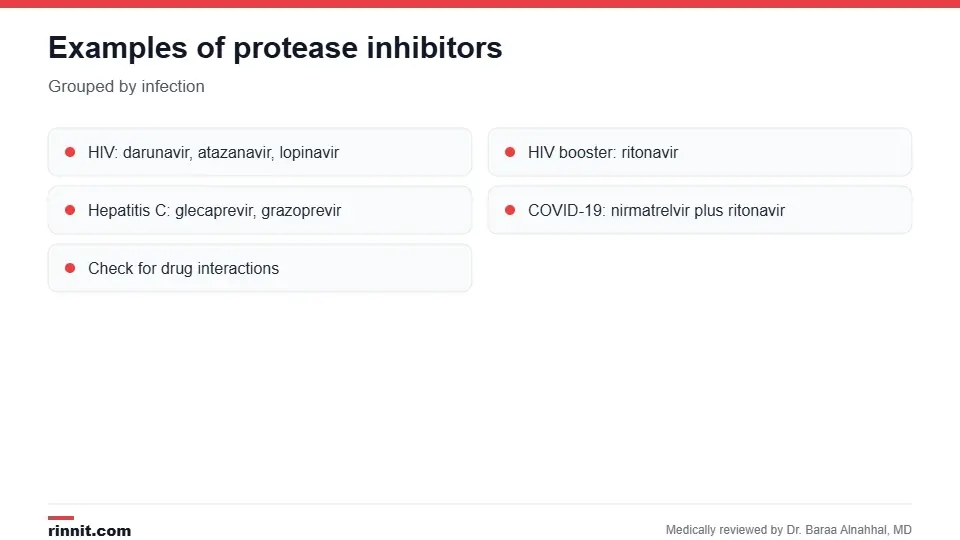
Ritonavir is often used as a booster.
Infection | Examples |
HIV | Atazanavir, darunavir, lopinavir, ritonavir, saquinavir, tipranavir |
Hepatitis C | Glecaprevir, grazoprevir, paritaprevir, simeprevir |
COVID-19 | Paxlovid (nirmatrelvir plus ritonavir) |
Sources: [1]
How they're chosen and taken
Your provider considers the infection, your health and other conditions, other medicines, past treatments, expected effectiveness and side effects.
Tell your provider about every medicine you take, since PIs have many interactions.
A meal with some fat helps your body absorb some PIs; ask what to take them with. Sources: [1]
Side effects
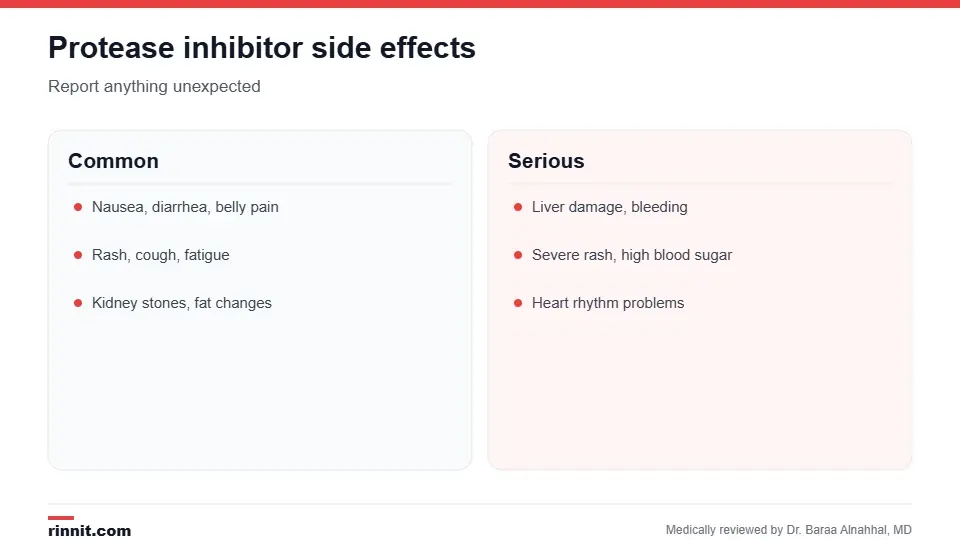
Side effects vary by drug and your health.
Type | Examples |
Common | Belly pain, nausea, vomiting, diarrhea, rash, cough, fatigue, kidney stones, body fat changes, bad taste |
Serious | Liver damage, internal bleeding, Stevens-Johnson syndrome, high blood sugar, high cholesterol, anemia, heart attack, long QT syndrome |
Sources: [1, 2]
Treatment length
HIV: treatment is lifelong; combinations may change over time.
Hepatitis C: usually curable with several weeks or months of treatment.
COVID-19: treatment lasts five days. Sources: [1]
Outlook
Protease inhibitors can help keep HIV undetectable, help cure hepatitis C and help keep COVID-19 from becoming severe. Taking them as directed, drinking plenty of water and avoiding interacting medicines make treatment easier. Sources: [1, 2, 3]
When to call your provider
Unexpected side effects or concerns.
Get immediate care for fever, confusion, yellow skin or eyes, a blistering or widespread rash, severe belly pain or severe vomiting. Sources: [1]
Conclusion
Protease inhibitors are a key part of treating HIV, hepatitis C and COVID-19. Sharing your full medicine list helps your provider choose a safe, effective combination.
Keep learning: read about antiretroviral therapy and antivirals.
Frequently asked questions
What are protease inhibitors?
Antiviral medicines that block a virus from copying itself.
What do protease inhibitors treat?
HIV, hepatitis C and COVID-19.
How can I tell what a PI treats?
"-navir" drugs treat HIV; "-previr" drugs treat hepatitis C.
What is a booster?
A PI, like ritonavir, that makes another drug work better.
Is Paxlovid a protease inhibitor?
Yes. It combines nirmatrelvir and ritonavir.
What are common side effects?
Nausea, diarrhea, rash, fatigue and belly pain.
Do PIs interact with other drugs?
Yes, so tell your provider about all your medicines.
Should I take them with food?
Some absorb better with a meal containing fat; ask your provider.
Can protease inhibitors cure HIV?
No, but they help keep it under control.
How long is COVID-19 treatment?
Five days.
Related Reading
Antiretroviral Therapy (ART) for HIV: How It Works and Side Effects HIV treatment combinations.
Antivirals: What They Treat, How They Work and Side Effects an overview of antiviral medicines.
HIV/AIDS: Symptoms, Causes, and How It Is Diagnosed and Treated an overview of HIV.
Hepatitis: Causes, Symptoms, and Modern Treatment Options an overview of hepatitis.
Post-Exposure Prophylaxis (PEP): How It Works and When to Start preventing HIV after exposure.
References
Cleveland Clinic. Protease Inhibitors: Types, How They Work & Side Effects. Cleveland Clinic. Last updated March 24, 2023. https://my.clevelandclinic.org/health/treatments/24937-protease-inhibitors
Hammond J, Leister-Tebbe H, Gardner A, et al. Oral nirmatrelvir for high-risk, nonhospitalized adults with Covid-19. New England Journal of Medicine. 2022;386(15):1397-1408. PMID 35172054. https://doi.org/10.1056/NEJMoa2118542
Raffi F, Babiker AG, Richert L, et al. Ritonavir-boosted darunavir combined with raltegravir or tenofovir-emtricitabine in antiretroviral-naive adults infected with HIV-1: 96 week results from the NEAT001/ANRS143 randomised non-inferiority trial. Lancet. 2014;384(9958):1942-1951. PMID 25103176. https://doi.org/10.1016/S0140-6736(14)61170-3
Medical disclaimer
This article is for general education only and does not replace advice from a qualified healthcare professional. Talk to your doctor about your own diagnosis and treatment, and seek emergency care right away for severe or sudden symptoms.



Comments