Urine Culture: How the Test Works, How to Collect a Sample and What Results Mean

Updated: 2 days ago
Written and medically reviewed by Dr. Baraa Alnahhal, MD · Last reviewed: November 2026 · How we review
Quick Answer: What is a urine culture?
A urine culture is a lab test that checks the urine for a bacterial or fungal infection by trying to grow germs from a sample. It shows which germ is causing a urinary tract infection (UTI) and which antibiotics will kill it. Results can take up to three days. [1]
What the research says
Cleansing before a midstream sample may not lower contamination. In a randomized trial of young women with UTI symptoms, contamination rates were nearly identical whether they gave a sample without cleansing, with midstream clean-catch cleansing, or with cleansing plus a tampon (29%, 32% and 31%). (Lifshitz and Kramer, Archives of Internal Medicine, 2000) [2]
Evidence for the best collection method is still limited. A systematic review of six studies with 1,010 women with UTI symptoms found no consistent evidence that midstream samples, with or without cleansing, were better than other noninvasive collection methods. (Llor et al., Family Practice, 2023) [3]
Key takeaways
A urine culture finds the bacteria or yeast causing an infection and which medicines will work against it. [1]
It is most often ordered for UTI symptoms or an unexplained fever. [1]
A urinalysis is a quicker screening test that helps decide whether a culture is needed. [1]
The main risk is contamination from skin germs, which can cause a false positive. [1]
Bacteria in the urine without symptoms (asymptomatic bacteriuria) usually does not need treatment. [1]
What is a urine culture?
A urine culture checks your urine for a bacterial or fungal infection by growing microorganisms from a sample in a lab. It identifies the germ causing the infection and which antibiotics will kill it, which helps your provider choose treatment. [1]
Why is a urine culture done?
Providers order a urine culture to check for a urinary tract infection (UTI), especially if you have: [1]
Pain when you urinate
A sudden, urgent need to urinate
Frequent urination
Leaking urine
An unexplained fever
A urinalysis is usually a faster screening test that looks for red and white blood cells and bacteria in your urine. Its results help decide whether a culture should be sent. [1]
How does a urine culture work?
A lab technician spreads your sample on a plate with nutrients. If you have a UTI, colonies of bacteria or yeast usually appear within a day or two, and the technician counts them. If germs grow, the lab also tests which antibiotics or antifungals stop them (sensitivity testing). [1]
How do you prepare for a urine culture?
Your provider may ask you to: [1]
Avoid urinating for at least 1 hour before giving the sample
Drink at least 8 ounces of water 20 minutes before collection
Give a first-morning sample
If you have shy bladder syndrome or trouble urinating away from home, tell your provider. [1]
How do you collect a clean-catch urine sample?
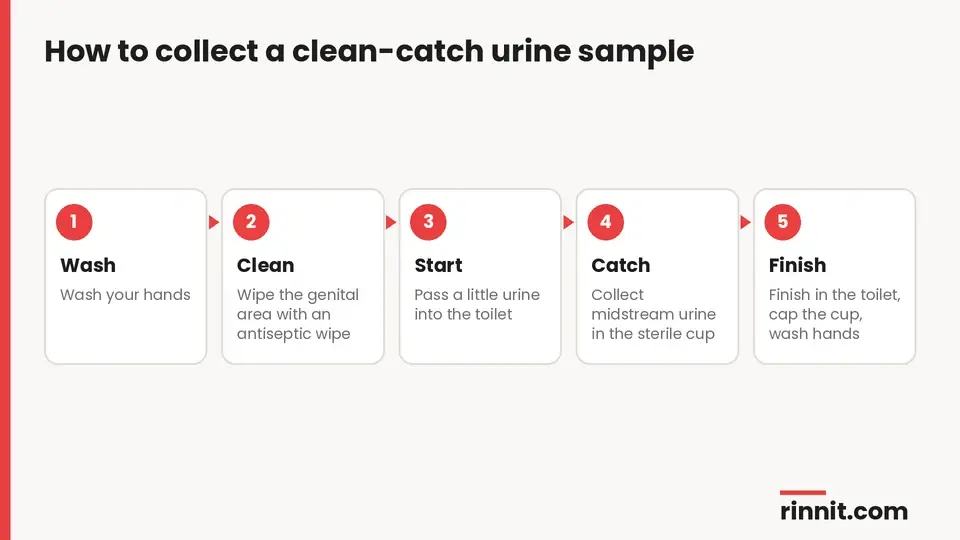
Wash your hands. [1]
Clean the area around your vagina or the head of your penis with an antiseptic wipe. If you are uncircumcised, pull back the foreskin first. [1]
Release a small amount of urine into the toilet. [1]
Collect the midstream urine in the sterile cup without letting the cup touch your skin. Fill it about halfway or as directed. [1]
Finish urinating into the toilet. [1]
Put the cap on the cup if one is provided, follow your provider's instructions for returning it, and wash your hands again. [1]
Other ways to collect urine
Method | How it's done |
Catheter | A thin tube is passed through the urethra into the bladder |
Urine bag (U bag) | An adhesive bag is attached to collect urine from infants and young children |
Needle aspiration | A needle is passed through numbed skin on the abdomen into the bladder |
Sources: [1]
Keep a sample collected at home in the refrigerator until you deliver it. [1]
What are the risks of a urine culture?
Clean-catch and urine bag collection are very safe. Catheter and needle methods carry a slight risk of infection. The main risk is contamination of the sample by bacteria or yeast from your skin, which can cause a false positive result. [1]
What do urine culture results mean?
Cultures take 24 to 48 hours to grow, and results may take up to three days. Your provider shares them, or they appear in your electronic health record. Normal ranges can vary by lab. [1]
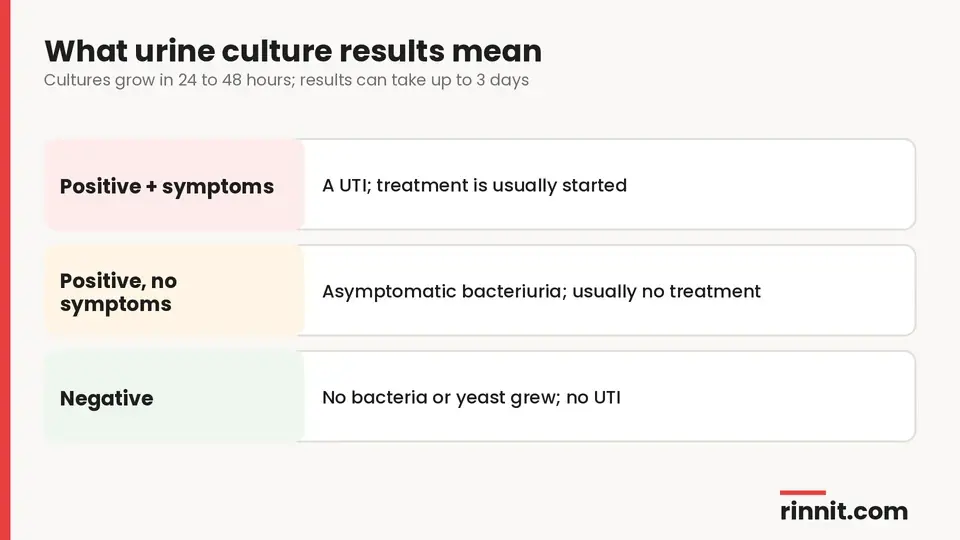
Result | What it usually means |
Positive, with symptoms | A UTI; treatment is usually started |
Positive, without symptoms | Asymptomatic bacteriuria; treatment is usually not needed |
Negative | No bacteria or yeast grew, so there is no UTI |
Sources: [1]
Sensitivity results
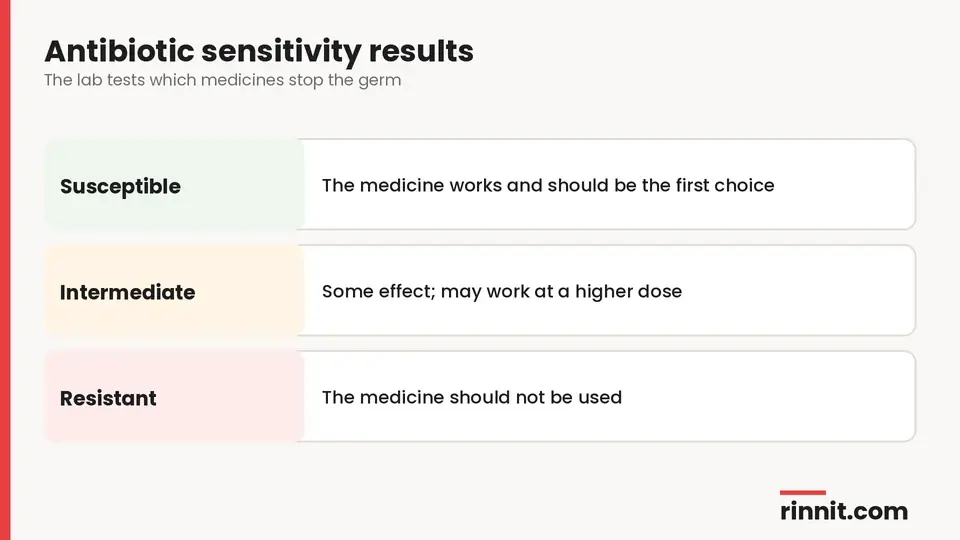
Category | What it means |
Susceptible | The medicine works and should be the first choice |
Intermediate | The medicine has some effect and may work at a higher dose |
Resistant | The medicine should not be used |
Sources: [1]
If your culture is negative but you have symptoms
Other causes of UTI-like symptoms include changes from menopause, kidney stones and masses in the bladder. Symptoms that do not go away or blood in your urine need more testing, which may include imaging or a referral to a urologist. [1]
What can a urine culture find?
E. coli, the most common cause of UTIs, which normally lives in the digestive tract. [1]
Streptococcus (strep). Group B strep can pass to a baby during vaginal birth, so pregnant people are usually tested with a vaginal and rectal swab near their due date. [1]
Not STIs. Chlamydia and gonorrhea can be found with urine tests, but these must be ordered separately and do not show up on a standard urine culture. [1]
When should you call your provider?
Call your provider if your symptoms do not improve after treatment or if you have questions about your results. Get care right away if you have fever, chills, back or side pain, nausea or vomiting, which can be signs of a kidney infection. [1]
Conclusion
A urine culture confirms a urinary tract infection and tells your provider exactly which medicine will work. A careful clean-catch sample helps avoid contamination and a misleading result.
If your symptoms do not improve on treatment, or your culture is negative but symptoms continue, follow up with your provider for more testing.
Keep learning: Read our guide to urinalysis, the quick screening test often done first, and our STD testing guide for infections a culture does not show.
FAQ
What is a urine culture?
A lab test that grows germs from a urine sample to find an infection and the medicine that treats it. [1]
Why would I need a urine culture?
To check for a UTI, especially with painful, urgent or frequent urination, leaking urine or an unexplained fever. [1]
How do I collect a clean-catch urine sample?
Clean the area with a wipe, pass a little urine into the toilet, then catch the midstream urine in a sterile cup. [1]
How long do urine culture results take?
Cultures grow in 24 to 48 hours, and results can take up to three days. [1]
What is the difference between a urinalysis and a urine culture?
A urinalysis is a quick screening test; a culture grows the germ and tests which antibiotics work. [1]
What does a positive urine culture mean?
With symptoms, it usually means a UTI that needs treatment; without symptoms, treatment is usually not needed. [1]
What does a contaminated urine culture mean?
Germs from the skin got into the sample, which can cause a false positive result. [1]
Can a urine culture detect STDs?
No; chlamydia and gonorrhea need separate tests. [1]
What is sensitivity testing?
It shows whether each antibiotic is susceptible, intermediate or resistant against the germ found. [1]
What if my culture is negative but I still have symptoms?
Other causes such as menopause changes, kidney stones or bladder masses may need more testing. [1]
Related Reading
Bacteria Culture Test: Types, How It Works and Results explains how labs grow and identify bacteria to guide antibiotic treatment.
Urinary Tract Infection (UTI): Symptoms, Causes, Treatment, and Prevention explains the infection a urine culture confirms.
Recurrent UTI: Symptoms, Causes, Diagnosis, and Prevention covers repeated infections that often need a culture.
Asymptomatic Bacteriuria: A Plain-Language Guide to Bacteria in Urine Without Symptoms explains a positive culture without symptoms.
What is a UTI During Pregnancy? covers why urine is checked during pregnancy.
E. coli Infection: Symptoms, Causes, and Treatment explains the most common germ found on a urine culture.
Group B Strep (GBS) and Pregnancy: What You Need to Know explains why strep is checked near the due date.
Kidney Stones: Symptoms, Causes, and Treatment Guide covers a cause of UTI-like symptoms with a negative culture.
References
Cleveland Clinic. Urine Culture: What It Is, Purpose, Procedure & Results. Cleveland Clinic. Last updated July 10, 2024. https://my.clevelandclinic.org/health/diagnostics/22126-urine-culture
Lifshitz E, Kramer L. Outpatient urine culture: does collection technique matter? Arch Intern Med. 2000;160(16):2537-2540. PMID 10979067. https://doi.org/10.1001/archinte.160.16.2537
Llor C, Moragas A, Aguilar-Sánchez M, et al. Best methods for urine sample collection for diagnostic accuracy in women with urinary tract infection symptoms: a systematic review. Fam Pract. 2023;40(1):176-182. PMID 35652481. https://doi.org/10.1093/fampra/cmac058
Medical disclaimer
This article is for general education only and does not replace advice from a qualified healthcare professional. Talk to your doctor about your own diagnosis and treatment, and seek emergency care right away for severe or sudden symptoms.



Comments