Asymptomatic Bacteriuria: A Plain-Language Guide to Bacteria in Urine Without Symptoms

Updated: 2 days ago
Medically reviewed by Dr. Baraa Alnahhal, MD. Last reviewed October 17, 2026. This content is for educational purposes and is not medical advice.
Quick Answer
Asymptomatic bacteriuria is bacteria in the urine without any symptoms, found during a urinalysis or urine culture. It is very common, and most cases are not treated because infection risk is low and antibiotic side effects and resistance outweigh the benefits. Antibiotics are recommended for pregnant women and people having certain urinary procedures, such as a TURP.
What the research says
In pregnancy, antibiotics may cut the risk of kidney infection and small or early babies, but the evidence is low-certainty. A Cochrane review of 15 studies involving more than 2,000 women found that antibiotic treatment compared with placebo or no treatment may reduce pyelonephritis (RR 0.24; 95% CI 0.13 to 0.41; 12 studies, 2,017 women), low birth weight (RR 0.64; 95% CI 0.45 to 0.93; 6 studies, 1,437 babies), and preterm birth (RR 0.34; 95% CI 0.13 to 0.88; 3 studies, 327 women). Only one trial was at low risk of bias, so confidence in the effect is limited (Smaill and Vazquez, Cochrane Database of Systematic Reviews, 2019).
In healthy women, bacteria in the urine often come and go within a day or two. In a cohort of 104 healthy premenopausal women with a history of recurrent UTI who were assessed daily for 3 months, asymptomatic bacteriuria events occurred in 45 (45%) women but on only 159 (2.5%) of 6,283 days. The median duration was 1 day, and E. coli was the most common cause. The authors said the data strongly support not screening for or treating asymptomatic bacteriuria in healthy, non-pregnant women (Hooton et al., Clinical Infectious Diseases, 2021).
Even for pregnancy, experts are still refining how much screening is needed. A review reports that asymptomatic bacteriuria affects 2% to 7% of pregnant women and that recent studies do not provide good-quality evidence linking untreated bacteriuria to acute pyelonephritis. It also found low-to-moderate-quality evidence that treatment reduces low birth weight and preterm birth, which justifies screening with a single urine culture in the first trimester (Ansaldi and Martinez de Tejada Weber, Clinical Microbiology and Infection, 2022).
What Is Asymptomatic Bacteriuria?
Asymptomatic bacteriuria is the presence of bacteria in your urine without any symptoms. The condition is found during a urinalysis (a routine urine test) or a bacterial culture (a test that grows urine bacteria in a lab so they can be identified). The word "asymptomatic" simply means "showing no symptoms."
In most people, this condition is not harmful and usually does not need treatment. Your healthcare provider may treat you with antibiotics if you are pregnant or about to have certain urinary procedures. Current guidelines no longer advise routine treatment for kidney transplant recipients more than a month after surgery. Treatment in these situations lowers the risk of complications.
Is Asymptomatic Bacteriuria the Same as a UTI?
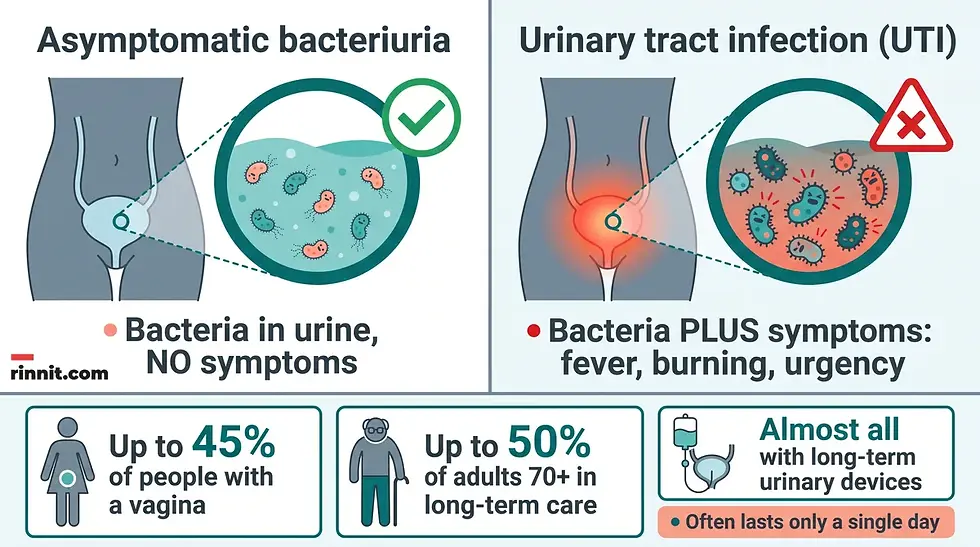
No, but the two are similar. Both involve having bacteria in the urinary tract, the system of organs that collects and carries urine out of the body. The key difference is symptoms. Healthcare providers diagnose a UTI only when symptoms are present. If there are no symptoms, the condition is called asymptomatic bacteriuria.
Feature | Asymptomatic bacteriuria | Urinary tract infection (UTI) |
Bacteria in urine | Yes | Yes |
Symptoms | None | Fever, burning when you pee, urgent need to pee frequently |
Usually treated | No | Yes, with antibiotics |
How Common Is It?
Asymptomatic bacteriuria is very common and often temporary. Studies suggest that when people are screened regularly, bacteria are found in the urine of:
Group | How often bacteria are found |
People with a vagina | Up to 45% (a shorter urinary tract makes bacterial infections more likely) |
People over 70 in long-term care facilities | Up to 50% |
People with long-term urinary devices (Foley catheter or ureteral stent) | Almost all |
A Foley catheter is a tube placed in the bladder to drain urine, and a ureteral stent is a small tube that keeps the passage between the kidney and bladder open. These bacteriuria events can be very brief, lasting as little as a single day.
What Are the Symptoms of Asymptomatic Bacteriuria?
There are none. Asymptomatic bacteriuria has no symptoms by definition. Once symptoms appear, the condition has become symptomatic bacteriuria, in other words, a urinary tract infection.
What Causes Asymptomatic Bacteriuria?
Bacteria live naturally in our intestinal tracts (the gut) and on our skin. Most people pick up bacteria in their urinary tract when the bacteria move there from poop or from skin, or from someone else's. Bacteria can move around in four common ways:
When you wipe after pooping.
If you have a medical device in your urinary tract.
While taking a bath.
During sex.
What Is the Most Common Cause?
E. coli is the most common cause of asymptomatic bacteriuria, followed by Klebsiella pneumoniae. Both are types of bacteria that normally live in the digestive system and on skin.

Who Is at Higher Risk?
You might be at higher risk for asymptomatic bacteriuria if you live in a long-term care facility or have any of the following:
Risk factor | Why it matters |
Long-term Foley catheter or permanent ureteral stent | Devices give bacteria a direct path into the urinary tract |
Spinal cord injury | Changes how the bladder empties |
Sickle-cell anemia | Affects the kidneys and infection risk |
Diabetes | Raises the risk of urinary tract infections |
How Is Asymptomatic Bacteriuria Diagnosed?
Healthcare providers usually diagnose asymptomatic bacteriuria with a urine culture, a lab test that grows and identifies bacteria from a urine sample. Providers typically do not screen for bacteria in your urine if you have no symptoms. If your provider has ordered a bacterial culture, it might be because you are at a higher risk for a symptomatic infection and would need antibiotic treatment if bacteria were found.
How Is Asymptomatic Bacteriuria Treated?
Most of the time, providers do not treat asymptomatic bacteriuria. The risk of developing a urinary tract infection from bacteriuria is low when you have no symptoms. The risk of using antibiotics (the treatment for bacterial infections) outweighs the benefits. Antibiotic use can contribute to antibiotic resistance (when bacteria learn to survive medicines that used to kill them), lead to hard-to-treat infections like C. diff, and cause uncomfortable or even painful side effects.
When Should You Treat Asymptomatic Bacteriuria?
Providers treat asymptomatic bacteriuria under certain circumstances:
Situation | Why treatment is needed |
Pregnancy | Untreated bacteriuria raises the risk of preterm birth and low birth weight |
Kidney (renal) transplant | Guidelines now advise against routine screening or treatment more than one month after a kidney transplant |
Certain urological procedures | Bacteriuria during procedures like TURP (transurethral resection of the prostate) raises the risk of complications |
A TURP is a procedure that removes part of the prostate through the urethra to treat urinary problems in men.
Which Antibiotics Are Used?
If your provider treats you for asymptomatic bacteriuria, they might use one of these antibiotics:
Amoxicillin
Ampicillin
Cephalosporin
Nitrofurantoin
Trimethoprim-sulfamethoxazole (TMP/SMX)
What Happens During Treatment?
Your provider will only treat you with antibiotics if you have a condition or an upcoming procedure that puts you at higher risk for complications if left untreated. Treatment lasts five to seven days [1] [2].
How Much Does Treatment Help in Pregnancy?
Treating asymptomatic bacteriuria with antibiotics during pregnancy can reduce the risk of certain pregnancy complications by up to 35%.
Can Asymptomatic Bacteriuria Be Prevented?
Some amount of bacteria in your urinary tract is common and hard to prevent. But strategies for preventing UTIs can also reduce your risk for asymptomatic bacteriuria. These include:
Peeing after sex
Wiping front to back if you have a vagina
Not using douches, powders, or sprays in your genital area
Avoiding baths (shower instead)
Drinking plenty of water
Following directions to properly care for any medical devices in your urinary tract, like a catheter

When Should I See My Healthcare Provider?
If a provider diagnoses you with asymptomatic bacteriuria, whether you treat it or not, contact them if you start developing symptoms of an infection, such as fever, an urgent need to pee, or pain in your abdomen. Your provider can tell you what specific symptoms to look out for.
What Questions Should I Ask My Doctor?
Question | Why it helps |
Do I need to treat bacteriuria if I have no symptoms? | Confirms whether antibiotics are right for your situation |
What symptoms should I look out for? | Helps you spot a real infection early |
How do I take my medication? | Ensures the antibiotic works correctly |
When should I follow up with you? | Keeps your care on track |
Conclusion and next steps
Sometimes, test results sound more alarming than they need to be. Having bacteria in your urine is common and does not mean you will get a UTI. But if you are pregnant or about to have certain urinary procedures, it is important to get antibiotic treatment to avoid complications.
Take action: If a test has found bacteria in your urine and you feel fine, ask your provider whether treatment is actually needed for you. Contact them right away if fever, burning, urgency, or abdominal pain develops.
Frequently asked questions
What is asymptomatic bacteriuria? Asymptomatic bacteriuria is the presence of bacteria in your urine without any symptoms. It is found during a urinalysis or a urine culture, and in most people it is not harmful and does not need treatment [1].
Is asymptomatic bacteriuria the same as a UTI? No. Both involve bacteria in the urinary tract, but a UTI is diagnosed only when symptoms such as fever, burning when you pee, or a frequent urgent need to pee are present [1].
How common is asymptomatic bacteriuria? Very common and often temporary. When screened regularly, up to 45% of people with a vagina, up to 50% of people over 70 living in long-term care, and almost everyone with a long-term urinary device have bacteria in their urine. Events can last as little as a single day [1] [3].
What symptoms does it cause? None. If symptoms appear, it has become a urinary tract infection [1].
What causes asymptomatic bacteriuria? Bacteria from the gut or skin move into the urinary tract, for example when you wipe after pooping, through a medical device in the urinary tract, while taking a bath, or during sex. E. coli is the most common cause, followed by Klebsiella pneumoniae [1].
Who is at higher risk? People living in long-term care facilities, and people with a long-term Foley catheter or permanent ureteral stent, a spinal cord injury, sickle-cell anemia, or diabetes [1].
How is it diagnosed? Usually with a urine culture. Providers typically don't screen for bacteria in your urine if you have no symptoms [1].
Why isn't it usually treated? The risk of developing a UTI from bacteriuria is low without symptoms, and antibiotics can contribute to antibiotic resistance, hard-to-treat infections like C. diff, and uncomfortable or painful side effects [1].
When is treatment recommended? During pregnancy and before certain urological procedures such as TURP; routine treatment is no longer advised for kidney transplant recipients more than a month after surgery [1] [4].
Which antibiotics are used? Options include amoxicillin, ampicillin, a cephalosporin, nitrofurantoin, and trimethoprim-sulfamethoxazole (TMP/SMX). Treatment lasts five to seven days [1] [2].
How much does treatment help in pregnancy? Treating asymptomatic bacteriuria with antibiotics during pregnancy can reduce the risk of certain pregnancy complications by up to 35% [1].
How can I prevent it? Pee after sex, wipe front to back, avoid douches, powders, and sprays in the genital area, shower instead of bathing, drink plenty of water, and properly care for any urinary devices such as a catheter [1].
When should I call my healthcare provider? If you develop symptoms of an infection, such as fever, an urgent need to pee, or pain in your abdomen [1].
Related Reading
Urinary Tract Infection (UTI): Symptoms, Causes, Treatment, and Prevention: symptoms, causes, and treatment of a symptomatic urinary tract infection.
Kidney Transplant: Understanding the Procedure, Benefits, and Recovery: what to watch for after a transplant.
Diabetes: Symptoms, Types, Causes, Diagnosis & Treatment — Complete Guide: managing diabetes, which raises the risk of urinary tract infections.
Urinalysis: What It Tests, How to Prepare, Normal Values and What Results Mean explains what a urinalysis looks for when it checks urine for bacteria.
Urine Culture: How the Test Works, How to Collect a Sample and What Results Mean explains how a urine culture confirms a UTI and guides antibiotic choice.
Trusted External Resources
References
Cleveland Clinic. Asymptomatic Bacteriuria. Cleveland Clinic. Last updated February 14, 2024. https://my.clevelandclinic.org/health/diseases/asymptomatic-bacteriuria
Widmer M, et al. Duration of treatment for asymptomatic bacteriuria during pregnancy. Cochrane Database Syst Rev. 2015;2015(11):CD000491. PMID 26560337. https://doi.org/10.1002/14651858.CD000491.pub3
Hooton TM, et al. Asymptomatic Bacteriuria and Pyuria in Premenopausal Women. Clin Infect Dis. 2021;72(8):1332-1338. PMID 32179902. https://doi.org/10.1093/cid/ciaa274
American College of Obstetricians and Gynecologists. Urinary Tract Infections in Pregnant Individuals. ACOG. Published online July 20, 2023. https://www.acog.org/clinical/clinical-guidance/clinical-consensus/articles/2023/08/urinary-tract-infections-in-pregnant-individuals
Nicolle LE, et al. Clinical Practice Guideline for the Management of Asymptomatic Bacteriuria: 2019 Update by the Infectious Diseases Society of America. Clin Infect Dis. 2019;68(10):e83-e110. PMID 30895288. https://doi.org/10.1093/cid/ciy1121
Smaill FM, et al. Antibiotics for asymptomatic bacteriuria in pregnancy. Cochrane Database Syst Rev. 2019;2019(11). PMID 31765489. https://doi.org/10.1002/14651858.CD000490.pub4
Ansaldi Y, et al. Urinary tract infections in pregnancy. Clin Microbiol Infect. 2022;29(10):1249-1253. PMID 36031053. https://doi.org/10.1016/j.cmi.2022.08.015
Medical disclaimer
This guide is for informational purposes only and does not provide medical advice, diagnosis, or treatment. Always seek the advice of a qualified healthcare provider with any questions you may have about a medical condition. Never disregard professional medical advice or delay seeking care because of something you have read here.



Comments