Rheumatoid Factor (RF) Test: Normal Range and What a Positive Result Means

Updated: 2 days ago
Written and medically reviewed by Dr. Baraa Alnahhal, MD · Last reviewed: November 2026 · How we review
Quick Answer: What is a rheumatoid factor test?
A rheumatoid factor (RF) test is a blood test that measures rheumatoid factor, an antibody the immune system can make by mistake that may damage healthy tissue. It helps diagnose rheumatoid arthritis and other autoimmune diseases such as Sjögren's syndrome and lupus. A normal result is less than 20 U/mL. A positive result doesn't diagnose anything on its own. [1]
What the research says
RF finds about 7 in 10 people with rheumatoid arthritis but is less specific than anti-CCP. A meta-analysis of 50 RF studies found IgM RF had a sensitivity of 69% and specificity of 85% for rheumatoid arthritis, while anti-CCP antibodies (37 studies) were similar in sensitivity (67%) but more specific (95%). (Nishimura et al., Annals of Internal Medicine, 2007) [2]
Very high RF raises long-term risk of rheumatoid arthritis. In 9,712 adults from the general population followed from the early 1980s to 2010, an RF level above 100 IU/mL was linked with a 26-fold higher risk of developing rheumatoid arthritis than a level below 25 IU/mL. (Nielsen et al., BMJ, 2012) [3]
Key takeaways
Rheumatoid factor is an antibody that may attack healthy tissue.
The RF test helps diagnose rheumatoid arthritis and other autoimmune diseases.
A normal result is less than 20 U/mL, often reported as "negative."
A positive result is a clue, not a diagnosis.
It is a simple blood draw with no preparation.
What is rheumatoid factor?
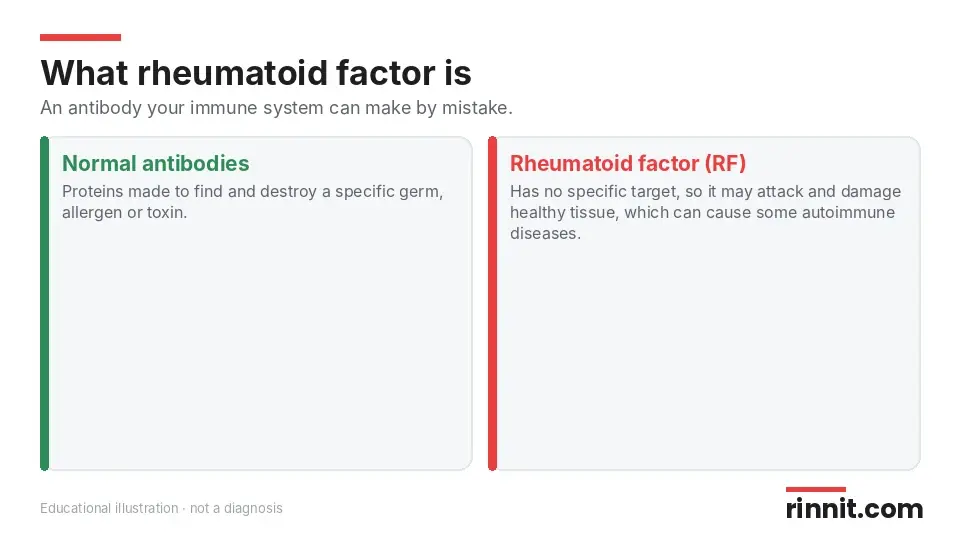
Rheumatoid factor (RF) is a type of antibody. Normally, your immune system makes antibodies, special proteins that find and destroy germs, allergens or toxins. Each one is made to target a specific invader. [1]
Your immune system makes RF by mistake or when it's overactive. Because RF doesn't have a specific target, it sometimes attacks and damages healthy tissue throughout your body. This can cause some autoimmune diseases. [1]
What are the symptoms of high rheumatoid factor?
Symptoms depend on what's causing the high level and where your immune system damages tissue. Some people have high RF and never have symptoms, and some have high RF for no clear reason. Common symptoms include: [1]
Pain, especially joint pain
Swelling (inflammation)
Skin discoloration
A feeling of warmth or heat
Fatigue
Frequent fevers
When is an RF test done?
The test helps diagnose autoimmune diseases, including: [1]
Rheumatoid arthritis
Sjögren's syndrome
Juvenile idiopathic arthritis
Lupus
Scleroderma
Mixed connective tissue disease
Providers sometimes use it to help diagnose chronic infections, such as hepatitis C, tuberculosis (TB) and infective endocarditis. [1]
An RF test can't confirm a condition by itself, but it can help your provider rule issues out or narrow in on a diagnosis. [1]
How do you prepare?
You don't need to do anything special. You can eat, drink and do your usual activities. Your provider may take the sample during a routine physical or a visit for new symptoms, or send you to a phlebotomist (blood draw specialist). [1]
What happens during the test?
The sample is usually taken from a vein inside your elbow or on the back of your hand. Tell your provider if needles make you nervous; they can help you relax. [1]
The area is cleaned with an antiseptic wipe.
An elastic band goes around your upper arm, and you may be asked to make a fist.
A needle is gently inserted; you may feel a sharp pinch.
Blood is collected in a vial.
The needle is removed and a bandage is applied.
Sources: [1]

Less often, your provider may give you a home finger-prick kit. You prick your fingertip with the lancet provided, collect blood on a special paper strip and mail it following the kit's directions. [1]
Are there risks?
There are very few risks. Some people feel dizzy or lightheaded after a blood draw and may need to rest for a few minutes. [1]
What is a normal rheumatoid factor level?
RF is usually reported in units per milliliter of blood (U/mL). [1]
Result | RF level | What it means |
Negative (normal) | Less than 20 U/mL | A normal amount of RF |
Positive | 20 U/mL or more | High RF; may point to an autoimmune disease or another condition |
Sources: [1]

A negative result is the "good" result. It means your blood doesn't show anything out of the ordinary. [1]
What does a high rheumatoid factor mean?
High RF can mean you have an autoimmune disease or another health condition. But it doesn't diagnose anything directly, and it doesn't automatically mean you have rheumatoid arthritis. It is one clue your provider uses, along with your symptoms and other tests, to find the cause. [1]
Questions to ask your provider
Is my RF negative or positive, and what was my level?
What other tests do I need, such as anti-CCP antibodies?
Could my symptoms be from rheumatoid arthritis or another condition?
What treatment options might help my symptoms?
Conclusion
A rheumatoid factor test is a simple blood draw that helps your provider look for autoimmune diseases like rheumatoid arthritis and Sjögren's syndrome. A level under 20 U/mL is normal.
A positive result is a clue, not a diagnosis. Your provider will combine it with your symptoms and other tests, and if you do have a condition, help you find treatments that keep symptoms from disrupting your daily life.
Keep learning: Read our guides to the antibody test, the ESR (sed rate) test, the complete blood count (CBC) and differential diagnosis. For more on this test, see MedlinePlus: Rheumatoid Factor (RF) Test.
FAQ
What is rheumatoid factor?
It is an antibody your immune system can make by mistake that may attack healthy tissue. [1]
What is a normal rheumatoid factor level?
Less than 20 units per milliliter (U/mL). [1]
What does a positive RF test mean?
It means you have high RF, which can point to an autoimmune disease or another condition but isn't a diagnosis. [1]
Does a positive RF mean I have rheumatoid arthritis?
Not necessarily. High RF doesn't automatically mean rheumatoid arthritis or any other condition. [1]
What conditions can an RF test help diagnose?
Rheumatoid arthritis, Sjögren's syndrome, juvenile idiopathic arthritis, lupus, scleroderma and mixed connective tissue disease. [1]
Can infections cause a high RF?
Yes. RF tests can help diagnose chronic infections like hepatitis C, tuberculosis and infective endocarditis. [1]
Do I need to fast for an RF test?
No. You can eat, drink and do your usual activities. [1]
Can you have high RF without symptoms?
Yes. Some people have high RF and never have symptoms. [1]
Can an RF test be done at home?
Sometimes. Your provider may give you a finger-prick kit to collect and mail a sample. [1]
Is the RF test risky?
No. There are very few risks; some people feel briefly dizzy after a blood draw. [1]
Related Reading
Learn more in our guide to Rheumatoid Arthritis — Symptoms, Causes, Diagnosis, Treatment & Complete Guide.
Learn more in our guide to Sjögren's Syndrome Guide: Symptoms, Causes, Diagnosis, and Treatment.
Learn more in our guide to Lupus: Symptoms, Causes & Treatment Guide.
Learn more in our guide to Scleroderma Guide: Symptoms, Causes, Diagnosis, and Treatment.
Learn more in our guide to Juvenile Idiopathic Arthritis (JIA): Symptoms, Types, Causes, Diagnosis & Treatment — Complete Guide.
Learn more in our guide to What Is Mixed Connective Tissue Disease (MCTD)? Symptoms, Causes & Treatment of This Rare Disorder.
Learn more in our guide to Tuberculosis (TB): Symptoms, Causes, Testing, Treatment and Prevention.
References
Cleveland Clinic. Rheumatoid Factor: What It Is, Test Details & Normal Range. Cleveland Clinic. Last updated January 18, 2024. https://my.clevelandclinic.org/health/diagnostics/rheumatoid-factor
Nishimura K, Sugiyama D, Kogata Y, et al. Meta-analysis: diagnostic accuracy of anti-cyclic citrullinated peptide antibody and rheumatoid factor for rheumatoid arthritis. Ann Intern Med. 2007;146(11):797-808. PMID 17548411. https://doi.org/10.7326/0003-4819-146-11-200706050-00008
Nielsen SF, Bojesen SE, Schnohr P, et al. Elevated rheumatoid factor and long term risk of rheumatoid arthritis: a prospective cohort study. BMJ. 2012;345:e5244. PMID 22956589. https://doi.org/10.1136/bmj.e5244
Medical disclaimer
This article is for general education only and does not replace advice from a qualified healthcare professional. Talk to your doctor about your own diagnosis and treatment, and seek emergency care right away for severe or sudden symptoms.



Comments