Differential Diagnosis: What It Means, How It Works and Examples

Updated: 5 days ago
Written and medically reviewed by Dr. Baraa Alnahhal, MD · Last reviewed: November 2026 · How we review
Quick Answer: What is a differential diagnosis?
A differential diagnosis is a list of possible conditions that could be causing your symptoms. Because many conditions share the same symptoms, your doctor builds this list from your history and exam, then uses tests to rule conditions out until one diagnosis remains. It is a step toward your diagnosis, not the final answer. [1]
What the research says
Diagnostic errors are common enough to matter. Combining three large US studies, researchers estimated that about 5.08% of adult outpatients, roughly 12 million people a year, experience a diagnostic error, and about half of these could be harmful. (Singh et al., BMJ Quality & Safety, 2014) [2]
Stopping the search too early is the top thinking error. In 100 cases of diagnostic error in internal medicine, cognitive factors contributed in 74%, and premature closure, failing to keep considering other reasonable possibilities, was the single most common cause. (Graber et al., Archives of Internal Medicine, 2005) [3]
Key takeaways
A differential diagnosis is a list of conditions that share your symptoms. [1]
It is built from your symptoms, medical history and physical exam. [1]
Tests such as blood work, imaging, ultrasound or a biopsy narrow the list. [1]
There is no set timeline; complex conditions can take longer to sort out. [1]
Tell your provider if your symptoms change, new ones appear or your medicines change. [1]
What is a differential diagnosis?
When you see a healthcare provider with symptoms, several conditions could explain them. Instead of guessing, your provider lists the conditions that fit. This list is your differential diagnosis. It is not your official diagnosis, but a working list that guides which tests to order next. [1]
A differential diagnosis is used whenever your symptoms match more than one condition and more testing is needed before a confident diagnosis can be made. [1]
How does the diagnostic process work?
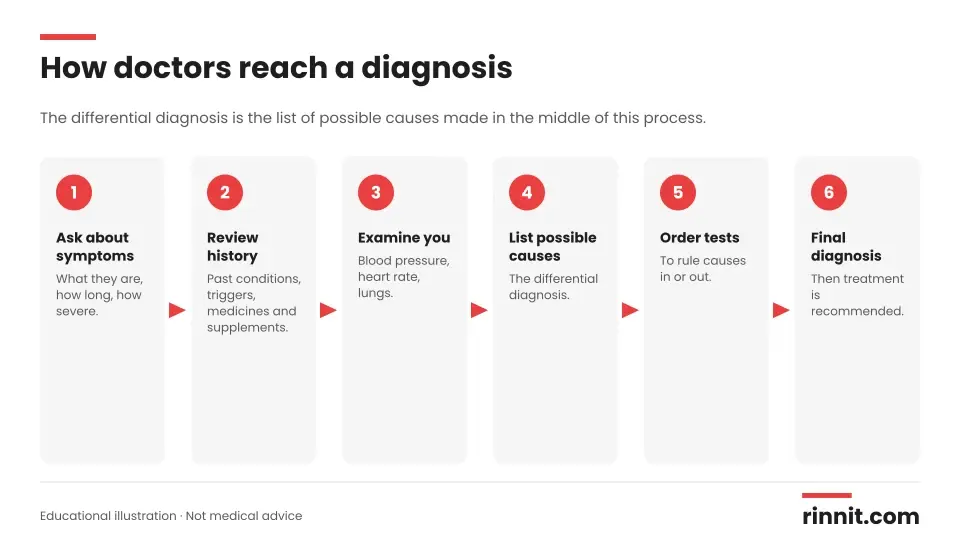
Your provider usually follows these steps: [1]
Asking about your symptoms
Reviewing your medical history
Doing a physical exam
Creating a differential diagnosis
Ordering more tests
Reviewing the test results and your symptoms
Making a diagnosis
Sources: [1]
What questions will your provider ask?
Your provider starts by learning as much as possible about your symptoms: [1]
What are your symptoms?
How long have you had them?
How severe are they?
Next come questions about your medical history: [1]
Have you had these symptoms before?
Does anything trigger them or make them better or worse?
Have you had any major life changes?
What medicines, vitamins or supplements do you take?
Then your provider examines you, for example by checking your blood pressure and heart rate and listening to your lungs. [1]
Which tests narrow a differential diagnosis?
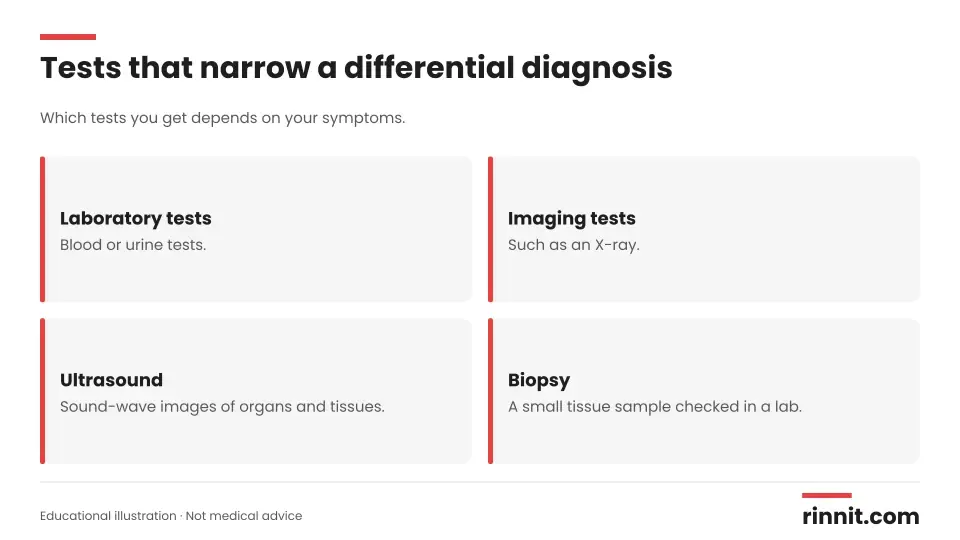
Tests act as a process of elimination. Which ones you need depends on your symptoms, but they may include: [1]
Laboratory tests on blood or urine
Imaging tests such as an X-ray
Ultrasound
A biopsy
Once your provider has reviewed your symptoms, history and test results, they can pinpoint the cause, make a final diagnosis and recommend treatment. [1]
Examples of differential diagnoses
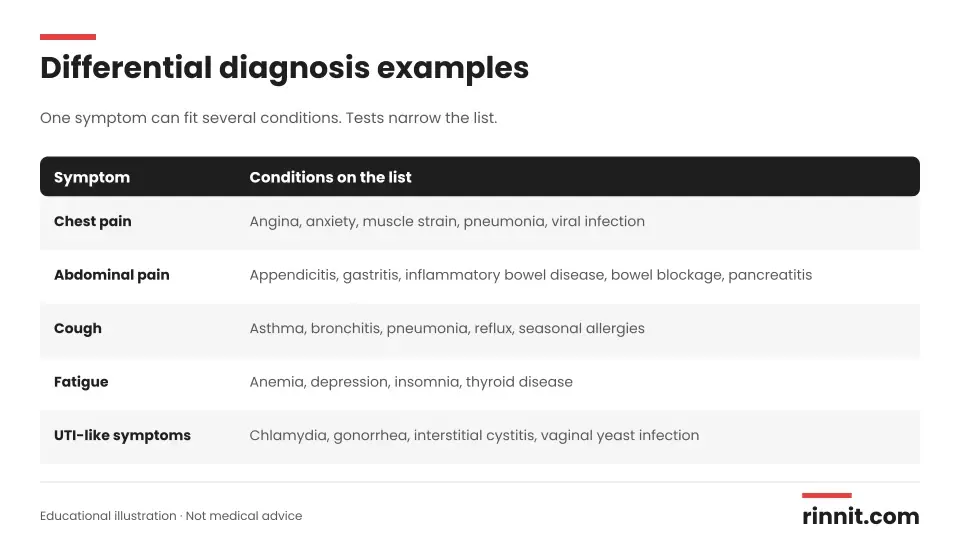
These examples show how one symptom can point to several conditions. Your provider weighs your full picture before deciding. [1]
Symptom | Conditions often considered |
Abdominal pain | Appendicitis, gastritis, inflammatory bowel disease, bowel blockage, pancreatitis |
Chest pain | Angina, anxiety, muscle strain, pneumonia, viral infection |
Cough | Asthma, bronchitis, pneumonia, reflux, seasonal allergies |
Back pain | Arthritis, herniated disk, fibromyalgia, osteoporosis |
Fatigue | Anemia, depression, insomnia, thyroid disease |
High blood pressure | Kidney disease, sleep apnea, thyroid disease |
Knee pain | Arthritis, cartilage tear, osteoarthritis, ligament strain, tendonitis |
Urinary symptoms | Urinary tract infection, chlamydia, gonorrhea, interstitial cystitis, vaginal yeast infection |
Sources: [1]
If a first treatment doesn't work, your provider may revisit the list and consider another diagnosis that fits your symptoms. [1]
How can you help your provider?
Bring a list of every medicine, vitamin and supplement you take, so your provider can check whether any of them could be causing your symptoms. [1] Seeing a long list of possible conditions can feel daunting, but it is normal and is simply how your provider avoids missing something. [1]
Are there risks?
A differential diagnosis is designed to reduce errors. Its goal is to find and treat the right condition instead of treating symptoms without knowing the cause. If a step in the process is skipped, there is a risk of reaching the wrong diagnosis, and additional testing greatly lowers that risk. [1]
How long does it take?
There is no set timeline. It depends on your symptoms and how complex the possible causes are. If you have sudden chest pain, trouble breathing, severe belly pain or signs of a stroke, call 911 right away instead of waiting. Contact your provider if: [1]
Your symptoms get worse or go away
You develop new symptoms
You stay in the hospital for any reason
Your medicines change
Conclusion
A differential diagnosis is how careful doctors think: list everything that fits, then test until the answer is clear. It is not your final diagnosis, so a long list of possibilities is not a cause for alarm. [1]
Share every symptom, even ones that seem unrelated, and keep your provider updated as things change. That information is often what moves a condition off the list or puts it at the top.
Keep learning: Read our guide to left-side chest pain or learn when abdominal pain becomes an emergency. For more background, see the differential diagnosis overview from MedlinePlus.
FAQ
What is a differential diagnosis?
It is a list of possible conditions that could explain your symptoms, made before a final diagnosis. [1]
Is a differential diagnosis the same as a diagnosis?
No. It is a step before the final diagnosis, a working list that tests help narrow down. [1]
Why do doctors make a differential diagnosis?
Many conditions share the same symptoms, so listing them helps doctors test for the right ones and avoid errors. [1]
How do doctors narrow a differential diagnosis?
They use your symptoms, history, exam and tests such as blood or urine tests, imaging, ultrasound or a biopsy. [1]
What are examples of differential diagnoses?
Chest pain may be angina, anxiety, muscle strain, pneumonia or a viral infection, and fatigue may be anemia, depression, insomnia or thyroid disease. [1]
How long does a differential diagnosis take?
There is no set timeline; it depends on your symptoms and how complex the possible causes are. [1]
What should I bring to my appointment?
Bring a list of all the medicines, vitamins and supplements you take. [1]
What questions will my doctor ask?
Expect questions about what your symptoms are, how long you've had them, how severe they are and what makes them better or worse. [1]
What if my treatment doesn't work?
Your provider may revisit the list and consider another diagnosis that fits your symptoms. [1]
When should I contact my provider during the process?
Contact them if symptoms worsen or go away, new symptoms appear, you're hospitalized or your medicines change. [1]
Related Reading
Left-Side Chest Pain: Causes and When It's an Emergency walks through the many possible causes of chest pain, a classic differential diagnosis.
Acute Abdomen: When Severe Abdominal Pain Becomes a Medical Emergency (2026 Guide) explains how doctors sort through causes of severe abdominal pain.
Understanding Headaches: Types, Triggers, and Treatment Options covers headache types that doctors weigh against one another.
References
Cleveland Clinic. Differential Diagnosis: Definition and Examples. Cleveland Clinic. Last updated January 27, 2022. https://my.clevelandclinic.org/health/diagnostics/22327-differential-diagnosis
Singh H, Meyer AND, Thomas EJ. The frequency of diagnostic errors in outpatient care: estimations from three large observational studies involving US adult populations. BMJ Qual Saf. 2014;23(9):727-731. PMID 24742777. https://doi.org/10.1136/bmjqs-2013-002627
Graber ML, Franklin N, Gordon R. Diagnostic error in internal medicine. Arch Intern Med. 2005;165(13):1493-1499. PMID 16009864. https://doi.org/10.1001/archinte.165.13.1493
Medical disclaimer
This article is for general education only and does not replace advice from a qualified healthcare professional. Talk to your doctor about your own diagnosis and treatment, and seek emergency care right away for severe or sudden symptoms.



Comments