Understanding Headaches: Types, Triggers, and Treatment Options

Updated: 2 days ago
Medically reviewed by Dr. Baraa Alnahhal, MD · Last reviewed: October 2026
Quick Answer: What causes a headache?
A headache is pain in the head or face caused by complex signals among the brain, blood vessels and surrounding nerves, felt as throbbing, constant, sharp or dull pain [1]. Most headaches are triggered by lifestyle factors such as stress, sleep changes or certain foods, though some are hereditary or caused by underlying health conditions [1].
What the research says
Migraine is one of the biggest sources of lost health worldwide. In the Global Burden of Disease Study 2021, the 37 nervous system conditions analyzed affected 3.40 billion people (43.1% of the world's population), and migraine ranked third among the ten conditions with the highest age-standardized disability-adjusted life years (DALYs) in 2021 (GBD 2021 Nervous System Disorders Collaborators, The Lancet Neurology, 2024) [3].
Hands-on therapy may ease tension-type headache, but the evidence is weak. A systematic review and meta-analysis of myofascial release found reduced pain intensity in tension-type headache (standardized mean difference -0.86, 95% CI -1.52 to -0.20) and less disability (-0.98, 95% CI -1.32 to -0.65); only the disability improvement was supported by moderate-quality evidence, and the rest was rated low or very low quality (Lu et al., Pain Research & Management, 2024) [4].
A sudden "thunderclap" headache needs an urgent check for bleeding in the brain. A review of how thunderclap headache is evaluated notes that subarachnoid hemorrhage is the most common secondary cause, and that under the 2019 American College of Emergency Physicians guideline a negative noncontrast head CT within 6 hours of onset essentially excludes it (Chen & Fuh, Current Opinion in Neurology, 2021) [5].
Key Takeaways
Feature | Description |
Global Impact | Affects ~96% of people; major cause of missed work/school [1]. |
Primary Types | Tension (most common), Migraine, Cluster, NDPH [1]. |
Secondary Types | Dehydration, Sinus, Thunderclap (emergency), Spinal [1]. |
Common Triggers | Alcohol, nicotine, lack of sleep, poor posture, hunger [1]. |
Genetic Link | Migraines are highly hereditary; 4x risk if parents have them [1]. |
Emergency Signs | Sudden severe pain, fever, stiff neck, vision changes [1]. |
What are the categories of headaches?
Medical professionals classify headaches into two main categories based on their origin.
1. Primary Headaches
These occur due to over-activity or dysfunction of pain-sensitive structures in the head and are not caused by an underlying medical condition [1].
Tension Headaches: The most common type, often feeling like a tight band around the head [1] [2].
Migraines: Characterized by intense throbbing pain, usually on one side, and sensitivity to light and sound [1] [2].
Cluster Headaches: Severe, recurring pain that typically occurs in or around one eye [2].
2. Secondary Headaches
These are symptoms of an underlying medical condition [1].
What triggers headaches, and does heredity play a role?
Understanding what initiates a headache is the first step toward prevention.
Cleveland Clinic explains that headache pain results from signals interacting among the brain, blood vessels, and surrounding nerves [1]. Headaches tend to run in families, especially migraines, and children whose parents have migraines are up to four times more likely to develop them [1].
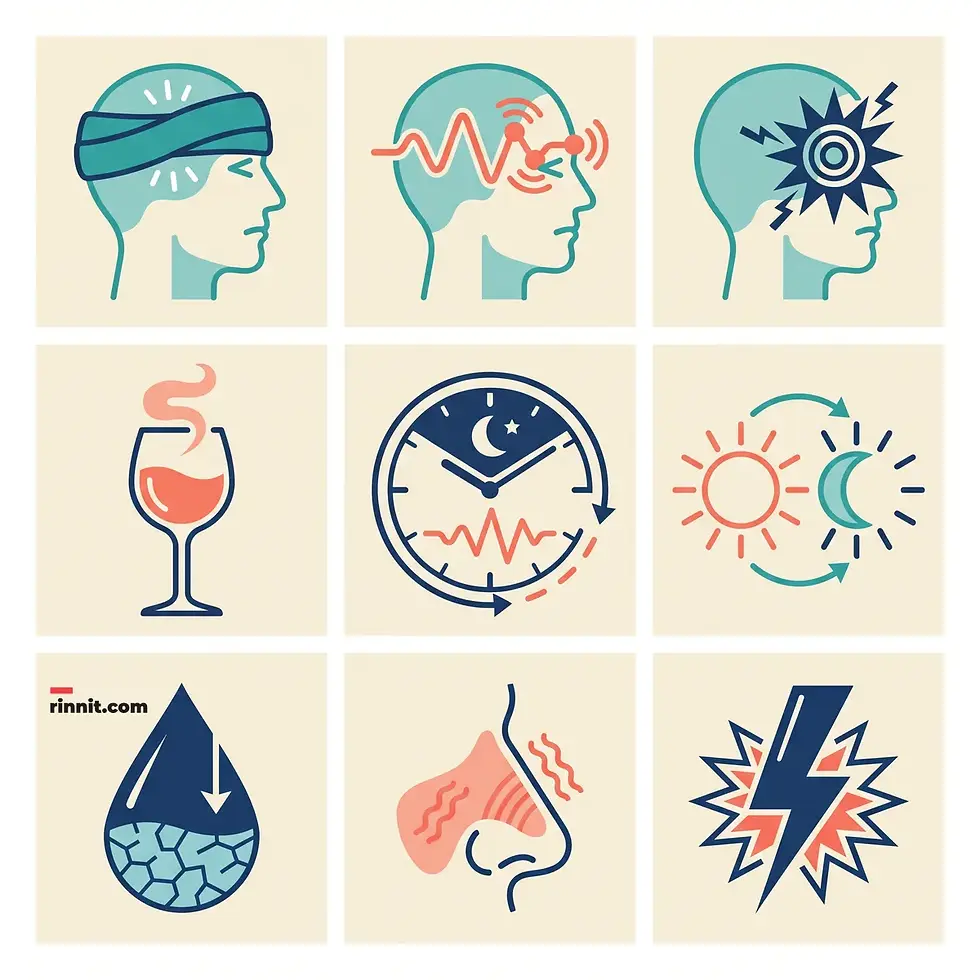
Lifestyle Triggers include:
When should you seek immediate medical care for headaches?
A headache needs emergency evaluation if it is sudden and severe, comes with fever, stiff neck or neurological signs, or is a new type after age 55 [1].
Sudden Onset: A new, severe headache that reaches peak intensity within one minute [1].
Associated Symptoms: Headache accompanied by fever, stiff neck, rash, or shortness of breath [1].
Neurological Signs: Weakness, dizziness, sudden loss of balance, vision changes, or confusion [1].
Age-Related: Developing a new type of headache after the age of 55 [1].

How are headaches managed and treated?
Treatment varies depending on the type and frequency of the headaches.
Lifestyle Management: Maintaining consistent sleep schedules, staying hydrated [2], and improving ergonomic posture at work [1].
Trigger Avoidance: Keeping a headache diary to identify and eliminate specific food or environmental triggers [1].
Medication: Over-the-counter (OTC) pain relievers for occasional tension headaches; prescription medications for migraines or cluster headaches [1].
Professional Consultation: A thorough evaluation including a physical and neurological exam is necessary for chronic or severe cases to rule out serious underlying diseases [1].
Conclusion
Headaches are a nearly universal human experience, but they don't have to control your life. By distinguishing between primary and secondary types and identifying personal triggers, most individuals can find effective relief. If you experience sudden, severe, or worsening head pain, always prioritize a professional medical evaluation.
Helpful External Resources
Frequently Asked Questions (FAQ)
What is the most common type of headache?
Tension-type headaches are the most frequent.
How many types of headaches are there?
There are more than 150 recognized types.
What is a primary headache?
One not caused by an underlying medical condition.
What is a secondary headache?
One that is a symptom of another health issue.
Are migraines hereditary?
Yes, they are highly hereditary, especially from parents to children.
What triggers a migraine?
Light, sound, smells, and certain foods are common triggers.
What is a thunderclap headache?
A sudden, extremely painful headache that peaks within a minute.
Is a thunderclap headache an emergency?
Yes, it can be a sign of a brain bleed or injury.
Can dehydration cause a headache?
Yes, lack of fluids is a common secondary trigger.
What is a sinus headache?
Pain caused by pressure and inflammation in the sinus cavities.
What are medication overuse headaches?
"Rebound" headaches caused by taking pain meds too frequently.
Does posture affect headaches?
Yes, poor posture can lead to tension-type headaches.
Can exercise cause a headache?
Yes, these are known as exertion headaches.
Why does red wine cause headaches?
It contains compounds that can trigger pain in sensitive individuals.
What is a cluster headache?
Intense pain that occurs in or around one eye.
How long do migraines usually last?
They typically last between 4 hours and several days.
Can children get headaches?
Yes, headaches affect all ages, including infants and adolescents.
Is a stiff neck with a headache serious?
Yes, it can be a sign of meningitis and requires immediate care.
Can vision changes accompany a headache?
Blurry or double vision can occur, especially with migraines.
What is a spinal headache?
One caused by a leak of spinal fluid, often after a medical procedure.
Can hunger cause a headache?
Yes, skipping meals is a common trigger.
Does nicotine cause headaches?
Yes, nicotine use is a known primary headache trigger.
What is an NDPH?
New Daily Persistent Headache, which starts suddenly and continues daily.
Can stress trigger a headache?
Stress is one of the most common triggers for tension headaches.
Is imaging (CT/MRI) always needed?
No, imaging is usually only to rule out other conditions.
What is a headache evaluation?
A detailed discussion of history and a physical exam by a doctor.
Can secondhand smoke cause headaches?
Yes, it is a significant environmental trigger.
Why does caffeine trigger headaches?
It affects blood vessels; both intake and withdrawal can cause pain.
What is the difference between a headache and a migraine?
A migraine is a specific neurological disorder.
Can weather changes cause headaches?
Yes, barometric pressure changes are a common trigger.
Is a headache after a head injury serious?
Yes, it should always be evaluated by a professional.
Can strong perfumes cause headaches?
Yes, strong odors are a frequent environmental trigger.
What is a "sharp" headache?
A sudden, stabbing sensation often associated with certain types of pain.
Can high blood pressure cause a headache?
Yes, severe spikes in blood pressure can cause secondary headaches.
How can I track my triggers?
Keeping a daily headache diary is the most effective method.
Are tension headaches dangerous?
No, but they can be very painful and disruptive.
Can allergies cause headaches?
Yes, environmental allergens can be a trigger for some.
What is a neurological exam?
A test of reflexes, strength, and senses to rule out brain issues.
Can fermented foods trigger migraines?
Yes, they contain tyramine, a known trigger.
Is a new headache after age 55 a concern?
Yes, it requires a medical evaluation to rule out new conditions.
Can sleep apnea cause headaches?
Yes, it often causes morning headaches due to oxygen changes.
What is a "throbbing" pain?
Rhythmic pain that feels like a heartbeat in the head.
Can chocolate trigger a headache?
Yes, for some people, chocolate is a dietary trigger.
Is nausea common with headaches?
It is a very common symptom of migraines.
Can poor sleep cause a headache?
Yes, both lack of sleep and changes in sleep patterns are triggers.
What is a "dull" headache?
A constant, low-level ache often felt in tension headaches.
Can processed meats cause headaches?
Yes, the nitrates used in processing are a known trigger.
Should I see a specialist?
If headaches are chronic or severe, a neurologist or headache specialist is recommended.
Can a dark room help a headache?
Yes, resting in a dark, quiet room is effective for migraines.
Where can I find reliable health info?
The Cleveland Clinic and Mayo Clinic are excellent resources.
Related Reading
Differential Diagnosis: What It Means, How It Works and Examples explains how doctors sort through conditions that share the same symptoms.
References
Cleveland Clinic. Headaches. Cleveland Clinic. Last updated August 29, 2022. https://my.clevelandclinic.org/health/diseases/9639-headaches
World Health Organization. Migraine and other headache disorders. World Health Organization. October 24, 2025. https://www.who.int/news-room/fact-sheets/detail/headache-disorders
GBD 2021 Nervous System Disorders Collaborators. Global, regional, and national burden of disorders affecting the nervous system, 1990-2021: a systematic analysis for the Global Burden of Disease Study 2021. The Lancet Neurology. 2024;23(4):344-381. PMID: 38493795. https://doi.org/10.1016/S1474-4422(24)00038-3
Lu Z, Zou H, Zhao P, et al. Myofascial release for the treatment of tension-type, cervicogenic headache or migraine: a systematic review and meta-analysis. Pain Research & Management. 2024;2024:2042069. PMID: 38585645. https://doi.org/10.1155/2024/2042069
Chen CY, Fuh JL. Evaluating thunderclap headache. Current Opinion in Neurology. 2021;34(3):356-362. PMID: 33661161. https://doi.org/10.1097/WCO.0000000000000917
Disclaimer
The information provided in this article is for educational purposes only and should not be used as a substitute for professional medical advice, diagnosis, or treatment. Always seek the advice of your physician or other qualified health provider with any questions you may have regarding a medical condition.



Comments