ESR (Sed Rate) Test: What It Measures, Normal Range by Age and What High Results Mean

Written and medically reviewed by Dr. Baraa Alnahhal, MD · Last reviewed: November 2026 · How we review
Quick Answer: What is an ESR (sed rate) test?
The erythrocyte sedimentation rate (ESR or sed rate) test is a simple blood test that checks for inflammation in your body. It measures how quickly your red blood cells settle to the bottom of a tall tube of blood; faster settling can mean inflammation. It cannot diagnose a specific condition, needs no preparation and has no side effects. [1]
What the research says
A normal ESR makes giant cell arteritis less likely, but no single test settles it. In a meta-analysis of 68 studies with 14,037 people suspected of giant cell arteritis, an ESR above 100 mm/h raised the odds of the disease about threefold, while not having an ESR above 40 mm/h lowered them markedly (negative likelihood ratio 0.18). (van der Geest et al., JAMA Internal Medicine, 2020) [2]
ESR works best alongside CRP. In 764 people who had a temporal artery biopsy, an elevated ESR had a sensitivity of 84.1% and CRP 86.9% for biopsy-proven giant cell arteritis; 4% of people with the disease had both a normal ESR and CRP. (Kermani et al., Seminars in Arthritis and Rheumatism, 2012) [3]
Key takeaways
ESR shows whether there are signs of inflammation, not what causes it. [1]
It is used to help diagnose and monitor inflammatory conditions and infections. [1]
No fasting or special preparation is needed. [1]
Normal values depend on age and sex and vary between labs. [1]
A high ESR leads to more tests; a low ESR is rarely a concern. [1]
What is an ESR test?
The ESR test is a blood test that helps detect inflammation. Providers often call it a sed rate or ESR test. [1]
An ESR cannot confirm or rule out any disease and cannot make a specific diagnosis, but it can show signs of inflammation. Your provider combines the result with other tests, a physical exam and your symptoms to narrow down a diagnosis. [1]
Why would you need an ESR test?
An ESR helps diagnose or monitor inflammatory conditions. Inflammation happens when your immune system responds to injury, viruses, bacteria or toxins, but too much or long-lasting inflammation can damage the body. [1]
Your provider may order a sed rate test if you have symptoms such as: [1]
Joint pain or stiffness
Fever
Headaches
Swelling or a feeling of warmth
Unexplained weight loss
Anemia
Loss of appetite
It can also be used to check for changes after you start a new treatment. [1]
How does an ESR test work?
Erythrocyte is the medical name for a red blood cell, and sedimentation rate is how fast something sinks to the bottom of a liquid. Your ESR is how quickly your red blood cells fall to the bottom of a sample of your blood held upright in a tube. If they fall faster than usual, you may have an inflammatory condition. [1]

The test measures how far red cells fall in one hour.
Most labs use the Westergren method: your blood goes into a special tall tube, and the lab measures how far the red blood cells settle, reported in millimeters per hour (mm/hr). [1]
What happens during an ESR test?
You do not need to prepare. You can eat, drink and take your usual medicines and supplements. [1]
A phlebotomist or provider cleans a spot on your arm with antiseptic.
They may ask you to make a fist, then insert a needle into a vein; you may feel a sharp pinch.
A small amount of blood is drawn, and a bandage is placed on the site.
Sources: [1]
ESR blood tests are extremely safe with no risk of complications or side effects. Your arm may hurt for a few hours, and minor bleeding or bruising is normal. Tell the staff if you are nervous about needles. [1]
What is a normal ESR?
A normal ESR depends on your age and sex: [1]
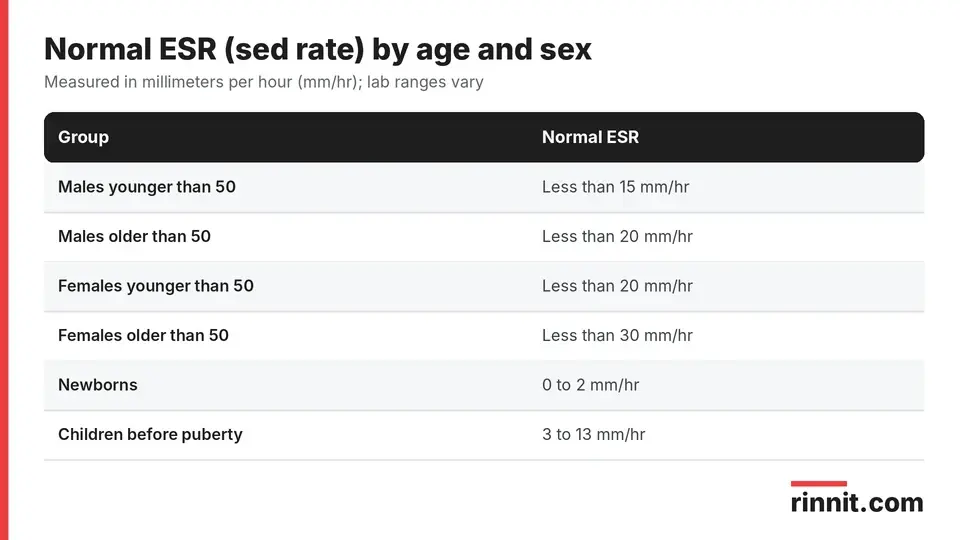
Normal ESR rises with age and is higher in females.
Group | Normal ESR |
Males younger than 50 | Less than 15 mm/hr |
Males older than 50 | Less than 20 mm/hr |
Females younger than 50 | Less than 20 mm/hr |
Females older than 50 | Less than 30 mm/hr |
Newborns | 0 to 2 mm/hr |
Children who have not reached puberty | 3 to 13 mm/hr |
Sources: [1]
Typical ranges vary from person to person, and labs may use different ranges. Your provider will explain your result. [1]
What do high and low ESR results mean?

ESR points to inflammation but not its cause.
High ESR
A high sed rate may mean there is inflammation somewhere in your body. It can be a sign of: [1]
Autoimmune diseases
Blood disorders
Infections
Inflammatory arthritis
Some types of cancer
Your provider will explain which other tests or treatments you need. [1]
Low ESR
A low ESR is not usually a cause for concern; most people's values fall below the upper limits, and some people naturally run higher or lower. A low ESR can sometimes be a sign of: [1]
Blood disorders
Heart failure
Kidney or liver conditions
Conclusion
The ESR is a fast, safe blood test that shows whether there is inflammation in your body. It cannot name a specific disease, so your provider reads it together with your symptoms, an exam and other tests.
You may need a repeat ESR later to see how your body is responding to treatment. If you are anxious about blood draws, let the staff know so they can help you stay comfortable.
Keep learning: Read our giant cell arteritis guide or our polymyalgia rheumatica guide. For more background, see the MedlinePlus page on the ESR test.
FAQ
What is an ESR test?
It is a blood test that measures how fast red blood cells settle in a tube, which helps show whether there is inflammation in your body.
What does ESR stand for?
Erythrocyte sedimentation rate; it is also called a sed rate test.
What is a normal ESR?
It depends on age and sex, for example under 15 mm/hr for men under 50 and under 30 mm/hr for women over 50.
What does a high ESR mean?
It suggests inflammation, which can come from autoimmune disease, infection, inflammatory arthritis, blood disorders or some cancers.
What does a low ESR mean?
Usually nothing concerning, though it can occur with blood disorders, heart failure and kidney or liver conditions.
Can an ESR test diagnose a disease?
No. It shows inflammation but cannot confirm or rule out a specific condition.
Do I need to fast before an ESR test?
No. You can eat, drink and take your usual medicines.
Does the ESR test have side effects?
It is very safe; you may have a brief pinch, minor bleeding or a bruise.
How is ESR measured?
Most labs use the Westergren method, timing how far red cells fall in a tall tube, in millimeters per hour.
Why would my doctor order an ESR test?
For symptoms like joint pain or stiffness, fever, headaches, swelling, weight loss, anemia or appetite loss, or to monitor treatment.
Related Reading
Giant Cell Arteritis (Temporal Arteritis): Symptoms, Causes, Diagnosis & Treatment — Complete Guide explains a condition in which ESR is a key early test.
Polymyalgia Rheumatica: Complete Guide to Symptoms, Causes, and Treatment covers an inflammatory condition often tracked with ESR.
Rheumatoid Arthritis — Symptoms, Causes, Diagnosis, Treatment & Complete Guide describes an inflammatory arthritis that can raise ESR.
Lupus: Symptoms, Causes & Treatment Guide explains an autoimmune disease linked to a high ESR.
References
Cleveland Clinic. Sedimentation Rate (ESR): What It Measures & Test Results. Cleveland Clinic. Last updated August 17, 2026. https://my.clevelandclinic.org/health/diagnostics/17747-sed-rate-erythrocyte-sedimentation-rate-or-esr-test
van der Geest KSM, Sandovici M, Brouwer E, Mackie SL. Diagnostic Accuracy of Symptoms, Physical Signs, and Laboratory Tests for Giant Cell Arteritis: A Systematic Review and Meta-analysis. JAMA Intern Med. 2020;180(10):1295-1304. PMID 32804186. https://doi.org/10.1001/jamainternmed.2020.3050
Kermani TA, Schmidt J, Crowson CS, et al. Utility of erythrocyte sedimentation rate and C-reactive protein for the diagnosis of giant cell arteritis. Semin Arthritis Rheum. 2012;41(6):866-871. PMID 22119103. https://doi.org/10.1016/j.semarthrit.2011.10.005
Medical disclaimer
This article is for general education only and does not replace advice from a qualified healthcare professional. Talk to your doctor about your own diagnosis and treatment, and seek emergency care right away for severe or sudden symptoms.



Comments