Bronchial Thermoplasty for Severe Asthma: How It Works and Results

Updated: 2 days ago
Written and medically reviewed by Dr. Baraa Alnahhal, MD · Last reviewed: November 2026 · How we review
Quick Answer
Bronchial thermoplasty is a procedure for severe asthma that doesn't improve with standard treatments. A provider passes a thin tube into the airways and applies heat to the smooth muscle, thinning it so it can't tighten as much. It takes three sessions at least three weeks apart. It doesn't cure asthma, so you'll still need your medicines.
What the research says
More people felt better after treatment: in a sham-controlled trial of 288 adults with severe asthma, 79% of treated people versus 64% with a sham procedure had a meaningful quality-of-life gain, with fewer severe attacks and ER visits the next year, though more treated people were hospitalized during the treatment period (Castro M et al., American Journal of Respiratory and Critical Care Medicine, 2010) [2]
Benefits held up for over 10 years: in 136 treated people followed a median of 12.1 years, severe asthma attacks stayed stable over time, and 7% of those without it at the start developed bronchiectasis, mostly mild (Chaudhuri R et al., Lancet Respiratory Medicine, 2021) [3]
Key takeaways
Bronchial thermoplasty treats severe asthma with heat.
It thins the muscle around your airways.
It takes three sessions at least three weeks apart.
It may reduce asthma attacks for 10 years or more.
You'll still need your asthma medicines.
What is bronchial thermoplasty?
In asthma, the muscle around your airways tightens and narrows them. Bronchial thermoplasty uses heat to thin or shrink that muscle, giving your lungs more room to breathe. In one study, it reduced airway muscle mass by 53%. Sources: [1]
Who it's for
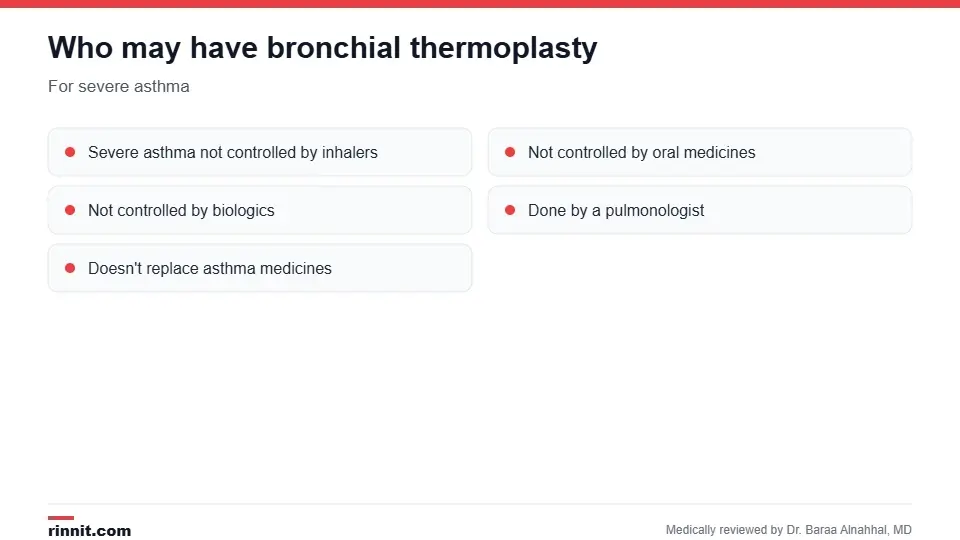
It's usually done by a pulmonologist.
It's for people whose severe asthma isn't controlled by standard treatments, such as inhalers, oral medicines or biologics. Sources: [1]
How the sessions work
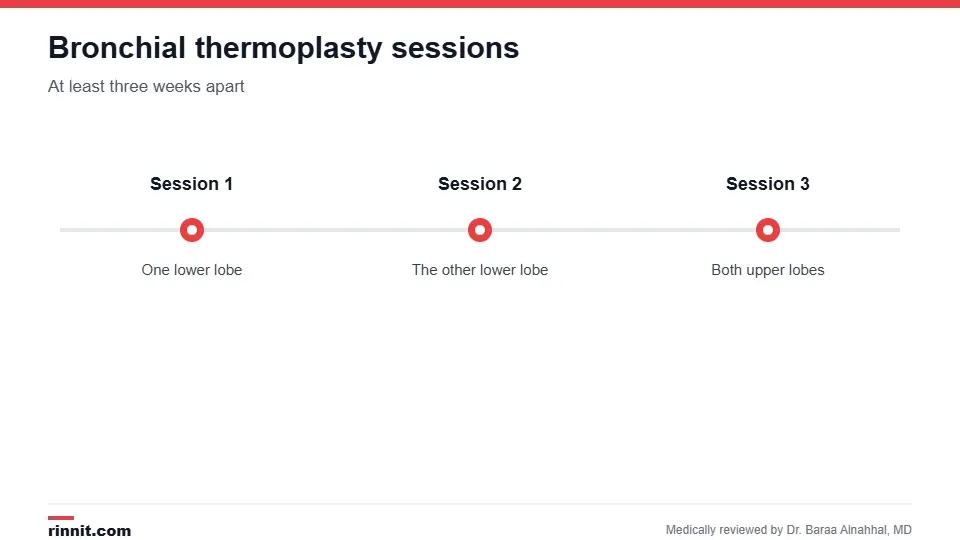
The right middle lobe isn't treated.
Session | Area treated |
1 | One lower lobe (right or left) |
2 | The other lower lobe |
3 | Both upper lobes |
Sessions are at least three weeks apart and each takes about 45 minutes to an hour. The right middle lobe isn't treated to avoid the risk of collapse. Sources: [1]
What happens during treatment
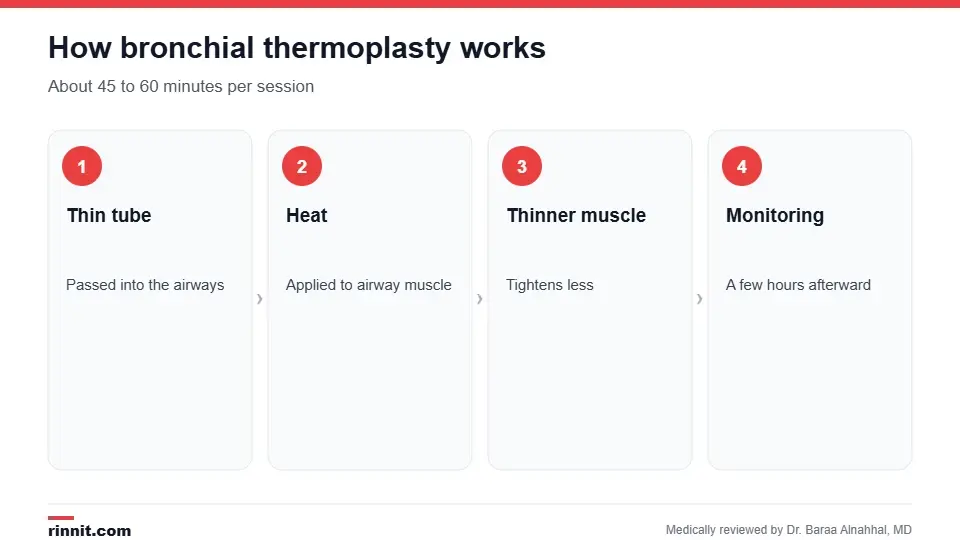
Each session takes about 45 minutes to an hour.
A provider passes a thin tube into your airways.
Controlled heat is applied to the smooth muscle around the airways.
The muscle thins, so it can't tighten as much. Sources: [1]
Side effects
Some people have new or worse asthma symptoms in the days after treatment. These usually improve within a week. Studies show some people develop bronchiectasis over time, usually mild. Sources: [1, 2, 3]
Recovery
You'll be monitored for at least a few hours as you wake up.
You may stay overnight if your symptoms get worse.
Keep taking your asthma medicines. Sources: [1]
Results
Some people improve after the first session; others don't notice until all three are done, or improve only slightly. Studies show better quality of life and fewer flare-ups, with benefits lasting at least 10 years. Sources: [1, 2, 3]
When to get help
Contact your provider with any concerns before or after treatment. Go to the emergency room for severe symptoms, such as an asthma attack that doesn't respond to your rescue inhaler. Sources: [1]
Conclusion
Bronchial thermoplasty offers another option when severe asthma doesn't respond to standard treatment. It can mean fewer attacks for years, though you'll still need your asthma medicines.
Frequently asked questions
What is bronchial thermoplasty?
A procedure that uses heat to thin the muscle around the airways in severe asthma.
Who is it for?
People with severe asthma not controlled by standard treatments.
How many sessions are needed?
Three, at least three weeks apart.
How long does each session take?
About 45 minutes to an hour.
Does it cure asthma?
No. You'll still need your medicines.
Will my asthma get worse afterward?
Symptoms may worsen for a few days and usually improve within a week.
Will I stay in the hospital?
You may go home after a few hours or stay overnight.
When will I notice results?
After the first session for some, or after all three for others.
How long do results last?
At least 10 years.
Why isn't the right middle lobe treated?
To avoid the risk of it collapsing.
Related Reading
Asthma: Symptoms, Causes, Triggers, Diagnosis & Treatment — Complete Guide an overview of asthma.
Bronchoscopy: Why It's Done, What to Expect, Recovery and Risks a similar airway procedure.
Biologics: What They Are, Types, Uses and Side Effects another severe asthma treatment.
Bronchodilators: Types, How They Work and Side Effects medicines that open the airways.
Asthma Attack: Symptoms, Triggers, Warning Signs & Emergency Treatment — Complete Guide recognizing an asthma attack.
References
Mayo Clinic Staff. Asthma - Diagnosis and treatment. Mayo Clinic. March 08, 2025. https://www.mayoclinic.org/diseases-conditions/asthma/diagnosis-treatment/drc-20369660
Castro M, Rubin AS, Laviolette M, et al. Effectiveness and safety of bronchial thermoplasty in the treatment of severe asthma: a multicenter, randomized, double-blind, sham-controlled clinical trial. Am J Respir Crit Care Med. 2010;181(2):116-124. PMID 19815809. https://doi.org/10.1164/rccm.200903-0354OC
Chaudhuri R, Rubin A, Sumino K, et al. Safety and effectiveness of bronchial thermoplasty after 10 years in patients with persistent asthma (BT10+): a follow-up of three randomised controlled trials. Lancet Respir Med. 2021;9(5):457-466. PMID 33524320. https://doi.org/10.1016/S2213-2600(20)30408-2
Medical disclaimer
This article is for general education only and does not replace advice from a qualified healthcare professional. Talk to your doctor about your own diagnosis and treatment, and seek emergency care right away for severe or sudden symptoms.



Comments