Bronchodilators: Types, How They Work and Side Effects

Updated: 2 days ago
Written and medically reviewed by Dr. Baraa Alnahhal, MD · Last reviewed: November 2026 · How we review
Quick Answer
Bronchodilators are medicines that relax the muscles around the airways so you can breathe more easily. They're prescribed for asthma, COPD and other lung conditions. Short-acting types work within a few minutes to stop sudden symptoms; long-acting types are used every day. Common side effects are shakiness, nervousness and a faster heartbeat.
What the research says
Tiotropium prevented more COPD flare-ups than salmeterol: in the POET-COPD trial of 7,376 people, the long-acting anticholinergic tiotropium delayed the first flare-up (187 vs. 145 days) and cut flare-up risk by 17% compared with the beta-2 agonist salmeterol (Vogelmeier C et al., New England Journal of Medicine, 2011) [2]
Long-term tiotropium improved breathing and quality of life: in the 4-year UPLIFT trial of 5,993 people with COPD, tiotropium improved lung function and quality of life and reduced flare-ups, hospital stays and respiratory failure versus placebo, though it didn't slow the yearly decline in lung function (Tashkin DP et al., New England Journal of Medicine, 2008) [3]
Key takeaways
Bronchodilators relax airway muscles to ease breathing.
Short-acting types work in minutes for sudden symptoms.
Long-acting types are taken daily for asthma and COPD.
The main types are beta-2 agonists and anticholinergics.
Seek help if a rescue dose doesn't help within 20 minutes.
What are bronchodilators?
Bronchodilators open your airways by relaxing the muscles around them. They're often given in an inhaler or nebulizer, and sometimes as pills. They treat airway narrowing called bronchoconstriction. Sources: [1]
What they treat
Bronchodilators treat symptoms of asthma, COPD and other lung conditions. Short-acting types stop sudden symptoms, while long-acting types manage asthma and COPD every day. Sources: [1]
Types of bronchodilators
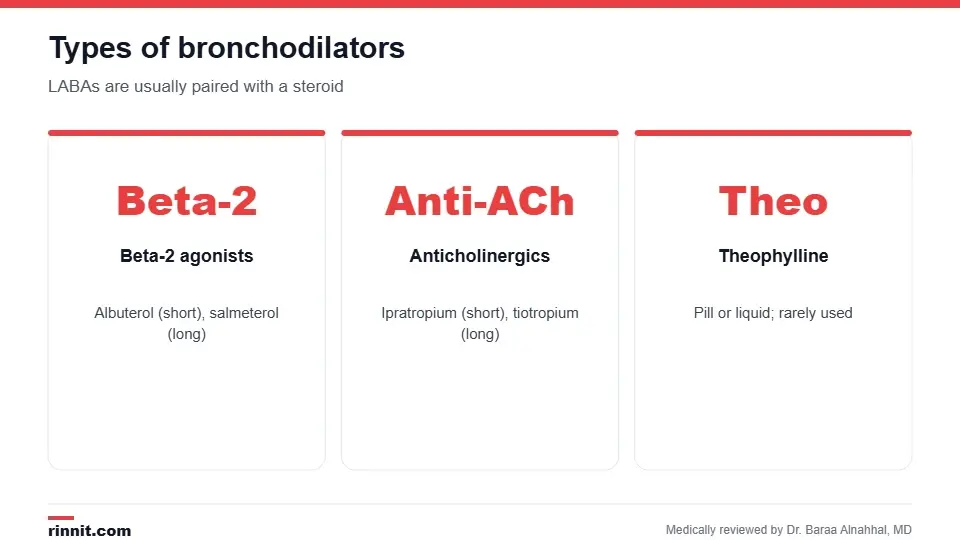
Long-acting beta-2 agonists are usually combined with a corticosteroid.
Type | Short-acting | Long-acting |
Beta-2 agonists | Albuterol, levalbuterol | Salmeterol, formoterol |
Anticholinergics | Ipratropium bromide | Tiotropium bromide |
Theophylline | Pill or liquid; rarely used now | — |
Long-acting beta-2 agonists are usually combined with a corticosteroid in one inhaler. For asthma, they should never be used alone without a steroid inhaler, because that raises the risk of severe asthma attacks and death. Sources: [1]
How they work

Short-acting types work within minutes.
Beta-2 agonists attach to receptors in your lungs that make airway muscles relax.
Anticholinergics block acetylcholine, a chemical that can tighten your airways.
Nebulizers turn liquid medicine into a mist that reaches your lungs. Sources: [1]
How to use a bronchodilator inhaler
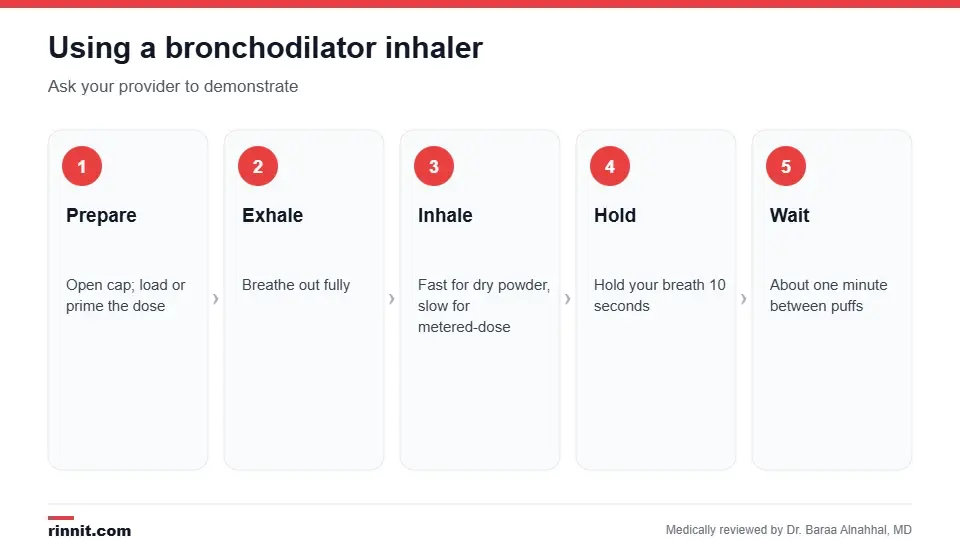
Ask your provider to show you how to use your device.
Open or remove the cap.
Load a dose (dry powder) or prime by shaking and spraying into the air (metered-dose).
Breathe out fully and put the inhaler in your mouth.
Breathe in quickly and deeply for dry powder, or slowly while pressing the canister for metered-dose.
Hold your breath for 10 seconds.
Wait about one minute between puffs.
Rinse and spit after an inhaler that contains a corticosteroid. Sources: [1]
Tell your provider if you have glaucoma or bladder or prostate problems. Sources: [1]
Side effects
Type | Possible side effects |
Most common | Nervousness, shakiness, faster heartbeat, lasting about an hour |
Beta-2 agonists | Overexcitement, upset stomach, trouble sleeping |
Anticholinergics | Bad taste, nausea, blurred vision, trouble peeing, dry mouth, eyes or nose |
Theophylline | Nausea, vomiting, headache, diarrhea, irregular heartbeat, muscle cramps |
The most serious side effect is paradoxical bronchospasm, when wheezing and shortness of breath get worse after a dose. Call 911 if this happens. Sources: [1]
How fast they work
Short-acting bronchodilators bring relief within a few minutes and last a few hours. Long-acting types can take several weeks to reach full effect, so you may need to use them for a while before noticing a difference. Sources: [1, 3]
When to get help
If you're not better within 20 minutes of a rescue dose, call your provider or go to the nearest ER.
Call 911 if symptoms get worse after a dose.
Talk to your provider if you need your rescue inhaler more than twice a week.
Ask your provider for a personal action plan. Sources: [1]
Conclusion
Bronchodilators are a cornerstone of treatment for asthma and COPD, offering both quick relief and daily control. Using the right type and the right technique helps you breathe easier.
Frequently asked questions
What is a bronchodilator?
A medicine that relaxes airway muscles to make breathing easier.
What's the difference between short- and long-acting bronchodilators?
Short-acting types give quick relief; long-acting types control symptoms daily.
Is albuterol a bronchodilator?
Yes. It's a short-acting beta-2 agonist.
How fast does a rescue inhaler work?
Within a few minutes.
How long do long-acting bronchodilators take to work?
They can take several weeks to reach full effect.
What are common side effects?
Shakiness, nervousness and a faster heartbeat.
What is paradoxical bronchospasm?
Worsening wheezing after a dose; call 911 if it happens.
Can bronchodilators be taken as pills?
Sometimes, such as theophylline.
Do I need to rinse my mouth?
Yes, after an inhaler that contains a corticosteroid.
When should I go to the ER?
If a rescue dose doesn't help within 20 minutes.
Related Reading
Beta-Agonists: Types, Uses and Side Effects explains beta-agonist medicines.
Bronchial Thermoplasty for Severe Asthma: How It Works and Results explains bronchial thermoplasty for severe asthma.
Inhalers: Types, Medicines and How to Use Them devices that deliver bronchodilators.
Asthma: Symptoms, Causes, Triggers, Diagnosis & Treatment — Complete Guide a common reason for bronchodilators.
What Is Chronic Obstructive Pulmonary Disease (COPD)? Symptoms, Causes, Stages, and Treatment a lung disease treated with bronchodilators.
Bronchospasm: When Your Airway Muscles Tighten, and What to Do About It sudden airway tightening.
Home Nebulizer: Essential Guide to Breathing Treatments another way to take bronchodilators.
References
Cleveland Clinic. Bronchodilators: Asthma, Purpose, Types & Side Effects. Cleveland Clinic. Last updated July 7, 2026. https://my.clevelandclinic.org/health/treatments/17575-bronchodilator
Vogelmeier C, Hederer B, Glaab T, et al. Tiotropium versus salmeterol for the prevention of exacerbations of COPD. N Engl J Med. 2011;364(12):1093-1103. PMID 21428765. https://doi.org/10.1056/NEJMoa1008378
Tashkin DP, Celli B, Senn S, et al. A 4-year trial of tiotropium in chronic obstructive pulmonary disease. N Engl J Med. 2008;359(15):1543-1554. PMID 18836213. https://doi.org/10.1056/NEJMoa0805800
Medical disclaimer
This article is for general education only and does not replace advice from a qualified healthcare professional. Talk to your doctor about your own diagnosis and treatment, and seek emergency care right away for severe or sudden symptoms.



Comments