Beta-Agonists: Types, Uses and Side Effects

Updated: 2 days ago
Written and medically reviewed by Dr. Baraa Alnahhal, MD · Last reviewed: November 2026 · How we review
Quick Answer
Beta-agonists are medicines that bind to and activate beta-receptors in your body, best known as bronchodilators that relax airway muscles to treat asthma and COPD. Short-acting types work within about 15 minutes during an attack; long-acting types are used daily and, for asthma, always with a corticosteroid. Common side effects include a fast heartbeat and shakiness.
What the research says
One combination inhaler for daily and rescue use cut asthma attacks: in a review of 16 trials including 22,524 people aged 12 and older, using one inhaled steroid plus long-acting beta-agonist inhaler for both maintenance and quick relief lowered asthma attack risk (risk ratio 0.68) compared with the same controller alone (Sobieraj DM et al., JAMA, 2018) [2]
Adding a long-acting beta-agonist to a steroid was safe: in the AUSTRI trial of 11,679 people with asthma, adding salmeterol to fluticasone didn't raise serious asthma events, caused no asthma deaths and lowered severe attacks by 21% (Stempel DA et al., New England Journal of Medicine, 2016) [3]
Key takeaways
Beta-agonists activate beta-receptors in the lungs, heart and bladder.
Beta-2 agonists relax airways to treat asthma and COPD.
Short-acting types work in about 15 minutes.
Long-acting types are used daily; for asthma, always with a steroid.
Inhaled forms usually cause few side effects.
What are beta-agonists?
Beta-agonists act on the sympathetic nervous system, your "fight-or-flight" response. They relax lung muscles, speed up the heart and relax the bladder. Beta-blockers do the opposite. Learn more about bronchodilators. Sources: [1]
Types of beta-agonists
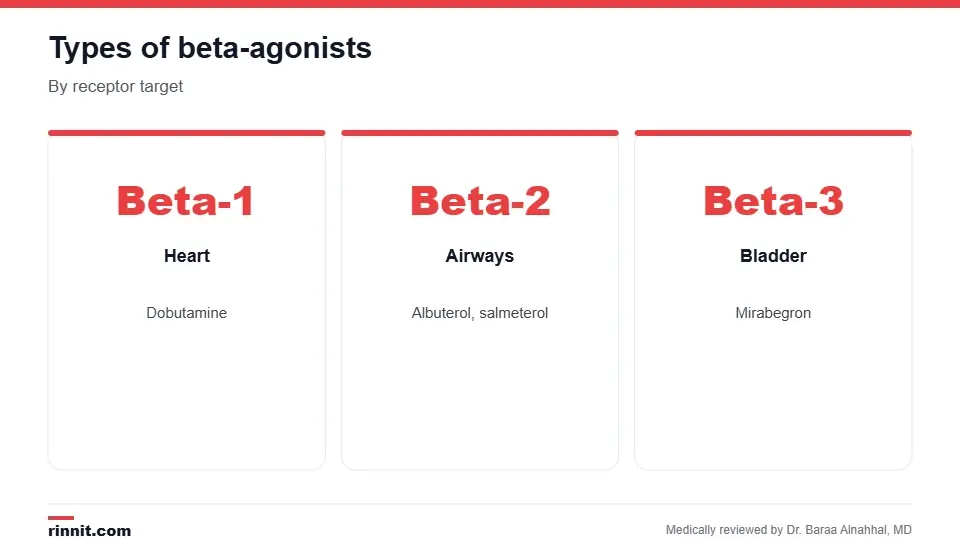
Selective agonists target one receptor type.
Type | Main target | Examples |
Beta-1 | Heart | Dobutamine, norepinephrine, dopamine |
Beta-2 short-acting | Airways | Albuterol, levalbuterol |
Beta-2 long-acting | Airways | Formoterol, salmeterol, indacaterol |
Beta-1 and beta-2 | Heart and airways | Epinephrine, isoproterenol |
Beta-3 | Bladder | Mirabegron |
Selective agonists target specific receptors; nonselective ones target all. Side effects usually happen when a drug affects organs it wasn't meant to. Sources: [1]
What they treat

Inhaled beta-2 agonists can be used at home.
COPD.
High potassium (hyperkalemia).
Emergencies such as acute heart failure, cardiogenic shock and anaphylaxis. Sources: [1]
How they're used
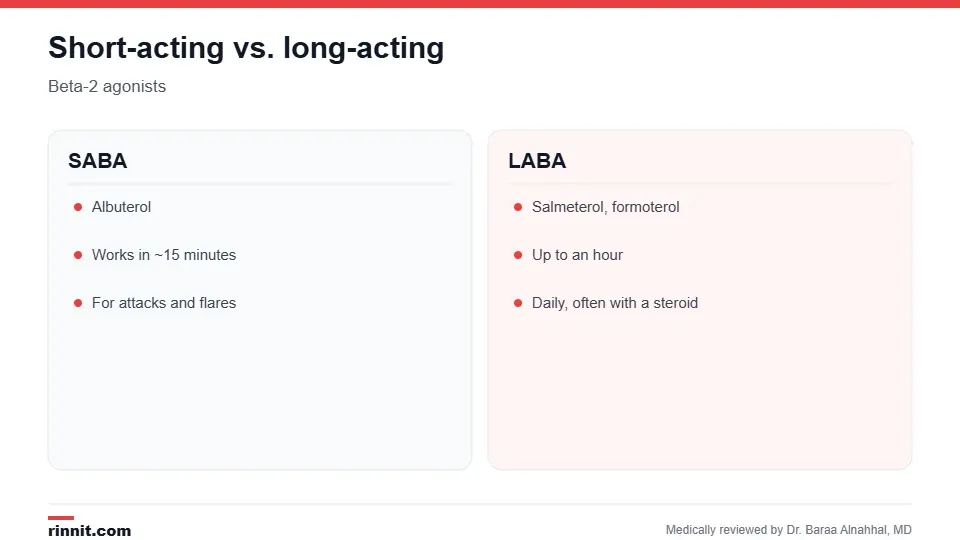
Regular use may make them less effective for some people.
Feature | Short-acting (SABA) | Long-acting (LABA) |
Starts working | About 15 minutes | Up to an hour |
When used | During an attack or flare | Daily, for control |
Asthma use | Quick relief | With a corticosteroid for asthma |
Inhaled beta-2 agonists come in inhalers or nebulizers. Other types are usually given only in the hospital. Sources: [1, 2, 3]
Side effects
Fast or irregular heartbeat.
High blood pressure.
Shakiness.
Anxiety or nervousness.
Sweating.
Headaches.
Muscle cramps. Sources: [1]
Inhaled beta-2 agonists usually cause minimal side effects. Regular use may make them less effective for some people. Sources: [1]
Outlook
Beta-agonists can help you manage asthma or COPD and improve your quality of life. Studies show that pairing a long-acting beta-agonist with an inhaled steroid lowers asthma attacks safely. Sources: [1, 2, 3]
When to call your provider
Call if you have unwanted side effects or your treatment doesn't seem to work. Call 911 if your rescue inhaler doesn't relieve severe trouble breathing. Get medical help right away for severe side effects. Sources: [1]
Conclusion
Beta-agonists open your airways quickly or keep them open day to day, and other types help in heart and bladder conditions. Using them as prescribed keeps them safe and effective.
Keep learning: read about bronchodilators and inhalers.
Frequently asked questions
What are beta-agonists?
Medicines that activate beta-receptors, mainly to open the airways.
What do beta-agonists treat?
Mostly asthma and COPD, plus some heart and bladder conditions.
Is albuterol a beta-agonist?
Yes, a short-acting beta-2 agonist.
How fast do they work?
Short-acting ones work within about 15 minutes.
What is a LABA?
A long-acting beta-agonist, like salmeterol or formoterol.
Why are LABAs paired with steroids?
For asthma, the combination controls symptoms better and lowers attacks.
What are common side effects?
Fast heartbeat, shakiness, nervousness, headache and muscle cramps.
Are beta-agonists the same as beta-blockers?
No. They have opposite effects.
Can I use them at home?
Yes, inhaled beta-2 agonists can be used at home.
Can they stop working?
Regular use may reduce their effect for some people.
Related Reading
Bronchodilators: Types, How They Work and Side Effects medicines that open the airways.
Inhalers: Types, Medicines and How to Use Them how inhaled medicines are delivered.
Beta-Blockers: What They Do, What They Treat, and Side Effects to Know medicines with the opposite effect.
Asthma: Symptoms, Causes, Triggers, Diagnosis & Treatment — Complete Guide a condition beta-agonists treat.
What Is Chronic Obstructive Pulmonary Disease (COPD)? Symptoms, Causes, Stages, and Treatment another lung condition they treat.
References
Cleveland Clinic. Beta-agonist: Types, Dosing, Benefits & Side Effects. Cleveland Clinic. Last updated March 24, 2023. https://my.clevelandclinic.org/health/treatments/24851-beta-agonist
Sobieraj DM, Weeda ER, Nguyen E, et al. Association of inhaled corticosteroids and long-acting β-agonists as controller and quick relief therapy with exacerbations and symptom control in persistent asthma: a systematic review and meta-analysis. JAMA. 2018;319(14):1485-1496. PMID 29554195. https://doi.org/10.1001/jama.2018.2769
Stempel DA, Raphiou IH, Kral KM, et al. Serious asthma events with fluticasone plus salmeterol versus fluticasone alone. New England Journal of Medicine. 2016;374(19):1822-1830. PMID 26949137. https://doi.org/10.1056/NEJMoa1511049
Medical disclaimer
This article is for general education only and does not replace advice from a qualified healthcare professional. Talk to your doctor about your own diagnosis and treatment, and seek emergency care right away for severe or sudden symptoms.



Comments