Beta-Blockers: What They Do, What They Treat, and Side Effects to Know

Updated: 6 days ago
Written and medically reviewed by Dr. Baraa Alnahhal, MD · Last reviewed: October 2026 · How we review
Quick Answer
Beta-blockers are prescription medicines that slow the heart rate and relax the heart and blood vessels, which can lower blood pressure and ease the heart's workload. They treat high blood pressure, chest pain, heart failure, irregular heartbeats and other conditions. Common side effects include dizziness and tiredness, and they should never be stopped without a doctor's advice. [1]
What the research says
Beta-blockers help people with heart failure live longer. A pooled analysis of 11 double-blind trials (14,262 patients in normal heart rhythm) found beta-blockers reduced deaths compared with placebo. In patients with a mildly reduced pumping strength (ejection fraction 40–49%), deaths were 7.2% with a beta-blocker vs. 12.4% with placebo. (Cleland et al., European Heart Journal, 2018) [2]
For high blood pressure alone, they lower stroke risk but aren't usually the first choice. A review of 13 randomized trials found beta-blockers cut stroke risk by about 20% vs. placebo, with no clear effect on overall deaths. They performed less well than some other blood pressure medicines. (Wiysonge et al., Cochrane Database of Systematic Reviews, 2017) [3]
After a heart attack with normal heart function, routine use may not add benefit. Pooled data from 5 trials (17,801 patients) showed the combined rate of death, repeat heart attack, or heart failure was 8.1% with a beta-blocker vs. 8.3% without, not a meaningful difference. (Kristensen et al., New England Journal of Medicine, 2026) [4]
Key Takeaways
Beta-blockers block stress hormones (adrenaline and noradrenaline) from speeding up your heart.
They treat a wide range of heart, circulation, and some nervous-system conditions.
There are two main groups: cardioselective and nonselective.
About 1 in 10 U.S. adults take a beta-blocker.
Many people take them long term. Don't stop suddenly without medical advice.
What are beta-blockers?
Beta-blockers are a class of prescription medicines most often used for problems involving the heart and circulatory system. [1]
They work by slowing down certain types of cell activity. This helps manage blood pressure, heart rate, and more.
They're among the most commonly prescribed medicines in the United States. Roughly 10% of adults there take one.
How do beta-blockers work?
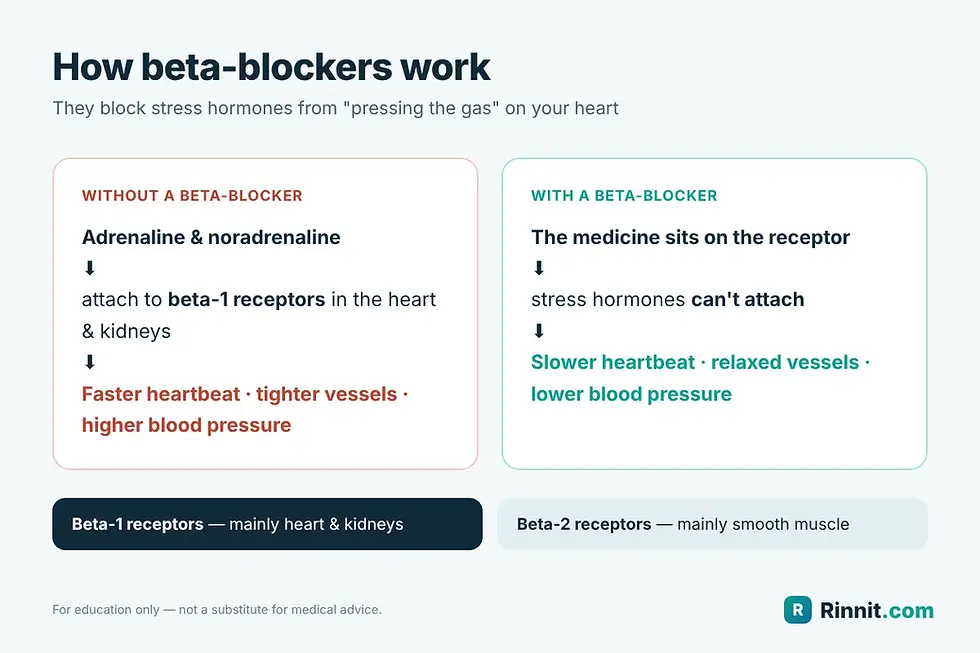
Beta-blockers work by blocking the stress hormones epinephrine (adrenaline) and norepinephrine (noradrenaline) from acting on receptors in your organs. [5]
These two chemical messengers drive your "fight or flight" response to stress and danger. When they attach to receptors in your organs, your heart beats faster and your blood vessels tighten.
Beta-blockers block that action. As a result, they:
Stop your heart from beating too fast
Relax smooth muscle in your blood vessels
Help lower your blood pressure
Improve the working conditions of your heart
For a deeper clinical overview, see the StatPearls review of beta blockers.
What is the difference between beta-1 and beta-2 receptors?
Beta-1 receptors sit mainly in the heart and kidneys and are the main target of beta-blockers, while beta-2 receptors sit mainly in smooth muscle tissue. [5]
Receptor type | Where it's found | Why it matters |
|---|---|---|
Beta-1 (B1) | Mainly the heart and kidneys | Main target of beta-blockers |
Beta-2 (B2) | Mainly smooth muscle tissue | Affected by nonselective beta-blockers |
What do beta-blockers treat?
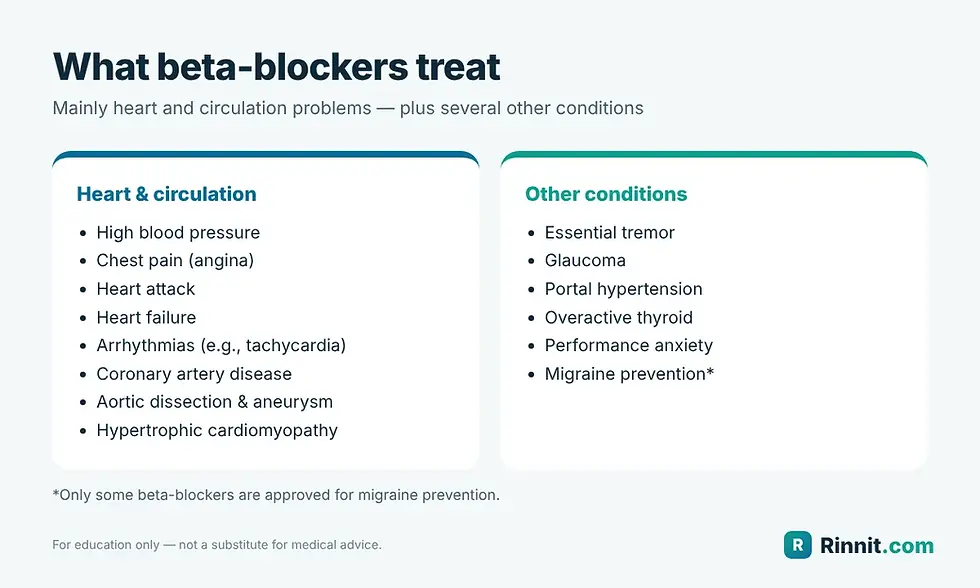
Beta-blockers mainly treat heart and circulation conditions such as high blood pressure, chest pain and heart failure, and they also help with conditions like essential tremor, glaucoma and migraine prevention. [1]
Heart and circulation conditions
Beta-blockers are mainly used for:
High blood pressure (hypertension)
Chest pain (angina)
Heart attack
Congestive heart failure
Coronary artery disease
Arrhythmias, such as tachycardia (a fast heart rate)
Aortic dissection and aortic aneurysms
Hypertrophic obstructive cardiomyopathy (an enlarged, thickened heart muscle)
Other conditions
Beta-blockers can also help treat:
Essential tremor
Portal hypertension (high pressure in the liver's blood vessels)
Hyperthyroidism (overactive thyroid)
Performance anxiety
Migraine prevention, though only some beta-blockers are FDA-approved for this
What are the types of beta-blockers?
Beta-blockers fall into two broad groups, cardioselective and nonselective, and your doctor considers this when choosing which one to prescribe. [1] [6]
Cardioselective: Block mainly the beta-1 receptors in the heart.
Nonselective: Act on beta-1 and other beta receptors throughout the body.
Cardioselective (beta-1) | Nonselective |
|---|---|
Acebutolol | Carvedilol |
Atenolol | Labetalol |
Betaxolol | Nadolol |
Bisoprolol | Penbutolol |
Esmolol | |
Metoprolol | Propranolol |
Nebivolol | Sotalol |
— | Timolol |
Metoprolol is the most commonly prescribed beta-blocker. It's cardioselective. Carvedilol is another common choice, a nonselective beta-blocker that may offer several benefits for the heart. Learn more in the StatPearls review of selective beta-1 blockers.

What are the benefits of beta-blockers?
The main benefits of beta-blockers are a lower risk of heart attack, stroke or heart failure hospital stays in certain cases, treating several linked problems at once, decades of study and low cost. [1]
Benefit | What it means for you |
|---|---|
Healthier, longer life | In certain cases, they may lower the risk of heart attack, stroke, or hospital stays for heart failure. |
Treat many problems at once | Heart and circulation problems are often linked, so one medicine can help several issues. |
Well studied | They've been used for decades, so their effects and safety are well understood. |
Low cost | Most are inexpensive, especially generic versions. |
How long can you take beta-blockers?
You can take beta-blockers for long periods, and many people stay on them indefinitely. [1]
Never stop taking a beta-blocker unless your doctor tells you to. If side effects worry you, talk to your doctor before making any change. Stopping suddenly can worsen chest pain or trigger a heart attack in people with heart disease, so doses are lowered slowly when needed.
What are the side effects of beta-blockers?
The most common side effects of beta-blockers are dizziness, fatigue, dry mouth and dry eyes, while sexual dysfunction is rare. [1]
How common | Side effects |
|---|---|
Seen with all beta-blockers | Dizziness, fatigue, dry mouth, dry eyes |
Rare | Sexual dysfunction, erectile dysfunction |
Your doctor or pharmacist can tell you which issues to watch for with your specific medicine. Tell your doctor if you have asthma or COPD, because some beta-blockers can tighten the airways, or diabetes, because beta-blockers can hide warning signs of low blood sugar such as a fast heartbeat.
When should you call your doctor while taking a beta-blocker?
You should call your doctor if your symptoms or side effects change suddenly while you're taking a beta-blocker. [1]
Watch for:
Shortness of breath
Chest pain
Heart palpitations (a racing, pounding, or skipping heartbeat)
Fainting
Repeated episodes of dizziness or lightheadedness
Conclusion
Beta-blockers are one of the most widely used and best-studied heart medicines. By blocking stress hormones, they slow your heart and relax your blood vessels, helping with conditions from high blood pressure and heart failure to tremor and migraines.
Still, they aren't the best choice for everyone. The right medicine depends on your condition, your heart's function, and your overall health.
Have questions about your beta-blocker? Save or share this guide and bring it to your next doctor's visit. For more clear, research-backed heart health guides, explore the Rinnit.com health library.
Frequently Asked Questions
What do beta-blockers do to your body?
They block adrenaline and noradrenaline from acting on your organs. This slows your heart rate, relaxes your blood vessels, and can lower your blood pressure.
What is the most common beta-blocker?
Metoprolol is the most commonly prescribed beta-blocker. It's a cardioselective type, meaning it mainly targets the heart's beta-1 receptors.
What is the difference between cardioselective and nonselective beta-blockers?
Cardioselective beta-blockers block mainly beta-1 receptors in the heart and kidneys. Nonselective beta-blockers also act on other beta receptors, such as beta-2 receptors in smooth muscle.
What are the most common side effects of beta-blockers?
Dizziness, tiredness, and dry mouth or eyes. Sexual problems, including erectile dysfunction, are rare.
Can I stop taking beta-blockers on my own?
No. Never stop a beta-blocker without your doctor's guidance. If side effects bother you, talk to your doctor about your options.
How long can you stay on beta-blockers?
Beta-blockers can be taken for extended periods. Many people take them indefinitely.
Are beta-blockers used for anxiety?
Yes. Beta-blockers can help with performance anxiety, alongside their main heart uses.
Can beta-blockers prevent migraines?
Some can. Only certain beta-blockers have U.S. FDA approval for migraine prevention.
When should I call my doctor while on a beta-blocker?
Call if you have shortness of breath, chest pain, palpitations, fainting, or repeated dizziness or lightheadedness.
Can I drink alcohol while taking a beta-blocker?
Alcohol can lower blood pressure further and make dizziness worse. Ask your doctor whether it is safe for you and how much, if any, is OK.
Related Reading
Beta-Agonists: Types, Uses and Side Effects explains beta-agonist medicines.
References
Cleveland Clinic. Beta-Blockers: Uses & Side Effects. Cleveland Clinic. Last updated April 17, 2025. https://my.clevelandclinic.org/health/treatments/22318-beta-blockers
Cleland JGF, Bunting KV, Flather MD, et al. Beta-blockers for heart failure with reduced, mid-range, and preserved ejection fraction: an individual patient-level analysis of double-blind randomized trials. Eur Heart J. 2018;39(1):26-35. PMID: 29040525. https://doi.org/10.1093/eurheartj/ehx564
Wiysonge CS, Bradley HA, Volmink J, et al. Beta-blockers for hypertension. Cochrane Database Syst Rev. 2017;1(1):CD002003. PMID: 28107561. https://doi.org/10.1002/14651858.CD002003.pub5
Kristensen AMD, Rossello X, Atar D, et al. Beta-Blockers after Myocardial Infarction with Normal Ejection Fraction. N Engl J Med. 2026;394(6):540-550. PMID: 41211954. https://doi.org/10.1056/NEJMoa2512686
Farzam K, Jan A. Beta Blockers. In: StatPearls [Internet]. Treasure Island (FL): StatPearls Publishing; updated August 22, 2023. https://www.ncbi.nlm.nih.gov/books/NBK532906/
Tucker WD, Sankar P, Theetha Kariyanna P. Selective Beta-1 Blockers. In: StatPearls [Internet]. Treasure Island (FL): StatPearls Publishing; updated January 30, 2023. https://www.ncbi.nlm.nih.gov/books/NBK499982/
Medical disclaimer
This article is for education only and is not a substitute for medical advice. Always talk to your doctor before starting, changing, or stopping any medicine.



Comments