Inhalers: Types, Medicines and How to Use Them

Updated: 2 days ago
Written and medically reviewed by Dr. Baraa Alnahhal, MD · Last reviewed: November 2026 · How we review
Quick Answer
Inhalers are handheld devices that deliver medicine through the mouth directly to the lungs, most often for asthma and COPD. Daily controller inhalers prevent symptoms, and rescue inhalers relieve symptoms fast during an attack. Correct technique matters: many people use their inhaler incorrectly, so less medicine reaches the lungs. After a steroid inhaler, rinse your mouth and spit.
What the research says
Most people make inhaler mistakes: a review of 144 studies with 54,354 patients found only 31% used their inhaler correctly, and common metered-dose errors included poor timing (45%) and not holding the breath (46%), with no improvement over 40 years (Sanchis J et al., Chest, 2016) [2]
Errors were linked to worse control: in 1,664 asthma and COPD outpatients, critical inhaler errors ranged from 12% to 44% depending on the device and were tied to more hospital stays, ER visits and oral steroid courses (Melani AS et al., Respiratory Medicine, 2011) [3]
Learning the right technique cuts flare-ups: in 8 studies of 1,812 adults aged 65 and older with asthma or COPD, inhaler-technique training lowered the risk of flare-ups by about 29% (Maricoto T et al., Journal of the American Geriatrics Society, 2019) [4]
Key takeaways
Inhalers deliver medicine directly to your lungs.
Controller inhalers prevent symptoms; rescue inhalers relieve them fast.
The main devices are metered-dose, dry powder and soft mist inhalers.
Correct technique makes a big difference.
Rinse and spit after using a steroid inhaler.
What is an inhaler?
An inhaler delivers medicine in one breath. Unlike a nebulizer, which is larger, needs electricity and takes several minutes, an inhaler fits in your hand. Metered-dose inhalers are sometimes called "puffers." Sources: [1]
What inhalers treat
Inhalers are most often used for asthma and COPD. Inhaled medicines are also prescribed for bronchitis, cystic fibrosis, diabetes, flu, Parkinson's disease and schizophrenia. Sources: [1]
Types of inhaler devices
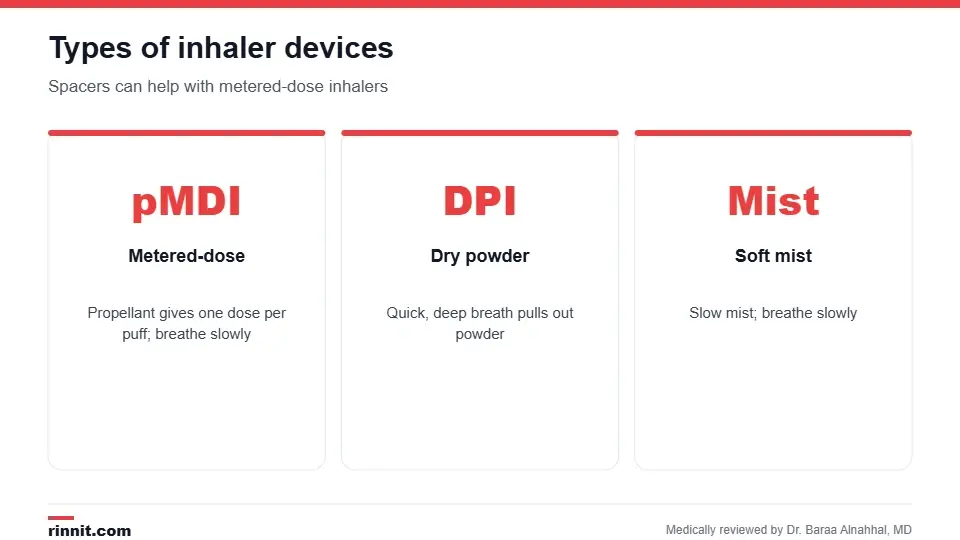
Spacers are an option for metered-dose inhalers.
Device | How it works | How to breathe in |
Metered-dose inhaler (pMDI) | A propellant pushes out one dose per puff | Slowly |
Dry powder inhaler (DPI) | Your breath pulls the powder out | Fast and deep |
Soft mist inhaler | Releases a slow-moving mist | Slowly |
Spacers can be used with metered-dose inhalers. Sources: [1]
Types of inhaler medicines
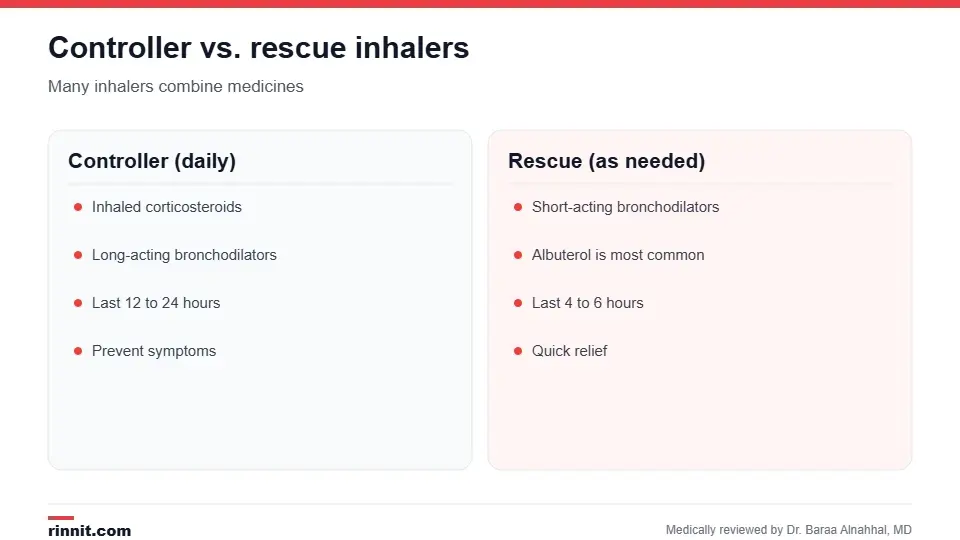
Many inhalers combine two or three medicines.
Medicine | What it does | Examples |
Inhaled corticosteroids (ICS) | Reduce lung inflammation | Daily controller |
Short-acting bronchodilators (SABA, SAMA) | Quick relief, lasting four to six hours | Albuterol, levalbuterol, ipratropium |
Long-acting bronchodilators (LABA, LAMA) | Daily control, lasting 12 to 24 hours | Daily controller |
Combinations | Two or three medicines in one inhaler | ICS/LABA, LABA/LAMA, ICS/LABA/LAMA |
For asthma, a steroid inhaler plus a rescue inhaler is common, with a long-acting bronchodilator added if needed. For COPD, combinations of long-acting medicines plus a rescue inhaler are common. Sources: [1]
How to use an inhaler
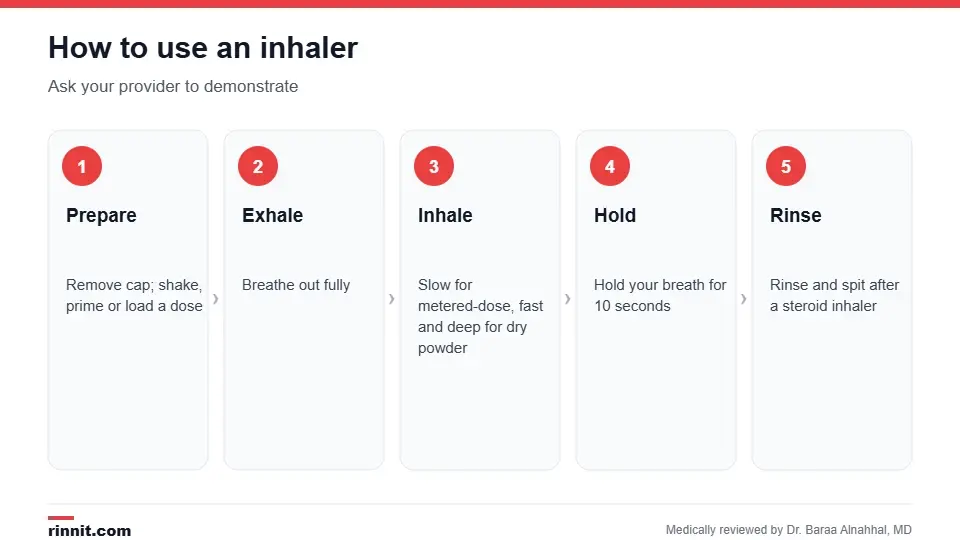
Ask your provider to show you how to use your device.
Remove the cap.
Shake, prime or load a dose if your device needs it.
Breathe out fully.
Place the mouthpiece in your mouth.
Breathe in slowly for a metered-dose or soft mist inhaler, or fast and deep for a dry powder inhaler.
Hold your breath for 10 seconds.
After a steroid inhaler, rinse your mouth and spit to prevent thrush. Sources: [1]
Read more about inhaler technique. Sources: [2, 3]
Risks and side effects
Side effects depend on the medicine.
Long-acting bronchodilators shouldn't be used alone for asthma because they raise the risk of asthma-related death.
Steroid inhalers may raise pneumonia risk in COPD.
Poor technique means less medicine reaches your lungs.
Don't take more than prescribed; many devices have dose counters. Sources: [1, 3]
When to call your provider
You wake at night with asthma symptoms.
You need your rescue inhaler more than twice a week.
You worry you're using too much medicine.
You have trouble using your device or it doesn't seem to work. Call 911 or go to the ER if you have severe trouble breathing or your rescue inhaler isn't helping. Sources: [1]
Conclusion
Inhalers are the main way to treat asthma and COPD because they send medicine straight to your lungs. Learning the right technique for your device helps you get the full benefit.
Keep learning: read about asthma and peak flow meters.
Frequently asked questions
What is an inhaler?
A handheld device that delivers medicine directly to your lungs.
What's the difference between a rescue and controller inhaler?
Rescue inhalers relieve symptoms fast; controllers prevent them daily.
What is the most common inhaled medicine?
Albuterol.
How long does a rescue inhaler last?
Short-acting bronchodilators last four to six hours.
Do I need a spacer?
A spacer is an option for metered-dose inhalers.
How long should I hold my breath?
About 10 seconds.
Why rinse after a steroid inhaler?
To help prevent thrush.
Is an inhaler better than a nebulizer?
Both work; inhalers are smaller and deliver medicine in one breath.
How do I know my inhaler is empty?
Many devices have a dose counter.
When should I call my provider?
If you need your rescue inhaler more than twice a week.
Related Reading
Biologic Therapy for Severe Asthma: Types, Side Effects and Results explains biologic therapy for severe asthma.
Beta-Agonists: Types, Uses and Side Effects explains beta-agonist medicines.
Bronchodilators: Types, How They Work and Side Effects explains bronchodilators for asthma and COPD.
Asthma: Symptoms, Causes, Triggers, Diagnosis & Treatment — Complete Guide the most common reason for inhalers.
What Is Chronic Obstructive Pulmonary Disease (COPD)? Symptoms, Causes, Stages, and Treatment a lung disease treated with inhalers.
Home Nebulizer: Essential Guide to Breathing Treatments another way to inhale medicine.
Peak Flow Meter: Monitoring Asthma and Lung Function at Home tracking your lung function.
References
Cleveland Clinic. Inhalers: Overview, Types, Dosing & How To Use. Cleveland Clinic. Last updated March 31, 2023. https://my.clevelandclinic.org/health/treatments/8694-inhalers
Sanchis J, Gich I, Pedersen S. Systematic review of errors in inhaler use: has patient technique improved over time? Chest. 2016;150(2):394-406. PMID 27060726. https://doi.org/10.1016/j.chest.2016.03.041
Melani AS, Bonavia M, Cilenti V, et al. Inhaler mishandling remains common in real life and is associated with reduced disease control. Respiratory Medicine. 2011;105(6):930-938. PMID 21367593. https://doi.org/10.1016/j.rmed.2011.01.005
Maricoto T, Monteiro L, Gama JMR, et al. Inhaler technique education and exacerbation risk in older adults with asthma or chronic obstructive pulmonary disease: a meta-analysis. Journal of the American Geriatrics Society. 2019;67(1):57-66. PMID 30291745. https://doi.org/10.1111/jgs.15602
Medical disclaimer
This article is for general education only and does not replace advice from a qualified healthcare professional. Talk to your doctor about your own diagnosis and treatment, and seek emergency care right away for severe or sudden symptoms.



Comments